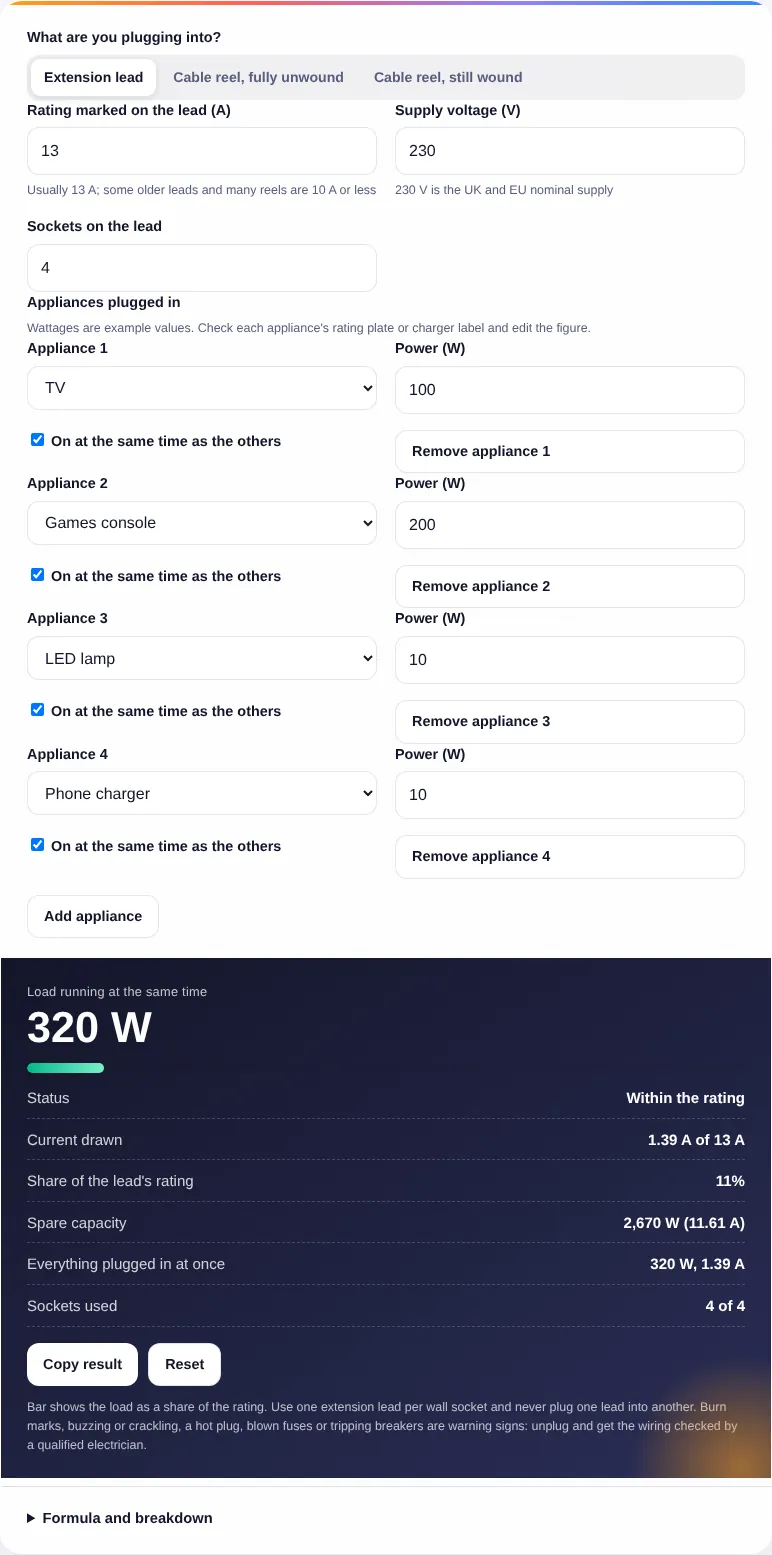
Bar shows the load as a share of the rating. Use one extension lead per wall socket and never plug one lead into another. Burn marks, buzzing or crackling, a hot plug, blown fuses or tripping breakers are warning signs: unplug and get the wiring checked by a qualified electrician.
Formula and breakdown
n/a
n/a
n/a
This extension lead load calculator adds up the appliances plugged into an extension lead or cable reel and checks the total against the lead's current rating, for homes and workplaces in the UK and other countries with 230 V supplies. It separates what is plugged in from what is switched on together, models a cable reel left wound, and warns about heaters on leads.
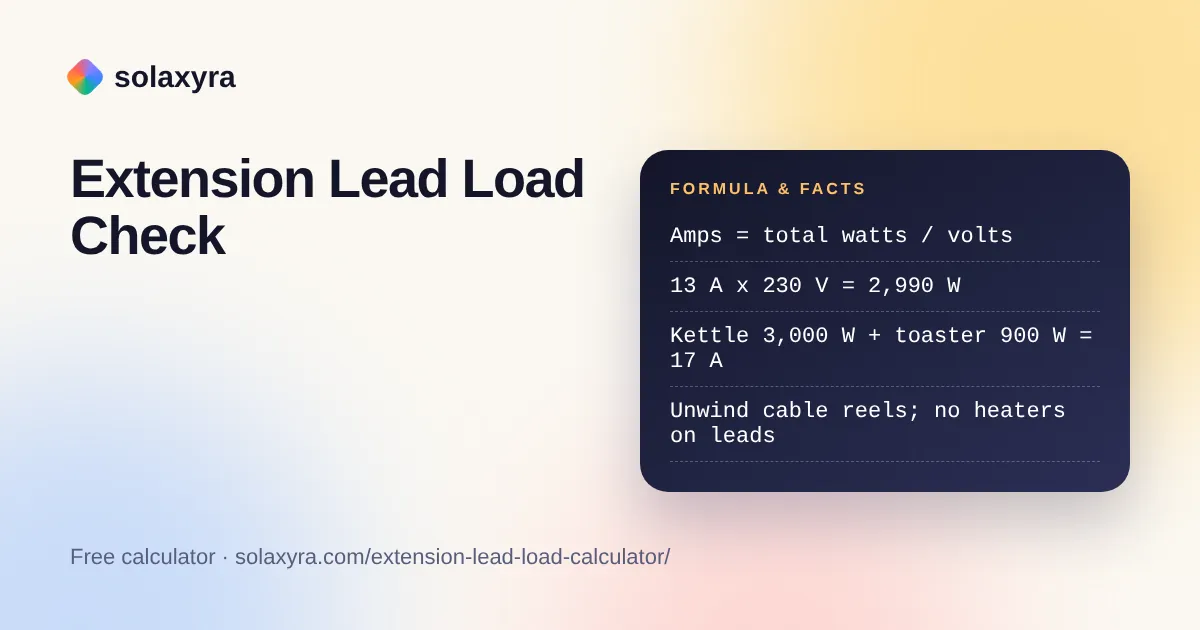
Quick answer: An extension lead load calculator adds the watts of everything switched on together and divides by the voltage to get amps. A 13 A lead on a 230 V supply can take about 2,990 W. A 3,000 W kettle and a 900 W toaster together draw 17 A, which overloads it and risks overheating.
What Is an Extension Lead Load Calculator?
An extension lead load calculator is a tool that totals the power of the appliances on a multi-way lead and converts it to amps, so you can see whether the lead is within its rating. In plain words: current in amps equals the total watts of everything running at the same time divided by the supply voltage, and that current must stay at or below the amps marked on the lead.
The rating covers the whole lead, not each socket. A four-way 13 A lead can supply 13 A in total, shared between all four sockets, and all of it flows through the single plug in the wall socket. That is why two high-power appliances can overload a lead even when two sockets are still empty.
How Do You Use the Extension Lead Load Calculator?
- Choose extension lead, cable reel fully unwound, or cable reel still wound.
- Enter the rating marked on the lead. If the reel is wound, enter the lower wound rating from its marking.
- Check the supply voltage (230 V nominal in the UK and EU) and the number of sockets.
- Pick each appliance from the list and edit the wattage to match its rating plate or charger label.
- Untick any appliance that is never on at the same time as the others.
- Read the status, current and spare capacity, and act on any warning shown.
How Much Can You Plug Into a 13 A Extension Lead?
A 13 A extension lead on a 230 V supply can carry about 2,990 W in total (13 x 230), and Electrical Safety First describes 3,000 W as the maximum rating of a wall socket in its guidance on plugs and fuses. Some older leads are rated at 10 A, about 2,300 W, and the marking on the back or underside of the lead tells you which you have.
The table shows how much of a 13 A lead a single appliance uses. The wattages are typical examples only, so check the rating plate on your own appliance; to convert any other figure, use the watts to amps calculator.
| Example appliance | Example power | Current at 230 V | Share of 13 A | Left for other items |
|---|---|---|---|---|
| Phone charger | 10 W | 0.04 A | 0% | 2,980 W |
| LED lamp | 10 W | 0.04 A | 0% | 2,980 W |
| TV | 100 W | 0.43 A | 3% | 2,890 W |
| Games console | 200 W | 0.87 A | 7% | 2,790 W |
| Desktop PC | 300 W | 1.30 A | 10% | 2,690 W |
| Toaster | 900 W | 3.91 A | 30% | 2,090 W |
| Microwave | 1,200 W | 5.22 A | 40% | 1,790 W |
| Hair dryer | 2,000 W | 8.70 A | 67% | 990 W |
| Fan heater | 2,000 W | 8.70 A | 67% | 990 W |
| Iron | 2,400 W | 10.43 A | 80% | 590 W |
| Kettle | 3,000 W | 13.04 A | 100.3% | None, 10 W over |
A kettle, iron, hair dryer or heater uses most of a lead's capacity by itself. Low-power electronics, by contrast, barely register: a TV, games console, lamp and phone charger together come to about 320 W, around 11% of the rating.
Can You Plug a Heater Into an Extension Lead?
No. Electrical Safety First's advice on portable heaters is to avoid powering a heater from an extension lead because leads can easily be overloaded. A 2,000 W heater alone takes about two-thirds of a 13 A lead, and it runs for hours at a time, which is exactly the situation that makes plugs and leads overheat.
Plug heaters directly into a wall socket, and do not put a multi-way adaptor between the heater and the socket either. The extension lead load calculator flags any heater in the list, even if it is not ticked as on. If you are working out what a heater costs to run rather than whether it is safe to plug in, the electricity cost calculator covers that.
Why Must a Cable Reel Be Fully Unwound?
A cable reel only reaches its marked current rating when the cable is fully unwound, because tightly coiled cable cannot lose heat. Electrical Safety First's guidance on extension leads, cable reels and block adaptors warns that running a reel in its wound state can cause it to overheat and catch fire, and recommends reels fitted with thermal cut-outs.
Many reels print two ratings, one wound and one unwound. Its separate page on overloading sockets says the wound rating is typically as low as 3 or 4 A. At 3 A on 230 V that is only 690 W, less than a single toaster. Choose the wound option in the extension lead load calculator to see the difference, or simply unwind the reel completely before use.
What Else Makes an Extension Lead Unsafe?
Overload is the main risk, but how a lead is used matters too: Electrical Safety First advises one extension lead or cable reel per wall socket, never plugging one lead into another, and leads fitted with a standard UK three-pin plug and fuse. The plug should meet BS 1363 and its fuse BS 1362.
- Do not daisy chain leads or add a block adaptor to an extension lead to gain sockets.
- Check the rating marked on the lead or reel before plugging in, rather than assuming 13 A.
- Fully unwind cable reels and choose reels fitted with a thermal cut-out.
- Treat burn marks, buzzing or crackling, blown fuses, tripping breakers or a hot plug as warning signs and stop using the lead.
If you regularly run out of sockets, the safe fix is more fixed sockets. That is electrical installation work: in the UK it must meet BS 7671 and should be carried out by a qualified, registered electrician. To see how much power everything in a room uses over a day, try the energy consumption calculator.
Worked Example: A Kitchen Worktop Lead
Example: a 13 A four-way lead on a kitchen worktop has a 3,000 W kettle, a 900 W toaster and a phone charger plugged in, and a 2,000 W fan heater has been added in the fourth socket for a cold morning.
- On together at breakfast: kettle 3,000 W + toaster 900 W + charger 10 W = 3,910 W.
- Current: 3,910 W / 230 V = 17.0 A.
- Share of rating: 17.0 / 13 = 131%, so the lead is overloaded by 920 W.
- With the heater also on, the total would be 5,910 W, about 25.7 A.
The fix is to move the kettle to its own wall socket and plug the heater directly into another wall socket, not into the lead. The lead is then left with the toaster and charger: 910 W, about 4 A, well inside its 13 A rating.
Frequently Asked Questions
How many watts can a 13 amp extension lead take?
Multiply 13 A by the supply voltage: on a 230 V supply that is 2,990 W, which is why about 3,000 W is often quoted. Electrical Safety First describes 3,000 W as the maximum rating of a wall socket. A 10 A lead takes about 2,300 W.
Can I plug a heater into an extension lead?
Electrical Safety First advises against powering a heater from an extension lead because leads are easily overloaded. A typical portable heater draws a large share of a lead's rating by itself, so plug it directly into a wall socket and do not share that socket through an adaptor.
Why does a cable reel need to be unwound?
Cable reels only reach their marked rating when fully unwound. Electrical Safety First says the rating can be as low as 3 or 4 A while wound, because the coiled cable cannot shed heat, and that running a wound reel can make it overheat and catch fire.
Can I plug one extension lead into another?
No. Electrical Safety First advises using only one extension lead or cable reel per wall socket and never plugging an extension lead into another one, known as daisy chaining. Every appliance still draws through the single wall socket plug, which can overheat.
Does having four sockets mean I can plug in four of anything?
No. The number of sockets says nothing about the total current. The whole lead shares one rating, usually 13 A, so four low-power devices are fine but two high-power appliances such as a kettle and a toaster can overload it on their own.
What are the signs an extension lead is overloaded?
Electrical Safety First lists burn marks, buzzing or crackling sounds, fuses blowing, circuit breakers tripping and a plug or lead that feels hot to touch. If you notice any of these, switch off and unplug, and have the socket and wiring checked by a qualified electrician.
Checked October 2026 by the Solaxyra Editorial Team. Sources: Electrical Safety First, extension leads and cable reels, Electrical Safety First, portable heaters, Electrical Safety First, plugs and fuses, Electrical Safety First, overloading sockets.