Estimate only. Hills, wind, rain, tyres, load and driving style also change range. Plan a charging stop with margin to spare.
Formula and breakdown
n/a
n/a
n/a
n/a
This EV range calculator estimates how far an electric car can go on the charge it has now, in miles or kilometres, for drivers in the UK, Ireland and Europe, with adjustments for motorway speed, cold weather and battery health.
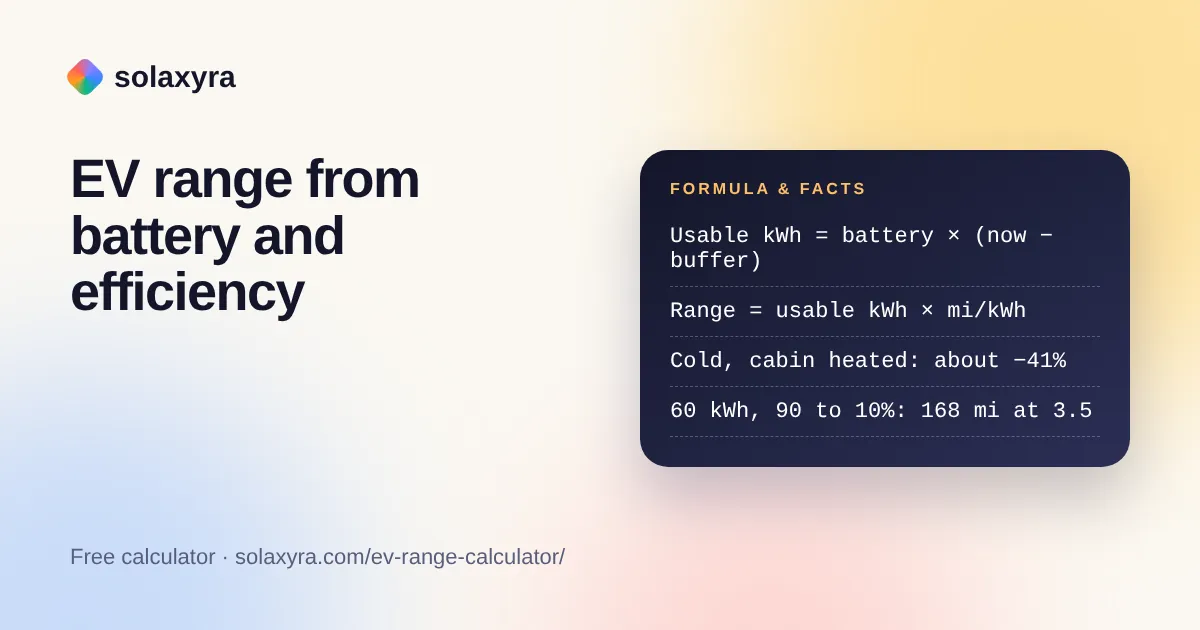
Quick answer: An EV range calculator multiplies usable battery capacity by the share of charge you will use and by your efficiency. A 60 kWh battery used from 90% to 10% gives 48 kWh, or 168 miles at 3.5 miles per kWh. Motorway speed and cold weather with cabin heating can cut that sharply.
What Is an EV Range Calculator?
An EV range calculator is a tool that turns the energy left in an electric car’s battery into a driving distance for the conditions you expect. In plain words: usable energy equals battery capacity times battery health times the share of charge you will use (from now down to your safety buffer); range equals that energy times your efficiency in miles or km per kWh, reduced for higher speed and for cold weather.
The official range in a brochure comes from the WLTP laboratory test. The UK Vehicle Certification Agency describes WLTP as closer to real driving than the older NEDC test, but notes that driving style, accessories and extra weight still change what you achieve. That is why this ev range calculator starts from your own efficiency figure rather than the official range.
How Do You Use the EV Range Calculator?
- Choose miles or kilometres for the results.
- Enter the usable battery capacity in kWh from the manufacturer’s specification, and battery health if the car or a battery report shows it.
- Enter your current charge and the charge you want to arrive with.
- Enter your efficiency in mild weather and pick its unit. The trip computer’s long-term average is a good source.
- Choose the weather. The cold presets use US Department of Energy test results; pick Custom to type your own reduction.
- Enter how much of the trip is at motorway speed and how much extra energy that uses. The speed table below helps you choose.
- Read the range and open the breakdown to see the speed and weather losses separately.

How Do You Calculate EV Range by Hand?
Range = usable kWh × (charge now − arrival buffer) × efficiency. A car with a 60 kWh usable battery at 90%, aiming to arrive with 10%, has 60 × 0.8 = 48 kWh to spend. At 3.5 miles per kWh that is 168 miles. Efficiency in other units converts like this: miles per kWh = 100 ÷ (kWh per 100 km) ÷ 1.609, and miles per kWh = 1,000 ÷ Wh per mile.
To add speed, multiply energy use by 1 + (motorway share × extra energy). Half the trip at motorway speed using 20% more energy gives 1.10, so 168 miles becomes 168 ÷ 1.10 = 153 miles. To add weather, multiply the range by 1 minus the weather reduction.
How Much Range Do Electric Cars Lose in Cold Weather?
Cold weather with the cabin heated can cut an electric car’s range by about 41%, according to tests reported by the US Department of Energy on fueleconomy.gov, which compared 20 °F (about −7 °C) with 77 °F (25 °C). With the heater off the loss was about 12%, so roughly two thirds of the extra energy goes on heating the cabin.
On days between mild and −7 °C, expect a loss somewhere between zero and those figures, depending mainly on how much you heat the cabin. The same DOE page notes that preheating the car while it is still plugged in can extend range, because the energy comes from the grid rather than the battery, and that seat heaters are a more efficient way to keep warm than heating the cabin air. If you know your own winter efficiency, enter it as the mild-weather figure and set the weather reduction to zero.
How Much Does Motorway Speed Reduce EV Range?
Energy per mile rises steeply with speed because aerodynamic drag grows with the square of speed: in our example car, 70 mph uses about 48% more energy per mile than 50 mph. The drag equation gives drag force as ½ × air density × speed² × drag coefficient × frontal area; rolling resistance stays almost constant per mile. The table applies both to an example car so you can see the shape of the curve.
| Steady speed | Energy use (Wh per km) | Miles per kWh | Energy per mile vs 50 mph |
|---|---|---|---|
| 30 mph | 88 | 7.0 | −29% |
| 40 mph | 103 | 6.0 | −17% |
| 50 mph | 125 | 5.0 | baseline |
| 60 mph | 152 | 4.1 | +22% |
| 70 mph | 184 | 3.4 | +48% |
| 80 mph | 222 | 2.8 | +78% |
Example model only: 1,900 kg with occupants, rolling resistance coefficient 0.009, drag area (Cd × A) 0.65 m², air density 1.2 kg/m³, 85% battery-to-wheel efficiency, 0.5 kW for heating, lights and electronics, flat road, no wind. Real cars differ, and stop-start town driving adds acceleration losses that regenerative braking only partly recovers. Use the percentage column to choose the extra-energy input: if your mild-weather average reflects mostly 50 to 60 mph driving, about 20% to 30% extra is a fair guess for a 70 mph motorway leg.
How Do You Plan Charging Stops From the Range?
Plan to arrive at a charger with your buffer intact, not at 0%. Once you know the range, the EV charging time calculator shows how long a top-up takes and the EV charging cost calculator what it costs. At home, the electricity cost calculator turns kWh into pounds at your tariff, and if you have solar panels the solar EV charging calculator estimates how many of those miles the roof can supply.
Battery health matters most for older cars. A battery at 80% health holds a fifth less energy, so every figure scales down by the same amount. Battery packs in electric cars should only be inspected or repaired by trained technicians, because they operate at high voltage.
Worked Example: A Winter Motorway Trip
Example: a family SUV with a 77 kWh usable battery averages 17 kWh per 100 km in mild weather. It starts a January trip at 80% and the driver wants to arrive with 20%. The whole route is motorway at about 70 mph, and it is around −7 °C with the cabin heated.
- Usable energy: 77 kWh × (80% − 20%) = 46.2 kWh.
- Mild-weather efficiency: 100 ÷ 17 = 5.88 km per kWh, or 3.66 miles per kWh.
- Mild-weather range: 46.2 × 5.88 = 272 km (169 miles).
- Speed: the whole trip at motorway speed with 48% extra energy, from the table, gives 272 ÷ 1.48 = 184 km.
- Weather: 184 × (1 − 0.41) = 108 km (67 miles).
In this example the car can cover about 108 km before reaching the 20% buffer, well under half the mild-weather figure. Preheating while plugged in and driving at 60 mph would both stretch it.
Frequently Asked Questions
How much range does an electric car lose in winter?
US Department of Energy test data shows range about 41% lower at minus 7 °C than at 25 °C when the cabin is heated, and about 12% lower with the heater off. Most of the extra energy goes on heating the cabin, so preheating while plugged in helps.
Why is my real range lower than the WLTP figure?
WLTP figures come from a standard laboratory test. The UK Vehicle Certification Agency notes that driving style, accessories and extra weight all change real results. Motorway speeds, cold weather and short trips with heating on are the usual reasons for a lower real-world figure.
How do I convert kWh per 100 km to miles per kWh?
Divide 100 by the kWh per 100 km figure to get km per kWh, then divide by 1.609 to get miles per kWh. For example, 17 kWh per 100 km is 5.88 km per kWh, or 3.66 miles per kWh. The ev range calculator accepts five units.
Does driving faster reduce EV range?
Yes. Aerodynamic drag rises with the square of speed, so energy per mile climbs quickly above about 50 mph. In our example car model, a steady 70 mph uses about 48% more energy per mile than 50 mph, which cuts range by roughly a third.
Should I plan to use the battery down to 0%?
No. Keep a buffer for detours, queues at chargers and estimate error. Many drivers aim to arrive with 10% to 20%. The ev range calculator subtracts your chosen buffer, so the result is the distance you can drive while keeping that reserve.
What is the difference between usable and gross battery capacity?
Gross capacity is the total energy the cells can hold; usable capacity is the part the car lets you use, with a margin kept back to protect the battery. Range calculations should use the usable figure, which manufacturers usually list in specifications.
Checked October 2026 by the Solaxyra Editorial Team. Sources: US DOE fueleconomy.gov: Fuel economy in cold weather, Vehicle Certification Agency: WLTP, Wikipedia: Drag equation.