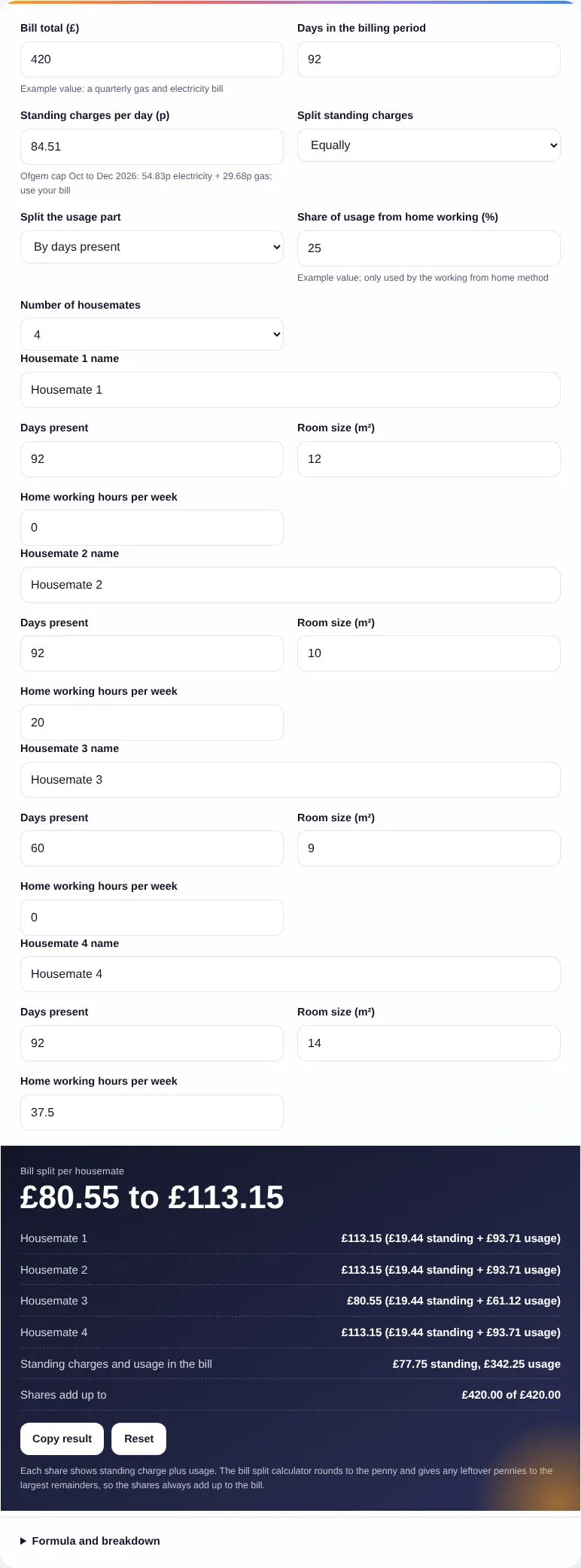
Each share shows standing charge plus usage. The bill split calculator rounds to the penny and gives any leftover pennies to the largest remainders, so the shares always add up to the bill.
Formula and breakdown
n/a
n/a
n/a
This bill split calculator divides a household gas and electricity bill fairly between up to six housemates in a UK or European house share. It separates the fixed standing charges from the usage part of the bill, then splits the usage equally, by days present, by room size or with extra weight for working from home, and rounds each share so the total matches the bill to the penny.
Quick answer: A bill split calculator separates the fixed standing charges from the usage part of an energy bill and shares each fairly. For a £420 quarterly bill shared by four housemates, one of whom was away for 32 days, the three at home pay £113.15 each and the fourth pays £80.55.

What Is a Bill Split Calculator?
A bill split calculator is a tool that divides one bill between several people using a rule everyone has agreed. In plain words, for an energy bill: standing charges = days in the period x standing charge per day; usage = bill total minus standing charges; each share = that person's part of the standing charges + that person's part of the usage.
Splitting the two parts separately is what makes the result fair. Energy UK, in its explainer on standing charges, describes them as fixed daily charges that stay the same however much energy a household uses, and that recover the cost of maintaining, operating and expanding the gas and electricity networks. They are the price of having a supply at all, so most house shares divide them equally. The usage part is where habits differ, so it is the part the methods below change.
How Do You Use the Bill Split Calculator?
- Enter the bill total and the number of days it covers, both from the bill.
- Enter the standing charges per day: add the electricity and gas figures printed on the bill.
- Choose whether standing charges are split equally or by days present.
- Choose how to split the usage: equally, by days present, by room size, or by days present plus home working.
- Pick the number of housemates and enter each person's name, days present, room size and home working hours per week.
- Read each share, with its standing and usage parts, and copy the result to your house chat.
What Is the Fairest Way to Split Energy Bills?
For most house shares the fairest rule is standing charges equally and usage by days present, because it is simple, easy to check and adjusts for anyone who was away. Room size or home working only make sense when the house has agreed that those things change how much energy each person causes.
| Method (£420 bill, 92 days) | Housemate 1 | Housemate 2 | Housemate 3 | Housemate 4 |
|---|---|---|---|---|
| Everything equal | £105.00 | £105.00 | £105.00 | £105.00 |
| Usage by days present (default) | £113.15 | £113.15 | £80.55 | £113.15 |
| Usage by room size | £110.70 | £95.49 | £87.89 | £125.92 |
| Days present plus 25% for home working | £89.72 | £119.48 | £65.28 | £145.52 |
The table uses the calculator's example household: rooms of 12, 10, 9 and 14 m², housemate 3 at home for 60 of the 92 days, and housemates 2 and 4 working from home for 20 and 37.5 hours a week. Standing charges are split equally in every row. One person's share of the same bill can change by more than £40 depending on the rule, which is why agreeing the method before the bill arrives matters more than the arithmetic.
How Do Standing Charges Affect a Bill Split?
Standing charges are a fixed cost per day, so they should not be split by usage: at the October to December 2026 price cap they total 84.51p a day, which is £77.75 of a 92 day quarterly bill. The Ofgem price cap announcement sets the average direct debit standing charges at 54.83p a day for electricity and 29.68p a day for gas, with unit rates of 26.32p and 7.97p per kWh.
Your own bill shows your supplier's actual standing charges, and they vary by region and tariff, so use those in the bill split calculator. If one person is away for a long time, the house can choose to split standing charges by days present instead, but the supply still costs the same while they are gone. The guide to standing charges explains them in more detail.
How Do You Split Bills When Someone Works From Home?
Agree what share of the usage comes from daytime home working, such as 25%, and split only that share by home working hours; the rest is split by days present as usual. In the example, the housemate working 37.5 hours a week pays £145.52 instead of £113.15.
The 25% is an example value, not a measured figure. A house can estimate the real effect by comparing a quarter before and after someone started working from home, or by adding up the extra devices and heating hours. The energy consumption calculator lists the kWh of a laptop, monitor and lights, and the electric heater running cost calculator prices a room heater used during the working day. If one person runs a heater in their own room, charging that person directly is often fairer than any percentage.
Who Is Responsible for the Energy Bill in a Shared House?
The person or people named on the bill are usually responsible for paying it, whatever the housemates agree between themselves. Shelter's advice on bills in shared housing says this, and adds that you should take your name off all bills when you move out, because an energy company can usually charge you for up to 2 days after you tell them you are leaving.
- Take meter readings with a photo on move-in and move-out days.
- Write the split method down and keep it with the tenancy papers.
- Collect shares by standing order before the direct debit leaves the account holder's bank.
- Recalculate each bill with the same rule rather than renegotiating each time.
Worked Example: A Four-Person House Share
Example: four housemates receive a £420 gas and electricity bill for a 92 day quarter. The standing charges on the bill are 54.83p a day for electricity and 29.68p a day for gas. Housemate 3 moved in 32 days into the quarter, so was present for 60 days; the others were present for all 92.
- Standing charges: 92 x 84.51p = £77.75, split equally, so £19.44 each.
- Usage: £420.00 minus £77.75 = £342.25.
- Person-days: 92 + 92 + 60 + 92 = 336.
- Usage shares: £342.25 x 92 / 336 = £93.71 for each full-time housemate, and £342.25 x 60 / 336 = £61.12 for housemate 3.
- Totals: £113.15 for each full-time housemate and £80.55 for housemate 3, which adds up to £420.00 exactly.
Splitting everything equally would have charged housemate 3 £105.00 for a quarter they were only partly there. Enter your own bill in the bill split calculator above to see each share with its breakdown.
Frequently Asked Questions
What is the fairest way to split energy bills with housemates?
Share the standing charges equally, because they are fixed daily costs that do not depend on use, then split the usage part by the days each person was at home. If someone works from home, assign part of the usage by home working hours. Agree the method in writing before the bill arrives.
How do you split a bill when someone moves in halfway through?
Count the days each person lived in the house during the billing period and split by days present. For a 92 day quarter, someone who moved in for the last 46 days carries half the usage weight of a full-time housemate. Take meter readings on the move-in date.
Should standing charges be split equally?
Usually yes. Standing charges are fixed daily amounts that cover network and supply costs and do not change with how much energy anyone uses. At the October to December 2026 cap they total 84.51p a day for gas and electricity, or £77.75 over a 92 day quarter.
Should someone who works from home pay more for energy?
Many house shares agree they should, because daytime heating, lighting and computers add to the bill. The calculator lets you choose what share of the usage is caused by home working, such as 25%, and splits only that share by home working hours. The rest is split by days present.
Who is responsible for paying the energy bill in a shared house?
The person or people named on the bill. Shelter says the person or people named on a bill are usually responsible for paying it, even if housemates owe them their shares. If you move out, take your name off the account and give the supplier a final meter reading.
Why do the shares not divide exactly?
A bill in pounds and pence rarely divides into equal whole pennies. The bill split calculator rounds every share down to the penny, then gives the leftover pennies to the housemates with the largest remainders, so the shares always add up to the exact bill total.
Checked October 2026 by the Solaxyra Editorial Team. Sources: Ofgem: price cap 1 October to 31 December 2026, Energy UK Explains: Standing charges, Shelter England: Bills in shared housing.