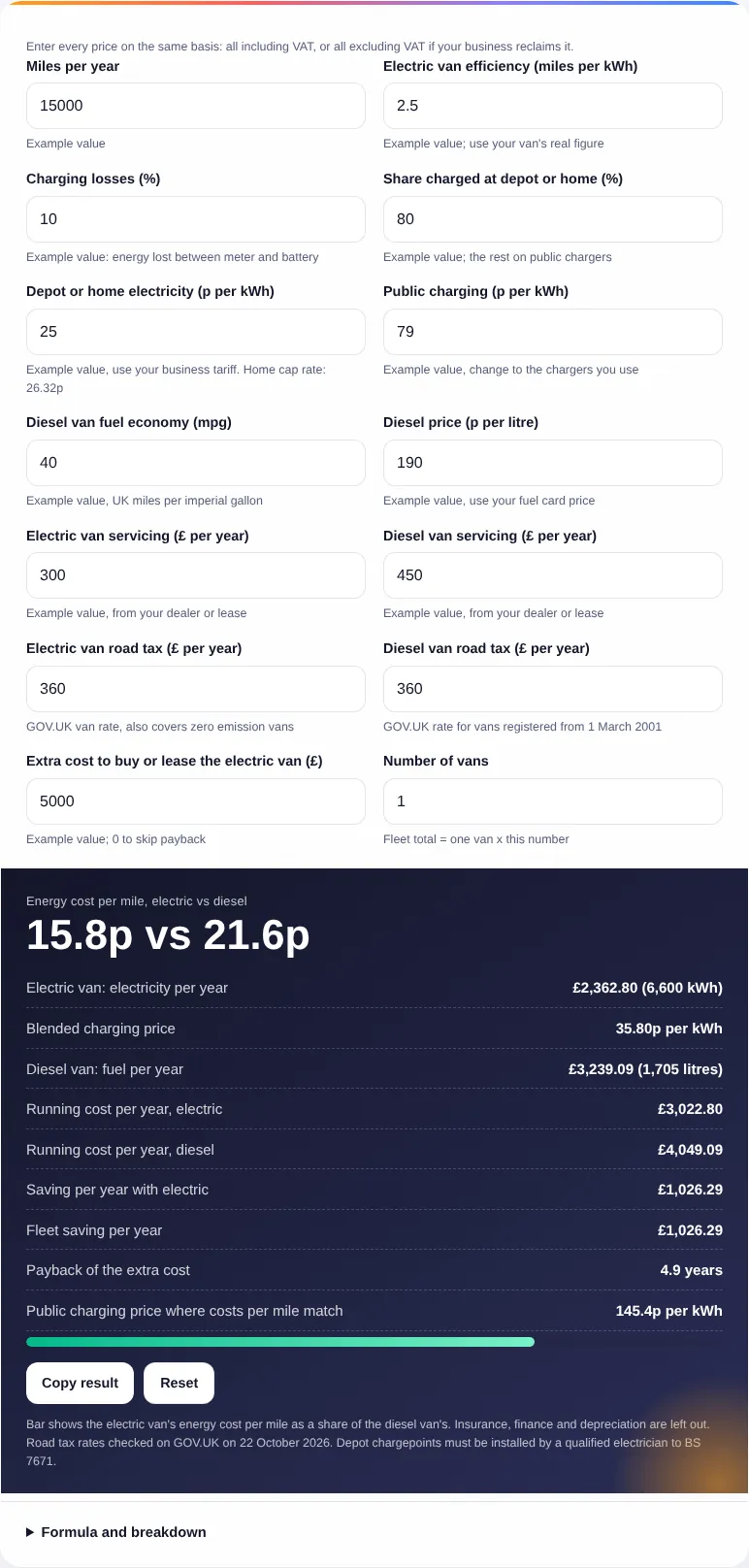
Enter every price on the same basis: all including VAT, or all excluding VAT if your business reclaims it.
Bar shows the electric van’s energy cost per mile as a share of the diesel van’s. Insurance, finance and depreciation are left out. Road tax rates checked on GOV.UK on 22 October 2026. Depot chargepoints must be installed by a qualified electrician to BS 7671.
Formula and breakdown
n/a
n/a
n/a
This electric van running cost calculator compares the yearly cost of running an electric van with a diesel van for UK businesses and sole traders, using your mileage, the van’s efficiency, how much you charge at the depot or at home versus on public chargers, the diesel van’s mpg, servicing and road tax. It shows energy cost per mile, the yearly saving per van and for a fleet, and how long any extra purchase cost takes to repay.
Quick answer: An electric van running cost calculator divides yearly miles by miles per kWh, adds charging losses and multiplies by a blended charging price, then compares that with diesel litres times the pump price. With example figures, 15,000 miles a year costs about 15.8p a mile electric against 21.6p diesel, saving about £1,026 a year.
What Is an Electric Van Running Cost Calculator?
An electric van running cost calculator is a tool that estimates what an electric van costs to run each year and per mile, and compares it with a diesel van doing the same work. In plain words: electricity cost equals miles divided by miles per kWh, plus charging losses, times the blended price of depot and public charging; diesel cost equals miles divided by mpg, times 4.54609 litres per gallon, times the price per litre. Servicing and road tax are then added to both.
The 4.54609 figure is the exact size of the imperial gallon, as Wikipedia’s article on the gallon sets out, and UK mpg figures use imperial gallons. Using the smaller US gallon by mistake would understate how much diesel a van burns.
How Do You Use the Electric Van Running Cost Calculator?
- Decide whether you will enter prices including or excluding VAT, and use the same basis for every price.
- Enter yearly miles and the electric van’s real efficiency in miles per kWh. A loaded van in winter can use more energy than its official figure.
- Set charging losses, the share of charging done at your depot or home, and both electricity prices.
- Enter the diesel van’s mpg and your fuel card price per litre.
- Add servicing for each van, check the road tax figures, and enter any extra cost of the electric van if you want a payback period.
- Enter the number of vans for a fleet total, then read the cost per mile, yearly totals and break-even public charging price.
Is an Electric Van Cheaper to Run Than a Diesel?
An electric van is cheaper to run per mile when most charging happens at a depot or home tariff, and can cost more than diesel when it relies mainly on public chargers. The charging mix matters more than any other input. The table uses the example figures: 15,000 miles, 2.5 miles per kWh with 10% losses, 25p depot electricity, 79p public charging, a 40 mpg diesel van at 190p per litre, servicing £300 electric and £450 diesel, and £360 road tax for each.
| Depot or home charging share | Electric pence per mile | Diesel pence per mile | Electric running cost per year | Diesel running cost per year | Saving per year |
|---|---|---|---|---|---|
| 100% | 11.0p | 21.6p | £2,310.00 | £4,049.09 | £1,739.09 |
| 80% (default) | 15.8p | 21.6p | £3,022.80 | £4,049.09 | £1,026.29 |
| 50% | 22.9p | 21.6p | £4,092.00 | £4,049.09 | minus £42.91 |
| 0% (public only) | 34.8p | 21.6p | £5,874.00 | £4,049.09 | minus £1,824.91 |
Every price in the table is an example, not a market average. Put your own tariff, charger prices and fuel card price into the electric van running cost calculator to see where your business sits.
How Much Road Tax Does an Electric Van Pay?
An electric van registered from 1 March 2001 pays the same vehicle tax as a diesel van: £360 for a 12-month payment. The GOV.UK rates for light goods vehicles, checked on 22 October 2026, state that the TC39 van rate also includes zero emission vehicles, and that Euro 4 and Euro 5 vans from the stated registration windows pay £140. Because the rate is the same for both, road tax does not change the saving, but it is included so the yearly totals are complete.
What Public Charging Price Wipes Out the Saving?
With the default figures, the electric van stays cheaper per mile until public charging costs about 145p per kWh, because only 20% of its energy comes from public chargers. The electric van running cost calculator shows this break-even public price for your own inputs. If public charging rises to 50% of the mix, the break-even falls to about 73p per kWh, close to the example 79p public price.
That is why depot charging is usually the first thing to plan. A depot chargepoint must be installed by a qualified electrician and the installation must meet BS 7671; a large bank of chargers may need a supply upgrade from the network operator. Our watts to amps calculator and kW to amps calculator help you understand the current a charger draws before you speak to an electrician.
What Does the Calculator Leave Out?
The electric van running cost calculator covers energy, servicing and road tax, which are the costs that differ most between the two vans in daily use. It deliberately leaves out insurance, finance, depreciation, tyres and driver time, because these depend heavily on the model and your contract. If you enter the extra cost of buying or leasing the electric van, the tool divides it by the yearly saving to give a simple payback period.
Two other points are worth checking. Check the electric model’s payload in its specification, as it can differ from the diesel version, and confirm it carries what you need. And range in winter or with full loads can be lower than the official figure, which may push more charging onto public networks. For electricity price checks, our electricity cost calculator and the EV charging cost calculator use the same inputs.
Worked Example: Plumbing Business With Three Vans
Example: a plumbing business in Bristol runs three vans, each covering 15,000 miles a year, and checks the switch with the electric van running cost calculator. It is replacing them with electric vans that average 2.5 miles per kWh, charged 80% at the yard at 25p per kWh and 20% on public chargers at 79p. Its current diesel vans return 40 mpg on fuel bought at 190p per litre.
- Electricity: 15,000 / 2.5 = 6,000 kWh, plus 10% losses = 6,600 kWh per van.
- Blended price: 80% x 25p + 20% x 79p = 35.8p per kWh. Cost: 6,600 x 35.8p = £2,362.80, or 15.8p per mile.
- Diesel: 15,000 / 40 = 375 gallons x 4.54609 = 1,704.8 litres x 190p = £3,239.09, or 21.6p per mile.
- Add servicing and £360 road tax: electric £3,022.80, diesel £4,049.09 per van per year.
- Saving: £1,026.29 per van, or £3,078.87 for three vans. An extra £5,000 per electric van repays in about 4.9 years.
If the yard is charged on the domestic cap rate of 26.32p instead, for example a sole trader charging at home, the saving per van falls to about £957 a year.
Frequently Asked Questions
How much does it cost to run an electric van per mile?
Divide your charging price by the van’s miles per kWh and add charging losses. At 2.5 miles per kWh, 10% losses and a 35.8p blended price, an electric van costs about 15.8p a mile. Charging only at a 25p depot tariff cuts that to 11.0p.
Is an electric van cheaper than a diesel van?
To run, usually yes when most charging is at a depot or home tariff. With the example prices, an electric van saves about £1,026 a year at 15,000 miles. If half the charging is public at 79p per kWh, the saving disappears.
Do electric vans pay road tax in the UK?
Yes. GOV.UK lists the light goods vehicle rate of £360 for a 12-month payment for vans registered from 1 March 2001, and states that this also includes zero emission vehicles. Some Euro 4 and Euro 5 vans pay £140.
Should I enter prices with or without VAT?
Use one basis for everything. A VAT-registered business that reclaims VAT on fuel and electricity should usually compare prices excluding VAT, while a business that cannot reclaim VAT should use the prices it actually pays, including VAT.
How do I convert mpg to litres?
Divide miles by mpg to get imperial gallons, then multiply by 4.54609 litres per gallon. A 40 mpg van covering 15,000 miles uses 375 gallons, which is about 1,705 litres of diesel a year.
What miles per kWh does an electric van achieve?
It varies with the model, load, speed and temperature, so use the figure from your van’s trip computer or telematics where you can. The 2.5 miles per kWh in the calculator is an example value, not a measured average.
Checked October 2026 by the Solaxyra Editorial Team. Sources: GOV.UK: Vehicle tax rates, light goods vehicles, Wikipedia: Gallon, Ofgem: Energy price cap 1 October to 31 December 2026.