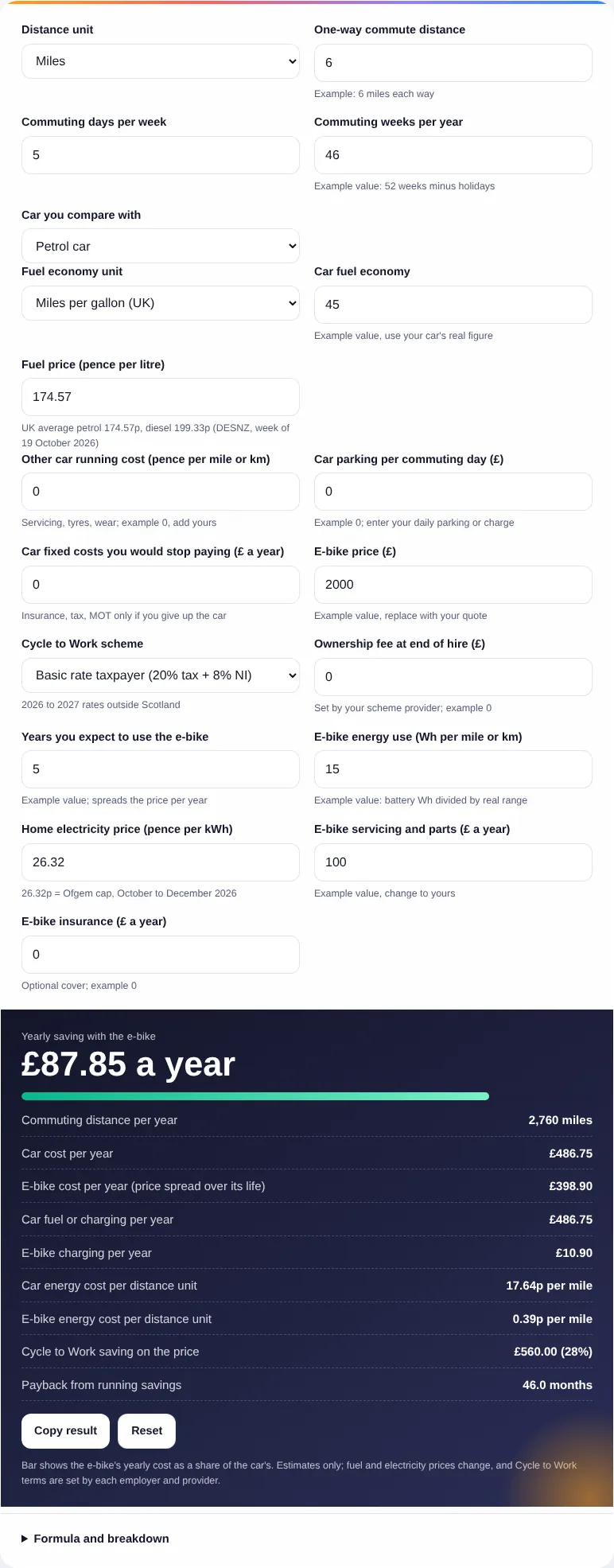
Bar shows the e-bike’s yearly cost as a share of the car’s. Estimates only; fuel and electricity prices change, and Cycle to Work terms are set by each employer and provider.
Formula and breakdown
n/a
n/a
n/a
n/a
This e-bike vs car cost calculator compares what a regular commute costs by car and by electric bike over a year, for UK and European commuters who want a clear answer before buying a bike or giving up a car. It covers petrol, diesel or electric cars, parking, servicing, the e-bike’s purchase price spread over its life, charging at home and the Cycle to Work scheme saving.
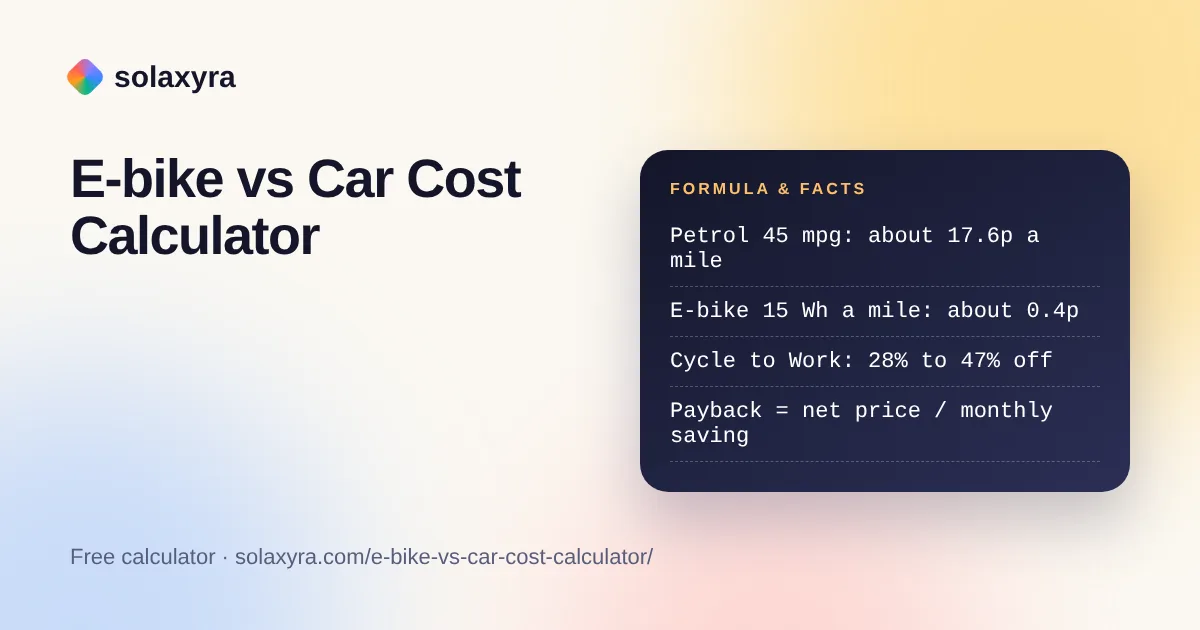
Quick answer: An e-bike vs car cost calculator multiplies your yearly commuting miles by each vehicle’s cost per mile, then adds parking, servicing and the bike’s price spread over its life. At October 2026 UK prices a 45 mpg petrol car spends about 17.6p a mile on fuel, an e-bike about 0.4p a mile on electricity.
What Is an E-bike vs Car Cost Calculator?
An e-bike vs car cost calculator is a tool that puts the yearly running cost of commuting by car next to the yearly cost of owning and charging an electric bike, so you can see the saving and how long the bike takes to pay for itself. In plain words: car cost equals miles times fuel or charging cost per mile, plus parking, other running costs and any fixed costs you would stop paying. E-bike cost equals miles times electricity per mile, plus servicing and insurance, plus the purchase price divided by the years you expect to ride it.
Payback is the bike’s net price divided by the monthly difference in running costs. Running costs leave out the purchase price on both sides, so the payback figure in the e-bike vs car cost calculator answers one question: how many months of cheaper commuting does it take to cover what you paid for the bike?
How Do You Use the E-bike vs Car Cost Calculator?
- Choose miles or kilometres, then enter your one-way commute, the days you commute each week and the weeks you commute each year.
- Pick the car you would otherwise use: petrol, diesel or electric. Enter its real fuel economy or EV efficiency and the price you pay.
- Add car parking per commuting day and any other running cost per mile, such as servicing and tyres, if you know them.
- If you would sell the car or cut its insurance because of the bike, enter those yearly fixed costs. If you keep the car, leave this at 0.
- Enter the e-bike price, your Cycle to Work tax band (or “Not used”), any ownership fee at the end of the hire, and how many years you expect to ride it.
- Enter the bike’s energy use in Wh per mile, your electricity price, servicing and optional insurance, then read the saving, cost per mile and payback months.
How Much Does It Cost to Charge an E-bike Compared With Fuelling a Car?
Charging an e-bike costs well under 1p a mile in the UK, while fuelling a typical petrol car costs 13p to 27p a mile. Fuel cost per mile is the pump price in pence per litre times 4.54609 litres per imperial gallon, divided by the car’s miles per gallon. E-bike cost per mile is its Wh per mile divided by 1,000, times your electricity price per kWh.
The table uses the UK average pump prices for the week of 19 October 2026 from the DESNZ weekly road fuel prices (petrol 174.57p, diesel 199.33p per litre) and the Ofgem cap unit rate of 26.32p per kWh for electricity. The mpg, miles per kWh and Wh per mile values are examples to compare against, not measured figures for any model.
| Vehicle (example efficiency) | Energy price used | Energy cost per mile | Energy cost for 1,000 miles |
|---|---|---|---|
| Petrol car, 30 mpg | 174.57p per litre | 26.45p | £264.50 |
| Petrol car, 45 mpg | 174.57p per litre | 17.64p | £176.40 |
| Petrol car, 60 mpg | 174.57p per litre | 13.23p | £132.30 |
| Diesel car, 45 mpg | 199.33p per litre | 20.14p | £201.40 |
| Electric car, 3.5 miles per kWh, home charging | 26.32p per kWh | 7.52p | £75.20 |
| E-bike, 10 Wh per mile | 26.32p per kWh | 0.26p | £2.63 |
| E-bike, 20 Wh per mile | 26.32p per kWh | 0.53p | £5.26 |
Energy is the smallest part of an e-bike’s cost. Over a year, servicing, a replacement battery fund and the purchase price matter far more than charging, which is why the e-bike vs car cost calculator spreads the price over the years of use instead of showing charging alone. To estimate your own bike’s energy use, divide the battery’s Wh by the range you actually get; our watts to kWh calculator helps if you know the charger’s wattage and charging time instead.
How Much Does the Cycle to Work Scheme Save on an E-bike?
For a basic rate taxpayer outside Scotland, the Cycle to Work scheme cuts the effective price of an e-bike by about 28% (20% Income Tax plus 8% National Insurance), and for a higher rate taxpayer by about 42% (40% plus 2%). The scheme works by salary sacrifice: your employer hires you the bike and your gross pay drops by the hire cost, so you pay less tax and National Insurance on that part of your salary.
The Department for Transport’s Cycle to Work scheme guidance for employers confirms that an electrically assisted pedal cycle can be included. Its worked tables show 32% for basic rate taxpayers because they were written when employee National Insurance was 12%; the e-bike vs car cost calculator uses the 2026 to 2027 rates published on GOV.UK instead: Income Tax 20%, 40% and 45%, and employee National Insurance 8% in the main band and 2% above the upper earnings limit. Scottish Income Tax bands differ, so Scottish taxpayers should treat the percentage as approximate.
Two details change the real saving. The guidance says there must be no automatic transfer of ownership at the end of the hire, so many schemes charge an ownership fee; enter it in the e-bike vs car cost calculator. And hire agreements above £1,000 need the provider to hold FCA authorisation, which is why some employers set a cap. Ask your employer for the scheme’s limit and fee before you choose a bike.
Does an E-bike Need Tax, Insurance or a Licence in the UK?
A legal e-bike in Great Britain does not need to be registered, taxed or insured, and you can ride it from age 14. GOV.UK’s electric bike rules define an electrically assisted pedal cycle (EAPC): pedals that propel it, a motor with a continuous rated power of no more than 250 W, and assistance that stops at 15.5 mph. A bike that does not meet those rules counts as a motorcycle or moped and needs a licence, registration, tax, insurance and a helmet, which changes the comparison completely.
Insurance is optional for a legal e-bike, but theft cover is worth pricing in if the bike is parked at work or at a station. The e-bike vs car cost calculator has an insurance field for this, set to 0 by default.
When Is an E-bike Not Cheaper Than a Car?
An e-bike is not cheaper when the car’s commuting cost is already very low, for example a short commute with free parking in an efficient car you keep anyway. In that case the only car cost you avoid is fuel, so an expensive bike can take years to pay back. With the default inputs in the e-bike vs car cost calculator (6 miles each way, 45 mpg petrol, free parking, a £2,000 e-bike bought through Cycle to Work as a basic rate taxpayer) the saving is about £88 a year after spreading the bike’s price over 5 years, and payback takes about 46 months.
The picture changes quickly with paid parking, a longer commute or giving up a second car. Each £1 of daily parking over 230 commuting days adds £230 a year to the car side, and the e-bike vs car cost calculator shows that change straight away. If you are weighing an electric car rather than an e-bike, the electricity cost calculator works out home charging costs for any appliance or vehicle, and the EV vs petrol cost calculator compares two cars directly.
Worked Example: 8-Mile Commute With Paid Parking
Example: a commuter in Bristol travels 8 miles each way, 5 days a week for 46 weeks, in a 45 mpg petrol car, paying £4 a day for parking. They are a higher rate taxpayer and buy a £2,000 e-bike through Cycle to Work, expect to ride it for 5 years, use 15 Wh per mile, pay 26.32p per kWh at home and budget £100 a year for servicing. All figures are examples; the parking charge and bike price are not quotes.
- Yearly distance: 8 x 2 x 5 x 46 = 3,680 miles.
- Car fuel: 174.57p x 4.54609 / 45 = 17.64p a mile. 3,680 x 17.64p = £649.00.
- Car parking: 230 days x £4 = £920. Car total: £1,569.00.
- Bike net price: £2,000 minus 42% (£840) = £1,160, spread over 5 years = £232 a year.
- Bike charging: 3,680 x 15 Wh = 55.2 kWh x 26.32p = £14.53. Running cost with servicing: £114.53.
- E-bike total: £114.53 + £232 = £346.53. Yearly saving: £1,569.00 minus £346.53 = £1,222.47.
- Payback: £1,160 / ((£1,569.00 minus £114.53) / 12) = about 9.6 months.
The same example in the e-bike vs car cost calculator gives the same figures. Without the parking charge, the yearly saving falls to about £302 and payback stretches to about 26 months, which shows how much parking drives the result.
Frequently Asked Questions
Is an e-bike cheaper than a car for commuting?
Usually, yes. At October 2026 UK prices a 45 mpg petrol car spends about 17.6p a mile on fuel, while an e-bike using 15 Wh a mile spends about 0.4p a mile on electricity. The purchase price, servicing and parking decide how quickly the bike pays for itself.
How much does it cost to charge an e-bike in the UK?
Multiply the battery’s capacity in kWh by your unit price. At the October to December 2026 Ofgem cap rate of 26.32p per kWh, a full charge of a 500 Wh battery costs about 13p, before small charger losses. Over a year of commuting this is usually a few pounds.
Can I buy an e-bike through the Cycle to Work scheme?
Yes. Department for Transport guidance says an electrically assisted pedal cycle can be included. You hire the bike through salary sacrifice, which saves Income Tax and National Insurance, but your employer sets the scheme limit and the provider may charge an ownership fee at the end of the hire.
How much do you save on the Cycle to Work scheme in 2026?
Outside Scotland, a basic rate taxpayer saves about 28% of the price (20% Income Tax plus 8% National Insurance), a higher rate taxpayer about 42% and an additional rate taxpayer about 47%, using 2026 to 2027 rates. Any ownership fee at the end of the hire reduces the saving.
Do I need insurance or a licence for an e-bike?
Not for a legal electrically assisted pedal cycle in Great Britain. GOV.UK says it does not need to be registered, taxed or insured, and riders must be 14 or over. The motor must be 250 W or less and stop assisting at 15.5 mph, otherwise it counts as a moped.
What does the e-bike vs car cost calculator leave out?
It does not count your time, health benefits, clothing, a secure bike store, battery replacement or car depreciation beyond the fixed costs you enter. Add a battery fund to the servicing figure if you plan to ride for many years, and only enter car fixed costs you would really stop paying.
Checked October 2026 by the Solaxyra Editorial Team. Sources: GOV.UK: Electric bikes, licensing, tax and insurance, Department for Transport: Cycle to Work scheme guidance for employers, GOV.UK: Income Tax rates and Personal Allowances, GOV.UK: National Insurance rates and categories, DESNZ: Weekly road fuel prices, Ofgem: Energy price cap, 1 October to 31 December 2026, Wikipedia: Gallon.