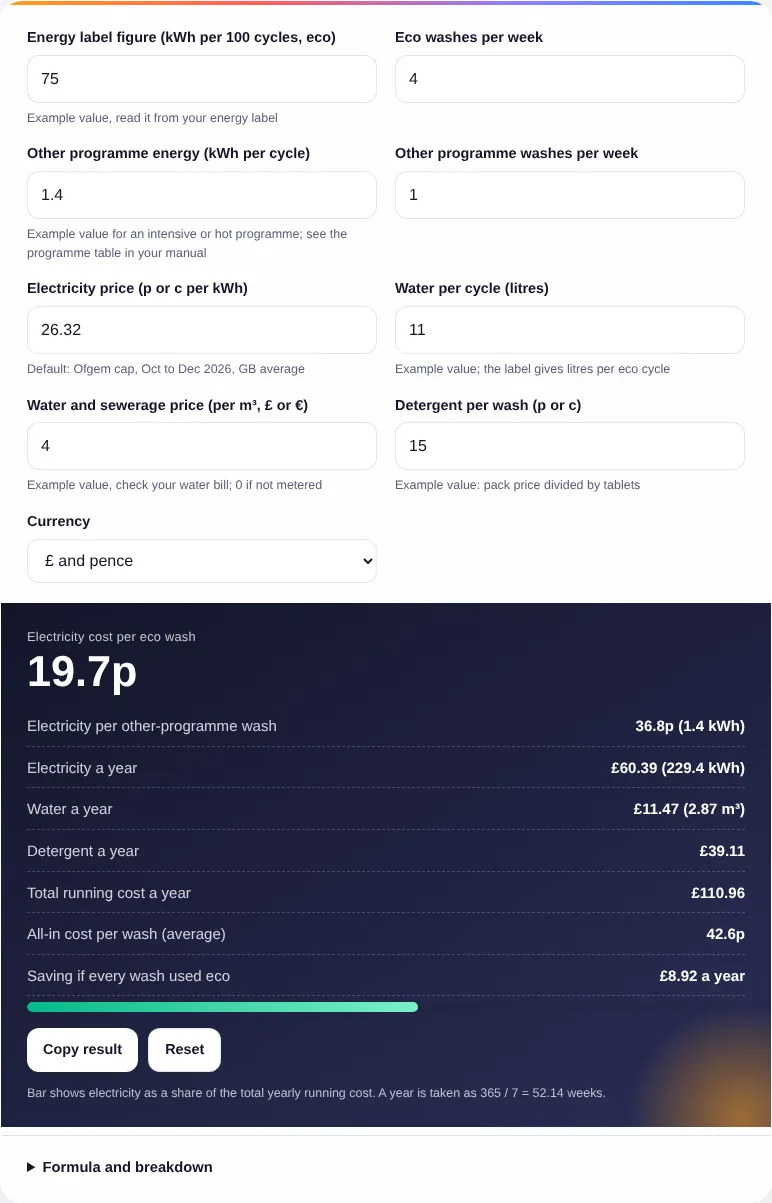
Bar shows electricity as a share of the total yearly running cost. A year is taken as 365 / 7 = 52.14 weeks.
Formula and breakdown
n/a
n/a
n/a
This dishwasher running cost calculator works out what each wash and a year of washes cost, using the kWh per 100 cycles figure on your energy label, for households in the UK, Ireland and the rest of Europe. It splits eco and hotter programmes, and adds water and detergent so you see the real cost per load, not just the electricity.
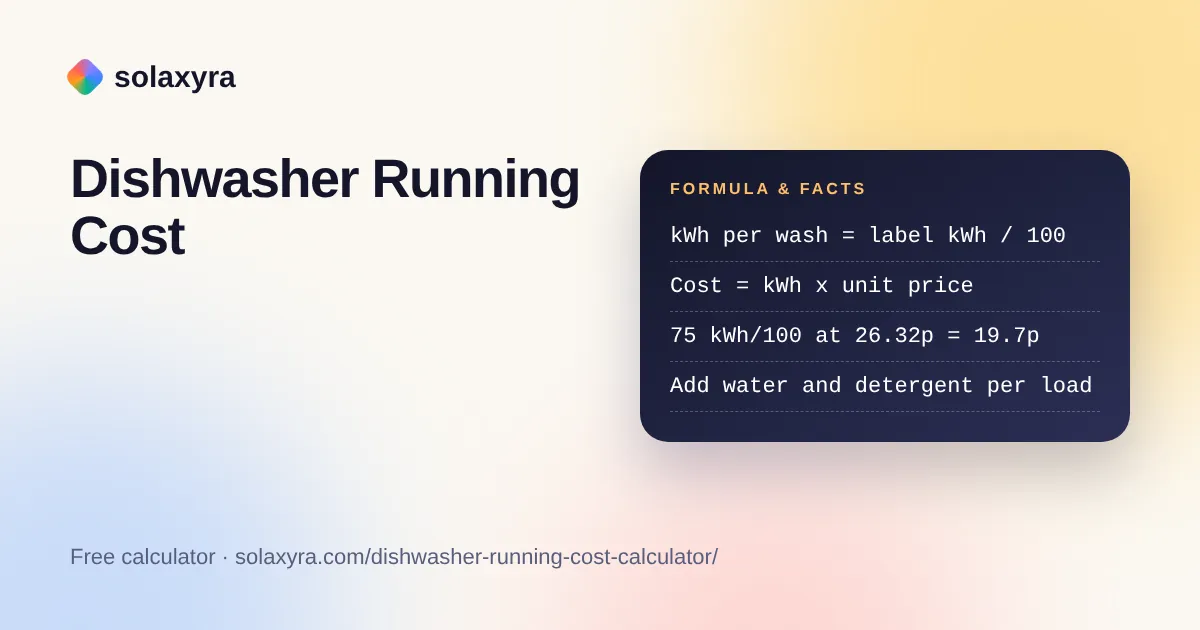
Quick answer: A dishwasher running cost calculator divides the label figure in kWh per 100 cycles by 100 and multiplies by your unit price. A dishwasher rated 75 kWh per 100 eco cycles uses 0.75 kWh a wash, which costs 19.7p at the 26.32p cap rate, or about £51 a year at five eco washes a week.
What Is a Dishwasher Running Cost Calculator?
A dishwasher running cost calculator is a tool that turns a dishwasher’s energy use into a cost per wash and per year at your electricity price. In plain words: cost per wash equals kWh per cycle times the unit price, and the yearly cost equals that times the number of washes a year, plus water and detergent if you want the full picture.
The starting figure is on the energy label. The European Commission’s guide to the dishwasher energy label explains that the label shows energy consumption for 100 cycles and water for one cycle, both measured on the eco programme, along with the A to G class, capacity in place settings, eco programme duration and noise. These labels have applied since 1 March 2021 under Regulation (EU) 2019/2017. In Great Britain, the government’s energy labelling guidance lists dishwashers among the products rescaled to A to G in March 2021, so the same kWh per 100 cycles figure appears on dishwashers sold there.
How Do You Use the Dishwasher Running Cost Calculator?
- Find the kWh per 100 cycles figure on the energy label or product sheet and enter it.
- Enter how many eco washes you run a week.
- If you also run an intensive, auto or quick hot programme, enter its kWh per cycle from the programme table in the manual and how often you use it.
- Enter your electricity unit price, or keep the Ofgem cap default.
- Optionally enter water litres per cycle, your water and sewerage price per cubic metre if you are metered, and the cost of a detergent tablet.
- Read the cost per eco wash, the yearly electricity, water and detergent, the all-in cost per wash and the saving from using eco every time.
How Much Does a Dishwasher Cost per Wash?
On the eco programme, a label figure of 50 to 105 kWh per 100 cycles means 13p to 28p of electricity per wash at the 26.32p cap rate. The unit price is the Ofgem price cap rate for 1 October to 31 December 2026, a period when Ofgem says VAT is removed from electricity bills. The table shows the cost per eco wash and per year for a range of label figures.
| Label figure (kWh per 100 eco cycles) | Cost per eco wash at 26.32p | kWh a year, 5 washes a week | Cost a year, 5 washes a week | Cost a year, 7 washes a week |
|---|---|---|---|---|
| 50 | 13.2p | 130.4 | £34.31 | £48.03 |
| 60 | 15.8p | 156.4 | £41.17 | £57.64 |
| 75 | 19.7p | 195.5 | £51.47 | £72.05 |
| 90 | 23.7p | 234.6 | £61.76 | £86.46 |
| 105 | 27.6p | 273.8 | £72.05 | £100.87 |
The label figures in the table are examples spanning efficient and less efficient machines rather than specific models. A year is taken as 365 / 7 = 52.14 weeks. For any other appliance, the electricity cost calculator uses the same price logic from a wattage and hours of use.
How Much More Does the Intensive Programme Cost Than Eco?
Hotter programmes such as intensive or pots and pans usually use more energy than eco, because they heat the wash water to a higher temperature. The exact figure for your model is in the programme table of the user manual, which lists kWh, litres and duration for each programme; enter it in the dishwasher running cost calculator to see the difference per wash and per year.
Eco is longer because it uses a lower temperature and more soaking time, which is how it reaches the low label figure. The Commission’s advice for low running costs is to use the eco programme, run full loads without overloading, skip pre-rinsing, use the right amount of detergent and keep salt and rinse aid topped up.
Is It Cheaper to Run a Dishwasher at Night?
Only if you pay less for electricity at night: on a single-rate tariff the cost is the same at any hour, while on a two-rate or time-of-use tariff a delay timer can move each wash into the cheaper period. Enter your night rate as the price to see the saving, and our Economy 7 calculator shows whether a two-rate tariff suits your home overall. If you have solar panels, running the dishwasher in the middle of a sunny day can use your own generation instead; the solar self-consumption calculator estimates how much of your output you use at home.
If you run it overnight or while you are out, follow the manufacturer’s instructions, make sure a working smoke alarm is fitted, and do not run the machine on an extension lead unless the manual allows it. A dishwasher that trips the electrics or leaks should be checked by the manufacturer’s service team or a qualified electrician before further use.
What Else Adds to the Cost of a Dishwasher Load?
Detergent can add almost as much as electricity, and for metered homes water and sewerage add a few pence per wash. With an example 15p tablet, 11 litres at an example £4 per cubic metre and five washes a week, detergent adds about £39 a year and water about £11.50, on top of about £60 of electricity in the default example. Homes without a water meter pay a fixed charge, so set the water price to zero.
The dishwasher running cost calculator adds these together into an all-in cost per wash, which is the fairer figure when comparing the dishwasher with washing up by hand. Our energy consumption calculator puts the dishwasher alongside your other appliances to show its share of the household bill.
Worked Example: A Family Dishwasher Used Seven Times a Week
Example: a family runs a 14 place-setting dishwasher labelled 68 kWh per 100 eco cycles, with five eco washes a week and two intensive washes at 1.5 kWh each from the manual. Each eco wash costs 0.68 x 26.32p = 17.9p and each intensive wash 1.5 x 26.32p = 39.5p. Over a year that is (5 x 0.68 + 2 x 1.5) x 52.14 = 333.7 kWh, costing £87.83.
Adding 10.5 litres a wash at an example £4 per cubic metre (£15.33) and an example 12p tablet (£43.80) gives £146.96 a year, about 40.3p per wash all-in. Switching the two intensive washes to eco would save 2 x 52.14 x (1.5 − 0.68) x 26.32p = £22.51 a year, about a quarter of the yearly electricity cost.
Frequently Asked Questions
How much electricity does a dishwasher use per wash?
Divide the kWh per 100 cycles figure on the energy label by 100 to get the eco programme figure for one wash. A label showing 75 kWh means 0.75 kWh per eco wash. Other programmes use different amounts, which are listed in the programme table of the user manual.
How much does it cost to run a dishwasher for a year?
Multiply the kWh per wash by the washes per year and your unit price. A machine using 0.75 kWh per eco wash, run five times a week at 26.32p per kWh, uses about 196 kWh a year and costs about £51 in electricity, before water and detergent.
What does kWh per 100 cycles on the energy label mean?
It is the electricity used by 100 washes on the eco programme, the standard test basis for the label. It appears on the A to G labels used since March 2021, and dividing it by 100 gives the energy for a single eco wash, which you multiply by your unit price.
Does the eco programme really save money?
Yes. The label figure is measured on eco, which uses lower water temperatures and longer soaking, so it usually uses less electricity than hotter programmes even though it takes longer. Check your manual’s programme table to see the kWh difference for your machine.
Is a dishwasher cheaper than washing up by hand?
Often, when you run full loads on eco, because the machine heats a small amount of water once for many place settings. Washing by hand with several bowls of hot water or a running tap can use more energy and water. Compare the all-in cost per wash with your own hand-washing habits.
Do half loads save money?
Check the programme table in your manual. If a half-load option uses more than half the energy and water of a full load, each item costs more to wash. Waiting until the dishwasher is full and running eco usually gives the lowest cost per plate.
Checked October 2026 by the Solaxyra Editorial Team. Sources: European Commission: dishwasher energy label, GOV.UK: the energy labelling of products, Ofgem: price cap 1 October to 31 December 2026.