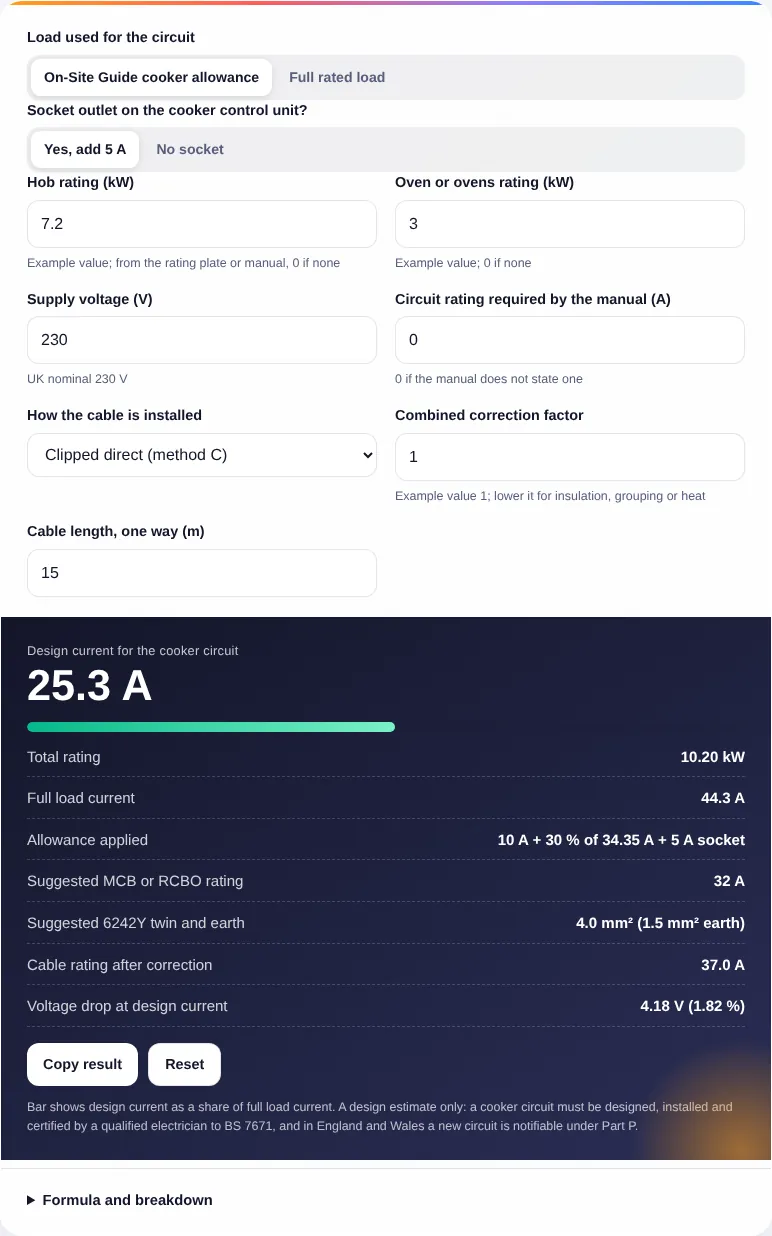
Bar shows design current as a share of full load current. A design estimate only: a cooker circuit must be designed, installed and certified by a qualified electrician to BS 7671, and in England and Wales a new circuit is notifiable under Part P.
Formula and breakdown
n/a
n/a
n/a
This cooker circuit calculator turns the kW rating of an electric cooker, range or induction hob into the design current for its circuit, using the IET On-Site Guide allowance for household cooking appliances, then suggests a protective device rating and a twin and earth cable size with a voltage drop check. It is for UK homeowners, kitchen fitters and electrical students who want to understand a quote or plan a kitchen; the result is a design estimate, not a substitute for an electrician’s design to BS 7671.
Quick answer: A cooker circuit calculator takes the first 10 A of full load current, adds 30 % of the rest and 5 A if the control unit has a socket. A 10.2 kW cooker draws 44.3 A at full load, giving 25.3 A, a 32 A device and 4 mm² twin and earth clipped direct.

What Is a Cooker Circuit Calculator?
A cooker circuit calculator is a tool that estimates the current a cooker circuit must be designed for and the protective device and cable that could carry it. In plain words: full load current equals rated watts divided by voltage; the On-Site Guide design current equals 10 A, plus 30 % of the full load current above 10 A, plus 5 A when a socket is built into the cooker control unit.
The allowance exists because a cooker almost never runs every ring and element at full power for long; thermostats cycle and people rarely use everything at once. The IET answers on electrical diversity say this example comes from Table A1 of the On-Site Guide for a household cooking appliance, that the result could be used to size the cable for that appliance and to work out the installation’s maximum demand, and that the 5 A applies when the cooker panel has an integral socket.
How Do You Use the Cooker Circuit Calculator?
- Choose the On-Site Guide allowance or full rated load, and say whether the cooker control unit has a socket outlet.
- Enter the hob and oven ratings in kW from the rating plate or installation manual. For a freestanding cooker, put the total in either box.
- If the manual states a circuit or fuse rating, enter it. The tool will never suggest a smaller device.
- Pick how the cable is installed and, if it passes through insulation, is bunched with other cables or runs somewhere hot, lower the correction factor.
- Enter the one-way cable length from the consumer unit.
- Read the design current, device rating, cable size and voltage drop, and open the breakdown to check each step.
How Do You Calculate Cooker Diversity?
Cooker diversity is the first 10 A of the full load current, plus 30 % of the remainder, plus 5 A if the cooker control unit has a socket. For a 12 kW range at 230 V, full load is 52.2 A, so the design current is 10 + 0.3 x 42.2 + 5 = 27.7 A.
Forum threads that rank for this topic argue about whether the allowance may be used for a single cooker circuit or only for the whole house. The IET’s own answer says the result could be used to size the cable for that application. What overrides both is the manufacturer: if the installation manual asks for a 40 A or 45 A circuit, design for that. Use the full rated load option to see the cautious case side by side, and the maximum demand calculator to add the cooker to the rest of the house.
What Size Cable and Breaker Does a Cooker Need?
Most home cookers rated 8 to 15 kW come out at a 25 A or 32 A device using the On-Site Guide allowance, which needs 4 mm² twin and earth clipped direct or 6 mm² in conduit in a wall, before any correction factors or a manual’s own requirement.
The cooker circuit calculator picks the smallest standard device rating at or above the design current, from the preferred values in the IEC 60898-1 list of MCB ratings: 6, 10, 13, 16, 20, 25, 32, 40, 50 and 63 A and upwards. It then picks the smallest 6242Y cable whose rating, times your correction factor, is at least that device rating and whose voltage drop stays within 5 %. Ratings come from a BS 6004 twin and earth datasheet that states they follow Table 4D5 of the IEE Wiring Regulations.
| Cooker rating | Full load at 230 V | Design current with socket | Device | Clipped direct | In conduit in a wall |
|---|---|---|---|---|---|
| 6 kW | 26.1 A | 19.8 A | 20 A | 1.5 mm² | 2.5 mm² |
| 8 kW | 34.8 A | 22.4 A | 25 A | 2.5 mm² | 4 mm² |
| 10.2 kW | 44.3 A | 25.3 A | 32 A | 4 mm² | 6 mm² |
| 12 kW | 52.2 A | 27.7 A | 32 A | 4 mm² | 6 mm² |
| 15 kW | 65.2 A | 31.6 A | 32 A | 4 mm² | 6 mm² |
The table assumes a 15 m run, no correction factors and no larger rating set by the manual. You may prefer a larger cable than the minimum so a bigger range cooker can be fitted later; the cooker circuit calculator shows the smallest size that passes, not the only acceptable choice. For other loads, our kW to amps calculator gives full load current and the voltage drop calculator checks longer runs in more detail.
How Is Voltage Drop Checked on a Cooker Circuit?
Voltage drop in volts equals the cable’s mV/A/m value times the design current times the length in metres, divided by 1,000, and BS 7671 recommends no more than 5 % from the origin to a load other than lighting.
An IET Wiring Matters article sets out that formula and the 5 % figure from Appendix 4, and notes the UK supply is 230 V with a tolerance of plus 10 % and minus 6 %. For 4 mm² twin and earth at 11 mV/A/m, 25.3 A over 15 m drops 4.18 V, or 1.82 %. Because the 5 % applies from the origin of the installation, a long cooker run in a large house can still push the cable size up.
Do You Need an Electrician for a Cooker Circuit?
Yes. A new cooker circuit in England and Wales is notifiable building work under Part P, and in the UK it should be designed, installed and certified by a qualified electrician to BS 7671.
Approved Document P lists the installation of a new circuit as notifiable. A registered competent person can self-certify and issue the certificates; otherwise building control must be notified before work starts. The electrician also checks things this cooker circuit calculator does not: earth fault loop impedance and disconnection time, RCD protection, the correction factors for your actual route, the isolator position and the cooker manual. Swapping a cooker like for like on an existing, suitable circuit is different, but the circuit’s rating still has to suit the new appliance.
Worked Example: Replacing a Cooker With an Induction Hob and Oven
Example: a kitchen refit in Nottingham replaces a freestanding cooker with a 7.2 kW induction hob and a 3 kW built-in oven on one circuit, with a socket on the cooker control unit. The cable will be clipped direct for 15 m and the manual does not state a circuit rating.
- Total rating = 7.2 + 3 = 10.2 kW. Full load current = 10,200 / 230 = 44.35 A.
- Design current = 10 A + 0.3 x 34.35 A + 5 A = 25.30 A.
- Smallest standard device at or above 25.30 A = 32 A.
- Smallest 6242Y clipped direct rated at least 32 A = 4 mm² (37 A).
- Voltage drop = 11 x 25.30 x 15 / 1,000 = 4.18 V, which is 1.82 % of 230 V.
If the cable instead runs in conduit in a wall, the cooker circuit calculator moves to 6 mm² (32 A). If the hob manual asked for a 40 A supply, the device would rise to 40 A and the cable to 6 mm² clipped direct, whatever the allowance gives.
Frequently Asked Questions
What is the cooker diversity formula?
The IET On-Site Guide allowance for a household cooker is the first 10 A of its full load current, plus 30 % of the remainder, plus 5 A if the cooker control unit includes a socket outlet. The IET says the result can be used to size the cable for that appliance.
What size MCB do I need for a cooker?
Use the smallest standard rating at or above the design current, unless the manual asks for more. Many 8 to 15 kW cookers come out at 32 A with the On-Site Guide allowance, but a qualified electrician must confirm the rating for your circuit.
Is 6 mm² cable enough for a cooker?
Often, yes. On the datasheet used here, 6 mm² twin and earth is rated 47 A clipped direct and 32 A in conduit in a wall. It suits a 32 A device in both cases before correction factors, and a 40 A device only when clipped direct with no derating.
Do induction hobs need their own circuit?
A hob rated above about 3 kW draws more than 13 A at 230 V, so it cannot run from a 13 A plug and is wired on a cooker circuit, alone or with an oven. Follow the rating and supply requirement in the hob’s installation manual.
Can an oven and hob share one cooker circuit?
Yes, a hob and oven are often fed from one cooker circuit, and the cooker circuit calculator adds their ratings before applying the allowance. The electrician will check the switch and isolation arrangements and whether either manual requires a separate supply.
Can I wire a cooker circuit myself?
In England and Wales, installing a new circuit is notifiable under Part P, so it must be done by a registered competent person or notified to building control first. For safety, have a qualified electrician design, install and certify the circuit to BS 7671.
Checked October 2026 by the Solaxyra Editorial Team. Sources: IET: Electrical diversity webinar questions and answers, BS 6004 624-Y twin and earth cable datasheet, IET Wiring Matters, July 2023, Approved Document P (gov.uk), Wikipedia: Circuit breaker.