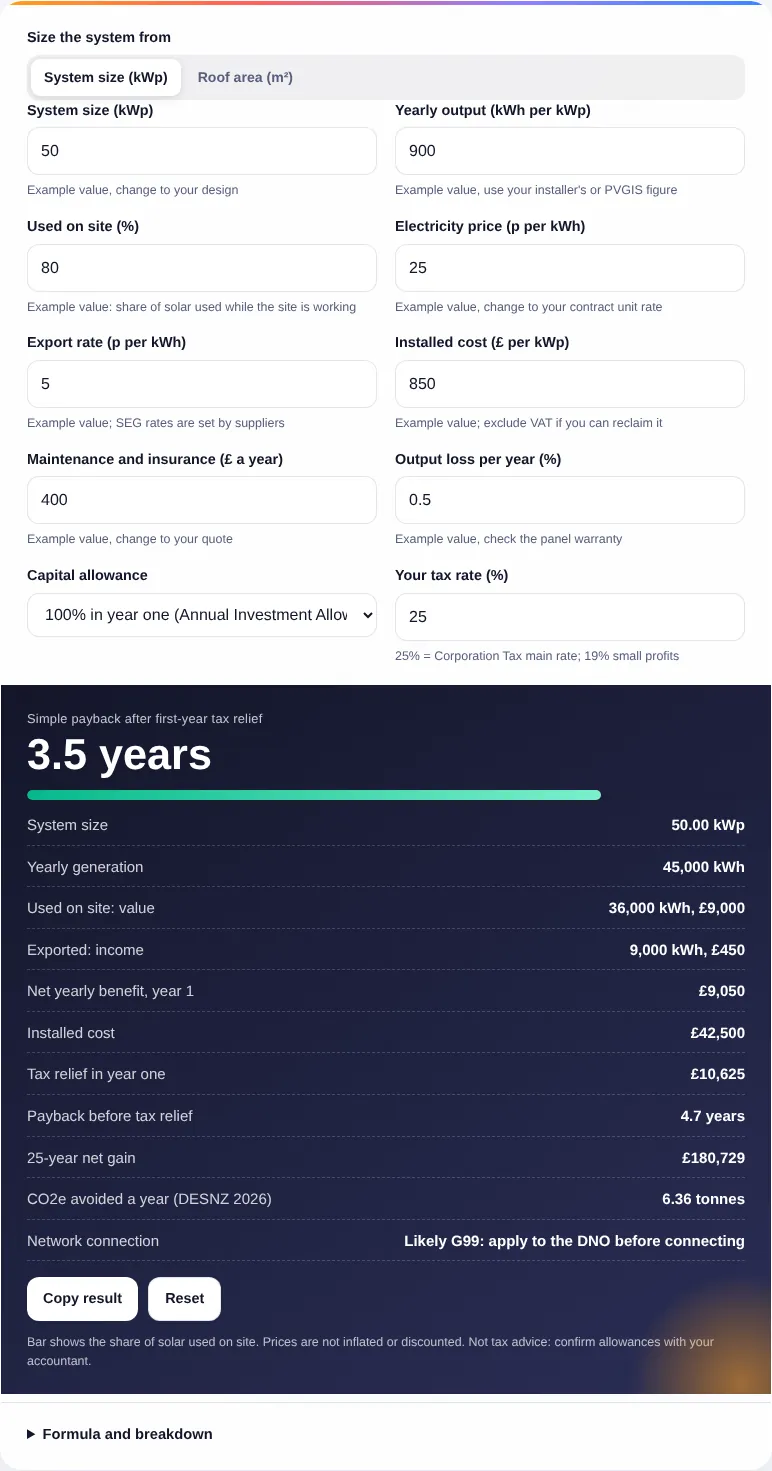
Bar shows the share of solar used on site. Prices are not inflated or discounted. Not tax advice: confirm allowances with your accountant.
Formula and breakdown
n/a
n/a
n/a
n/a
This commercial solar panel calculator estimates the size, yearly generation, savings, export income, payback and carbon saving of a rooftop solar system for a UK business, farm, school or other non-domestic site. It works from a system size in kWp or from your usable roof area, splits solar used on site from solar exported, and applies UK capital allowance options and your tax rate.
Quick answer: A commercial solar panel calculator divides the installed cost, less any first-year tax relief, by the yearly saving. Example: 50 kWp at £850 per kWp making 900 kWh per kWp, 80% used on site at 25p and the rest exported at 5p, pays back in about 4.7 years, or 3.5 years after 25% tax relief.

What Is a Commercial Solar Panel Calculator?
A commercial solar panel calculator is a tool that turns a business site’s solar system size, electricity price and usage pattern into yearly savings and a payback period. In plain words: yearly generation equals kWp times kWh per kWp; the share used on site is valued at your electricity unit rate, the rest at your export rate; subtract upkeep to get the yearly benefit, and divide the net cost by that benefit for payback.
Businesses differ from homes in three ways that change the answer. Most of the power is used during working hours, when the panels are producing, so a high share is used on site. Unit rates come from a negotiated contract rather than the household price cap. And the cost can attract capital allowances that cut the tax bill.
How Do You Use the Commercial Solar Panel Calculator?
- Choose whether to size by kWp or by roof area. For roof area, enter the area, the usable share, and the panel’s rating and size from its datasheet.
- Enter the yearly output per kWp for your site, from your installer’s design or PVGIS.
- Enter the share of solar used on site, your contract unit rate and your export rate.
- Enter the installed cost per kWp, yearly maintenance and the yearly output loss.
- Pick a capital allowance option and your tax rate.
- Read the payback with and without tax relief, the 25-year net gain and the CO2e saving, then open the breakdown to check each line.
How Big a Solar System Fits on a Commercial Roof?
Divide the usable roof area by the area of one panel, round down, then multiply by the panel rating. In the roof area mode of the commercial solar panel calculator, with an example usable share of 70%, a 400 m² roof takes 143 panels of 1.95 m², which at 430 W each is 61.49 kWp.
The usable share allows for edge clearances, rooflights, plant and maintenance walkways, and it varies a lot between buildings. A structural engineer should confirm that the roof can carry the extra load before any design is finalised, and our solar panel roof area calculator gives a more detailed layout for pitched roofs with set-backs. Planning rules for non-domestic roofs differ from those for houses, so check with your local planning authority.
Why Does Self-Consumption Matter So Much for Business Solar?
Each kWh used on site saves your full unit rate, while each kWh exported earns only the export rate, so the share used on site drives payback more than any other input. In the example below, raising self-consumption from 40% to 100% cuts payback before tax relief from 7.8 to 3.9 years.
| Used on site | 20p per kWh | 25p per kWh | 30p per kWh |
|---|---|---|---|
| 40% | 9.3 years | 7.8 years | 6.7 years |
| 60% | 7.2 years | 5.9 years | 4.9 years |
| 80% | 5.9 years | 4.7 years | 3.9 years |
| 100% | 4.9 years | 3.9 years | 3.2 years |
Example inputs for every cell: 50 kWp, 900 kWh per kWp (45,000 kWh a year), export 5p per kWh, £850 per kWp (£42,500), £400 a year upkeep, payback before tax relief. Sites that run seven days a week, or have daytime refrigeration, ventilation or process loads, sit near the top of the table. Our solar self-consumption calculator helps estimate the share from your load profile, and half-hourly meter data from your supplier gives the best figure.
Can a Business Sell Surplus Solar Power?
Yes. The Smart Export Guarantee covers solar installations up to 5 MW in Great Britain, and Ofgem’s Smart Export Guarantee page says licensed suppliers set the rate, length and terms, with rates that must always be above zero. Payments are based on export meter readings.
Because each supplier sets its own price, the export rate in the commercial solar panel calculator is an example to replace with a real offer. Our Smart Export Guarantee calculator works out export income on its own if you want to compare offers.
What Tax Relief Can a Business Claim on Solar Panels?
GOV.UK lists solar panels in the special rate pool, which gets a writing down allowance of 6% a year, but most businesses can instead deduct the cost in full in year one under the Annual Investment Allowance, which is £1 million a year. The commercial solar panel calculator offers both options and multiplies the allowance by your tax rate.
The AIA is open to sole traders, companies and partnerships whose members are all individuals. Companies can also look at full expensing or the 50% first-year allowance on new and unused plant and machinery bought from 1 April 2023, which only companies can claim. The Corporation Tax main rate is 25%, with 19% for profits of £50,000 or less. Which allowance fits depends on your accounts, so confirm with your accountant. GOV.UK also says a VAT-registered business can reclaim VAT on business purchases with a valid invoice, which is why the cost field asks for the price before VAT in that case.
Does a Commercial Solar System Need G99 Approval?
Usually, yes. G98 covers generation up to and including 16 A per phase, which is 3.68 kW per phase at 230 V or 11.04 kW on a three-phase supply; above that G99 applies, and MCS guidance says permission to connect must be granted by the network operator before connection.
The commercial solar panel calculator flags any system above 11.04 kWp as a likely G99 case. The network operator may limit how much the site can export, which would reduce export income, so ask for the connection offer early. Installation must be carried out by qualified installers, with the electrical work meeting BS 7671 and the roof checked for load.
How Much CO2 Does Commercial Solar Save?
Using the UK government’s 2026 conversion factors, each kWh used on site avoids 0.14396 kg CO2e and each kWh exported avoids 0.13096 kg CO2e. The 50 kWp example avoids about 6.36 tonnes a year.
The two factors come from Table 9 of the DESNZ 2026 methodology paper: 0.13096 kg for electricity generated and 0.01299 kg for transmission and distribution losses, which together give 0.14396 kg for electricity consumed. Self-used solar avoids both, so it uses the consumed factor; exported solar enters the network and is counted at the generated factor. The figure suits Scope 2 reporting estimates; your sustainability adviser may apply a different method.
Worked Example: 50 kWp on a Warehouse Roof
Example: a warehouse in the Midlands plans 50 kWp and enters it in the commercial solar panel calculator. The installer’s design gives an example 900 kWh per kWp. The site uses 80% of the output during its working day at a contract rate of 25p per kWh and exports the rest at 5p. The system costs £850 per kWp before VAT, upkeep is £400 a year, and the company pays Corporation Tax at 25% and claims the AIA.
- Generation: 50 x 900 = 45,000 kWh a year.
- Used on site: 36,000 kWh x 25p = £9,000. Exported: 9,000 kWh x 5p = £450.
- Net yearly benefit: £9,000 + £450 minus £400 = £9,050.
- Cost: 50 x £850 = £42,500. Tax relief: £42,500 x 25% = £10,625.
- Payback: £42,500 / £9,050 = 4.7 years before relief; (£42,500 minus £10,625) / £9,050 = 3.5 years after.
- 25 years with output falling 0.5% a year: £9,450 x 23.56 minus £10,000 upkeep minus £42,500 plus £10,625 = about £180,729.
- CO2e: 36,000 x 0.14396 + 9,000 x 0.13096 = 6,361 kg a year.
For a home-style ROI view with price inflation, the solar ROI calculator adds a year-by-year cash flow.
Frequently Asked Questions
How long does commercial solar take to pay back in the UK?
It depends mostly on the share used on site and your unit rate. In this calculator’s example, 50 kWp at £850 per kWp with 80% used on site at 25p pays back in about 4.7 years, or 3.5 years after 25% tax relief under the Annual Investment Allowance.
Can a limited company claim solar panels against tax?
Yes, solar panels are plant and machinery. GOV.UK lists them in the special rate pool at 6% a year, and the Annual Investment Allowance lets most businesses deduct up to £1 million of qualifying spending in year one. Companies may also consider full expensing or the 50% first-year allowance. Check with an accountant.
Can a business get the Smart Export Guarantee?
Ofgem says the Smart Export Guarantee covers solar installations up to 5 MW in Great Britain. Suppliers set their own export rates, which must be above zero, and payment is based on export meter readings. Compare offers, because rates and contract terms vary between suppliers.
Do I pay VAT on commercial solar panels?
GOV.UK says a VAT-registered business can reclaim VAT on items bought for use in the business, with a valid VAT invoice. In that case enter the cost before VAT. If you cannot reclaim it, for example on the Flat Rate Scheme, enter the cost including VAT and ask your accountant.
What size solar system does my business need?
Size it to your daytime demand rather than your total yearly use, because power used on site is worth far more than exported power. Half-hourly meter data shows how much you use while the panels produce. The roof area mode in this commercial solar panel calculator shows the most that will fit.
How is the carbon saving calculated?
Self-used solar is multiplied by the DESNZ 2026 factor for electricity consumed, 0.14396 kg CO2e per kWh, and exported solar by the factor for electricity generated, 0.13096 kg CO2e per kWh. The 50 kWp example avoids about 6.36 tonnes of CO2e a year.
Checked October 2026 by the Solaxyra Editorial Team. Sources: GOV.UK: Capital allowances rates and pools, GOV.UK: Annual Investment Allowance, GOV.UK: Full expensing and 50% first-year allowance, GOV.UK: Corporation Tax rates, GOV.UK: Reclaim VAT on business expenses, Ofgem: Smart Export Guarantee, MCS: Notifying DNOs (G98 and G99), DESNZ: 2026 GHG conversion factors methodology, Table 9.