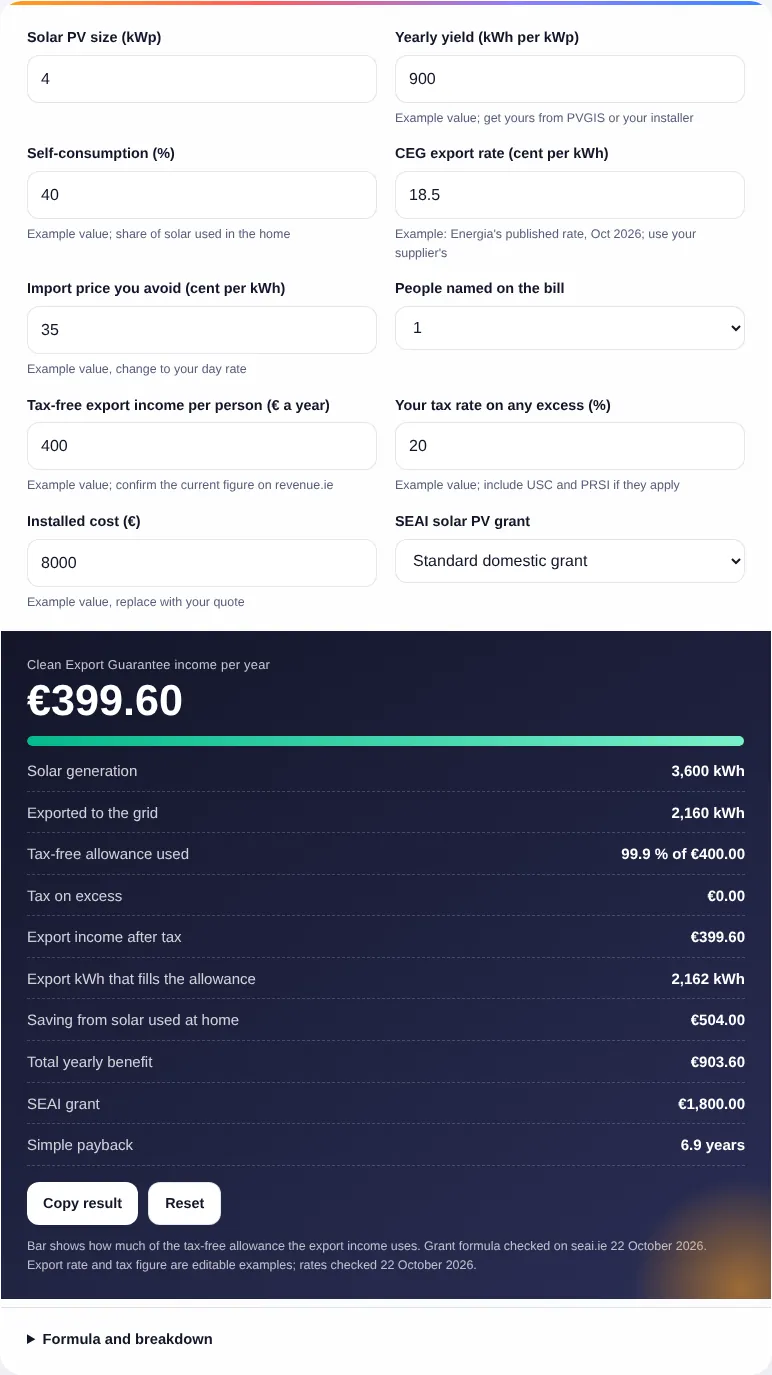
Bar shows how much of the tax-free allowance the export income uses. Grant formula checked on seai.ie 22 October 2026. Export rate and tax figure are editable examples; rates checked 22 October 2026.
Formula and breakdown
n/a
n/a
n/a
n/a
This clean export guarantee calculator estimates how much an Irish home with solar panels earns each year from its electricity supplier for the surplus it sends to the grid, whether that income stays inside the tax-free allowance, and how export income and self-use savings together pay back the system. Amounts are in euro, and the export rate, tax allowance and installed cost are inputs you can set to match your own supplier and quote.
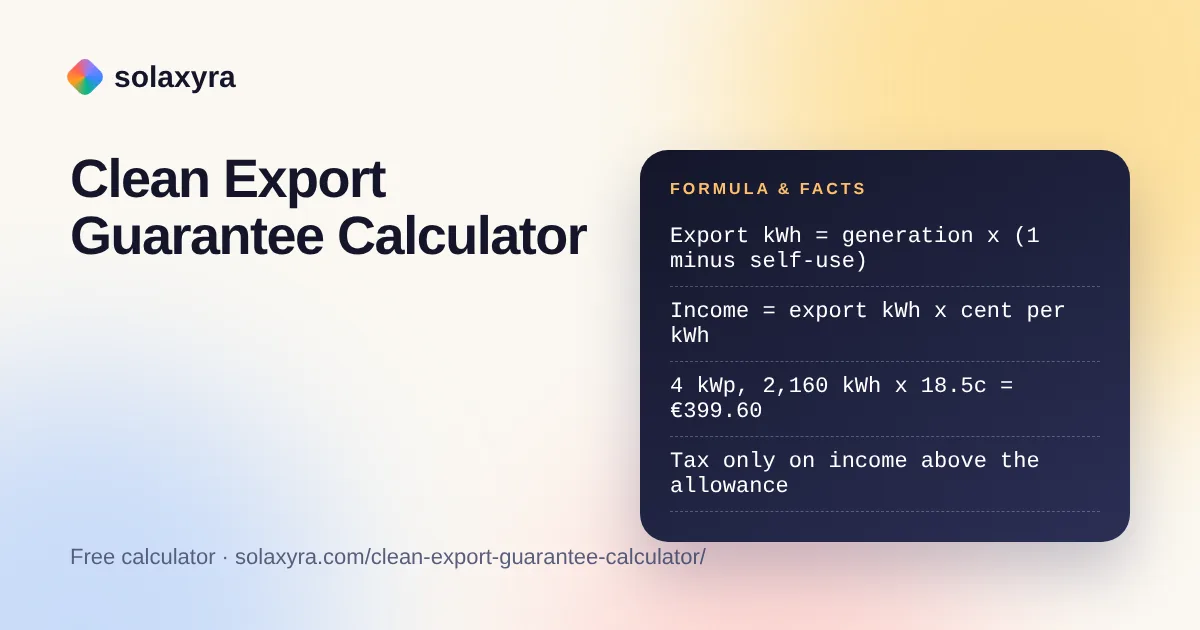
Quick answer: A clean export guarantee calculator multiplies the kWh you export by your supplier’s export rate. A 4 kWp system making 900 kWh per kWp and using 40 % at home exports 2,160 kWh; at an example 18.5 cent per kWh that earns €399.60 a year, just under a €400 allowance.
What Is a Clean Export Guarantee Calculator?
A clean export guarantee calculator is a tool that turns your solar system size, expected yield, self-consumption share and supplier export rate into the yearly payment you receive under Ireland’s Clean Export Guarantee (CEG). In plain words: export kWh equals generation times the share you do not use yourself, and CEG income equals export kWh times the rate in cent per kWh.
The CEG is the payment suppliers make to microgenerators for renewable electricity exported to the grid. A parliamentary answer recorded by the Oireachtas explains that it became available when Article 21 of the EU Renewable Energy Directive was transposed into Irish law in February 2022. The Commission for Regulation of Utilities (CRU) chose a competitive, market-based approach, so each supplier sets its own rate.
How Do You Use the Clean Export Guarantee Calculator?
- Enter your system size in kWp and the yearly yield per kWp from your installer’s estimate or the EU PVGIS tool.
- Set the share of your solar output you use in the home. The rest is exported.
- Enter your supplier’s CEG export rate in cent per kWh and the import price you avoid when you use your own solar.
- Choose how many people are named on the electricity bill, check the tax-free amount per person and set your tax rate on any excess.
- Enter your installed cost and whether you receive the standard SEAI grant.
- Read the export income, the after-tax figure, the total yearly benefit and the simple payback.
How Much Do Irish Suppliers Pay for Exported Electricity?
Irish suppliers set their own Clean Export Guarantee rates, and Energia’s microgeneration page lists 18.5 cent per kWh in October 2026, credited to the customer’s bill rather than paid into a bank account.
Because rates change and differ between suppliers, the clean export guarantee calculator treats the rate as an input. Energia also lists what it needs before paying: a microgenerator such as solar PV, an export connection, a smart meter, and an NC6 notification form submitted to ESB Networks, often by the installer. ESB Networks states that the eligibility rules for export payments are set by the CRU, in its decision on enduring arrangements for the CEG. Remember that you normally sell to the same supplier you buy from, so compare import prices too.
Is Clean Export Guarantee Income Taxable?
Export income is taxable above a yearly disregard per person, and only the excess is taxed. A €200 disregard was introduced in Budget 2021, according to the same Oireachtas record, and Energia now refers to a yearly exemption of €400.
We could not open Revenue’s own guidance page on 22 October 2026, so the clean export guarantee calculator shows €400 per person as an editable example rather than a confirmed figure. Check the current amount, the conditions (for example that it applies to a home, not a business meter) and whether two named bill payers can each claim it on revenue.ie before you rely on it. The calculator taxes only the income above the allowance at the rate you enter.
How Does System Size Change Export Income?
The table keeps the same example assumptions, 900 kWh per kWp, 40 % self-consumption, 18.5 cent per kWh, one person on the bill with a €400 allowance and 20 % tax on any excess, and changes only the system size.
| System size | Exported kWh | CEG income | Tax on excess | Income after tax |
|---|---|---|---|---|
| 2 kWp | 1,080 | €199.80 | €0.00 | €199.80 |
| 3 kWp | 1,620 | €299.70 | €0.00 | €299.70 |
| 4 kWp | 2,160 | €399.60 | €0.00 | €399.60 |
| 5 kWp | 2,700 | €499.50 | €19.90 | €479.60 |
| 6 kWp | 3,240 | €599.40 | €39.88 | €559.52 |
The pattern shows why the allowance matters more than it seems: below about 2,160 kWh of export at this rate, every euro is kept, while above it each extra euro is reduced by your tax rate. Raising self-consumption, for example with a battery or a timer on the immersion, moves kWh from the export column to the home-use saving, which is not taxed and is usually worth more per kWh. Our solar self-consumption calculator helps estimate that share.
How Does the SEAI Grant Affect Payback?
The standard SEAI domestic solar PV grant is €700 per kWp for the first 2 kWp plus €200 for each extra kWp up to 4 kWp, capped at €1,800, which the clean export guarantee calculator subtracts from your quote.
The SEAI solar electricity grant page also lists a €600 battery grant and an enhanced grant for homeowners receiving certain Department of Social Protection payments, which this tool does not model. Payback here is installed cost minus grant, divided by yearly export income after tax plus the value of solar used at home. It ignores panel degradation and price changes; for a year-by-year view use the solar payback calculator, and for output by orientation the solar panel output calculator.
Worked Example: A 4 kWp System on a Semi-Detached House in Cork
Example: a household in Cork installs 4 kWp of solar for a quoted €8,000 and receives the standard SEAI grant. The installer estimates 900 kWh per kWp a year, and the family expects to use 40 % of it at home. One person is named on the bill, the supplier pays an example 18.5 cent per kWh and the avoided day rate is an example 35 cent per kWh.
- Generation = 4 x 900 = 3,600 kWh. Export = 3,600 x 60 % = 2,160 kWh. Used at home = 1,440 kWh.
- CEG income = 2,160 x €0.185 = €399.60, inside a €400 allowance, so no tax.
- Home use saving = 1,440 x €0.35 = €504.00.
- Total yearly benefit = €903.60.
- Grant = 2 x €700 + 2 x €200 = €1,800. Payback = (€8,000 minus €1,800) / €903.60 = 6.9 years.
If the same home added a battery and lifted self-consumption to 60 %, the clean export guarantee calculator shows export income falling to €266.40 but the home-use saving rising to €756.00, a total of €1,022.40 a year before the battery’s cost.
Frequently Asked Questions
What is the Clean Export Guarantee?
The Clean Export Guarantee is the Irish arrangement under which electricity suppliers pay microgenerators, such as homes with solar panels, for renewable electricity they export to the grid. Each supplier sets its own rate in cent per kWh, and payments are usually credited to the customer’s electricity bill.
Do I need a smart meter to get paid for export?
Suppliers such as Energia list a smart meter as a requirement, along with an export connection and an NC6 form sent to ESB Networks. The smart meter records half-hourly export so the supplier can pay for the actual kWh you send to the grid.
How much will I earn from the Clean Export Guarantee?
Multiply the kWh you export by your supplier’s rate. A 4 kWp system that exports 60 % of 3,600 kWh earns about €400 a year at 18.5 cent per kWh. Using more solar at home lowers export income but usually saves more on your bill.
Is export income tax free in Ireland?
Export income up to a yearly allowance per person is disregarded for tax, and only the excess is taxed. Energia currently refers to €400 a year, up from the €200 introduced in Budget 2021. Confirm the current figure and conditions with Revenue before relying on it.
Which supplier pays the best export rate?
Rates change often, and each supplier publishes its own. Check each supplier’s microgeneration page, and compare the import unit rate and standing charge at the same time, because you normally have to buy from the supplier that pays you for export.
Is it better to export or use my solar electricity?
Using it is usually better when your import price is higher than the export rate. With an example import rate of 35 cent and export of 18.5 cent, each kWh used at home is worth almost twice as much as each kWh exported.
Checked October 2026 by the Solaxyra Editorial Team. Rates checked 22 October 2026. Sources: Energia: microgeneration scheme, SEAI: solar electricity grant, Oireachtas: Clean Export Guarantee answer, 30 March 2022, ESB Networks: eligibility to get paid for export, DECC presentation on the Micro-generation Support Scheme (Teagasc, 2022).