This guide explains how UK households can charge an EV with solar panels: what equipment you need, how many miles your panels can add in summer and winter, and when using solar for the car is worth more, or less, than exporting it and charging on a cheap overnight tariff. If you want to charge an EV with solar panels, the numbers depend on when the car is at home, your tariff and the season, so each is worked through with examples you can change.
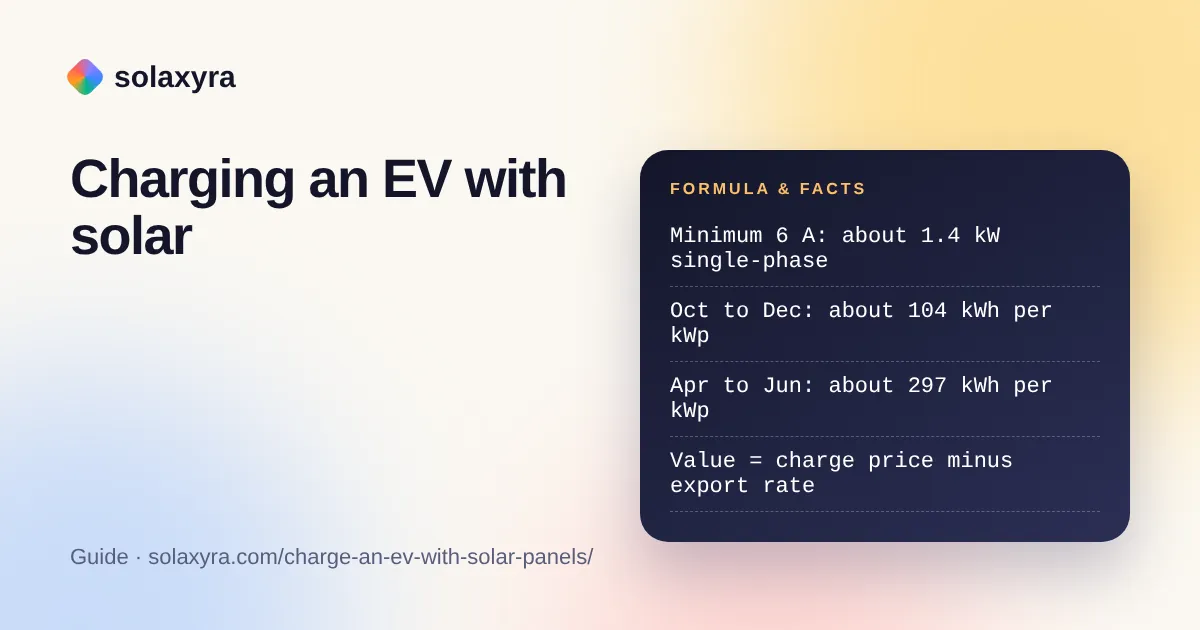
Quick answer: You can charge an EV with solar panels whenever the panels produce more than your home is using and the car is plugged in. A solar-aware charger follows the surplus, but cars need at least 6 A, about 1.4 kW on a single-phase supply, so small surpluses need a grid top-up. Winter solar adds few miles.
Can you charge an EV with solar panels at home?
Yes: any grid-connected home solar system can charge an electric car, because the solar electricity feeds your home’s wiring and the charge point draws from the same supply. Solar power goes to whatever is running in the house first; only the remainder is exported to the grid. When the car is charging during the day, part or all of its energy comes from the panels.
When you charge an EV with solar panels, three conditions decide how much of the charge is solar:
- The car must be at home and plugged in during daylight. A car that leaves at 8:00 and returns at 18:00 on weekdays only charges from solar at weekends.
- Generation must exceed household use. The surplus, not the total output, is what is available for the car.
- The charger must match the surplus. An ordinary charger pulls its full rate, for example 7 kW, from solar and the grid together; a solar-aware charger varies the rate to follow the surplus.
Why can’t a car charge from a small solar surplus?
Most EVs and charge points will not charge below 6 A, which is about 1.38 kW on a 230 V single-phase supply, so a smaller surplus cannot charge the car on solar alone. The control pilot signal used by J1772 and IEC 61851 charging tells the car how much current it may draw, and its lowest setting, a 10% duty cycle, corresponds to 6 A.
| Supply | Minimum charging power at 6 A | What it means for solar charging |
|---|---|---|
| Single-phase, 230 V (most UK homes) | 6 × 230 = 1,380 W, about 1.4 kW | Surplus must reach about 1.4 kW before solar-only charging can start |
| Three-phase, 230 V per phase, charger using all three phases | 6 × 230 × 3 = 4,140 W, about 4.1 kW | Needs a large surplus; some chargers switch to one phase to charge from smaller surpluses |
Solar-aware chargers usually offer modes such as solar only (charges only when the surplus is above the minimum), solar plus grid (tops up from the grid to reach the minimum) and full speed. They read the surplus from a current clamp on the incoming supply or from the solar inverter. The exact mode names and settings depend on the charger, so check the manual.
How many miles can solar panels add each season?
A UK solar system produces about 104 kWh per kWp from October to December but about 297 kWh per kWp from April to June, so if you charge an EV with solar panels in winter you get only a fraction of the miles you get in late spring. Those figures come from the DESNZ Feed-in Tariff load factor analysis for 2024/25, which measured 282,047 solar installations: 4.7% load factor in October to December and 13.6% in April to June.
The table uses the Energy Saving Trust’s average domestic system of 4.5 kWp. The share of output available as surplus for the car (50%) and the car’s efficiency (3.5 miles per kWh) are example values; change them to match your home and car.
| Period | Total solar, 4.5 kWp | Per day | Example surplus for the car (50%) | Example miles a day at 3.5 miles per kWh |
|---|---|---|---|---|
| October to December | 468 kWh | about 5.1 kWh | about 2.5 kWh | about 9 miles |
| April to June | 1,337 kWh | about 14.7 kWh | about 7.3 kWh | about 26 miles |
These are averages over a quarter. A bright June day gives far more and a grey December day far less, and on many winter days the surplus never reaches the 1.4 kW minimum. For your own car, mileage and roof, the solar EV charging calculator works out how much of a year’s driving solar could cover and how many panels that takes.
Is solar charging always the cheapest way to charge an EV?
No: when you charge an EV with solar panels, each solar kWh you put into the car is worth the price you would otherwise pay to charge minus the export payment you give up, and on a cheap overnight EV tariff that can be less than zero. Under the Ofgem price cap for October to December 2026 the average standard import rate is 26.32p per kWh. The Energy Saving Trust gives roughly 12p per kWh as a typical export payment, and some suppliers offer EV tariffs with a lower overnight rate. The 12p export rate and the 7p overnight rate below are example values; use your own.
| Your situation (example rates) | Cost you avoid per kWh | Export you give up per kWh | Value of using solar in the car |
|---|---|---|---|
| Standard tariff, car would otherwise charge at 26.32p | 26.32p | 12p | +14.32p per kWh |
| Smart EV tariff, car would otherwise charge overnight at an example 7p | 7p | 12p | minus 5p per kWh (exporting pays more) |
| No export payment at all | 26.32p or your rate | 0p | The full import rate |
Example: an EV covers 7,000 miles a year at 3.5 miles per kWh, which needs 2,000 kWh. Charged entirely at the 26.32p cap rate that costs £526.40; charged at an example overnight rate of 7p it costs £140.00. If the household has a cheap overnight EV rate and a good export rate, it may earn more by exporting midday solar and charging overnight. If it has a standard tariff, or exports for little or nothing, it is clearly worth it to charge an EV with solar panels. Run your own figures in the electricity cost calculator and the Smart Export Guarantee calculator.
How do you set up solar EV charging?
Use a smart charge point with a solar or eco mode, a current clamp or inverter link to measure the surplus, and a routine that leaves the car plugged in during daylight. These steps apply whenever you want to charge an EV with solar panels, whether you are adding a charger to existing panels or planning both together.
- Check your supply: most UK homes are single-phase, which sets the 1.4 kW minimum above.
- Choose a charge point that offers a solar surplus mode, and ask the installer how it measures surplus (current clamp or inverter connection).
- Have the charge point installed by a qualified electrician (see the safety section below).
- Set the charger’s mode: solar only on sunny days when the car is not needed urgently, solar plus grid when you need a minimum charge by a set time.
- Plug in whenever the car is home in daylight, even if the battery is fairly full. Short, frequent solar top-ups add up.
- If you have a home battery, decide its priority: many systems let you choose whether surplus goes to the house battery or the car first.
- Review a month of data in the charger and solar apps to see how many kWh came from solar, and adjust tariffs if exporting would pay more.
In Great Britain, smart charge points sold for home use must meet the Electric Vehicles (Smart Charge Points) Regulations: they must be able to send and receive information, respond to signals to change the charging rate or time, come with pre-set off-peak default charging hours that the owner can accept, remove or change, and include a randomised delay function. If your charger seems to refuse to start at midday, check whether default off-peak hours are still active.
Do you need a home battery to charge an EV with solar?
No: the car’s own battery is far larger than a typical home battery and can absorb solar directly whenever it is plugged in. A home battery helps you charge an EV with solar panels if the car is away all day, because it stores midday surplus for an evening charge, but each kWh passes through two sets of conversion losses and the home battery may be needed for the house in the evening.
The Energy Saving Trust puts home batteries at £5,000 to £8,000, so for most households changing when the car is plugged in, or using a cheap overnight EV rate, costs less than buying a battery mainly for the car.
How many solar panels do you need to charge an EV?
To produce a car’s yearly kWh on paper, divide it by about 806 kWh per kWp, the median UK yield in the DESNZ data. For the example 2,000 kWh a year, that is 2,000 ÷ 806 = about 2.5 kWp on top of what the rest of the home needs. In practice much of that summer output will be exported because the car is not always home, and in winter the panels cannot cover daily driving, so size panels for the whole home with the solar panel calculator and check the share you can use directly with the solar self-consumption calculator.
What safety rules apply to EV charge points and solar?
An EV charge point is a high-current, fixed electrical installation and must be installed by a qualified electrician, with the work meeting BS 7671 in the UK. A 7 kW charger draws about 30 A continuously for hours, which needs a dedicated circuit, correct cable size and suitable protection; the installer should also check that the existing supply can take the extra load. Do not charge from a domestic extension lead or adaptor, and do not alter charger, inverter or consumer unit wiring yourself.
Solar panels and inverters must likewise be installed by a qualified installer, and GOV.UK says the installation and installer must be MCS certified, or certified under an accredited equivalent, to receive Smart Export Guarantee payments.
Frequently Asked Questions
Can I charge my electric car directly from solar panels without a special charger?
Yes, any charger uses solar electricity when the panels are generating, but an ordinary charger draws its full rate regardless, topping up from the grid. A solar-aware charger adjusts its rate to match the surplus so more of the charge comes from your panels.
What is the minimum solar surplus needed to charge an EV?
Most cars and chargers need at least 6 A, which is about 1.4 kW on a single-phase 230 V supply and about 4.1 kW when charging on all three phases. Below that, a solar-only mode waits, and a solar plus grid mode tops up from the grid.
Can solar panels charge an EV in winter?
Only a little. DESNZ data show UK solar output from October to December is about 104 kWh per kWp, roughly a third of April to June. A 4.5 kWp system averages about 5 kWh a day in that quarter, much of it used by the house.
Is it better to export solar or use it to charge my EV?
Compare the price you would otherwise pay to charge with your export rate. On a standard tariff at 26.32p, using solar is worth far more than exporting at 12p. On a cheap overnight EV rate below your export rate, exporting and charging overnight can earn more.
How many miles can I get from a kWh of solar?
It depends on the car. At an example efficiency of 3.5 miles per kWh, each kWh of solar adds about 3.5 miles. Small, efficient cars do better and large SUVs worse, so use the figure from your car’s trip computer or app.
Do I need a home battery to charge my EV with solar?
No. The car’s battery can take solar directly whenever it is plugged in during the day. A home battery mainly helps if the car is away during daylight, and its cost of £5,000 to £8,000 is hard to justify for car charging alone.
Checked October 2026 by the Solaxyra Editorial Team. Sources: DESNZ: Feed-in Tariff load factor analysis 2024/25, GOV.UK: regulations for EV smart charge points, Energy Saving Trust: charging electric vehicles, Energy Saving Trust: solar panels, Ofgem: price cap October to December 2026, GOV.UK: Smart Export Guarantee, Wikipedia: SAE J1772.