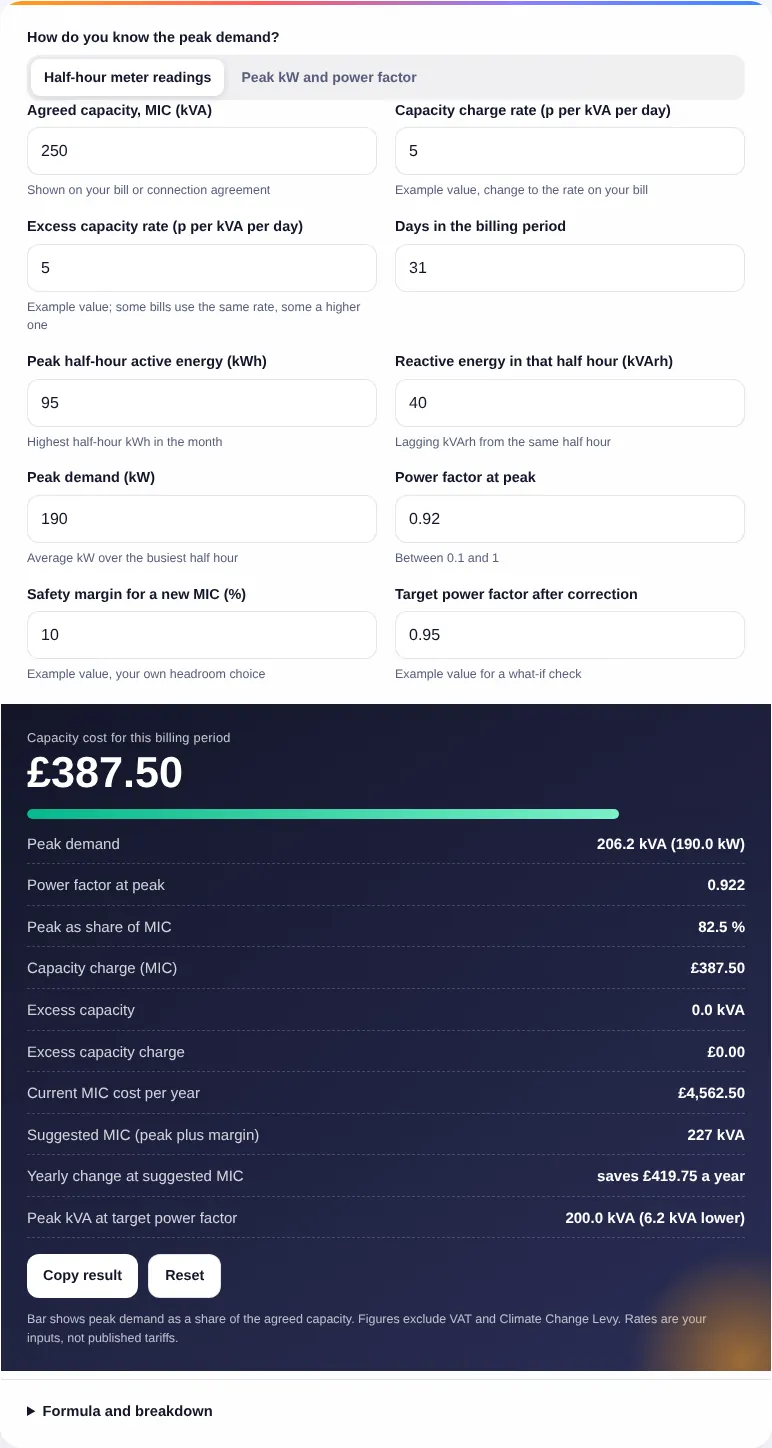
Bar shows peak demand as a share of the agreed capacity. Figures exclude VAT and Climate Change Levy. Rates are your inputs, not published tariffs.
Formula and breakdown
n/a
n/a
n/a
n/a
This capacity charge calculator works out what a UK business with a half-hourly electricity meter pays each billing period for its agreed supply capacity, and whether a busy half hour pushed it into excess capacity charges. It is for facilities managers, finance teams and energy consultants who want to check a bill line, test a lower agreed capacity or see how much power factor correction could trim the peak.
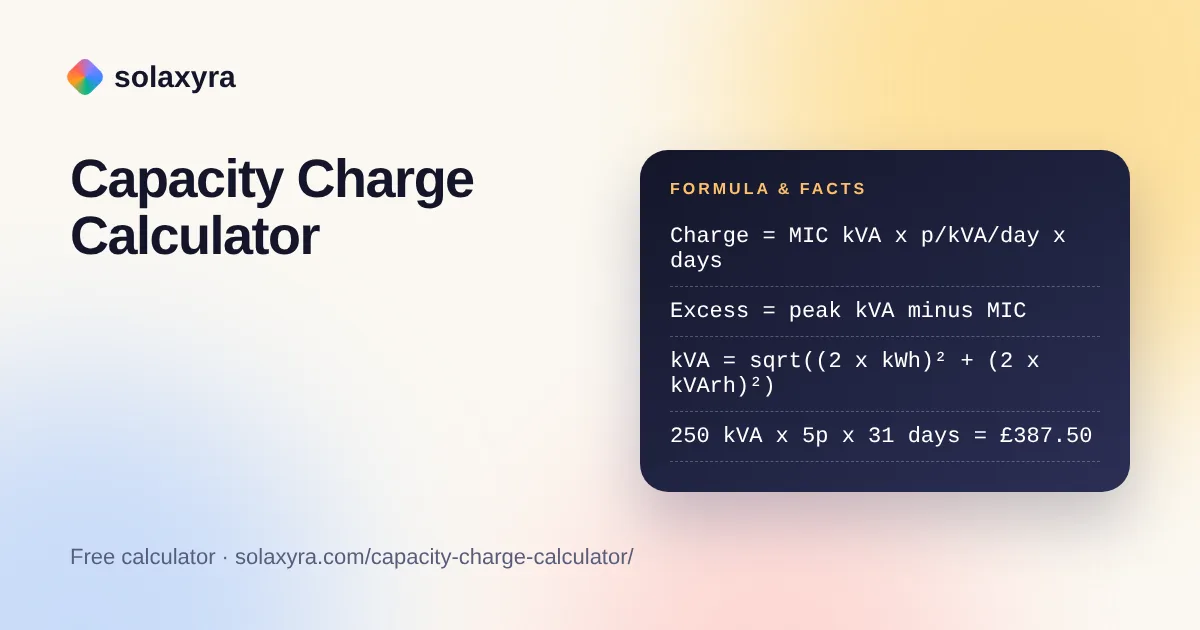
Quick answer: A capacity charge is the agreed capacity in kVA multiplied by the daily rate in pence and the days billed. Excess is the peak half-hour kVA above that agreement, charged at the excess rate on your bill. With 250 kVA at an example 5p per kVA per day, a 31-day month costs £387.50.
What Is a Capacity Charge Calculator?
A capacity charge calculator is a tool that turns your agreed supply capacity, the daily pence per kVA rate on your bill and your measured peak demand into the money you pay to have that capacity reserved on the distribution network. In plain words: capacity charge equals agreed kVA times rate times days, and excess charge equals the kVA above the agreement times the excess rate times days.
The agreed figure is usually called the Maximum Import Capacity, or MIC. It is set in the connection agreement between the site and its distribution network operator (DNO) and passed through by the supplier as part of the Distribution Use of System (DUoS) charges. The capacity charge is paid every day whether the site runs flat out or sits empty, which is why an MIC set years ago for a bigger operation can quietly cost thousands.
How Do You Use the Capacity Charge Calculator?
- Enter the agreed capacity (MIC) in kVA from your bill or connection agreement.
- Type the capacity charge rate and the excess capacity rate in pence per kVA per day exactly as they appear on your invoice. The defaults are example values only.
- Set the number of days in the billing period.
- Choose how you know the peak. With half-hourly data, enter the highest half-hour kWh and the kVArh from the same half hour. Otherwise switch to peak kW and power factor.
- Pick a safety margin for a possible new MIC and a target power factor for the what-if row.
- Read the period cost, the excess, the suggested MIC and the yearly change, then open the breakdown to check every step.
How Is Peak kVA Worked Out From Half-Hourly Data?
Peak kVA is twice the half-hour kWh and twice the half-hour kVArh combined with Pythagoras: kVA equals the square root of (2 x kWh)² plus (2 x kVArh)². Doubling turns energy in one half hour into average power over an hour, and the square root combines real and reactive power into apparent power.
The Wikipedia article on power factor defines power factor as real power divided by apparent power, and describes apparent power as the combination of real and reactive power on the power triangle. An Ofgem capacity charging sub-group paper from the structure of charges work recommended working out kVA for each half hour and taking the highest value, rather than using an averaged power factor, and noted that most sites run lagging. The capacity charge calculator follows that approach in half-hour mode.
How Are Excess Capacity Charges Calculated?
Excess capacity is the peak kVA minus the agreed capacity, and it is charged per kVA per day for the billing period in which it happened. If the peak never goes above the MIC, the capacity charge calculator shows zero excess and only the standard capacity charge applies.
The rate is the part that varies. Published guides on the DCP161 distribution change proposal disagree: some say excess is billed at the same rate as agreed capacity, others say it is higher, and the Ofgem sub-group paper recorded that earlier attempts to charge excess at a higher level had been viewed by Ofgem as not cost reflective. Rather than guess, the capacity charge calculator has a separate excess rate field. Copy the excess capacity rate from your own invoice or your DNO's charging statement and the result will match your bill's method.
Is My Agreed Capacity Too High?
Your agreed capacity is probably too high if your highest half-hour kVA over the last 12 months sits well below the MIC, for example under 80 % of it. Every unused kVA is still paid for every day.
The suggested MIC row in the capacity charge calculator takes the measured peak, adds your chosen margin and rounds up to a whole kVA, then shows the yearly saving or extra cost at your capacity rate. Before asking for a reduction, check a full year of data, including seasonal peaks such as winter heating or summer cooling, and ask your DNO about notice periods and any limits on how soon you can change it again. The same sub-group paper discussed a fixing period of about three years after connection before a reduction, so rules can apply.
Can Power Factor Correction Lower a Capacity Charge?
Yes, power factor correction can lower the kVA peak, because the same kW drawn at a higher power factor needs fewer kVA. At 190 kW, a power factor of 0.92 means about 206 kVA, while 0.95 means 200 kVA.
That lower peak only saves money if it lets you avoid excess charges or agree a lower MIC. Use our power factor calculator to size correction in kVAr, and the kVA to kW converter to compare figures from a meter report. Capacitor banks and other correction equipment on a fixed installation must be designed and fitted by a qualified electrician working to BS 7671.
How Do Peak and Power Factor Change the Bill?
The table shows the same 250 kVA agreement at an example rate of 5p per kVA per day for a 31-day month. Only the peak half hour changes. All figures are worked by the capacity charge calculator method and use the same example rate for excess.
| Peak half hour | Peak kVA | Power factor | Excess kVA | Period cost |
|---|---|---|---|---|
| 95 kWh, 40 kVArh | 206.2 | 0.922 | 0 | £387.50 |
| 120 kWh, 30 kVArh | 247.4 | 0.970 | 0 | £387.50 |
| 120 kWh, 60 kVArh | 268.3 | 0.894 | 18.3 | £415.91 |
| 140 kWh, 70 kVArh | 313.0 | 0.894 | 63.1 | £485.23 |
The middle rows show why reactive power matters: the same 120 kWh half hour stays inside the agreement at 30 kVArh but breaches it at 60 kVArh. If you only have clamp meter readings from the main switchboard, the three-phase power calculator converts line current and voltage into kW and kVA for a quick cross-check against the meter data.
Worked Example: A Workshop With an Old 250 kVA Agreement
Example: a light engineering workshop in the West Midlands has a 250 kVA MIC. Its bill shows a capacity charge rate of 5p per kVA per day (an example rate for this illustration). The highest half hour in the last year recorded 95 kWh and 40 kVArh.
- Peak kW = 2 x 95 = 190 kW. Peak kVAr = 2 x 40 = 80 kVAr.
- Peak kVA = square root of (190² + 80²) = 206.2 kVA. Power factor = 190 / 206.2 = 0.922.
- Capacity charge for a 31-day month = 250 x 5p x 31 = 3,875p, or £387.50. No excess.
- Yearly cost at 250 kVA = 250 x 5p x 365 = £4,562.50.
- With a 10 % margin, a new MIC would be 206.2 x 1.10 = 226.8, rounded up to 227 kVA, costing £4,142.75 a year.
- Potential saving: £419.75 a year, before any fee the DNO or supplier charges for the change.
The capacity charge calculator also shows that power factor correction to 0.95 would bring the peak to 200 kVA, giving more headroom if the workshop later adds machines.
Frequently Asked Questions
What is a capacity charge on an electricity bill?
It is a daily charge for the supply capacity reserved for your site on the local distribution network, shown in pence per kVA per day. It is based on your agreed Maximum Import Capacity, not on how much electricity you use, so it is paid every day of the billing period.
How do I find my agreed capacity?
Your agreed capacity, or Maximum Import Capacity, is normally printed on half-hourly electricity bills next to the capacity charge line, and it is set in the connection agreement with your distribution network operator. If it is not shown, ask your supplier or the DNO for the figure.
How is kVA calculated from kWh and kVArh?
Double the half-hour kWh to get average kW and double the half-hour kVArh to get average kVAr. Then kVA equals the square root of kW squared plus kVAr squared. For 95 kWh and 40 kVArh the peak is about 206 kVA.
Is excess capacity charged at a higher rate?
It depends on your network area and contract, and published guides disagree. Some bills charge excess kVA at the same daily rate as agreed capacity and others use a higher rate. Copy the excess capacity rate from your invoice or DNO charging statement into the calculator.
Can I reduce my Maximum Import Capacity?
Usually yes, by applying to your distribution network operator, often through your supplier or broker. Check a full year of half-hourly data first, leave a safety margin for seasonal peaks, and ask about fees, notice periods and how long you must wait before changing it again.
Do these figures include VAT?
No. The calculator shows capacity and excess charges before VAT and before the Climate Change Levy, using the rates you enter. Your invoice adds VAT and any levies on top, so compare the result with the net capacity charge line on the bill.
Checked October 2026 by the Solaxyra Editorial Team. Sources: Ofgem: Structure of Distribution Charges, Capacity Charging Sub-Group paper, Wikipedia: Power factor.