Uses the International Table BTU (1,055.056 J). 1 kW = 3,412.14 BTU/h. Costs assume full rated output; thermostats and inverters usually run below it.
Formula and breakdown
n/a
n/a
This BTU to kW calculator converts heating and cooling power between BTU per hour, kilowatts, watts and tons of refrigeration, and energy between BTU, kWh, therms and megajoules, for anyone in the UK, Ireland or Europe comparing radiators, air conditioners, heat pumps or gas appliances rated in American units. It also shows the electricity an appliance draws at its COP and what that costs per hour at your unit price.
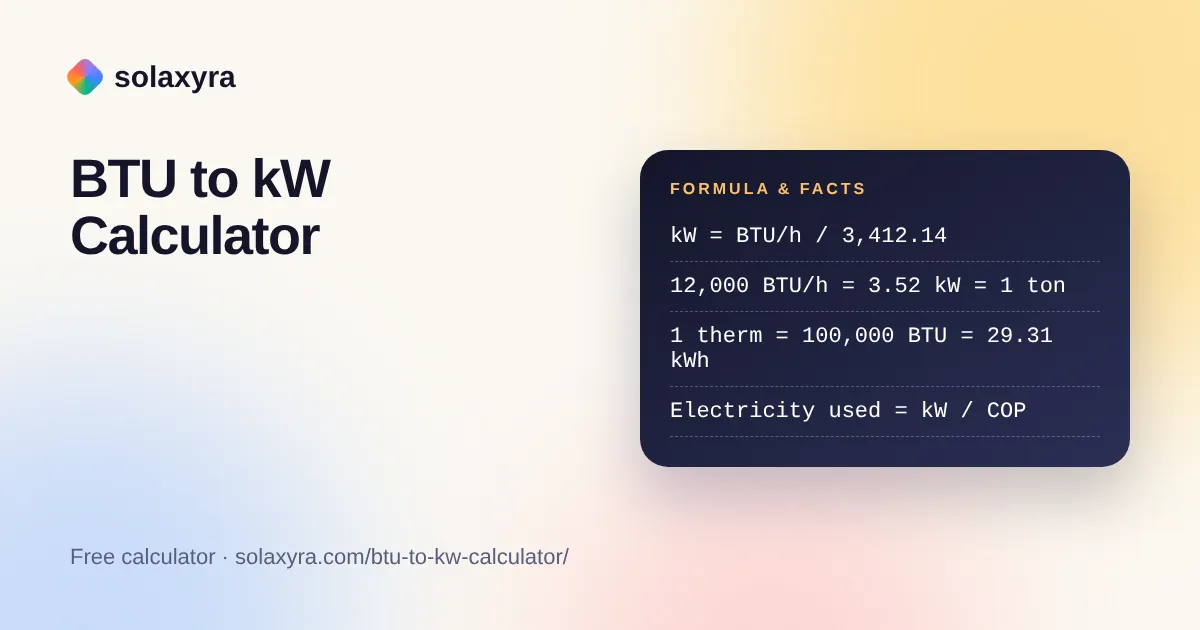
Quick answer: A BTU to kW calculator divides BTU per hour by 3,412.14 to give kilowatts, because one kilowatt equals 3,412.14 BTU/h. A 12,000 BTU/h air conditioner is 3.52 kW of cooling, and 9,000 BTU/h is 2.64 kW. For energy, 3,412.14 BTU make one kWh and one therm is 29.31 kWh.
What Is a BTU to kW Calculator?
A BTU to kW calculator is a tool that converts a power rating in British thermal units per hour into kilowatts, the unit used on UK and European appliance labels and energy bills. In plain words: kW equals BTU/h divided by 3,412.14, and BTU/h equals kW multiplied by 3,412.14.
The Wikipedia article on the British thermal unit defines the International Table BTU as about 1,055.06 joules and gives 1 W as about 3.412142 BTU/h. Several slightly different BTU definitions exist (the thermochemical BTU is about 1,054.35 J), but the differences are under 0.1% and do not matter for sizing heaters or air conditioners. This btu to kw calculator uses the International Table value.
How Do You Use the BTU to kW Calculator?
- Choose Power for appliance ratings (BTU/h, kW) or Energy for amounts of heat (BTU, kWh, therms).
- Enter the value and choose the unit it is in. The result switches direction automatically: BTU in gives kW out, kW in gives BTU out.
- For running costs, enter the efficiency or COP. Use 1 for a direct electric heater, or the rated COP or EER (in W/W) for a heat pump or air conditioner.
- Enter your electricity unit price in pence per kWh. The default is the Ofgem price cap rate for direct debit customers from 1 October to 31 December 2026, which carries no VAT on electricity until 31 March 2027.
- Enter hours of use per day to see a daily cost at full output.

How Many kW Is 12,000 BTU?
12,000 BTU/h is 3.52 kW, because 12,000 / 3,412.14 = 3.517. It is also exactly one ton of refrigeration, the US cooling unit that Wikipedia gives as 12,000 BTU/h or 3.52 kW. Air conditioners sold in the UK often carry both figures, for example "12,000 BTU" in the product name and 3.5 kW cooling capacity on the energy label.
The table converts common ratings and adds the cost per hour at full output, using the October to December 2026 cap price of 26.32p per kWh: once for a direct electric heater (COP 1) and once for a heat pump or air conditioner with an example COP of 3.
| BTU/h | kW | Tons | Cost per hour at COP 1 | Cost per hour at COP 3 (example) |
|---|---|---|---|---|
| 2,000 | 0.59 | 0.17 | 15.4p | 5.1p |
| 5,000 | 1.47 | 0.42 | 38.6p | 12.9p |
| 7,000 | 2.05 | 0.58 | 54.0p | 18.0p |
| 9,000 | 2.64 | 0.75 | 69.4p | 23.1p |
| 12,000 | 3.52 | 1.00 | 92.6p | 30.9p |
| 18,000 | 5.28 | 1.50 | 138.8p | 46.3p |
| 24,000 | 7.03 | 2.00 | 185.1p | 61.7p |
These are worst-case figures at full rated output. A thermostat or inverter compressor cuts back once the room reaches temperature, so real hourly costs are usually lower. To cost a heater from its watts instead, the electric heater running cost calculator adds a thermostat duty cycle.
Is BTU the Same as BTU per Hour?
No: a BTU is an amount of energy, while BTU per hour (BTU/h or BTUH) is a rate of energy, which is power. Appliance ratings such as "9,000 BTU" almost always mean 9,000 BTU/h, so they convert to kW. A gas bill or fuel quantity in BTU or therms is energy, so it converts to kWh. Mixing the two is the most common conversion mistake.
The same split exists in metric units: kW is power and kWh is energy. The watts to kWh calculator turns a power rating into energy over a number of hours, which is the step between a kW rating and a cost.
How Do You Convert BTU to kWh?
Divide BTU by 3,412.14 to get kWh: 100,000 BTU is 29.31 kWh. Wikipedia notes that the therm, used in US and older UK gas pricing, represents 100,000 BTU, so one therm is also 29.31 kWh. One kWh is 3.6 MJ, which links these units to the megajoules used for gas calorific values on UK bills.
Use Energy mode with an efficiency to see how much fuel or electricity you buy to deliver that heat. A boiler or heater with an efficiency below 1 needs more input energy than the heat it delivers; a heat pump with a COP above 1 needs less.
Why Does COP Change the Running Cost of a BTU Rating?
The BTU or kW rating of a heat pump or air conditioner is its heat output, not its electricity use: divide the output by the COP to get the electrical input. A 3.52 kW (12,000 BTU/h) unit with a COP of 3 draws about 1.17 kW, a third of what a 3.52 kW electric heater uses for the same heat. Manufacturers state COP or EER at specific test temperatures, and real values fall as the outdoor temperature drops.
For whole-home heating, the heat pump running cost calculator compares annual costs with a gas boiler using seasonal efficiency rather than a single test point.
How Many BTU Do I Need for a Room?
A room needs enough output to replace the heat it loses on a cold day, which depends on its size, insulation, windows and the outside temperature, so there is no single BTU per square metre figure that suits every home. Work out the heat loss in watts first, then convert to BTU/h if the product you are comparing uses that unit. Radiators sold in the UK usually list output in both watts and BTU/h, often at a stated temperature difference.
Gas boilers, gas fires and fixed heating must be installed by a Gas Safe registered engineer in the UK, and wired heaters or air conditioners by a qualified electrician working to BS 7671.
Worked Example: Running a 9,000 BTU Portable Air Conditioner
Example: a top-floor flat in London uses a portable air conditioner rated at 9,000 BTU/h of cooling, with a stated EER of 2.6 W/W, for 5 hours on hot afternoons. Electricity costs the cap rate of 26.32p per kWh.
- Cooling power: 9,000 / 3,412.14 = 2.64 kW.
- Electricity drawn: 2.64 / 2.6 = 1.01 kW.
- Cost per hour at full output: 1.01 kW x 26.32p = 26.7p.
- Cost per day: 26.7p x 5 h = £1.34.
- Over 20 hot days: about £26.70, less if the thermostat cycles the compressor.
Frequently Asked Questions
How do I convert BTU to kW?
Divide the BTU per hour figure by 3,412.14. For example, 18,000 BTU/h divided by 3,412.14 is 5.28 kW. To go the other way, multiply kilowatts by 3,412.14, so a 2 kW heater is about 6,824 BTU/h.
How many BTU is 1 kW?
One kilowatt is 3,412.14 BTU per hour, and one kilowatt-hour is 3,412.14 BTU. The figure comes from the International Table BTU of about 1,055.06 joules, and it is often rounded to 3,412 for everyday use.
Is 9,000 BTU enough to cool a room?
9,000 BTU/h is 2.64 kW of cooling, a common size for portable units aimed at single rooms. Whether it is enough depends on the room size, sun on the windows, insulation and how many people and devices add heat, so check the manufacturer's room guidance as well.
What is the difference between BTU and BTU/h?
A BTU is a quantity of energy, about 1,055 joules. BTU/h is a rate, so it measures power. Appliance ratings use BTU/h even when written as "BTU", and they convert to kilowatts. Fuel amounts in BTU or therms convert to kilowatt-hours instead.
How many kWh is a therm?
One therm is 100,000 BTU, which is 29.31 kWh. To convert a gas price per therm to pence per kWh, divide it by 29.31. UK gas bills now show usage in kWh after converting the volume on your meter with the calorific value.
Does a higher BTU rating cost more to run?
For a direct electric heater, yes: running cost rises in line with the BTU or kW rating. For a heat pump or air conditioner, divide the rating by the COP or EER to find the electricity used, so an efficient larger unit can cost less to run than an inefficient smaller one.
Checked October 2026 by the Solaxyra Editorial Team. Sources: Wikipedia: British thermal unit, Ofgem: Changes to the energy price cap, 1 October to 31 December 2026.