Comparison rows use your power factor. This is a power conversion, not a cable, fuse or breaker rating; circuits must be designed by a qualified electrician (UK: BS 7671).
Formula and breakdown
n/a
n/a
This tool converts a current in amps into real power in kilowatts for DC, single-phase and three-phase circuits, set up for UK and European supplies (230 V and 400 V) with 120 V and 240 V alongside. The amps to kW calculator also gives apparent power in kVA, reactive power in kVAr, and the energy and cost of an hour of use, so you can see what a fuse, plug or charger rating means in power and in money.
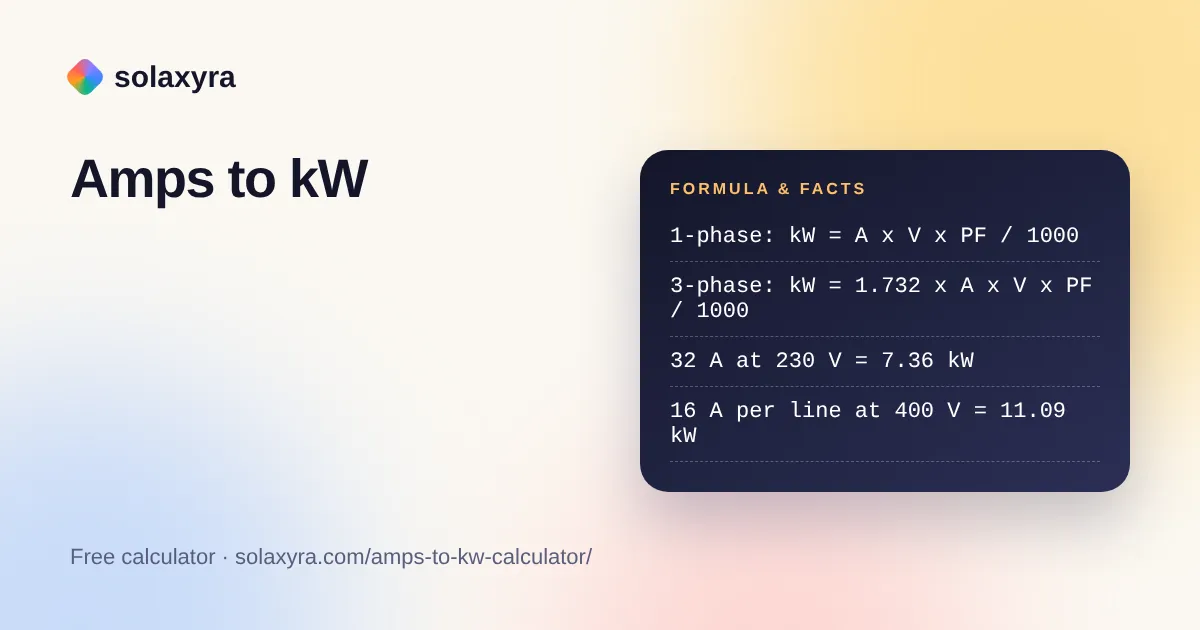
Quick answer: An amps to kW calculator multiplies current by voltage and power factor, then divides by 1,000. On 230 V single-phase, 10 A at power factor 1 is 2.3 kW. On 400 V three-phase, multiply by 1.732 as well: 16 A per line gives 11.09 kW. For DC, kW equals amps times volts divided by 1,000.
What Is an Amps to kW Calculator?
An amps to kW calculator is a tool that turns a measured or rated current into the real power, in kilowatts, that a load draws at a given voltage and phase. In plain words: multiply amps by volts to get volt-amperes, multiply by the power factor to get watts of real power, and divide by 1,000 for kilowatts. On a balanced three-phase supply, multiply by the square root of 3 (1.732) when you use the line to line voltage, or by 3 when you use the line to neutral voltage.
The power factor is the share of the current that does useful work. Heaters, kettles, immersion elements and most EV chargers have a power factor close to 1. Motors, compressors and some power supplies draw extra current that flows back and forth without delivering energy, so their power factor is lower and the same amps give fewer kW. The power factor is the ratio of real power (kW) to apparent power (kVA).
How Do You Use the Amps to kW Calculator?
- Choose single-phase AC (most homes), three-phase AC (commercial premises and some homes) or DC (batteries, solar strings, vehicles).
- Enter the current in amps. For three-phase, enter the current in each line.
- Choose the voltage. For three-phase, say whether it is the line to line value (400 V) or the line to neutral value (230 V).
- Enter the power factor from the rating plate, or keep 1 for resistive loads.
- Optionally enter your unit price to see the energy and cost of running the load for one hour.
- Read kW, kVA and kVAr, and compare the same current on the other common supplies.
How Many kW Is 32 Amps?
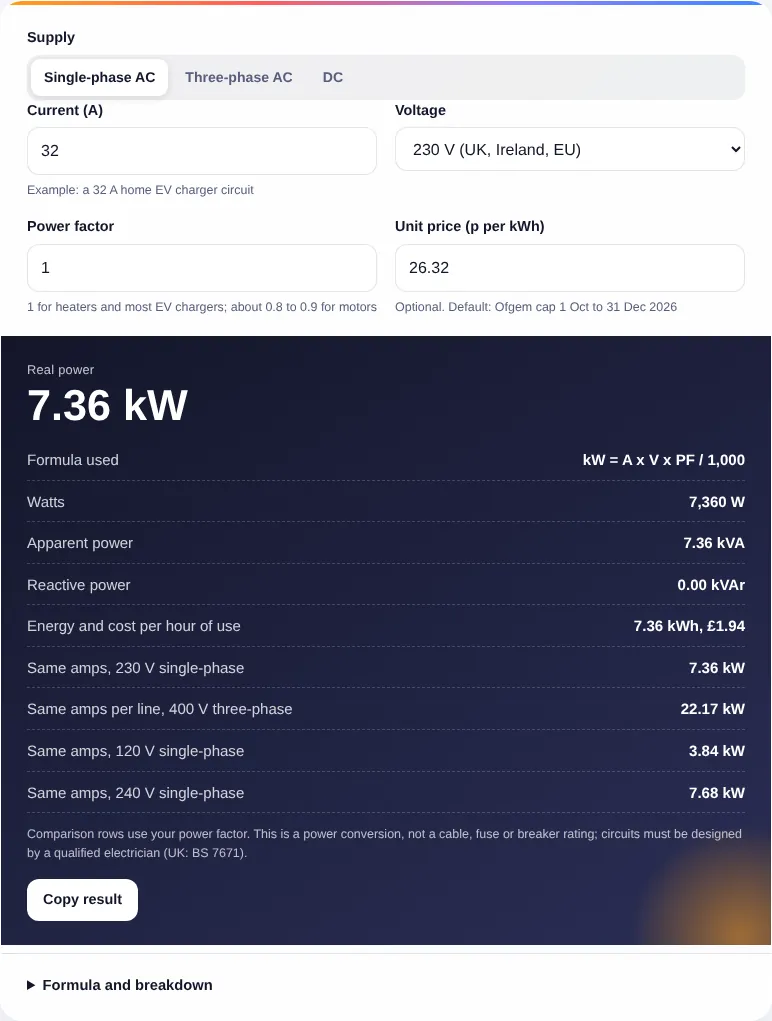
32 A on a 230 V single-phase supply is 7.36 kW at a power factor of 1, which is why home EV chargers on a 32 A circuit are sold as 7.4 kW units. The same 32 A per line on a 400 V three-phase supply delivers 22.17 kW, three times the line to neutral power. At 240 V, 32 A is 7.68 kW, and at 120 V it is 3.84 kW. Running a 7.36 kW load for an hour uses 7.36 kWh, which costs about £1.94 at the Ofgem cap rate of 26.32p per kWh.
How Many kW Can a 13 Amp Plug Supply?
A 13 A plug on a 230 V supply can deliver up to about 2.99 kW at a power factor of 1, because 13 x 230 = 2,990 W. BS 1363 plugs and sockets are rated at 13 A, and the plug fuse can be up to 13 A. That is why the largest kettles and heaters sold for UK plugs are rated around 3 kW. Anything bigger, such as an electric shower, cooker or fast EV charger, needs its own fixed circuit installed by a qualified electrician.
Why Does Three-Phase Give More kW for the Same Amps?
A balanced three-phase supply delivers about 3 times the power of one phase for the same current per line, because each of the three lines carries that current at the phase voltage. Written with the line to line voltage, the factor becomes √3 x 400 V, since 400 V is √3 times 230 V. The two forms, both offered in the amps to kW calculator, give almost the same answer: 3 x 16 A x 230 V = 11.04 kW, while 1.732 x 16 A x 400 V = 11.09 kW. The small gap exists because 400 V is a rounded value of 230 x 1.732 = 398 V.
The harmonised European standard sets nominal values of 230 V and 400 V, replacing the old 240/415 V and 220/380 V systems, as described on Wikipedia's mains electricity by country page.
What Is the Difference Between kW and kVA?
kW is real power that does work; kVA is apparent power, the voltage times the current the supply must carry, and kW = kVA x power factor. A motor drawing 30 A at 230 V with a power factor of 0.85 uses 5.87 kW of real power but loads the supply with 6.90 kVA. Generators, UPS units and transformers are rated in kVA for this reason. The kVA to kW calculator and the power factor calculator go into this in more depth.
Amps to kW Conversion Table
Real power for common currents, as the amps to kW calculator works it out. Three-phase values are per line current at 400 V line to line.
| Current (A) | 230 V single-phase, PF 1 | 240 V single-phase, PF 1 | 400 V three-phase, PF 1 | 400 V three-phase, PF 0.85 |
|---|---|---|---|---|
| 1 | 0.23 kW | 0.24 kW | 0.69 kW | 0.59 kW |
| 6 | 1.38 kW | 1.44 kW | 4.16 kW | 3.53 kW |
| 10 | 2.30 kW | 2.40 kW | 6.93 kW | 5.89 kW |
| 13 | 2.99 kW | 3.12 kW | 9.01 kW | 7.66 kW |
| 16 | 3.68 kW | 3.84 kW | 11.09 kW | 9.42 kW |
| 20 | 4.60 kW | 4.80 kW | 13.86 kW | 11.78 kW |
| 32 | 7.36 kW | 7.68 kW | 22.17 kW | 18.84 kW |
| 40 | 9.20 kW | 9.60 kW | 27.71 kW | 23.56 kW |
| 63 | 14.49 kW | 15.12 kW | 43.65 kW | 37.10 kW |
| 100 | 23.00 kW | 24.00 kW | 69.28 kW | 58.89 kW |
Worked Example: A Three-Phase Workshop Compressor
Example: a workshop compressor on a 400 V three-phase supply draws 12 A per line, and its rating plate gives a power factor of 0.82.
- Choose Three-phase AC and line to line voltage, 400 V.
- Real power: 1.732 x 12 x 400 x 0.82 / 1,000 = 6.82 kW.
- Apparent power: 6.82 / 0.82 = 8.31 kVA.
- Reactive power: √(8.31² minus 6.82²) = 4.76 kVAr.
- Cost per hour at 26.32p per kWh: 6.82 x 26.32p = about £1.79 while it runs flat out.
To go the other way, from a power rating to the current a circuit must carry, use the kW to amps calculator. If you only need watts for small loads, the amps to watts converter is quicker, and the three-phase power calculator adds phase voltage options. For apparent power alone, see the amps to kVA calculator.
Can I Use This Result to Size a Cable or Breaker?
No: the amps to kW calculator converts current to power and does not size cables, fuses or breakers. Circuit design depends on cable type, installation method, length, grouping, ambient temperature, voltage drop and fault protection. In the UK, new circuits and changes to fixed wiring must be designed and installed by a qualified electrician to BS 7671, and elsewhere to the local wiring rules. Do not open consumer units or connect loads to fixed wiring yourself.
Frequently Asked Questions
How do I convert amps to kW for single-phase?
Multiply amps by volts and by the power factor, then divide by 1,000. At 230 V and power factor 1, 20 A gives 20 x 230 / 1,000 = 4.6 kW. With a power factor of 0.9 the same current gives 4.14 kW of real power.
How do I convert amps to kW for three-phase?
Multiply the line current by 1.732, the line to line voltage and the power factor, then divide by 1,000. For 25 A per line at 400 V and power factor 0.9: 1.732 x 25 x 400 x 0.9 / 1,000 = 15.59 kW. With line to neutral voltage, multiply by 3 instead of 1.732.
How many kW is 100 amps?
100 A is 23 kW at 230 V single-phase and 24 kW at 240 V, with a power factor of 1. On a 400 V three-phase supply, 100 A per line is 69.28 kW. These are power conversions, not the safe continuous load of any particular supply or circuit.
How do I convert DC amps to kW?
Multiply amps by the DC voltage and divide by 1,000; there is no power factor. A 48 V battery delivering 100 A supplies 4.8 kW. A 12 V system at 100 A supplies only 1.2 kW, which is why larger battery systems use higher voltages.
Why does my clamp meter reading give a different kW figure?
Clamp meters measure current, not power factor, and the real supply voltage varies around the 230 V nominal value. Loads such as fridges and heat pumps also cycle and draw a surge at start. Use the rating plate power factor and an average current for a fair estimate.
Is kW the same as kWh?
No. kW is power, the rate of energy use at a moment, while kWh is energy over time. A 2.3 kW load running for two hours uses 4.6 kWh. The calculator shows the kWh used per hour of running so you can price it at your tariff.
Checked October 2026 by the Solaxyra Editorial Team. Sources: Wikipedia, Power factor, Wikipedia, Three-phase electric power, Wikipedia, Mains electricity by country, Wikipedia, BS 1363, Ofgem, price cap October to December 2026.