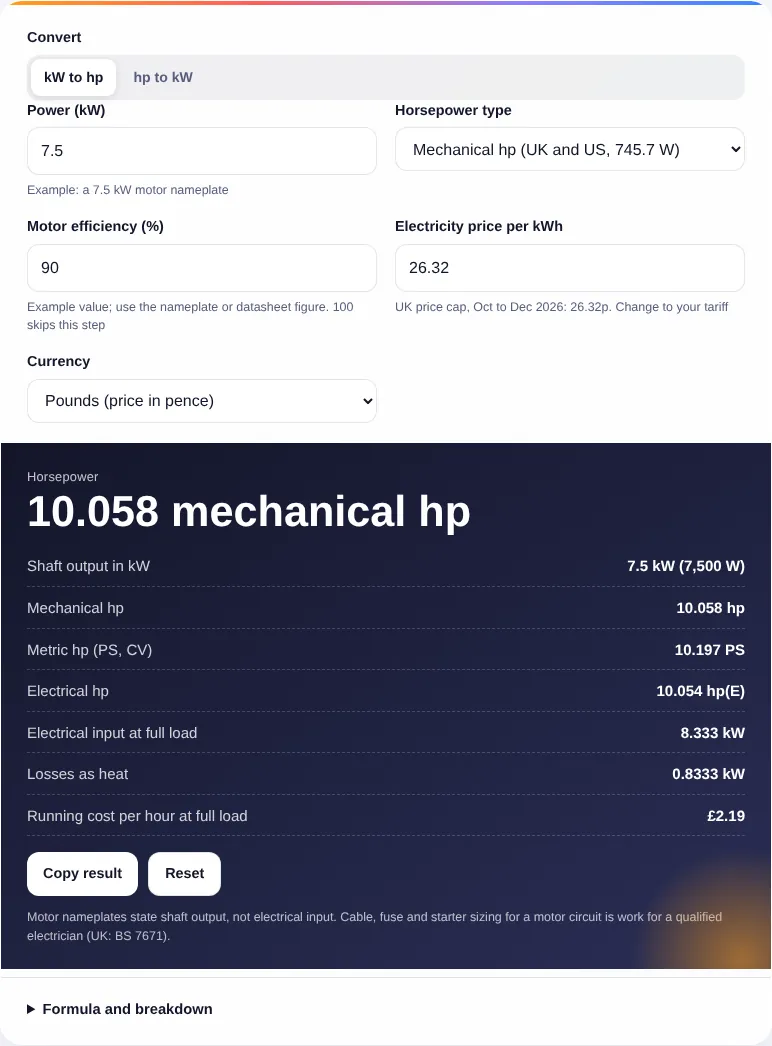
Motor nameplates state shaft output, not electrical input. Cable, fuse and starter sizing for a motor circuit is work for a qualified electrician (UK: BS 7671).
Formula and breakdown
n/a
n/a
This kW to hp calculator converts kilowatts to horsepower and back for motors, pumps, compressors, generators and cars, using the mechanical horsepower common in the UK and US, the metric horsepower (PS) used across Europe, or electrical horsepower. It also turns a motor’s rated output into the electrical input it draws, the heat it loses and what it costs to run per hour.
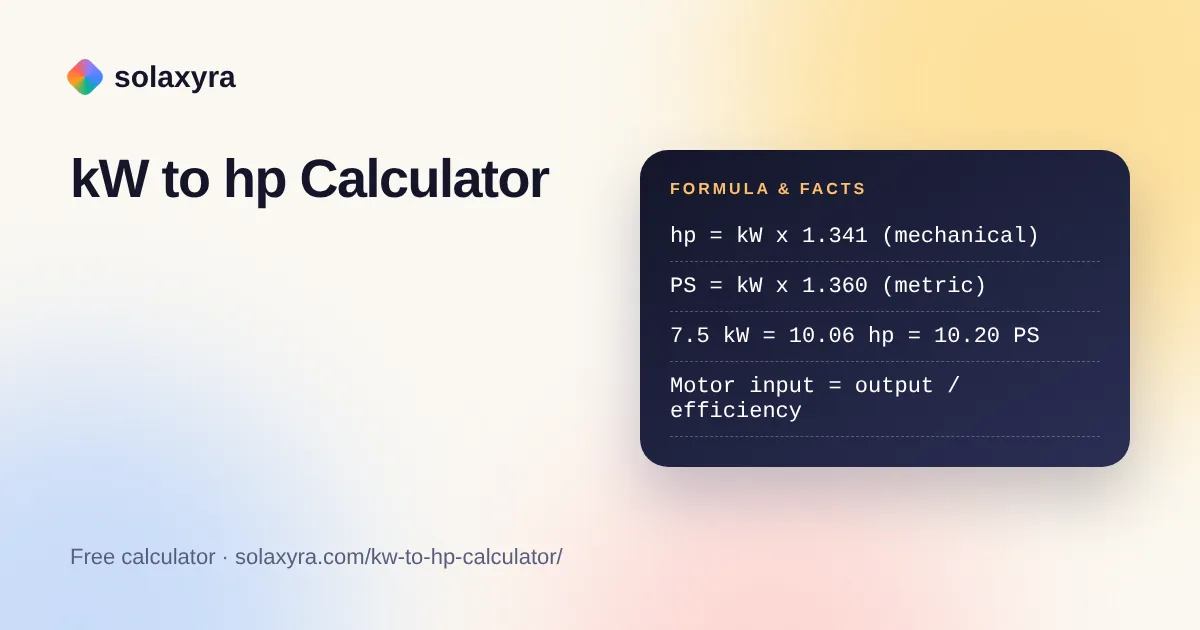
Quick answer: A kW to hp calculator multiplies kilowatts by 1.341 for mechanical horsepower or by 1.360 for metric horsepower (PS). So 7.5 kW is 10.06 hp or 10.20 PS, and 100 kW is 134.1 hp or 136.0 PS. Going back, 1 hp is 0.7457 kW and 1 PS is 0.7355 kW.
What Is a kW to hp Calculator?
A kW to hp calculator is a tool that converts power in kilowatts into horsepower by dividing the watts by the number of watts in one horsepower of the chosen type. In plain words: hp = kW x 1,000 / 745.7 for mechanical horsepower, and PS = kW x 1,000 / 735.5 for metric horsepower.
The Wikipedia article on horsepower defines mechanical horsepower as 550 foot-pounds per second, which is 745.69987 W, metric horsepower as 75 kilogram-force metres per second, which is 735.49875 W or 98.6% of a mechanical horsepower, and electrical horsepower as exactly 746 W. The kw to hp calculator uses these exact values, so its results match to every decimal place shown.
How Do You Use the kW to hp Calculator?
- Choose the direction: kW to hp, or hp to kW.
- Enter the power. For a motor, use the rating on its nameplate.
- Choose the horsepower type: mechanical for most UK and US motors and engines, metric (PS or CV) for European car figures, or electrical.
- For an electric motor, enter its efficiency from the nameplate or datasheet; use 100% to skip this step.
- Check the price per kWh, which defaults to the UK price cap rate.
- Read the result in all three horsepower types, the electrical input, the losses and the cost per hour at full load.
How Many hp Is 1 kW?
One kilowatt is 1.341 mechanical horsepower, 1.360 metric horsepower or 1.340 electrical horsepower. The reverse factors are 0.7457 kW per mechanical hp, 0.7355 kW per PS and 0.746 kW per electrical hp. The table converts a range of motor and engine ratings.
| kW | Mechanical hp | Metric hp (PS) | Electrical hp |
|---|---|---|---|
| 0.37 | 0.50 | 0.50 | 0.50 |
| 0.75 | 1.01 | 1.02 | 1.01 |
| 1.5 | 2.01 | 2.04 | 2.01 |
| 2.2 | 2.95 | 2.99 | 2.95 |
| 4 | 5.36 | 5.44 | 5.36 |
| 7.5 | 10.06 | 10.20 | 10.05 |
| 15 | 20.12 | 20.39 | 20.11 |
| 22 | 29.50 | 29.91 | 29.49 |
| 100 | 134.10 | 135.96 | 134.05 |
For small ratings the three types round to the same figure, but the gap grows with size: at 100 kW, metric and mechanical horsepower differ by almost 2 hp. Boiler horsepower is a different, much larger unit for steam boilers, around 9.8 kW, and should not be mixed with the others.
What Is the Difference Between hp and PS?
hp in the UK and US usually means mechanical horsepower of 745.7 W, while PS (Pferdestärke) is the metric horsepower of 735.5 W used for European car figures, also written CV, ch or pk in other languages. So a car rated 150 PS has about 148 mechanical hp, and the two numbers should not be compared directly.
Wikipedia notes that EU Directive 80/181/EEC has allowed horsepower only as a supplementary unit in the EU since 1 January 2010, which is why kW is the main unit in Europe, with PS or hp often given alongside it. Whichever unit a figure uses, check which horsepower it means before comparing two machines.
Is a Motor’s kW Rating Input or Output Power?
It is output: according to the Wikipedia horsepower article, electric motor nameplates show the shaft power the motor can deliver, not the electrical power it takes in. The input is always higher, by the motor’s losses, so divide the rated output by the efficiency to get the power drawn at full load.
Example: a 7.5 kW motor at 90% efficiency draws 7.5 / 0.9 = 8.33 kW, and the extra 0.83 kW becomes heat. That input figure is what sets the current, so carry it into the kW to amps calculator or, for a three-phase supply, the three-phase power calculator. Motors also draw reactive power, which the power factor calculator covers. Cables, protective devices and starters for a motor circuit must be selected by a qualified electrician; in the UK the work must meet BS 7671.
How Much Does a Motor Cost to Run per Hour?
Multiply the electrical input in kW by the price per kWh: a 7.5 kW motor drawing 8.33 kW at full load costs 8.33 x 26.32p = £2.19 an hour at the Ofgem price cap rate of 26.32p per kWh for October to December 2026. Business tariffs differ, so enter your own rate.
The figure is an upper estimate, because most motors spend much of their time below full load and draw less. For a running cost based on measured kWh, use the electricity cost calculator with the metered figure.
Worked Example: Sizing Up a Workshop Compressor
Example: a farm workshop compares an air compressor advertised as 15 hp with one rated 11 kW. The motor datasheet for the 11 kW unit gives an efficiency of 91% (example value, use your own datasheet).
- 11 kW in mechanical horsepower: 11 x 1,000 / 745.7 = 14.75 hp, so it is slightly smaller than the 15 hp unit, which is 15 x 0.7457 = 11.19 kW.
- Electrical input at full load: 11 / 0.91 = 12.09 kW.
- Losses as heat: 12.09 minus 11 = 1.09 kW.
- Cost per hour at 26.32p: 12.09 x 26.32 = 318.2p, or £3.18.
- Six hours at full load in a day would cost about £19.09; real use at part load will cost less.
Frequently Asked Questions
How many hp is 1 kW?
1 kW is 1.341 mechanical horsepower, 1.360 metric horsepower (PS) or 1.340 electrical horsepower. The figures differ because each horsepower has its own definition in watts: 745.7 W for mechanical, 735.5 W for metric and exactly 746 W for electrical.
What is the difference between hp and PS?
hp usually means mechanical horsepower, defined as 550 foot-pounds per second, or about 745.7 W. PS is metric horsepower, defined as 75 kilogram-force metres per second, or 735.5 W, about 98.6% of a mechanical horsepower. European car figures are usually given in PS alongside kW.
How do I convert hp to kW?
Multiply mechanical horsepower by 0.7457, or metric horsepower (PS) by 0.7355. A 150 PS car engine is 150 x 0.7355 = 110.3 kW, and a 10 hp motor is 7.457 kW. The calculator does both directions and shows all three horsepower types.
Is a motor’s kW rating its input or output?
Output. Electric motor nameplates show the shaft power the motor can deliver, not the electricity it draws. The input is higher by the losses: divide the output by the efficiency. A 7.5 kW motor at 90% efficiency draws about 8.33 kW from the supply at full load.
How much does it cost to run a 1 hp motor?
A 1 hp motor delivers 0.7457 kW. At 80% efficiency it draws about 0.93 kW at full load, which costs about 24.5p an hour at the UK price cap of 26.32p per kWh. Motors running below full load draw less, so this is an upper estimate.
Why do cars in Europe use kW instead of hp?
The kilowatt is the SI unit of power, and under EU Directive 80/181/EEC horsepower has been allowed only as a supplementary unit since 1 January 2010. That is why kW is the main unit in Europe, with PS or hp often given alongside it.
Checked October 2026 by the Solaxyra Editorial Team. Sources: Wikipedia: Horsepower, Ofgem: Energy price cap, 1 October to 31 December 2026.