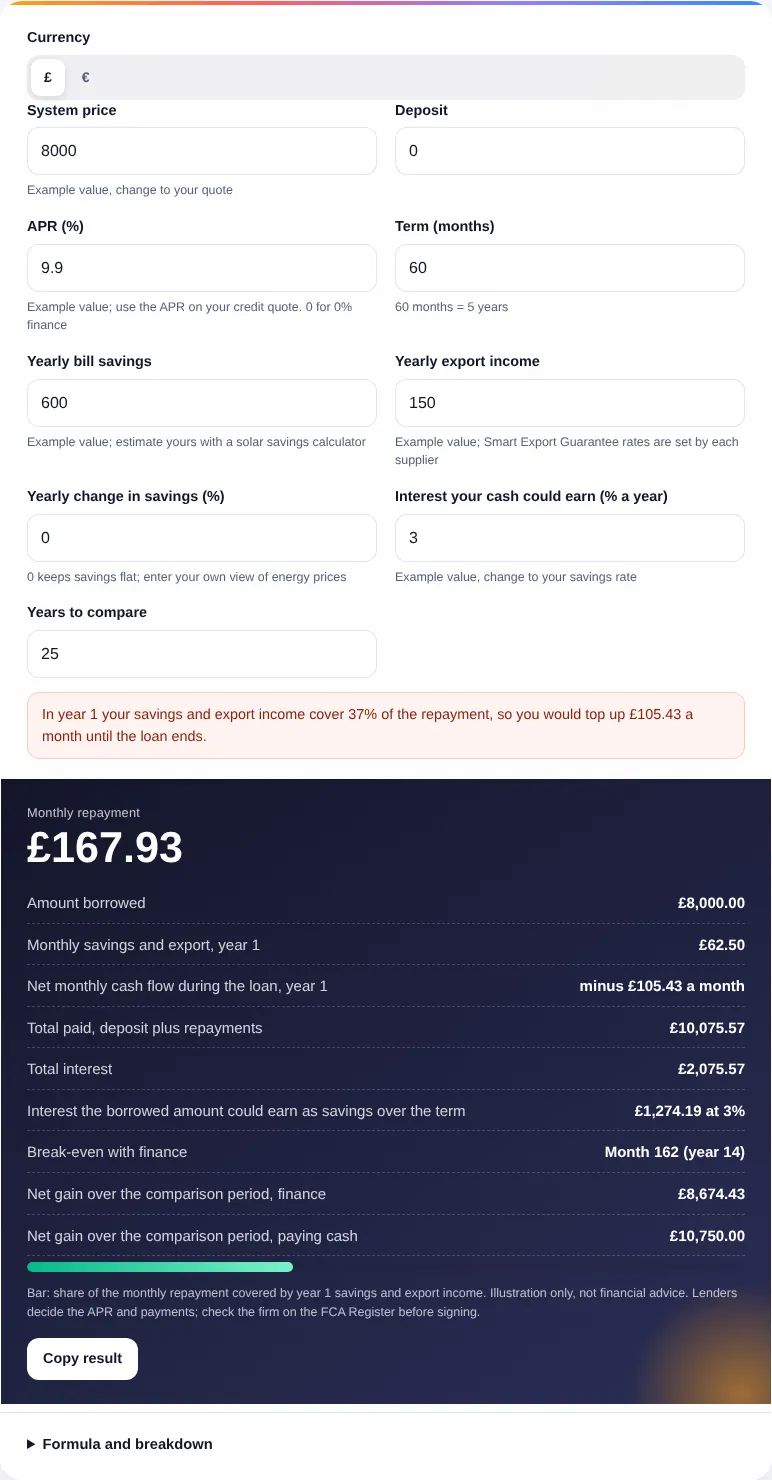
Bar: share of the monthly repayment covered by year 1 savings and export income. Illustration only, not financial advice. Lenders decide the APR and payments; check the firm on the FCA Register before signing.
Formula and breakdown
n/a
n/a
n/a
This tool works out the monthly repayment, total interest and break-even point for solar panels or a home battery bought on a loan or a finance plan, for households in the UK, Ireland and the rest of Europe. The solar finance calculator converts the APR on your quote into a monthly rate the way the regulated APR definition requires, then sets the repayment against your bill savings and export income, so you can see the monthly gap during the loan and the long-run cost of borrowing compared with paying cash.
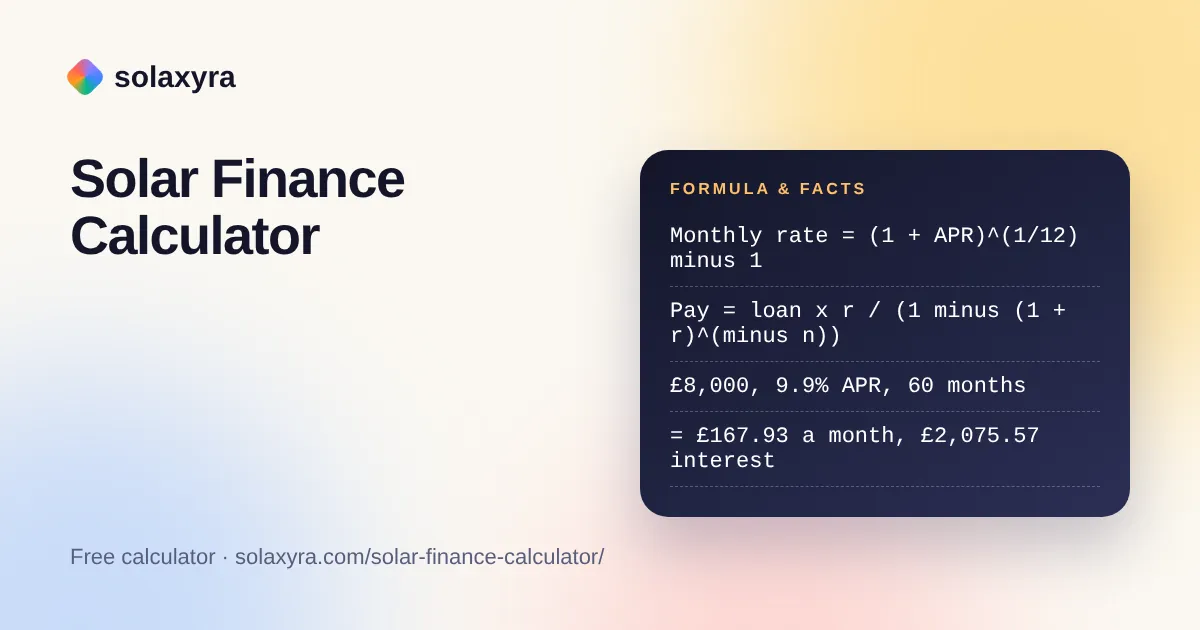
Quick answer: A solar finance calculator turns the APR into a monthly rate, r = (1 + APR)^(1/12) minus 1, then applies payment = loan x r / (1 minus (1 + r)^(minus n)). Example: £8,000 at 9.9% APR over 60 months costs £167.93 a month and £2,075.57 in interest.
What Is a Solar Finance Calculator?
A solar finance calculator is a tool that estimates the repayments on a solar or battery loan and compares them with the money the system saves. In plain words: subtract any deposit from the price to get the loan, turn the APR into a monthly rate, spread the loan and interest over equal monthly payments, then subtract those payments from your monthly bill savings and export income to see your net cash flow.
The solar finance calculator gives an illustration, not financial advice. The lender sets the APR, fees and payments after checking your circumstances, and the binding figures are the ones in the credit agreement. Before you sign, check that the lender or broker is authorised on the FCA Financial Services Register.
How Do You Use the Solar Finance Calculator?
- Enter the system price from your quote and any deposit.
- Enter the APR shown on the credit quote, or 0 for interest-free finance, and the term in months.
- Enter your yearly bill savings and export income. If you do not know them, estimate them with the solar savings calculator and the Smart Export Guarantee calculator first.
- Optionally set a yearly change in savings, the interest your cash could earn instead, and the number of years to compare.
- Read the monthly repayment, the net monthly cash flow, the total interest, the break-even month and the long-run gain with finance and with cash.
How Is the Monthly Payment on Solar Finance Calculated?
The monthly payment is the loan times the monthly rate, divided by 1 minus (1 + monthly rate) to the power of minus the number of months. The monthly rate comes from the APR. Under the FCA’s APR rules, the APR is calculated on an annual basis so that the present value of the money lent equals the present value of the repayments and charges. That makes it an annual effective rate, so the matching monthly rate is (1 + APR)^(1/12) minus 1, not APR divided by 12.
The difference is small but real. At 9.9% APR the correct monthly rate is 0.7898%, while 9.9 / 12 gives 0.825%. On £8,000 over 60 months that is £167.93 against £169.58 a month. Lenders’ quoted payments can still differ from the solar finance calculator by a few pence or pounds because of fees included in the APR and the way they count days, so always use the figure on your credit agreement.
Do Solar Savings Cover the Finance Repayments?
Often not during the loan: a typical repayment on a five year term is higher than the monthly bill savings plus export income, so most households top up each month until the loan ends and gain afterwards. In the default example, savings and export income of £750 a year are £62.50 a month against a £167.93 repayment, so the household pays about £105 a month extra for five years. After the last payment, the full £62.50 a month is a gain, and the purchase breaks even in month 162, during year 14.
Longer terms cut the monthly payment but raise the total interest. Bigger deposits, lower APRs and higher self-consumption (for example with a battery, see the home battery savings calculator) bring the cash flow closer to neutral. Export rates are set by each supplier: Ofgem’s SEG rules say suppliers determine the rate and terms, and the rate must always be above zero.
Is It Better to Finance Solar Panels or Pay Cash?
Paying cash always costs less in total, by exactly the loan interest, but finance can still make sense if you do not have the cash or if the cash earns more elsewhere than the loan costs. The solar finance calculator shows both sides: the total interest on the loan, and the interest the amount you would borrow could earn as savings over the loan term at the rate you enter.
At 9.9% APR on £8,000 over five years, the loan interest is £2,075.57, while £8,000 left in savings at an example 3% a year would earn about £1,274.19 over the same five years. When a 0% finance offer is genuine and has no fees, borrowing and keeping your cash in savings comes out ahead.
For the full long-run picture, including panel degradation, use the solar payback calculator or the solar ROI calculator with the total you will actually pay.
Monthly Repayments on an £8,000 Solar Loan
Monthly payments from the solar finance calculator, using the APR method above, with no deposit and no separate fees. Interest columns show the total interest over the term.
| APR | 36 months | 60 months | 84 months | 120 months | Interest, 60 months | Interest, 120 months |
|---|---|---|---|---|---|---|
| 0% | £222.22 | £133.33 | £95.24 | £66.67 | £0.00 | £0.00 |
| 4.9% | £239.03 | £150.21 | £112.30 | £84.05 | £1,012.80 | £2,085.56 |
| 9.9% | £256.18 | £167.93 | £130.66 | £103.42 | £2,075.57 | £4,410.24 |
| 14.9% | £273.30 | £186.02 | £149.79 | £124.07 | £3,161.27 | £6,888.20 |
Worked Example: 0% Finance With a Deposit
Example: a household is offered £8,000 of solar panels with a £2,000 deposit and the rest on 0% finance over 24 months. It expects £600 a year in bill savings and £150 in export income, flat over time.
- Loan: £8,000 minus £2,000 = £6,000.
- Payment at 0%: £6,000 / 24 = £250.00 a month; total interest £0.00.
- Savings and export: £750 / 12 = £62.50 a month, so the net cash flow during the loan is minus £187.50 a month.
- Break-even: total outlay is £8,000, recovered at £62.50 a month in month 128, during year 11, the same as paying cash because there is no interest.
- Over 25 years: savings total £750 x 25 = £18,750, so the net gain is £18,750 minus £8,000 = £10,750 with finance or cash.
Keeping the £6,000 in savings at an example 3% a year for the two years would earn about £365, so a genuine fee-free 0% offer is worth taking if you can afford the £250 a month.
What Should You Check Before Signing Solar Finance?
Check the APR, the total amount payable, the term, any arrangement or early repayment fees, and whether the agreement is secured on your home, since those decide what the loan really costs. Also check:
- The lender or broker appears on the FCA Register, and you receive the pre-contract credit information before signing.
- The system price is competitive with a cash quote; finance should not inflate the price.
- VAT is correct. In Great Britain, solar panels and batteries installed in homes are zero-rated until 31 March 2027 and revert to 5% from 1 April 2027, according to HMRC VAT Notice 708/6.
- The installer is competent and certified for the work, and in the UK the electrical installation meets BS 7671.
- The savings figures in any sales illustration use your own electricity use and tariff, not optimistic assumptions.
If you are unsure whether borrowing suits your circumstances, speak to a regulated financial adviser or a free, impartial money guidance service before committing.
Frequently Asked Questions
How do I calculate the monthly payment on a solar loan?
Convert the APR to a monthly rate with (1 + APR) to the power 1/12, minus 1. Then payment = loan x rate / (1 minus (1 + rate) to the power minus months). For £8,000 at 9.9% APR over 60 months, that gives £167.93 a month.
Why should I not just divide the APR by 12?
Under UK consumer credit rules the APR is an annual effective rate, which already includes monthly compounding. Dividing it by 12 slightly overstates the monthly rate. At 9.9% APR the correct monthly rate is 0.7898%, not 0.825%, a difference of about £1.65 a month on £8,000 over five years.
Will solar panel savings cover my finance payments?
Sometimes, but often not on short terms. Compare your monthly bill savings plus export income with the repayment. Many households pay a monthly top-up during the loan and then keep all the savings after it ends. Longer terms lower the payment but add interest.
Is 0% solar finance really free?
A 0% APR means no interest, and because APR includes required charges, a genuine 0% offer should carry no compulsory fees either. Check the total amount payable equals the cash price and that the system price matches what you would pay in cash.
Does paying cash for solar panels save money?
Paying cash avoids loan interest, so it costs less in total. The trade-off is the interest your money could earn elsewhere. If your savings rate is lower than the loan APR, paying cash usually wins; with a genuine 0% offer, borrowing can come out ahead.
Is this calculator financial advice?
No. It is an illustration based on the figures you enter. Lenders set the APR and payments after assessing affordability, and the credit agreement is binding. For advice on your circumstances, speak to a regulated adviser and check any lender on the FCA Register.
Checked October 2026 by the Solaxyra Editorial Team. Sources: FCA Handbook, CONC App 1.2 APR calculation, FCA, Financial Services Register, GOV.UK, VAT Notice 708/6, Ofgem, Smart Export Guarantee, Wikipedia, Annual percentage rate.