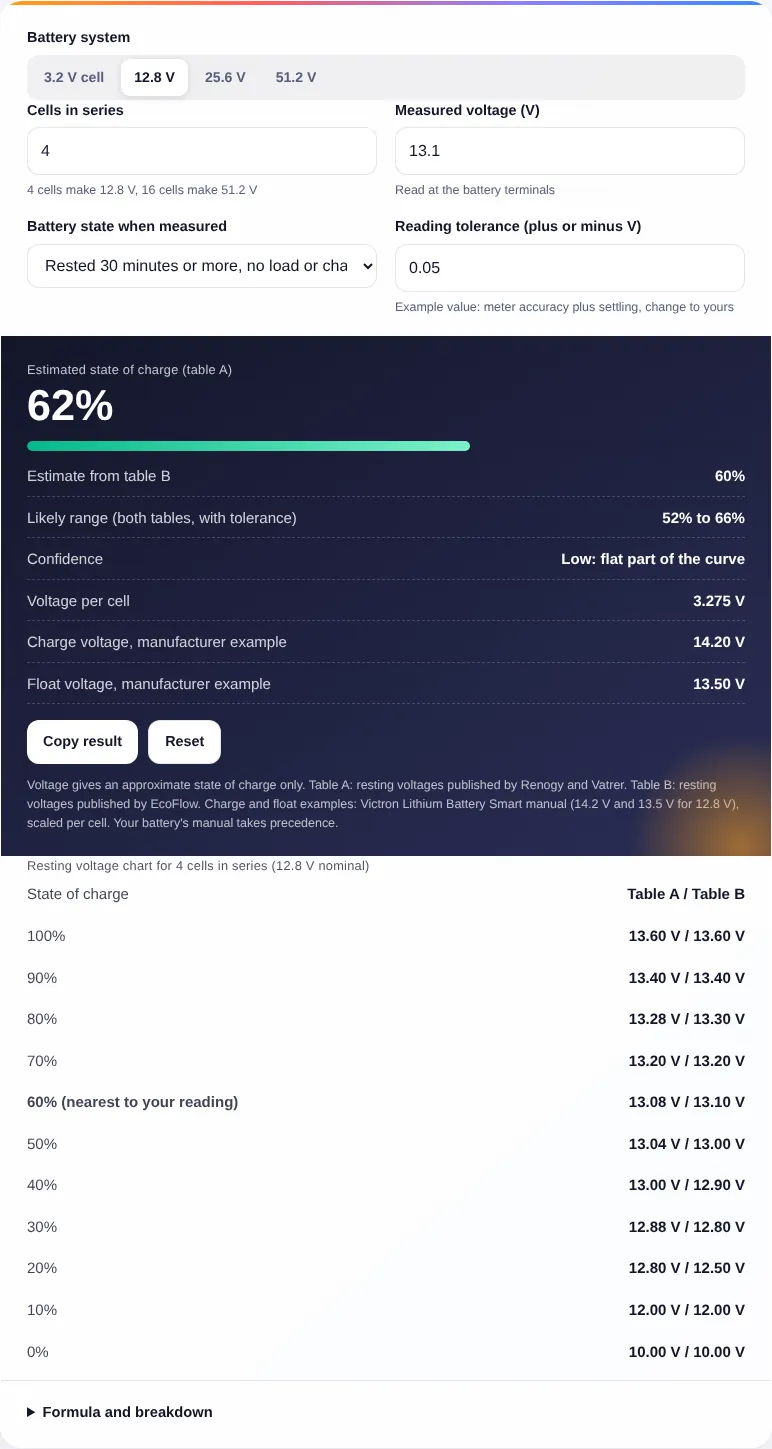
Voltage gives an approximate state of charge only. Table A: resting voltages published by Renogy and Vatrer. Table B: resting voltages published by EcoFlow. Charge and float examples: Victron Lithium Battery Smart manual (14.2 V and 13.5 V for 12.8 V), scaled per cell. Your battery’s manual takes precedence.
Formula and breakdown
n/a
n/a
n/a
This LiFePO4 voltage chart turns a voltage reading from a lithium iron phosphate battery into an estimated state of charge, for 3.2 V cells and 12.8 V, 25.6 V and 51.2 V batteries used in campervans, boats, off-grid cabins and home storage across the UK and Europe. It compares two manufacturer tables, shows a likely range for your meter’s tolerance and tells you how far to trust the answer.
Quick answer: A LiFePO4 voltage chart maps resting voltage to approximate charge. For a 12.8 V battery, about 13.6 V is full, 13.0 to 13.1 V is roughly half and 12.0 V is about 10%. Per cell that is 3.40, 3.25 to 3.27 and 3.00 V. The curve is flat, so treat mid-range readings as rough.

What Is a LiFePO4 Voltage Chart?
A LiFePO4 voltage chart is a table that links the resting voltage of a lithium iron phosphate battery to its approximate state of charge, from full at about 3.40 V per cell to empty at about 2.50 V per cell. To use it for a whole battery, multiply the per-cell figure by the number of cells in series.
The Wikipedia article on lithium iron phosphate batteries gives a nominal cell voltage of 3.2 V and explains that four cells in series make a nominal 12.8 V, close to a six-cell lead-acid battery. The same article warns against charging beyond about 3.6 V per cell and against discharging any cell below 2.5 V, which sets the top and bottom of every chart.
How Do You Use the LiFePO4 Voltage Chart?
- Pick your battery: a single 3.2 V cell, 12.8 V, 25.6 V or 51.2 V, or type the number of cells in series.
- Disconnect loads and chargers and let the battery rest for at least 30 minutes.
- Measure the voltage at the battery terminals and enter it.
- Set the battery state to rested, under load or charging, so the tool can judge the reading.
- Enter your meter’s tolerance; the example of 0.05 V covers a typical reading error plus some settling.
- Read the estimate from each table, the likely range and the confidence label. The chart below the result highlights the nearest row.
What Does Each Voltage Mean on a 12 V, 24 V and 48 V LiFePO4 Battery?
A 12.8 V LiFePO4 battery reads about 13.6 V at rest when full and about 12.0 V at 10%, with most of the capacity packed into the 12.8 to 13.4 V band. The table uses the resting values published by Renogy and Vatrer (table A in the tool), scaled by cell count, with EcoFlow’s 12.8 V values (table B) alongside for comparison.
| State of charge | Per cell | 12.8 V (4 cells) | 25.6 V (8 cells) | 51.2 V (16 cells) | 12.8 V, table B |
|---|---|---|---|---|---|
| 100% | 3.40 V | 13.60 V | 27.20 V | 54.40 V | 13.6 V |
| 90% | 3.35 V | 13.40 V | 26.80 V | 53.60 V | 13.4 V |
| 80% | 3.32 V | 13.28 V | 26.56 V | 53.12 V | 13.3 V |
| 70% | 3.30 V | 13.20 V | 26.40 V | 52.80 V | 13.2 V |
| 60% | 3.27 V | 13.08 V | 26.16 V | 52.32 V | 13.1 V |
| 50% | 3.26 V | 13.04 V | 26.08 V | 52.16 V | 13.0 V |
| 40% | 3.25 V | 13.00 V | 26.00 V | 52.00 V | 12.9 V |
| 30% | 3.22 V | 12.88 V | 25.76 V | 51.52 V | 12.8 V |
| 20% | 3.20 V | 12.80 V | 25.60 V | 51.20 V | 12.5 V |
| 10% | 3.00 V | 12.00 V | 24.00 V | 48.00 V | 12.0 V |
| 0% | 2.50 V | 10.00 V | 20.00 V | 40.00 V | 10.0 V |
The two manufacturer tables agree at the top and bottom but drift apart in the middle and low range. At 3.25 V per cell (13.0 V on a 12.8 V battery), table A says 40% and table B says 50%. At 12.8 V, table A says 20% and table B says 30%. Neither is wrong; they describe different cells measured in different ways, which is why the tool reports both and a range.
How Accurate Is a LiFePO4 Voltage Chart?
For a rested battery, a LiFePO4 voltage chart is reasonably reliable above about 90% and below about 20%, but only a rough guide between those points, where the voltage barely changes. In table A the whole span from 20% to 90% covers just 0.15 V per cell, or 0.6 V on a 12.8 V battery, so a small error moves the estimate a long way.
Example: a 12.8 V battery reads 13.10 V at rest. Table A gives 62% and table B gives 60%. With a reading tolerance of plus or minus 0.05 V, the battery could be anywhere from about 52% to 66%. A cheap multimeter, a warm or cold battery, or a load that was switched off only a few minutes earlier can each shift the reading by that much.
The Victron manual for its Lithium Battery Smart range notes that state of charge is calculated in the battery monitor rather than in the battery, which is the reliable route. A shunt-based monitor counts amp-hours in and out, so it is not fooled by the flat curve. Treat a voltage chart as a cross-check, and as a warning when a reading falls into the steep part near empty.
What Voltage Should You Charge a LiFePO4 Battery To?
Charge voltage depends on the battery’s own manual, but one manufacturer example is Victron’s recommendation of 14.2 V for its 12.8 V batteries and 28.4 V for 25.6 V, within an allowed 14.0 to 14.4 V and 28.0 to 28.8 V, with a float of 13.5 V and 27.0 V. That is 3.55 V per cell for charging and 3.375 V per cell for float, which the tool scales to your cell count.
The Victron Lithium Battery Smart technical data also limits charging to between 5 and 50 degrees Celsius. Other makers set different figures, and many batteries refuse to charge in the cold, so always use the values in your battery’s manual. The battery charging time calculator estimates how long a charger takes to bring the battery back up.
Why Does My LiFePO4 Battery Read Higher Than the Chart?
A reading above the chart almost always means the battery is still charging or has only just stopped: near the end of charging a 12.8 V battery reads 14.0 V or more, and it takes 30 minutes to an hour to settle back towards 13.6 V. A solar controller still feeding a trickle of current will keep it high all day.
The opposite applies under load. A 12.8 V battery supplying an inverter or a fridge reads lower than its resting voltage, and the larger the current the bigger the gap, so a reading taken with loads running will understate the charge. If the battery reads low even at rest, compare its real capacity with the label using the battery runtime calculator and a timed test.
Victron’s operation guide adds that its batteries need at least 2 hours in absorption each month, and 4 to 8 hours for heavily cycled systems, to give the cell balancer time to work. Unbalanced cells are a common reason for a battery that reads full but cuts out early.
Worked Example: Checking a Campervan Battery Before a Trip
Example: a campervan has a 12.8 V, 100 Ah LiFePO4 leisure battery. The night before a trip the owner switches off the fridge and lights, disconnects the solar controller and waits an hour.
- The resting reading is 13.28 V, which is 13.28 / 4 = 3.32 V per cell.
- Table A puts 3.32 V at 80%. Table B puts it between 70% (3.30 V) and 80% (3.325 V), at 70 + (3.32 minus 3.30) / (3.325 minus 3.30) x 10 = 78%.
- With a 0.05 V tolerance the reading could be 13.23 to 13.33 V, which gives about 73% to 84% across both tables.
- Stored energy at 78%: 0.78 x 100 Ah x 12.8 V = 998 Wh, or about 1 kWh. The Ah to kWh converter does this step for any battery.
- Decision: about three quarters full, so it is worth topping up before leaving if the trip starts with a cloudy day. Sizing panels for the trip is covered by the campervan solar calculator.
Batteries in vehicles and boats are low-voltage DC, but a home battery connected to mains wiring through an inverter is a different matter: it must be installed by a qualified electrician or certified installer, and in the UK the electrical work must meet BS 7671.
Frequently Asked Questions
What voltage is a fully charged 12 V LiFePO4 battery?
About 13.6 V after it has rested with no load or charger, which is 3.40 V per cell. While charging it reads higher, typically 14.0 to 14.6 V depending on the charger setting and the manufacturer. The reading falls back towards 13.6 V within an hour or so once charging stops.
What voltage is 50% on a 12 V LiFePO4 battery?
Published manufacturer tables put 50% at about 13.0 to 13.04 V at rest, or 3.25 to 3.26 V per cell. Because the curve is so flat here, a difference of 0.05 V can mean 10 points of charge, so use a battery monitor for an accurate mid-range figure.
Why is voltage a poor guide to LiFePO4 charge?
LiFePO4 cells hold an almost constant voltage across most of their capacity. In the published tables, the resting voltage of a 12.8 V battery changes by only about 0.6 V between 20% and 90%, so meter error, temperature and recent current can shift the estimate by a large amount.
How long should a LiFePO4 battery rest before measuring?
Disconnect loads and chargers and wait at least 30 minutes, and preferably an hour, before reading the voltage. Readings taken during charging are higher than the resting value and readings under load are lower, so neither matches the chart.
What is the lowest safe voltage for a LiFePO4 cell?
LiFePO4 cells should not be discharged below about 2.5 V per cell, which is 10 V for a 12.8 V battery, or severe damage can result. The battery management system normally disconnects before this point. In practice, stopping around 3.0 V per cell leaves a margin.
Is a 24 V or 48 V LiFePO4 chart different from a 12 V chart?
Only by the number of cells. A 12.8 V battery has 4 cells in series, 25.6 V has 8 and 51.2 V has 16, so multiply the per-cell voltage by the cell count. A 3.30 V per-cell reading is 13.2 V, 26.4 V or 52.8 V.
Checked October 2026 by the Solaxyra Editorial Team. Sources: Victron Energy: Lithium Battery Smart technical data, Victron Energy: Lithium Battery Smart operation, Wikipedia: Lithium iron phosphate battery, Renogy: LiFePO4 voltage chart, EcoFlow: LiFePO4 voltage chart.