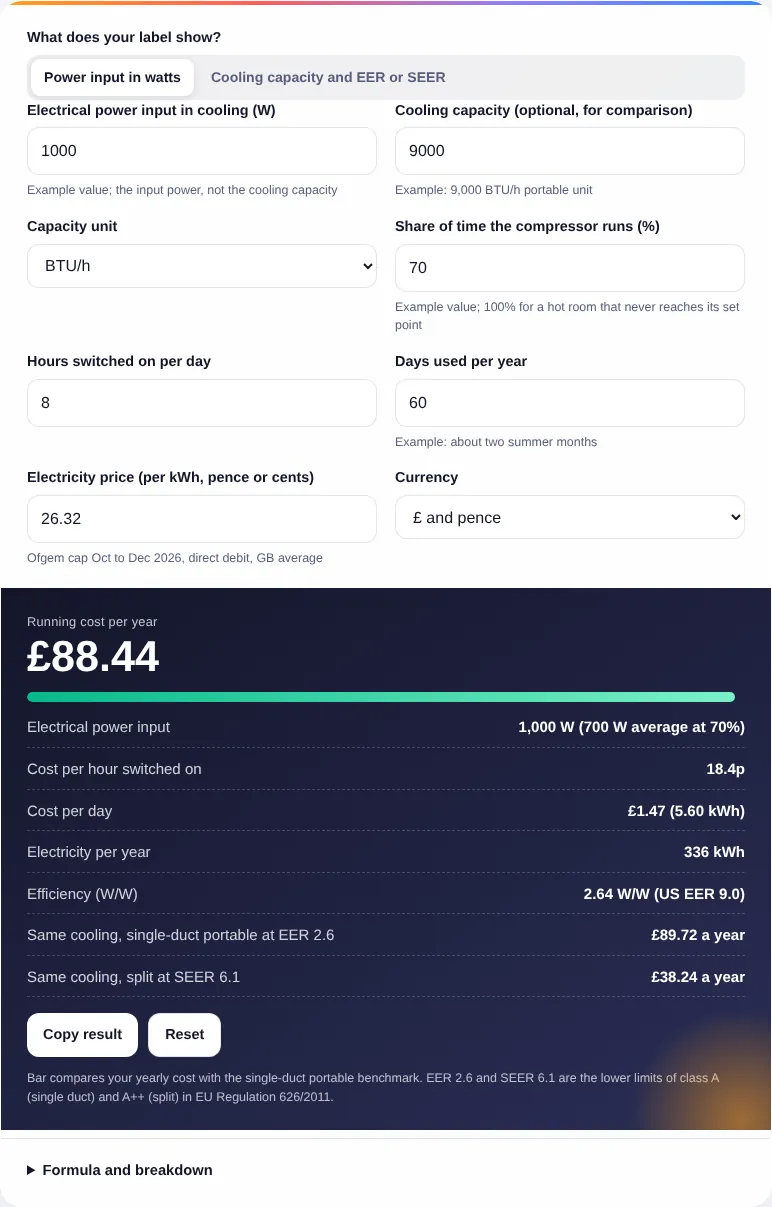
Bar compares your yearly cost with the single-duct portable benchmark. EER 2.6 and SEER 6.1 are the lower limits of class A (single duct) and A++ (split) in EU Regulation 626/2011.
Formula and breakdown
n/a
n/a
n/a
This air conditioner running cost calculator works out what a portable, window or split air conditioner costs per hour, per day and per summer, from either the electrical power on the label or the cooling capacity in BTU/h or kW with its EER or SEER, for households in the UK, Ireland and the rest of Europe. It also shows what the same cooling would cost from a class A portable and a class A++ split unit.
Quick answer: An air conditioner running cost calculator multiplies the unit's electrical input in kW by hours, the share of time the compressor runs and your unit price. Example: a 1,000 W portable running 70% of 8 hours a day for 60 days uses 336 kWh, costing £88.44 at the 26.32p Ofgem cap.
What Is an Air Conditioner Running Cost Calculator?
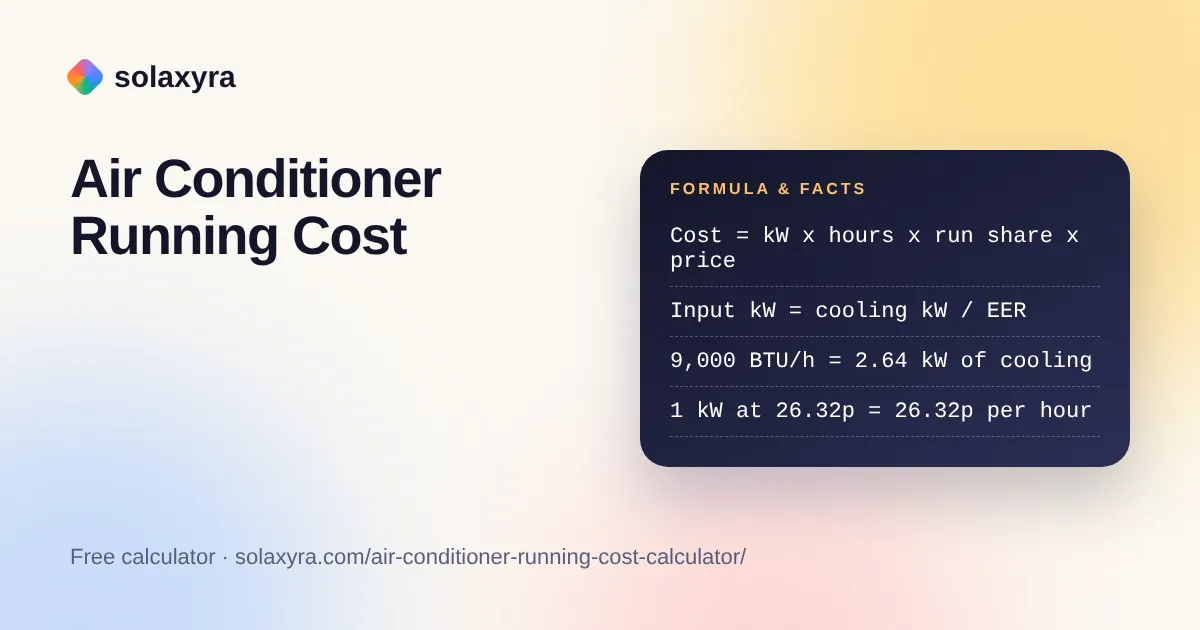
An air conditioner running cost calculator is a tool that turns an air conditioner's electrical power, or its cooling capacity and efficiency, into the cost of the electricity it uses over an hour, a day or a season. In plain words: cost equals electrical input in kW times hours switched on times the share of time the compressor runs times the price per kWh.
The figure that matters is the electrical input, which is much lower than the cooling capacity because an air conditioner moves heat rather than making it. The efficiency rating links the two. As the article on seasonal energy efficiency ratio explains, EER is cooling output divided by electrical input, and SEER averages that over a cooling season; one watt-hour equals 3.412 BTU.
How Do You Use the Air Conditioner Running Cost Calculator?
- Choose whether you know the power input in watts or the cooling capacity with its EER or SEER.
- Enter the power input from the label or manual, or the cooling capacity in BTU/h or kW and the efficiency rating, picking EU or US units.
- Add the cooling capacity even in watts mode to unlock the portable and split comparison.
- Set the share of time the compressor runs, the hours switched on per day and the days of use per year.
- Enter your electricity price and currency, then read the cost per hour, day and year with the full breakdown.
How Much Does It Cost to Run an Air Conditioner per Hour?
An air conditioner costs its electrical input in kW times your unit price for each hour the compressor runs: a 1,000 W unit costs 26.32p an hour at the Ofgem cap of 26.32p per kWh for 1 October to 31 December 2026 (direct debit, GB average). The Ofgem price cap announcement also confirms VAT is removed from electricity bills from 1 October 2026 to 31 March 2027, and that rate already reflects it.
In practice the compressor switches off once the room reaches the set temperature, so the average cost per hour switched on is lower. The air conditioner running cost calculator's run share covers this: at 70%, the same 1,000 W unit averages 700 W, or 18.4p an hour. In a hot, sunny room that never reaches its set point, use 100%. Our electricity cost calculator handles any other appliance the same way.
How Do You Convert BTU to Running Cost?
Divide the BTU/h figure by 3,412 to get cooling kW, divide that by the EER to get electrical kW, then multiply by hours and price. A 9,000 BTU/h portable is 2.64 kW of cooling; at an EER of 2.6 it draws about 1.01 kW, which costs about 26.7p for each hour of compressor running at 26.32p per kWh.
A common mistake is to treat the cooling capacity as the electricity used. Costing a 12,000 BTU/h unit as 3.5 kW of electricity overstates the bill roughly three times, because its input at EER 2.9 is about 1.2 kW. The air conditioner running cost calculator warns when the efficiency implied by your figures falls below 1.5, which usually means the two numbers have been swapped. For straight conversions, see our watts to kWh calculator.
Are Split Air Conditioners Cheaper to Run Than Portables?
For the same cooling, a split system usually uses well under half the electricity of a single-duct portable, because the label scales are different. Under EU Regulation 626/2011, single-duct and double-duct units are rated by EER, with class A starting at 2.6, while split and other fixed units are rated by SEER, with class A starting at 5.1 and A++ at 6.1. The table shows the yearly cost of 9,000 BTU/h (2.64 kW) of cooling at each class limit, running 70% of 8 hours a day for 60 days at 26.32p.
| Type and label class limit | Efficiency (W/W) | Electrical input | Electricity per year | Cost per year |
|---|---|---|---|---|
| Single duct, class C | EER 2.1 | 1,256 W | 422 kWh | £111.08 |
| Single duct, class A | EER 2.6 | 1,014 W | 341 kWh | £89.72 |
| Single duct, class A++ | EER 3.6 | 733 W | 246 kWh | £64.79 |
| Split, class B | SEER 4.6 | 573 W | 193 kWh | £50.71 |
| Split, class A | SEER 5.1 | 517 W | 174 kWh | £45.74 |
| Split, class A++ | SEER 6.1 | 432 W | 145 kWh | £38.24 |
| Split, class A+++ | SEER 8.5 | 310 W | 104 kWh | £27.44 |
EER is measured at one rated condition and SEER over a season, so the comparison is indicative rather than exact. It still shows the scale of the gap: the running cost difference can help justify the higher purchase and installation cost of a split system if you use cooling every summer.
How Many Hours a Day Does Air Conditioning Run?
It runs for as long as you leave it on, but the compressor only works for the share of that time needed to hold the set temperature, which depends on the weather, the room and the unit's size. Enter your own hours and days, and adjust the run share: closer to 100% for an undersized unit in a sunny room, lower for a well-matched unit with curtains drawn. If you track your use with a plug-in meter, divide the measured kWh by the hours switched on and by the rated input to find your real run share.
Can Solar Panels Cover Air Conditioning Costs?
Cooling demand peaks on sunny afternoons, which is when solar panels generate most, so a home with solar can often run air conditioning largely on its own generation. Every kWh of solar used this way saves the full import price instead of earning an export rate. Our appliance solar panel calculator estimates how many panels an appliance needs, and the energy consumption calculator adds air conditioning to the rest of your household use.
Fixed split and ducted systems contain fluorinated refrigerant gases; GOV.UK guidance says technicians working on them need F gas qualifications and their company needs certification. Any new circuit or fused spur for an indoor or outdoor unit must be installed by a qualified electrician and meet BS 7671.
Worked Example: A Portable Unit in a Loft Bedroom
Example: a loft bedroom in Bristol is cooled by a 9,000 BTU/h single-duct portable air conditioner with a label EER of 2.6. It is switched on for 8 hours on 60 summer days, and the compressor runs about 70% of the time. Electricity costs 26.32p per kWh.
- Cooling capacity: 9,000 / 3,412 = 2.64 kW.
- Electrical input: 2.64 / 2.6 = 1.01 kW.
- Average draw: 1.01 x 0.70 = 0.71 kW, or 18.7p per hour switched on.
- Per day: 0.71 x 8 = 5.68 kWh, about £1.50.
- Per year: 5.68 x 60 = 341 kWh, about £89.72.
- A class A++ split giving the same cooling would use about 145 kWh, about £38.24, saving about £51 a year.
Frequently Asked Questions
How much does it cost to run an air conditioner per hour in the UK?
Multiply the electrical input in kW by your unit price. A unit drawing 1,000 W costs 26.32p for each hour the compressor runs at the October to December 2026 Ofgem cap. If it cycles off for part of the time, the average cost per hour is lower.
Is 9,000 BTU the power an air conditioner uses?
No. BTU/h is the cooling the unit delivers, not the electricity it draws. Convert to kW by dividing by 3,412, then divide by the EER to get the input. A 9,000 BTU/h unit at EER 2.6 draws about 1.01 kW, not 2.64 kW.
What is the difference between EER and SEER?
EER is cooling output divided by electrical input at one rated condition. SEER is the same ratio averaged over a cooling season. EU and UK labels give both as plain ratios in W/W; US figures are in BTU per watt-hour, which is 3.412 times larger.
Is a split air conditioner cheaper to run than a portable one?
Usually, yes, for the same cooling. Under EU Regulation 626/2011 a single-duct portable reaches class A from an EER of 2.6, while a split reaches A++ from a SEER of 6.1. At those ratings the split uses less than half the electricity for the same cooling.
How can I reduce air conditioning running costs?
Close curtains on sunny windows, shut doors to the room being cooled, set the thermostat a few degrees higher and keep filters clean. Choose a model with a high EER or SEER, and match the cooling capacity to the room so it reaches its set point and cycles off.
Who can install a fixed air conditioning system in the UK?
Split and ducted systems contain fluorinated refrigerant gases, and GOV.UK guidance says technicians need F gas qualifications and their company needs certification. The electrical supply must be installed by a qualified electrician and meet BS 7671. Portable units only need a suitable socket.
Checked October 2026 by the Solaxyra Editorial Team. Sources: Ofgem: price cap October to December 2026, EUR-Lex: Regulation (EU) No 626/2011, Wikipedia: Seasonal energy efficiency ratio, GOV.UK: F gas guidance.