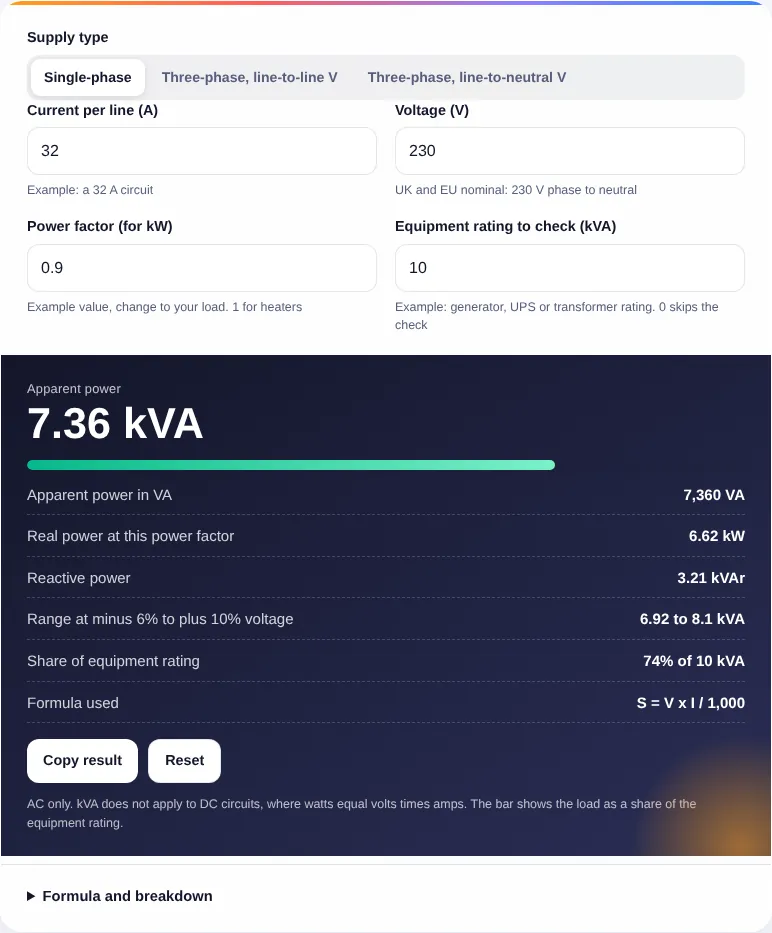
AC only. kVA does not apply to DC circuits, where watts equal volts times amps. The bar shows the load as a share of the equipment rating.
Formula and breakdown
n/a
n/a
n/a
This amps to kVA calculator converts the current on an AC circuit into apparent power in kVA for single-phase and three-phase supplies, using the 230 V and 400 V systems found in the UK, Ireland and the rest of Europe by default, with any other voltage available for North America and elsewhere. It also shows the real power in kW at your power factor, how the result moves within the legal UK voltage tolerance, and whether a generator, UPS or transformer rating is large enough.
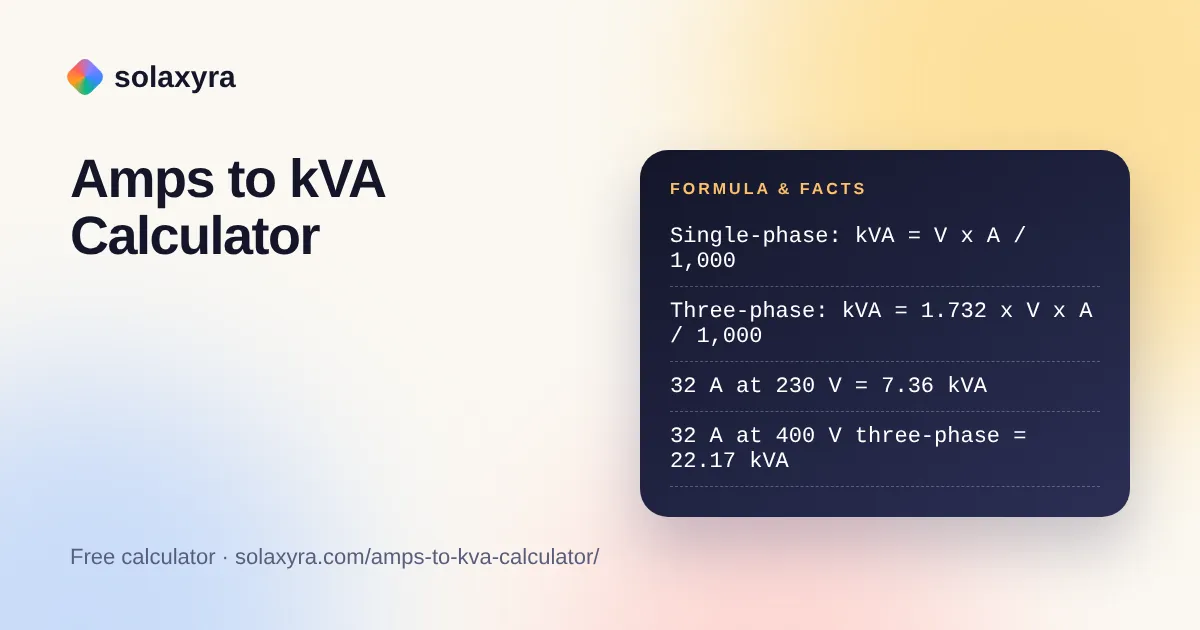
Quick answer: An amps to kVA calculator multiplies current by voltage and divides by 1,000 for single-phase, so 32 A at 230 V is 7.36 kVA. For a balanced three-phase load, multiply by 1.732 and the line-to-line voltage: 32 A at 400 V is 22.17 kVA. kVA applies to AC only.
What Is an Amps to kVA Calculator?
An amps to kVA calculator is a tool that turns a measured or rated AC current into apparent power, the total volt-amperes a supply or machine has to carry. In plain words: kVA equals volts times amps divided by 1,000 on a single-phase circuit, and the square root of 3 (about 1.732) times line-to-line volts times amps divided by 1,000 on a balanced three-phase circuit.
The Wikipedia article on AC power defines apparent power as the product of the RMS voltage and RMS current, measured in volt-amperes. It also explains why equipment is rated in kVA rather than kW: cables, transformers and generators must carry the whole current, including the part that does no useful work at the load. That is why the current you measure on a clamp meter converts directly to kVA, while kW also depends on the power factor.
How Do You Use the Amps to kVA Calculator?
- Choose single-phase, three-phase with line-to-line voltage, or three-phase with line-to-neutral voltage.
- Enter the current per line in amps, from a clamp meter, a nameplate or a breaker rating.
- Check the voltage: the amps to kva calculator fills in 230 V for single-phase and line-to-neutral, and 400 V for line-to-line.
- Enter a power factor if you also want kW and kVAr. Use 1 for resistive loads such as heaters.
- Add the kVA rating of a generator, UPS or transformer to see the load as a share of it, or enter 0 to skip.
- Open "Formula and breakdown" to see each step, then copy the result.
How Do You Convert Amps to kVA on a Three-Phase Supply?
Multiply the line current by the line-to-line voltage and by 1.732, then divide by 1,000: 50 A per line on a 400 V supply is 1.732 x 400 x 50 / 1,000 = 34.64 kVA. This assumes a balanced load, with roughly the same current on each line.
If you only know the phase-to-neutral voltage, multiply by 3 instead of 1.732, because 400 V between lines is 1.732 times the 230 V from each line to neutral. The Wikipedia article on three-phase electric power describes this as a 230/400 V system, while North American supplies are often 120/208 V. Both routes give the same answer: 3 x 230 x 50 / 1,000 = 34.5 kVA, and the small gap comes from 400 V being a rounded figure. For unbalanced loads, work out each phase on its own and add them. Our three-phase power calculator goes further into kW, kVA and kVAr for balanced loads.
What Is a Circuit's kVA at Common UK and EU Currents?
A 13 A plug at 230 V is about 3 kVA, a 32 A circuit is 7.36 kVA, and a 100 A single-phase supply is 23 kVA. The table gives the apparent power for common breaker and fuse ratings at the European voltages and at the two common North American voltages.
| Current (A) | Single-phase 230 V (kVA) | Three-phase 400 V (kVA) | Single-phase 120 V (kVA) | Single-phase 240 V (kVA) |
|---|---|---|---|---|
| 6 | 1.38 | 4.16 | 0.72 | 1.44 |
| 10 | 2.30 | 6.93 | 1.20 | 2.40 |
| 13 | 2.99 | 9.01 | 1.56 | 3.12 |
| 16 | 3.68 | 11.09 | 1.92 | 3.84 |
| 20 | 4.60 | 13.86 | 2.40 | 4.80 |
| 32 | 7.36 | 22.17 | 3.84 | 7.68 |
| 40 | 9.20 | 27.71 | 4.80 | 9.60 |
| 63 | 14.49 | 43.65 | 7.56 | 15.12 |
| 80 | 18.40 | 55.43 | 9.60 | 19.20 |
| 100 | 23.00 | 69.28 | 12.00 | 24.00 |
A breaker or fuse rating is a limit, not the load you actually draw, so for sizing equipment use the measured or calculated current where you can. To go the other way, from a kVA rating to the current it allows, use the kVA to amps calculator.
Does Supply Voltage Change the kVA Result?
Yes: at a fixed current, kVA rises and falls in direct proportion to the voltage, so a 10% higher voltage gives 10% more kVA. In Great Britain the declared low-voltage supply is 230 V between phase and neutral, and regulation 27 of the Electricity Safety, Quality and Continuity Regulations 2002 allows it to vary by up to 10% above or 6% below that figure, which is about 216 V to 253 V.
The amps to kva calculator shows the kVA at both ends of that band for the current you enter. For a 32 A load the range is 6.92 to 8.10 kVA. That spread matters when a generator or UPS is close to its limit, because the nameplate figure is only one point within it. Many loads also draw a different current when the voltage changes, so treat the range as a sensitivity check rather than a forecast.
What Is the Difference Between kVA and kW?
kVA is apparent power and kW is real power; kW equals kVA multiplied by the power factor, so 7.36 kVA at a power factor of 0.9 is 6.62 kW. For a purely resistive load such as a kettle or heater the power factor is close to 1 and the two numbers match. Motors, compressors and some power supplies draw extra current that does no work, so their kVA is higher than their kW.
The amps to kva calculator also gives reactive power in kVAr, from kVAr = the square root of (kVA squared minus kW squared). If you know kW and need kVA, the kW to kVA calculator does that division for you, and the power factor calculator works out the power factor from your own readings.
Can You Convert Amps to kVA on a DC Circuit?
No: kVA is defined only for alternating current, because it exists to separate apparent power from real power when voltage and current are out of step. On a DC circuit, such as a solar array or battery bank, voltage and current are always in phase, so power in watts simply equals volts times amps. A 12 V battery supplying 50 A delivers 600 W, not "0.6 kVA". The tool warns you when the voltage looks like a low DC system.
Worked Example: Is a 10 kVA Generator Big Enough for a Three-Phase Workshop?
Example: a small workshop on a 400 V three-phase supply measures 16 A on each line with a clamp meter while its machines run, and the motor nameplates suggest a power factor of about 0.8 (an example value). The owner is considering a 10 kVA three-phase standby generator.
- Apparent power: 1.732 x 400 V x 16 A = 11,085 VA, or 11.09 kVA.
- Real power: 11.09 x 0.8 = 8.87 kW.
- Rating check: 11.09 / 10 = 111% of the generator rating, so the generator is too small for this load even though the kW figure is below 10.
- Motor starting draws a short surge well above the running current, so the margin needs to be larger still; the generator maker's sizing guidance sets that margin.
Connecting any generator to a building's fixed wiring needs a suitable changeover arrangement and must be designed and installed by a qualified electrician; in the UK the work must meet BS 7671.
Frequently Asked Questions
How many kVA is 100 amps?
On a 230 V single-phase supply, 100 A is 23 kVA. On a 400 V three-phase supply with 100 A on each line, it is 1.732 x 400 x 100 / 1,000 = 69.28 kVA. At 120 V it is 12 kVA and at 240 V it is 24 kVA.
What is the formula for amps to kVA?
For single-phase, kVA = volts x amps / 1,000. For a balanced three-phase load, kVA = 1.732 x line-to-line volts x amps / 1,000, or 3 x line-to-neutral volts x amps / 1,000. The result is apparent power, which includes current that does no useful work.
How many kVA is a 13 amp plug?
A 13 A plug at 230 V carries up to 230 x 13 / 1,000 = 2.99 kVA, so about 3 kVA. That is the most the fuse allows, not what a typical appliance draws. An appliance rated at 3 kW runs very close to that limit.
Why are generators rated in kVA instead of kW?
A generator's windings and cables heat up according to the current they carry, whatever the power factor of the load. Rating them in kVA describes that current limit directly. The kW they can deliver is the kVA rating multiplied by the power factor of the connected load.
Do I need the power factor to convert amps to kVA?
No. Converting amps to kVA needs only the current, the voltage and whether the supply is single-phase or three-phase. You need the power factor only if you also want real power in kW, or reactive power in kVAr, from the same reading.
Should I use 230 V or 240 V for UK calculations?
Use 230 V, the declared nominal voltage for UK low-voltage supplies, which may vary between about 216 V and 253 V. If you have a reliable reading of your own supply voltage, enter that figure instead.
Checked October 2026 by the Solaxyra Editorial Team. Sources: Wikipedia: AC power, Wikipedia: Three-phase electric power, legislation.gov.uk: ESQCR 2002 regulation 27.