n/a
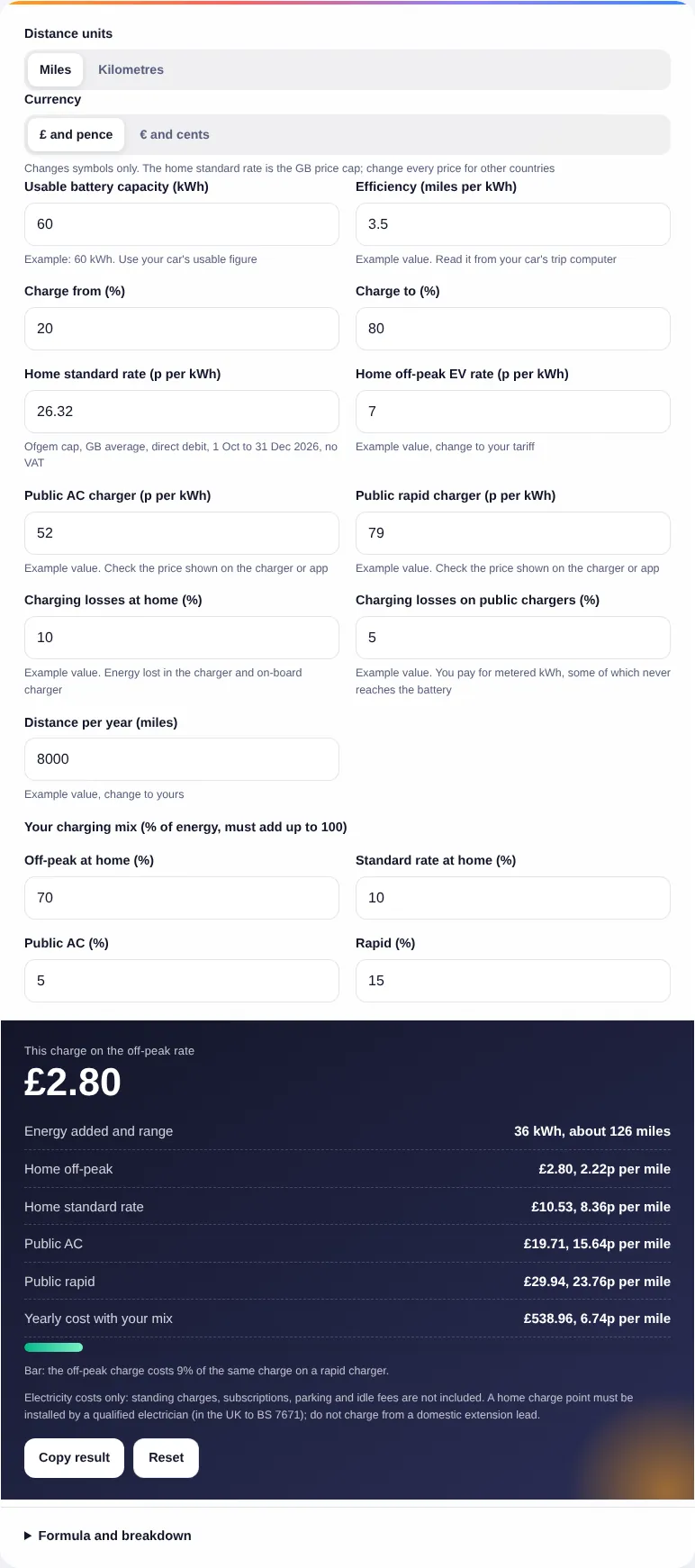
Electricity costs only: standing charges, subscriptions, parking and idle fees are not included. A home charge point must be installed by a qualified electrician (in the UK to BS 7671); do not charge from a domestic extension lead.
Formula and breakdown
n/a
n/a
n/a
n/a
This EV charging cost calculator shows UK drivers what one charge and each mile costs at home on an off-peak EV tariff, at home on the standard price cap rate, on a public AC charger and on a rapid charger, including charging losses, and then works out a yearly cost from your own mix of charging. Drivers in Ireland and the rest of Europe can switch to kilometres and cents and enter local prices.
Quick answer: An EV charging cost calculator multiplies the energy you add by the price per kWh, after allowing for charging losses. At the GB price cap of 26.32p per kWh, adding 36 kWh at home with 10% losses costs about £10.53, or 8.4p a mile at 3.5 miles per kWh; an example 79p rapid charger costs about £29.94.
What Is an EV Charging Cost Calculator?
An EV charging cost calculator is a tool that converts the energy you put into an electric car’s battery into money, at the price per kWh of each place you charge. The formula in plain words: energy added equals usable battery capacity times the difference between the end and start charge levels; energy paid for equals energy added divided by one minus the charging losses; cost equals energy paid for times the price per kWh. Cost per mile equals the price per kWh divided by one minus losses, divided by the miles the car covers per kWh.
The ev charging cost calculator runs the same charge through four prices so you can see how much the choice of charger matters, and uses your yearly distance and charging mix to give an annual figure.
How Do You Use the EV Charging Cost Calculator?
- Choose miles or kilometres, and pounds or euros.
- Enter your car’s usable battery capacity and its efficiency in miles per kWh, or kWh per 100 km.
- Set the charge level you start from and the level you charge to.
- Check the four prices. The home standard rate is the GB price cap; the others are examples to replace with your tariff and the prices shown on the chargers you use.
- Adjust the charging losses for home and public charging if you know your car’s figures.
- Enter your yearly distance and the share of energy from each type of charging, adding up to 100%.
- Read the cost of the charge at each price, the cost per mile and the yearly total, and open the breakdown to check the arithmetic.
How Much Does It Cost to Charge an Electric Car at Home?
At the October to December 2026 price cap, charging at home costs 26.32p per kWh, so adding 36 kWh with 10% losses costs about £10.53. That rate is the average for direct debit customers on standard variable tariffs in Great Britain, according to Ofgem’s announcement of the cap, and it does not include VAT because VAT is removed from electricity bills from 1 October 2026 to 31 March 2027. Your own tariff may be higher or lower, so enter it if you know it.
An off-peak EV tariff gives a much lower rate for a few hours overnight. The 7p used in the ev charging cost calculator is an example; enter the night rate from your own tariff. If you only run the charger in the cheap window, set the off-peak share of your mix high and the standard share low. To see what any other appliance costs at the same rate, try the electricity cost calculator.
How Much Does Public and Rapid Charging Cost?
Public prices are set by each network and change often, so the ev charging cost calculator treats them as editable examples: 52p per kWh for a public AC charger and 79p for a rapid charger. At those prices the same 36 kWh costs about £19.71 and £29.94 once 5% losses are included. Always check the price per kWh on the charger screen or app before you start, and look out for connection, parking or overstay fees that this tool does not include.
| Car efficiency | Off-peak, example 7p | Price cap, 26.32p | Public AC, example 52p | Rapid, example 79p |
|---|---|---|---|---|
| 3.0 miles per kWh | £2.59 | £9.75 | £18.25 | £27.72 |
| 3.5 miles per kWh | £2.22 | £8.36 | £15.64 | £23.76 |
| 4.0 miles per kWh | £1.94 | £7.31 | £13.68 | £20.79 |
The table shows the cost of driving 100 miles, with 10% losses at home and 5% on public chargers. Divide by 100 for pence per mile. Moving from rapid charging to an off-peak home tariff cuts the energy cost of the same 100 miles by more than 90% on these figures.
Is There VAT on EV Charging?
Public charging is always charged at the standard 20% VAT rate, while home electricity in Great Britain is zero rated until 31 March 2027. Both points come from HMRC VAT Notice 701/19, which also says that Northern Ireland keeps the 5% reduced rate for domestic electricity during this period. If a tariff you are comparing is quoted without VAT, add the correct rate before entering it.
How Much Energy Is Lost When You Charge an EV?
You pay for more electricity than the battery stores, because some energy turns into heat in the charge point, the car’s on-board charger and the battery itself. The amount depends on the car, the charging power and the temperature, and it is rarely published, so the tool uses example losses of 10% at home and 5% on public chargers. You can measure your own figure by comparing the kWh shown by a smart charge point or the public charger with the kWh the car reports adding.
Home charging needs a dedicated circuit. A home charge point must be installed by a qualified electrician, in the UK to BS 7671, and you should not charge a car from a domestic extension lead. The kW to amps calculator shows why: a 7.4 kW charger draws about 32 A at 230 V.
Worked Example: A 60 kWh Car Charged Four Ways
Example: a family car with a 60 kWh usable battery that covers 3.5 miles per kWh is charged from 20% to 80%, and the household drives 8,000 miles a year.
- Energy added: 60 x (80% minus 20%) = 36 kWh, worth about 126 miles.
- Energy paid for: 36 / 0.90 = 40 kWh at home; 36 / 0.95 = 37.89 kWh on public chargers.
- Per charge: off-peak 40 x 7p = £2.80; price cap 40 x 26.32p = £10.53; public AC 37.89 x 52p = £19.71; rapid 37.89 x 79p = £29.94.
- Per mile: 2.22p, 8.36p, 15.64p and 23.76p.
- Mix of 70% off-peak, 10% standard, 5% public AC and 15% rapid: 0.70 x 2.22 + 0.10 x 8.36 + 0.05 x 15.64 + 0.15 x 23.76 = 6.74p per mile.
- Yearly: 6.74p x 8,000 miles = about £539.
The rapid share is only 15% of the energy but makes up more than half of the yearly cost. If you have solar panels, the solar EV charging calculator shows how much of this mileage your own generation could cover.
Frequently Asked Questions
How much does it cost to charge an electric car at home in the UK?
At the Ofgem price cap of 26.32p per kWh for October to December 2026, a 60 kWh battery charged from 20% to 80% with 10% losses costs about £10.53. On an off-peak EV tariff at an example 7p per kWh, the same charge costs about £2.80.
Why is rapid charging so much more expensive?
Each network sets its own rapid price to cover expensive high-power equipment and its grid connection, so the price per kWh is usually several times a home tariff. Public charging is also always charged at the standard 20% VAT rate, while home electricity in Great Britain is zero rated until 31 March 2027.
Is there VAT on EV charging?
HMRC Notice 701/19 says recharging at public charge points is always standard rated at 20%. Home electricity in Great Britain carries 0% VAT from 1 October 2026 to 31 March 2027, while Northern Ireland keeps the 5% reduced rate for domestic electricity.
How much energy is lost when charging an EV?
Some energy is lost as heat in the charge point, the car’s on-board charger and the battery, so you pay for more kWh than the battery stores. Losses vary by car, charging speed and temperature; the calculator uses example values of 10% at home and 5% on public chargers.
What is a good EV cost per mile?
It depends on your price and the car’s efficiency. At 3.5 miles per kWh, an example 7p off-peak tariff with 10% losses gives about 2.2p a mile, the price cap gives about 8.4p, and an example 79p rapid charger gives about 23.8p.
Does the standing charge count towards EV charging cost?
No. The daily standing charge, 54.83p for electricity under the October to December 2026 cap, is paid whether or not you charge a car, so it is not part of the extra cost of charging. Only the unit rate for each kWh counts.
Checked October 2026 by the Solaxyra Editorial Team. Sources: Ofgem energy price cap, October to December 2026, HMRC VAT Notice 701/19.