Modelled estimate for an average year. Check the fixing method with your landlord or building manager before mounting anything on a railing.
Formula and breakdown
n/a
n/a
n/a
This balcony solar calculator estimates the monthly and yearly output of a small solar kit mounted on a balcony railing, a floor stand or a wall, for homes in the UK, Ireland and across Europe. It focuses on the geometry that decides balcony yields: panel tilt, the direction the balcony faces and shade from the floor above, and it shows how much you give up compared with an ideal roof angle.
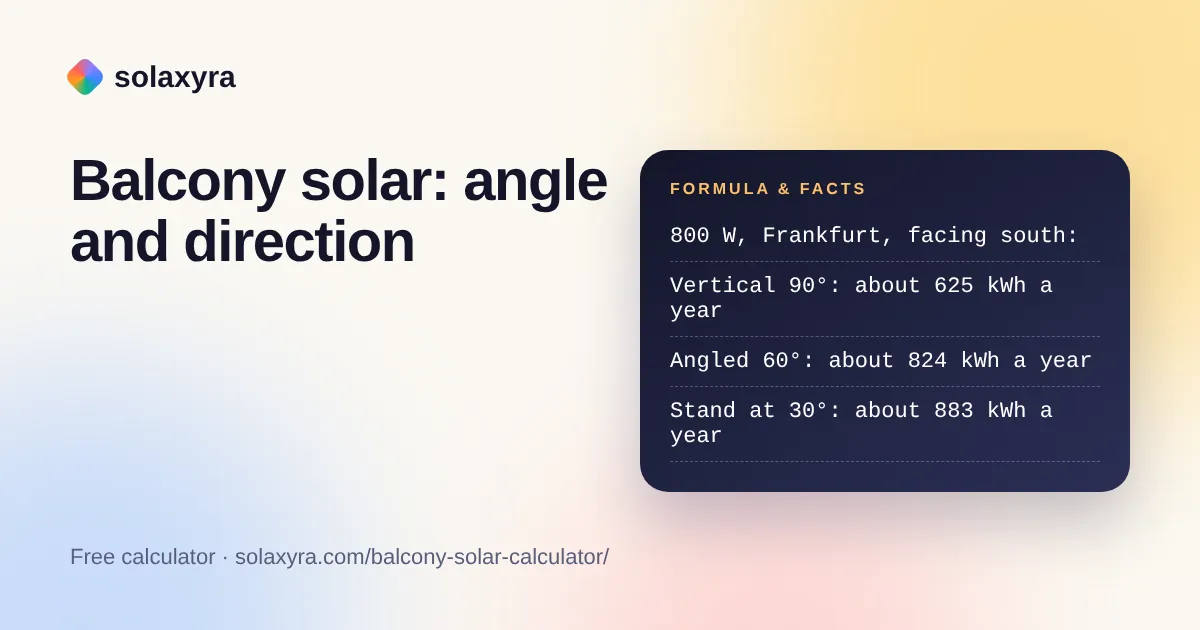
Quick answer: A balcony solar calculator scales local solar yield by the sunlight your panel angle and direction receive. In central Germany, 800 W of panels hanging vertically on a south-facing railing gives about 625 kWh a year, against about 883 kWh on a 30° stand. East or west railings drop to roughly 483 kWh.
What Is a Balcony Solar Calculator?
A balcony solar calculator is a tool that predicts how many kWh a balcony-mounted solar kit will produce each month, based on where you live and exactly how the panels are fixed. The formula in plain words: monthly output equals the kWh per kWp that an ideally angled panel makes in that month at your location, times your panel kWp, times the share of that month’s sunlight your actual plane receives, minus shading and any output the inverter cuts off.
The ideal figures come from the World Bank Global Solar Atlas. To work out the share for your plane, the calculator splits each month’s sunlight into direct and diffuse parts, follows the sun’s path through an average day and adds a small amount of light reflected from the ground. Vertical panels catch less diffuse light from the sky and lose high summer sun, which is why their yearly totals are lower even on a sunny balcony.
How Do You Use the Balcony Solar Calculator?
- Choose the country or region closest to you.
- Pick a mounting type: vertical on the railing, angled on the railing, a floor stand at 30°, or a wall bracket where you set the tilt yourself.
- Select the direction the balcony faces. Use a phone compass while standing with your back to the wall.
- Enter the total panel watts and the inverter limit. In the UK the limit is 800 W; check your own national rules elsewhere.
- Estimate shading from the balcony above, side walls, plants or trees. A covered balcony often loses 10% or more.
- Read the monthly bars, the loss against an ideal roof and the comparison with other mounting angles.
How Much Does a Vertical Balcony Panel Lose?
A vertical panel on a south-facing railing produces roughly 70% of what the same panel would make at the best roof angle in central and northern Europe, so expect a loss of about 30%. In our Frankfurt model, 800 W gives 625 kWh vertical and 883 kWh at 30°. The loss is larger further south: in Madrid the vertical figure falls to about two thirds of the ideal, because the summer sun is higher in the sky.
The table compares 800 W of panels in Frankfurt with no shading, across three mounting angles and four directions.
| Balcony faces | Vertical 90° (kWh a year) | Angled 60° | Stand at 30° |
|---|---|---|---|
| South | 625 | 824 | 883 |
| South east or south west | 590 | 772 | 843 |
| East or west | 483 | 634 | 741 |
| North | 300 | not modelled | 577 |
Tilting a railing panel out to 60° recovers most of the gap for south, south east and south west balconies. For a fuller picture of how direction and tilt combine on any surface, the solar panel orientation calculator covers every compass point.
Is a Vertical Panel Better in Winter?
Yes, on a south-facing balcony a vertical panel can match or beat a 30° panel from November to February, because the low winter sun strikes it almost head on. In Frankfurt our model gives 34 kWh in January for the vertical panel against 32 kWh at 30°, and 27 kWh against 24 kWh in December. In summer the order reverses sharply: 58 kWh vertical against 109 kWh at 30° in June.
This flatter profile has a practical benefit. A vertical south kit sends out fewer big midday peaks, so more of its output tends to be used in the home rather than exported, and it rarely hits the inverter limit. The calculator’s “October to March share” row shows how evenly your kit spreads its output through the year.
Which Direction Is Best for a Balcony Solar Kit?
South is best in Europe, south east and south west lose only about 5%, east and west lose about 15% to 25% compared with south at the same tilt, and north-facing balconies are rarely worth it. East and west balconies have one advantage: output arrives in the morning or the evening, when many households use more electricity, rather than at midday when they are out.
If you are choosing between two sides of a flat, model both. A west balcony at 60° in Frankfurt gives about 634 kWh, a little more than a south-facing vertical panel at 625 kWh. To turn any of these figures into money, use the plug-in solar calculator, which adds your tariff, self-use share and payback.
What Should You Check Before Mounting Panels on a Balcony?
Check that the mounting is approved by the kit maker, that the railing can carry the load and wind force, and that your landlord, building manager or owners’ association agrees before you fit anything. Panels on a railing act like a sail, and a falling panel can seriously injure someone below.
In Great Britain the government’s interim product specification for plug-in solar says kits must not rely on cable ties, rope, tape or straps, asks manufacturers to show the mounting is structurally safe for wind and snow loads, and excludes timber balconies and aluminium composite cladding. The Energy Saving Trust advice on plug-in solar adds that the kit must plug straight into a fixed socket, never an extension lead. If you need a new outdoor socket, a registered electrician must fit it to BS 7671; elsewhere, follow your local wiring rules and use a qualified electrician.
Worked Example: Lena in Berlin
Lena lives on the third floor of a block in Berlin. Her balcony faces west and has a concrete slab above it, so she allows 10% for shading. She is choosing between two 400 W panels hung vertically on the railing, the same panels on brackets angled at 60°, or a floor stand at 30°.
- Vertical 90°: about 422 kWh a year, from 58 kWh in May and June to 9 kWh in December.
- Angled 60°: about 550 kWh a year.
- Floor stand 30°: about 638 kWh a year, but the stand sits behind the railing, which would shade the lower cells for much of the day.
- The ideal roof figure for 800 W in Berlin is about 857 kWh, so the vertical option loses about 51%.
Lena chooses the 60° brackets, which her building management approves. She also checks a larger 2,000 W vertical array: about 1,038 kWh a year with only 18 kWh lost to the 800 W limit, because a vertical west panel seldom reaches full power. Whether that is worth the extra cost depends on the price and the space on her railing.
Frequently Asked Questions
How much does a balcony solar panel produce per year?
In central Europe, 800 W of panels hanging vertically on a south-facing railing produce roughly 550 to 650 kWh a year, and about 850 to 900 kWh on a 30° stand. East or west balconies give around 15% to 25% less. Shade from the balcony above can cut a further 10% or more.
Is a vertical balcony solar panel worth it?
Often yes, if the balcony faces between south east and south west and gets little shade. A vertical panel loses roughly 30% of yearly output compared with an ideal roof angle, but performs well in winter and is the simplest and least exposed way to mount panels on a railing.
What angle is best for balcony solar panels?
For yearly output, about 30° to 35° facing south is best in most of Europe. On a railing, a 60° angle captures most of that while keeping the panel compact. Vertical mounting gives the most even output across the seasons and slightly more in the depths of winter.
Does a balcony solar kit work on a north-facing balcony?
It works, but output is low. In Frankfurt our model gives about 300 kWh a year for 800 W hanging vertically facing north, roughly a third of the ideal figure. Unless the kit is very cheap or you have no other option, a north-facing balcony is usually not worth it.
Do I need permission to put solar panels on my balcony?
If you rent, or live in a block with shared areas, ask your landlord, building manager or owners’ association first, because railings and facades are often shared property. In Great Britain the kit itself must also meet the plug-in solar product specification and be registered online.
How much power is lost to the 800 W inverter limit on a balcony?
Very little for most balcony layouts. Vertical and east or west panels rarely reach 800 W, so even 2,000 W of panels on a west railing in Berlin loses under 2% of yearly output in our model. Steeply angled south-facing arrays lose more on clear spring days.
Checked October 2026 by the Solaxyra Editorial Team. Sources: Global Solar Atlas (World Bank), EU Joint Research Centre PVGIS, Plug-in Solar Device Interim Product Specification, Energy Saving Trust plug-in solar advice.