This guide compares a portable power station vs generator for UK and European buyers who want power for camping, power cuts, vans or work sites, using cost per kWh, runtime and safety rather than brand claims. It works out what each kWh really costs from official fuel and electricity prices and shows which option suits which job.
Quick answer: In the portable power station vs generator choice, a power station suits quiet, indoor-safe power for small loads over hours: phones, lights, a fridge or a laptop. A petrol generator suits heavy loads or several days without mains, because a litre of petrol holds about 9.5 kWh. Generators must always run outdoors.
What is the difference between a portable power station and a generator?
A portable power station is a battery with a built-in inverter and sockets: it stores a fixed amount of energy, measured in watt-hours (Wh), and must be recharged from the mains, a car or solar panels. A generator is an engine driving an alternator: it makes electricity for as long as it has fuel, and its output is limited by power (watts or kVA), not by stored energy.
That one difference explains most of the portable power station vs generator trade-offs. A power station has no engine, so it is quiet, produces no exhaust and can be used indoors, but it runs out. A generator can run for days if you keep refuelling it, but it is noisy, needs servicing and produces carbon monoxide.
| Factor | Portable power station | Petrol generator |
|---|---|---|
| Energy source | Stored in a battery, often LiFePO4 | Petrol burned in an engine |
| Limit | Capacity in Wh and inverter power in W | Rated power in W or kVA; runs while fuel lasts |
| Indoor use | Yes, following the manufacturer’s instructions | Never: carbon monoxide risk |
| Noise | Fans only | Engine noise; many campsites restrict use |
| Maintenance | Keep charged; occasional firmware updates | Oil, filters, spark plug, stale fuel |
| Recharging or refuelling | Hours from mains, car or solar | Minutes with a can of petrol |
| Running cost per kWh (examples below) | About 31p from mains plus battery wear | About 87p in fuel plus servicing |
How long will a portable power station run?
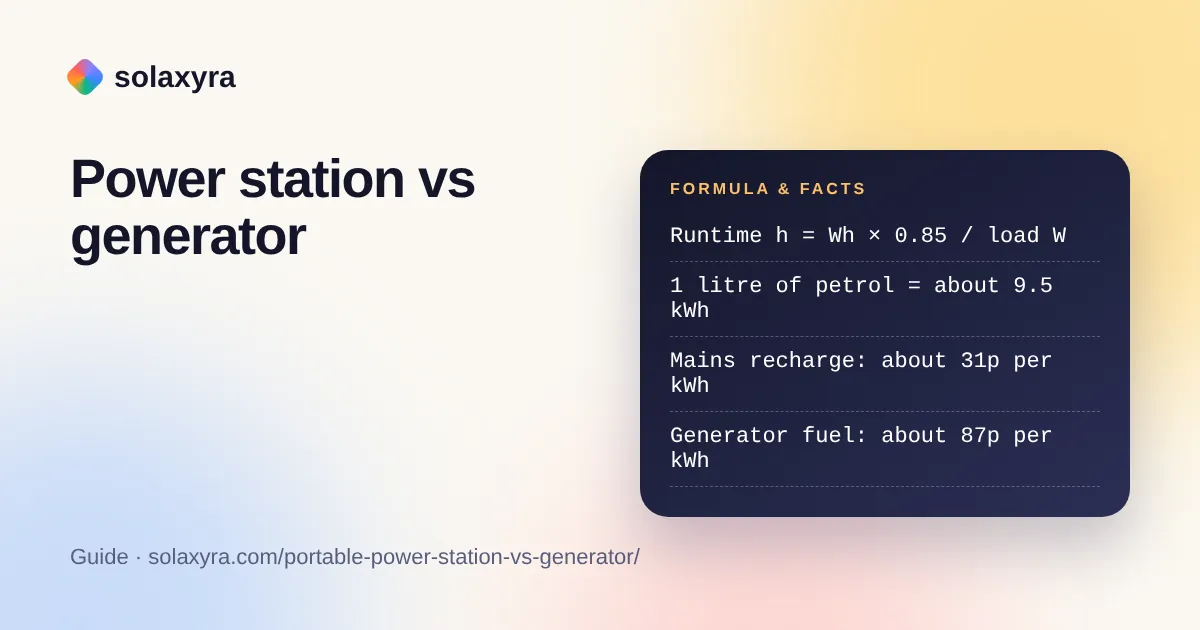
Runtime in hours = capacity in Wh × inverter efficiency ÷ load in watts. Some energy is lost in the battery and inverter, so use an example efficiency of 85% unless the manufacturer gives a figure. The power station runtime calculator does this with device presets, and the battery runtime calculator handles batteries rated in amp-hours.
Example scenarios, all using example capacities and loads you should replace with your own:
- Power cut essentials. Fridge-freezer averaging 100 W, broadband router 10 W and LED lights 20 W, so 130 W. A 1,500 Wh power station gives 1,500 × 0.85 ÷ 130 = about 9.8 hours.
- Camping fridge. A 12 V compressor cool box averaging 45 W on a 1,024 Wh unit: about 19 hours, longer if you use the 12 V output and skip the inverter losses.
- Heavy load. A 700 W microwave on a 2,000 Wh unit: about 2.4 hours of running time, which is plenty for meals but shows how quickly heating appliances drain a battery.
The inverter’s power rating matters as much as capacity. A 3 kW kettle will not run on a power station with a 2 kW inverter, however many Wh it holds. To check how much energy any appliance uses over a day, the watts to kWh calculator converts its rating and hours into kWh.
How long will a generator run, and why does petrol go further?
A generator runs until its tank is empty, and petrol is a very dense energy store: petrol contains about 34.2 MJ per litre, which is 9.5 kWh. Engines waste most of that as heat, but even at the example fuel use below, one litre supplies about 2 kWh of electricity, more than many large power stations hold.
Generator fuel use varies with load and model, so take the figure from your generator’s manual. This guide uses an example of 0.5 litres per kWh delivered at part load, which corresponds to an overall efficiency of about 21%; change it to your own machine’s figure. At that rate, a generator carrying 10 litres of petrol could supply about 20 kWh before refuelling, the equivalent of more than ten fully charged 1,500 Wh power stations.
Generators are sized by power. Petrol models are often rated in kVA as well as watts; the kW to kVA calculator converts between them using the power factor. Leave headroom for motors such as fridges, pumps and power tools, which draw a surge of several times their running power for a moment as they start.
Which is cheaper to run per kWh?
From mains electricity, a power station costs about 31p per kWh delivered at the October 2026 price cap, while a petrol generator costs about 87p per kWh in fuel alone at current pump prices, before oil and servicing. The portable power station vs generator figures come from two official prices:
- Power station recharge. The Ofgem price cap average for October to December 2026 is 26.32p per kWh, with VAT removed from domestic electricity until 31 March 2027. With an example 85% round trip efficiency, each kWh delivered costs 26.32 ÷ 0.85 = about 31p. Recharging from your own solar panels costs nothing per kWh.
- Generator fuel. The GOV.UK weekly road fuel price for unleaded petrol on 5 October 2026 was 174.88p per litre. At the example 0.5 litres per kWh, fuel costs 0.5 × 174.88 = about 87p per kWh.
In the portable power station vs generator cost comparison, there is a hidden cost on the power station side too: battery wear. Divide the purchase price by the rated number of full cycles and the capacity to get a wear cost per kWh.
Example: a 1 kWh unit costing £800 (example price) rated for 3,000 cycles wears out at about £800 ÷ 3,000 = 27p per kWh, similar to the electricity cost. So a power station’s true cost is roughly 31p plus 27p, about 58p per kWh in this example, still cheaper than generator fuel and with no servicing, but not as cheap as the electricity price suggests. The electricity cost calculator works out the mains part for your own tariff.
Portable power station vs generator: which one should you choose?
Choose a power station when loads are small to moderate, quiet or indoor use matters, and you can recharge regularly; choose a generator when you need high power or several days of supply without mains; many people use both. The table matches common jobs to the better fit.
| Use | Better fit | Reason |
|---|---|---|
| Weekend camping, phones, lights, cool box | Power station | Quiet, no fumes near tents, recharge from car or solar |
| Power cut of a few hours: fridge, router, lights | Power station | Safe indoors, no fuel stored, ready instantly |
| Power cut lasting days, or heating pumps and freezers | Generator, or both | Energy needed exceeds any portable battery |
| Building site, power tools, welders | Generator | High continuous and surge power |
| Campervan with solar on the roof | Power station or fixed leisure battery | Solar recharges it daily in summer |
| Remote off-grid property in winter | Generator with a battery system | Covers long shortfalls; battery handles quiet hours |
For long outages, a hybrid setup means you do not have to settle the portable power station vs generator question: run the generator outdoors for an hour or two to recharge the power station, then switch it off and run essentials quietly from the battery.
What safety rules apply to generators and power stations?
A generator must only be run outdoors, away from doors, windows and vents, because its exhaust contains carbon monoxide, which has no smell and can kill. The NHS guidance on carbon monoxide poisoning names portable generators as a source and warns against running engines in enclosed spaces such as garages. Never run one in a garage, shed, tent, awning, porch or van, and fit carbon monoxide alarms in any building or vehicle nearby. Headache, dizziness, sickness and confusion are warning signs; get into fresh air and call 999 if symptoms are severe.
Petrol storage at home is regulated. The HSE says you can store up to 30 litres of petrol at home without informing your Petroleum Enforcement Authority, in plastic containers of up to 10 litres or metal containers of up to 20 litres, and not in your living accommodation. Refuel only when the engine has stopped and cooled.
Power stations are the safer choice in any portable power station vs generator comparison, but they still store a lot of energy. Keep them away from heat and water, use the supplied chargers, and do not cover them while charging. Neither device should ever be connected to a house’s wiring by plugging into a socket, which can backfeed and endanger anyone working on the supply. Connecting a generator or power station to a home circuit needs a proper changeover switch or inlet installed by a qualified electrician to BS 7671.
Frequently Asked Questions
Can a portable power station replace a generator?
For small and moderate loads over a few hours, yes. For heavy loads, power tools or outages lasting days, usually not, because a litre of petrol holds about 9.5 kWh, far more than most portable batteries. Many households keep a power station and use a generator only to recharge it.
Can I use a power station indoors?
Yes. A power station has no engine and produces no exhaust, so it can be used indoors following the manufacturer’s instructions. Keep it ventilated while charging, away from heat and water. A generator must never be used indoors because of carbon monoxide.
Is it cheaper to run a generator or a power station?
Per kWh, a power station charged from the mains is cheaper. In this guide’s example, it costs about 31p per kWh plus about 27p of battery wear, against about 87p per kWh in petrol for a generator, before oil and servicing.
How much petrol can I store at home for a generator?
The HSE allows up to 30 litres at home without telling your Petroleum Enforcement Authority, in plastic containers of up to 10 litres or metal containers of up to 20 litres. It must not be kept in living accommodation.
Can I plug a generator into my house?
Not through a socket. Backfeeding a socket can energise the supply cable and injure people working on it. A generator or power station must connect through a changeover switch or dedicated inlet installed by a qualified electrician to BS 7671.
What size power station do I need for a power cut?
Add up the watts of the essentials and multiply by the hours you need. Example: 130 W of fridge, router and lights for 8 hours is about 1,040 Wh, so a unit of about 1,500 Wh covers it after inverter losses.
Checked October 2026 by the Solaxyra Editorial Team. Sources: NHS: carbon monoxide poisoning, HSE: storing petrol at home, GOV.UK: weekly road fuel prices, Ofgem: price cap October to December 2026, Wikipedia: energy density.