This guide explains when homeowners in England need planning permission for rooftop, wall, balcony, ground-mounted and plug-in solar, using the permitted development rules as amended in August 2026, with a short note for Wales, Scotland and Northern Ireland. Most people asking about planning permission for solar panels on a house will find they do not need it, but the exceptions are specific, measurable and easy to check before you pay a deposit.
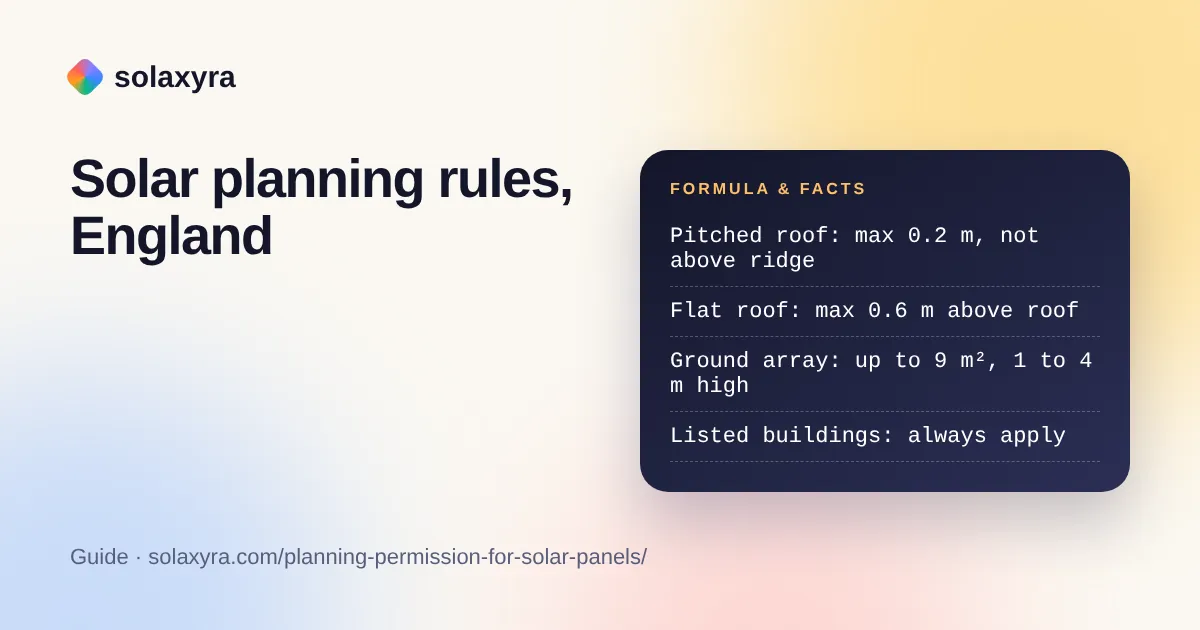
Quick answer: In England, most homes do not need planning permission for solar panels because they are permitted development. On a pitched roof, panels must not project more than 0.2 m or rise above the highest part of the roof. On a flat roof the limit is 0.6 m. Listed buildings and scheduled monuments are excluded.
Do you need planning permission for solar panels in England?
No, not usually: solar panels on a house or a building within its garden are permitted development under Class A of Part 14, Schedule 2 of the General Permitted Development Order 2015, provided they meet the size limits and conditions in that Part. Permitted development is a national grant of planning permission, so no application is needed when every limit is met.
The rules were last changed by the Town and Country Planning (General Permitted Development) (England) (Amendment) Order 2026, S.I. 2026/896, which separated the limits for houses from those for blocks of flats, added wall and balcony limits and brought plug-in solar into the wording. Many guides online about planning permission for solar panels still describe the older version, so check the dates on anything you read. Your local council can also remove permitted development rights in a defined area with an Article 4 direction, so a quick check with the planning department is sensible if you live in a conservation area or on an estate with a history of restrictions.
What are the permitted development limits for solar panels on a house?
For a house in England, panels on a pitched roof must not stick out more than 0.2 m from the roof slope and must not be higher than the highest part of the roof, excluding any chimney. The table sets out every Class A and Class B limit for a dwellinghouse as the law reads in October 2026.
| Where the panels go | Permitted development limit (house in England) | When you need to apply |
|---|---|---|
| Pitched roof | Up to 0.2 m out from the roof slope, and not above the highest part of the roof (chimneys excluded) | Projection over 0.2 m or panels above the ridge |
| Flat roof | Highest part of the panels no more than 0.6 m above the highest part of the roof | Taller frames; prior approval needed first on designated land such as conservation areas and National Parks |
| Wall facing a highway | Up to 0.2 m out from the wall | Always in a conservation area or World Heritage Site |
| Any other wall | Up to 0.4 m out from the wall | Projection over 0.4 m |
| Balcony or roof enclosure | 0.2 m if it abuts a highway, otherwise 0.4 m | Facing a highway in a conservation area or World Heritage Site |
| Ground-mounted in the garden | Panel area up to 9 m²; height 4 m, reduced to 2 m within 5 m of the boundary and 1 m if also in front of the principal elevation | Larger arrays, taller frames, or within the curtilage of a listed building |
| Plug-in solar | Same size limits, but no part on a wooden wall, balcony, fence, gate or timber-clad exterior | Timber mounting is outside permitted development |
| Listed building or scheduled monument | Not permitted development at all | Always |
Every installation must also meet three conditions: the panels must be sited, so far as practicable, to minimise their effect on the building’s appearance and on the amenity of the area, and they must be removed as soon as reasonably practicable when no longer needed. Blocks of flats have their own, slightly different list in the same Part.
How high can solar panels be on a flat roof?
On a flat roof the highest part of the panels and frame can be up to 0.6 m above the highest part of the roof, excluding any chimney, before you need planning permission for solar panels. On designated land, which the Order calls article 2(3) land (National Parks, areas of outstanding natural beauty, conservation areas and similar), you must first apply to the council to decide whether prior approval of the appearance is needed.
The 0.6 m limit decides how steeply you can tilt a panel on a frame. The height of a tilted panel is its length up the slope multiplied by the sine of the tilt angle, plus the height of the frame base. The figures below use example panel lengths, so change them to your datasheet.
- Example: a panel 1.72 m long in portrait at 30° rises 1.72 × sin 30° = 0.86 m. That breaks the 0.6 m limit before the frame is even counted.
- Example: the same panel in landscape, 1.13 m along the slope, at 30° rises 0.565 m. With a 0.05 m base the total is 0.615 m, just over the limit; at 25° it is 0.478 + 0.05 = 0.528 m, which fits.
- Example: with a 0.05 m base, the steepest legal tilt is about 18.6° in portrait (1.72 m) and about 29.1° in landscape (1.13 m).
Lower tilts on a flat roof also need less space between rows. The solar panel angle calculator shows the loss at a lower tilt for your latitude, and the roof area calculator shows how many panels fit once you know the layout.
When do you need planning permission for solar panels?
You need to apply when any limit in the table is broken, when the building is listed or within a scheduled monument, or when your council has removed permitted development rights with an Article 4 direction. In practice the common triggers are:
- a listed house, or a ground-mounted array within the curtilage of a listed building;
- panels on a wall, balcony or roof enclosure fronting a highway in a conservation area or World Heritage Site;
- frames on a flat roof taller than 0.6 m, or a ground array over 9 m² or over the height limits;
- plug-in solar fixed to timber, such as a wooden balcony or fence;
- panels on a block of flats that break the separate block of flats limits (a leaseholder also needs the freeholder’s agreement, which planning law does not replace);
- conditions on the original planning permission for a new-build estate that restrict alterations.
Listed buildings usually also need listed building consent for works that affect their character, which is a separate application from planning permission for solar panels. Ask the council’s conservation officer before choosing panels, because slate-style or all-black modules on a rear slope are often treated differently from a bright array on a street-facing roof.
How do you check whether your solar installation needs permission?
You can check whether most homes need planning permission for solar panels yourself with a tape measure, the installer’s drawings and the council’s online maps. Work through these steps before you sign a contract:
- Confirm whether the property is listed, using the national heritage list, and whether it is in a conservation area, National Park, area of outstanding natural beauty or World Heritage Site, using the council’s planning map.
- Ask the council whether any Article 4 direction or planning condition removes solar permitted development rights at your address.
- For a pitched roof, ask the installer for the mounting system’s projection from the tiles and check it is no more than 0.2 m.
- For a flat roof, calculate the height of the tallest panel edge plus frame using the method above and keep it at or below 0.6 m.
- For a ground array, measure panel area, distance to every boundary and whether it sits in front of the principal elevation, then read the height row of the table.
- If any answer is unclear, apply for a lawful development certificate so you have written confirmation from the council before work starts.
Do plug-in and balcony solar panels need planning permission?
Usually not: plug-in solar on a house in England is covered by the same Class A and Class B limits, with one extra rule that no part may be fixed to a wooden wall, balcony, fence, gate or a timber-clad part of the house. The Order defines plug-in solar as solar PV intended for connection to the home’s electricity installation by a standard plug and socket.
Planning is only one of the rules: plug-in kits became legal to buy and use in Great Britain on 27 August 2026 and produce up to 800 W each, and the government advises checking landlord, freeholder, planning and listed building permissions first. Our UK plug-in solar rules guide covers the electrical side, and the plug-in solar calculator estimates what a kit would save. If you rent or own a leasehold flat, check the lease or tenancy agreement as well as planning, because landlord consent is a private matter that permitted development does not override.
What other rules apply even without planning permission?
Permitted development only answers the question of planning permission for solar panels; the roof must still carry the load, the wiring must be safe and the network operator must be told. These requirements apply to almost every rooftop system:
- Structure: panels and rails add weight and wind load. If the roof is old, altered or a flat roof with ballasted frames, ask for a structural engineer’s assessment before installation.
- Electrical safety: the inverter connection and any new circuit must be installed by a qualified electrician and meet BS 7671, the UK wiring regulations.
- Grid notification: the installer tells the distribution network operator, either after installation under G98 or by applying beforehand under G99. See our G98 vs G99 guide.
- Certification: an MCS certified installer registers the system, which is normally needed for export payments. See MCS certificates explained.
Wales, Scotland and Northern Ireland each have their own permitted development legislation, with different limits from England. If you live outside England, check the rules on planning permission for solar panels published by your own government or council rather than relying on the figures in this guide.
Frequently Asked Questions
Do I need planning permission for solar panels in a conservation area?
Not for most roof panels. In a conservation area, panels are not permitted development on a wall, balcony or roof enclosure that fronts a highway, and flat roof arrays need a prior approval application first. Roof slopes, including front slopes, are allowed within the 0.2 m and ridge limits.
Can I put solar panels on a listed building without permission?
No. Part 14 permitted development does not apply to a listed dwellinghouse or to buildings in its curtilage, and ground arrays within the curtilage of a listed building are also excluded. You need planning permission, and usually listed building consent, so speak to the council’s conservation officer first.
How far can solar panels stick out from a roof?
On a pitched roof in England, no more than 0.2 m from the roof slope, measured at right angles to the surface, and never above the highest part of the roof excluding chimneys. On a flat roof, the highest part may be up to 0.6 m above the highest part of the roof.
Do ground-mounted solar panels need planning permission?
Not if the panel area is 9 m² or less and the height limits are met: 4 m in general, 2 m within 5 m of the boundary, and 1 m if also in front of the house. Larger arrays, listed building curtilages and some designated land need an application or prior approval.
Can my neighbour object to solar panels that are permitted development?
There is no planning application to object to when the installation is permitted development, so a neighbour cannot stop it through the planning system. They could report a breach if your panels exceed the limits, which is why measuring before installation matters.
What changed in the August 2026 planning rules for solar?
S.I. 2026/896 separated the limits for houses and blocks of flats, allowed 0.4 m projection on walls and enclosures not facing a highway, set a stepped height table for ground arrays, added prior approval in some designated areas and took plug-in solar fixed to timber out of permitted development.
Checked October 2026 by the Solaxyra Editorial Team. Sources: legislation.gov.uk: GPDO 2015 Schedule 2 Part 14, legislation.gov.uk: S.I. 2026/896, legislation.gov.uk: GPDO article 2(3) land, GOV.UK: plug-in solar panels come to market.