This guide explains the plug in solar rules UK households must follow in England, Scotland and Wales: what the law allows, which document sets each limit, what you must check before buying, and where the rules stop. It is written for homeowners, tenants and flat owners who want to plug a small solar kit into a socket legally and safely.
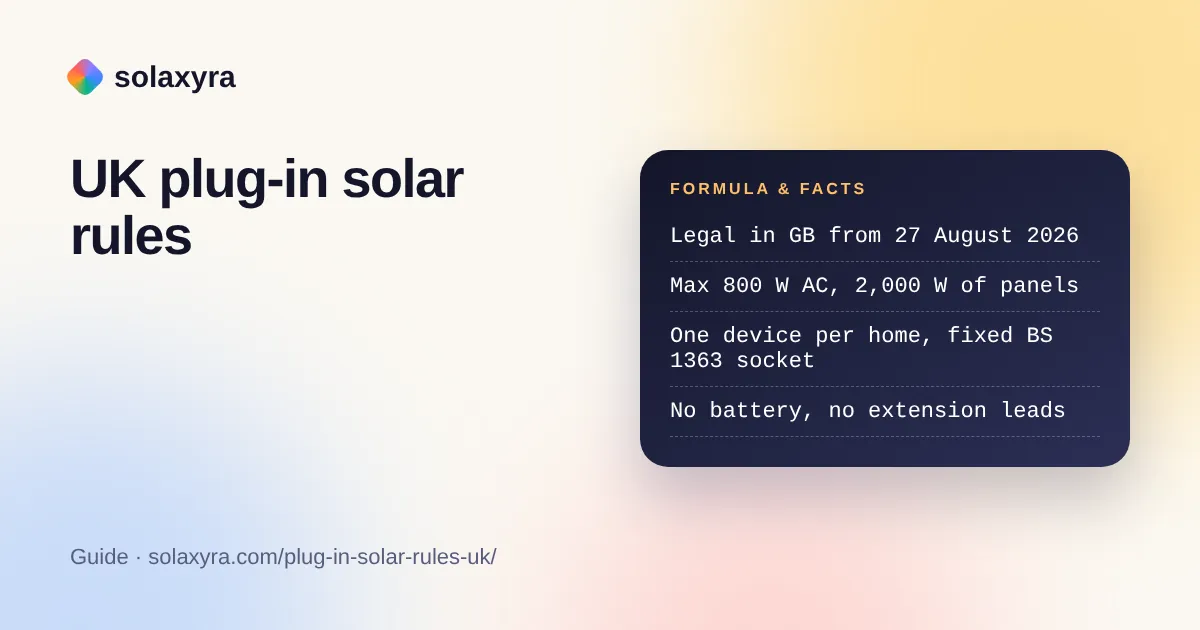
Quick answer: The plug in solar rules UK households follow took effect on 27 August 2026. In Great Britain you may use one plug-in solar device of up to 800 W AC, with no more than 2,000 W of panels, plugged into a fixed BS 1363 socket. It must be ENA-registered, registered online, and never used with a battery.
When Did Plug-In Solar Become Legal in the UK?
Plug-in solar became legal in Great Britain on 27 August 2026, when SI 2026/848 came into force after being made on 16 July 2026. Its full title is the Plugs and Sockets etc. (Safety) Regulations 1994 and Electricity Safety, Quality and Continuity Regulations 2002 (Amendment) Regulations 2026, and you can read it on legislation.gov.uk.
The instrument does two things. First, it lets approved bodies certify a plug for a solar microgenerator that otherwise follows BS 1363, which the 1994 plug rules previously blocked. Second, it amends the 2002 supply regulations so that a plug-in microgenerator is acceptable when it complies with the government’s Plug-in Solar Device Interim Product Specification. The law defines a plug-in microgenerator as a device that turns sunlight into electricity, has a rated AC output of no more than 800 watts, connects through a standard plug and socket, runs in parallel with the network and does not store energy.
Ofgem separately approved a change to Engineering Recommendation G98, the network connection standard for small generators, so that plug-in devices are treated as a distinct category limited to 800 W and one per household.
What Are the Main Plug-In Solar Rules?
There are seven core rules: an 800 W AC cap, a 2,000 W panel cap, a fixed BS 1363 socket, no adaptors or extension leads, one device per household, no battery, and registration so the network operator is told. The table shows each rule and the official document it comes from, so you can check it yourself.
| Rule | Limit or requirement | Where it is set |
|---|---|---|
| AC output | No more than 800 VA (800 W) and 3.5 A into the home | SI 2026/848 definition; Interim Product Specification clause 4.1 |
| Panel size | Total panel rating (Pmax) no more than 2,000 W | Interim Product Specification clause 4.1 |
| Above 960 W of panels | Professional assessment should be considered | Interim Product Specification clause 4.1 |
| Plug and socket | Moulded, non-rewireable BS 1363 plug with a BS 1362 fuse of 5 A or less, into a fixed socket | Interim Product Specification clause 6.2.3.2 |
| Adaptors | No extension cables, multi-way adaptors, RCD adaptors or travel adaptors | Interim Product Specification clauses 6.2.3.1 and 8.3.2 |
| Number of devices | One plug-in solar device per household | G98 amendment approved by Ofgem; Interim Product Specification scope |
| Type testing | Tested to G98 and listed on the ENA type test register | Interim Product Specification section 7 |
| Battery | Must not be connected to or used with a battery storage system | SI 2026/848 definition; Interim Product Specification clause 8.3.2 |
| Notification | The householder tells the network operator about connection and disconnection | Ofgem decision on DCRP/MP/26/02; Interim Product Specification clause 8.2.3.1 |
| Permissions | Landlord, freeholder, managing agent or planning consent where needed | Interim Product Specification clause 8.3.1 |
The 800 W limit applies to what the inverter delivers, not to the panels. That is why a kit can carry up to 2,000 W of panels: the extra panel area lifts output in mornings, evenings and winter, while the inverter clips anything above 800 W on bright days. To see how much an oversized kit actually adds where you live, run your numbers through the plug-in solar savings calculator.
What Socket and Wiring Does Plug-In Solar Need?
A plug-in solar device must go straight into a fixed BS 1363 socket on a circuit in good condition with modern residual current protection, and never into an extension lead or adaptor. The Energy Saving Trust plug-in solar checklist adds that the socket should not be one that also controls lighting or a hardwired appliance such as a boiler or cooker.
A quick current check shows why the limits fit together. At 800 VA and a nominal 230 V, the device sends about 3.48 A into the circuit (800 divided by 230). That sits just inside the 3.5 A cap in the specification and well below the 5 A fuse required in the plug. You can repeat the sum for any inverter rating with our watts to amps converter.
The specification tells users to check that the installation has modern RCBO protection. If your home still has an older fuse board without RCDs or RCBOs, the installation must be checked and, where necessary, upgraded by a professional electrician. Any change to the final circuit, or a new outdoor socket, is work for a registered electrician to BS 7671. The Energy Saving Trust says an outdoor socket should be rated at least IP65 and installed by a qualified electrician.
The device must also stop feeding power when the grid goes down. The specification requires disconnection within 100 milliseconds of losing the mains, and the voltage on the plug pins must drop below 34 V in that time, so the pins are not live when you unplug the kit.
Where Can You Mount Plug-In Solar Panels?
You can mount a kit in a garden, on a flat roof, wall or suitable balcony, but the specification bans fixings that rely only on cable ties, rope, string, adhesive tape, bungee cords or straps. Every attachment must be reversible and non-permanent and must not harm the structure, fire performance or weatherproofing of the building.
The specification lists surfaces where a plug-in kit must not be installed:
- aluminium composite or metal composite cladding systems;
- high pressure laminate cladding systems;
- timber cladding systems;
- timber balconies;
- buildings subject to external wall remediation, building safety remediation or similar restrictions.
Manufacturers must publish the full mounting system and a structural analysis covering wind and snow loads. If you plan to fix panels to a garage or outbuilding roof, the Energy Saving Trust advises checking that it can take the weight; for anything beyond a ground or wall frame, a structural engineer’s view is sensible. Facing direction also matters: east or west panels work but produce less, and the solar panel orientation calculator shows the loss for your angle.
How Do You Install Plug-In Solar Legally?
Installing legally comes down to five checks, done in this order, before and just after you plug in.
- Get permission. Ask your landlord, freeholder or managing agent in writing, and check planning on the Planning Portal (England and Wales) or ePlanning Scotland, especially for listed buildings and conservation areas.
- Check the product. Confirm the exact model appears on the ENA type test register and that it is sold as a complete kit with a moulded plug.
- Check the circuit. Find a suitable fixed socket, confirm RCD or RCBO protection at the consumer unit, and call a registered electrician if you have an old fuse board or need an outdoor socket.
- Mount it securely with the manufacturer’s frame, then plug directly into the socket and fix the supplied label at or near your consumer unit.
- Register the device. The Energy Saving Trust directs householders to the UK plug-in solar registration website, which asks for your name, postcode and the make and model. Ofgem’s decision places the duty to notify the network operator on the customer.
The Energy Saving Trust also recommends telling your buildings and contents insurer and testing the circuit breaker protection every six months.
Does Plug-In Solar Apply in Northern Ireland?
No, plug-in solar is not currently legal in Northern Ireland, according to the Energy Saving Trust. SI 2026/848 changes the 2002 supply regulations only for England, Wales and Scotland, and Northern Ireland uses a separate connection standard, G98/NI. The interim specification says its application to Northern Ireland is still under consideration.
Can You Add a Battery or Get Paid for Exports?
No battery is allowed: the legal definition excludes devices that store energy, and every kit must carry a warning that it is not for use with a battery storage system. Ofgem’s decision notes that plug-in storage remains prohibited pending a future review.
Payment for exported electricity is unlikely. The Energy Saving Trust says an MCS certificate is needed to sell power under the Smart Export Guarantee, which plug-in kits do not normally have. Surplus power simply flows to the grid unpaid, so the value of a kit comes from the electricity you use while it generates. The Energy Saving Trust estimates around 700 kWh a year from a typical kit and savings of about £70 to £100 a year depending on whether you are home in the day. At the current price cap rate of 26.32p per kWh set by Ofgem, every 100 kWh you use from the panels is worth about £26.
Frequently Asked Questions
What is the maximum size of plug-in solar allowed in the UK?
The inverter may deliver no more than 800 W (800 VA) into your home, and the panels connected to it may total no more than 2,000 W. If your panels exceed 960 W, the government specification says you should consider a professional assessment before installing.
Can I use an extension lead with plug-in solar panels?
No. The interim product specification forbids extension cables, multi-way adaptors, plug-in RCD adaptors and travel adaptors. The kit’s moulded plug must go directly into a fixed BS 1363 socket on a circuit that is in good condition and protected by an RCD or RCBO.
Do I need to register plug-in solar panels?
Yes. The network operator must be told when a plug-in device is connected or removed, and the householder is responsible. The Energy Saving Trust points people to the UK plug-in solar registration website, which asks for your name, postcode and the make and model of the device.
Can I have two plug-in solar kits?
No. Ofgem approved a change to Engineering Recommendation G98 limiting plug-in microgenerators to one per household, and the specification requires kits to be labelled with this rule. Linking several devices together to get around the 800 W limit is not allowed.
Is plug-in solar legal in Northern Ireland?
Not yet. The 2026 amendment to the supply regulations covers England, Wales and Scotland only, and Northern Ireland uses its own connection standard, G98/NI. The Energy Saving Trust says regulations there need updating before plug-in solar can be used.
Do I need an electrician for plug-in solar?
Not to plug in a compliant kit, but you do if your home has an old fuse board without RCD or RCBO protection, if the circuit needs changing, or if you need a new outdoor socket. That work must be done by a registered electrician to BS 7671.
Checked October 2026 by the Solaxyra Editorial Team. Sources: SI 2026/848 on legislation.gov.uk, DESNZ Plug-in Solar Device Interim Product Specification, Ofgem decision on DCRP/MP/26/02, Energy Saving Trust: plug-in solar panels, Energy Saving Trust: plug-in solar checklist, GOV.UK announcement, Ofgem price cap October to December 2026.