Public charger prices differ by network, speed and membership. Check the price in the app or on the charger before you plug in.
Formula and breakdown
n/a
n/a
n/a
This EV public charging cost calculator works out what a rapid or public charging session costs, how many miles it adds and the cost per mile. It also shows what the same energy would cost at home, so you can see the premium for charging on the road.
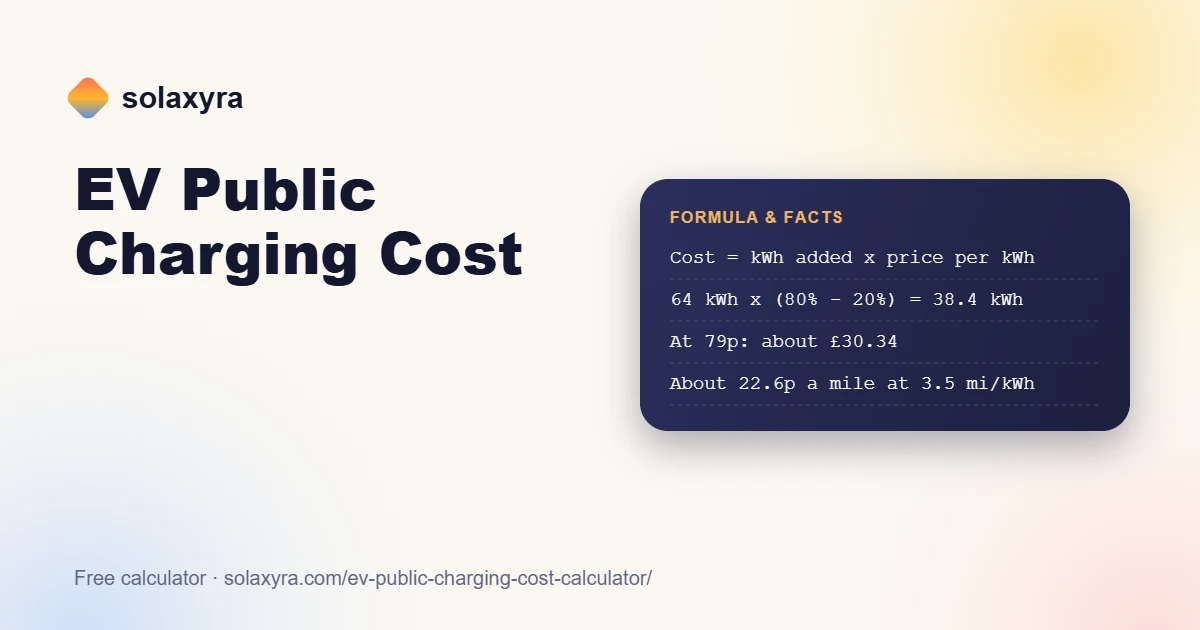
Quick answer: Multiply the kWh you add by the price per kWh. Adding 20% to 80% on a 64 kWh battery is 38.4 kWh; at an example 79p per kWh that costs about £30.34, around 22.6p a mile at 3.5 miles per kWh. At home at 26.32p it would cost about £11.23.
What Is an EV Public Charging Cost Calculator?
An EV public charging cost calculator turns a charging session into pounds and pence. Public chargers usually bill per kWh delivered, sometimes with a connection or parking fee, and prices depend on the network, the charger speed and any subscription you hold.
How Do You Use the EV Public Charging Cost Calculator?
- Enter your car’s usable battery capacity.
- Enter the state of charge you start from and stop at.
- Enter the price per kWh shown in the charging app or on the unit, and any session fee.
- Enter your typical efficiency in miles per kWh. Many cars show this in the trip computer.
- Enter your home electricity price to see the comparison.
How Much Does Public Charging Cost?
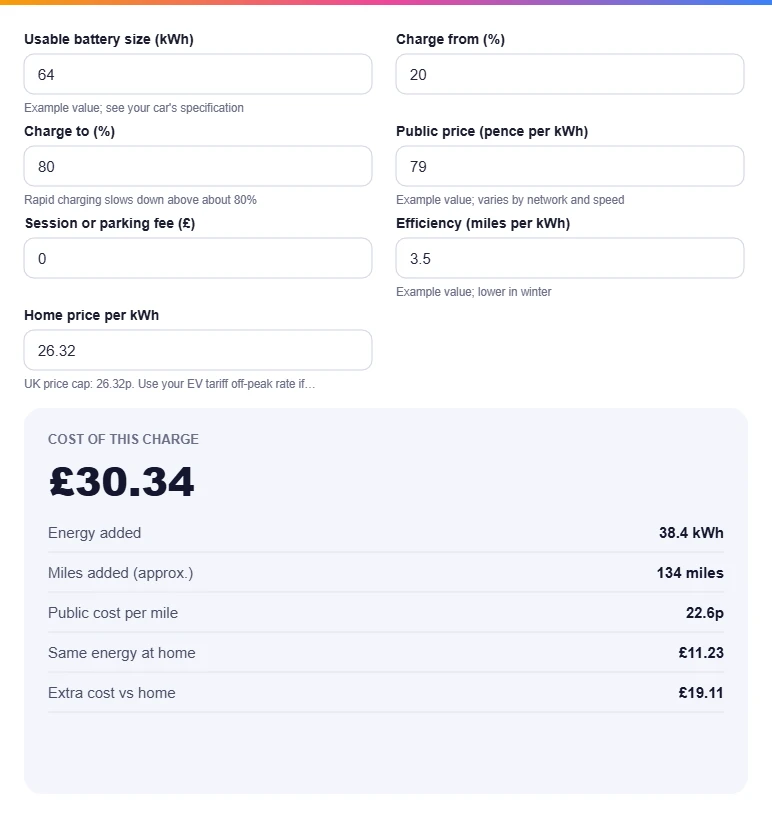
Adding 38.4 kWh (20% to 80% on a 64 kWh battery), about 134 miles at 3.5 miles per kWh:
| Price per kWh | Session cost | Cost per mile |
|---|---|---|
| Home cap rate, 26.32p (incl. 10% loss) | £11.23 | 8.4p |
| Slow public charger, 50p | £19.20 | 14.3p |
| Fast public charger, 65p | £24.96 | 18.6p |
| Rapid charger, 79p | £30.34 | 22.6p |
| Ultra-rapid, 89p | £34.18 | 25.4p |
Prices in the table are examples to show the range.
Is Public Charging Cheaper Than Petrol?
At rapid charger prices it can be close. A petrol car doing 45 miles per gallon at 140p a litre costs about 14p a mile. Rapid charging at 79p per kWh and 3.5 miles per kWh is about 22.6p a mile, while home charging on the price cap is about 8p and an off-peak EV tariff is often far less.
Why Is Public Charging More Expensive?
Rapid chargers need costly grid connections and hardware, and operators pay demand charges and maintenance. Public charging also carries a higher rate of VAT than home electricity. Paying for convenience and speed is the trade-off.
Ways to Pay Less When Charging Away From Home
- Use network subscriptions if you charge often on one network.
- Stop at 80%; charging slows after that and you pay for time at many sites.
- Use destination chargers at hotels and car parks, which can be cheaper or free.
- Charge at home or work before long trips.
Worked Example: A Motorway Trip
Example: a driver from Exeter to Manchester needs one rapid stop.
- Battery 77 kWh, charged from 15% to 75%: 46.2 kWh.
- At 85p per kWh the stop costs £39.27.
- At 3.2 miles per kWh in winter that adds about 148 miles, 26.5p a mile.
- The same energy at home on a 7p off-peak EV tariff would cost about £3.59.
Frequently Asked Questions
How much does it cost to charge an EV at a public charger?
Typically £15 to £40 for a 20% to 80% charge, depending on battery size and the price per kWh.
Is it cheaper to charge an EV at home?
Yes, usually much cheaper, especially on an off-peak EV tariff.
Why do rapid chargers cost more?
They cost more to build and connect to the grid, and they deliver energy far faster.
Do I need a subscription to use public chargers?
Most rapid chargers accept contactless or an app; subscriptions can lower the price per kWh.
Checked November 2026 by the Solaxyra Editorial Team. Sources: Ofgem: Energy price cap, 1 October to 31 December 2026, GOV.UK: Electric vehicle public charging infrastructure statistics.