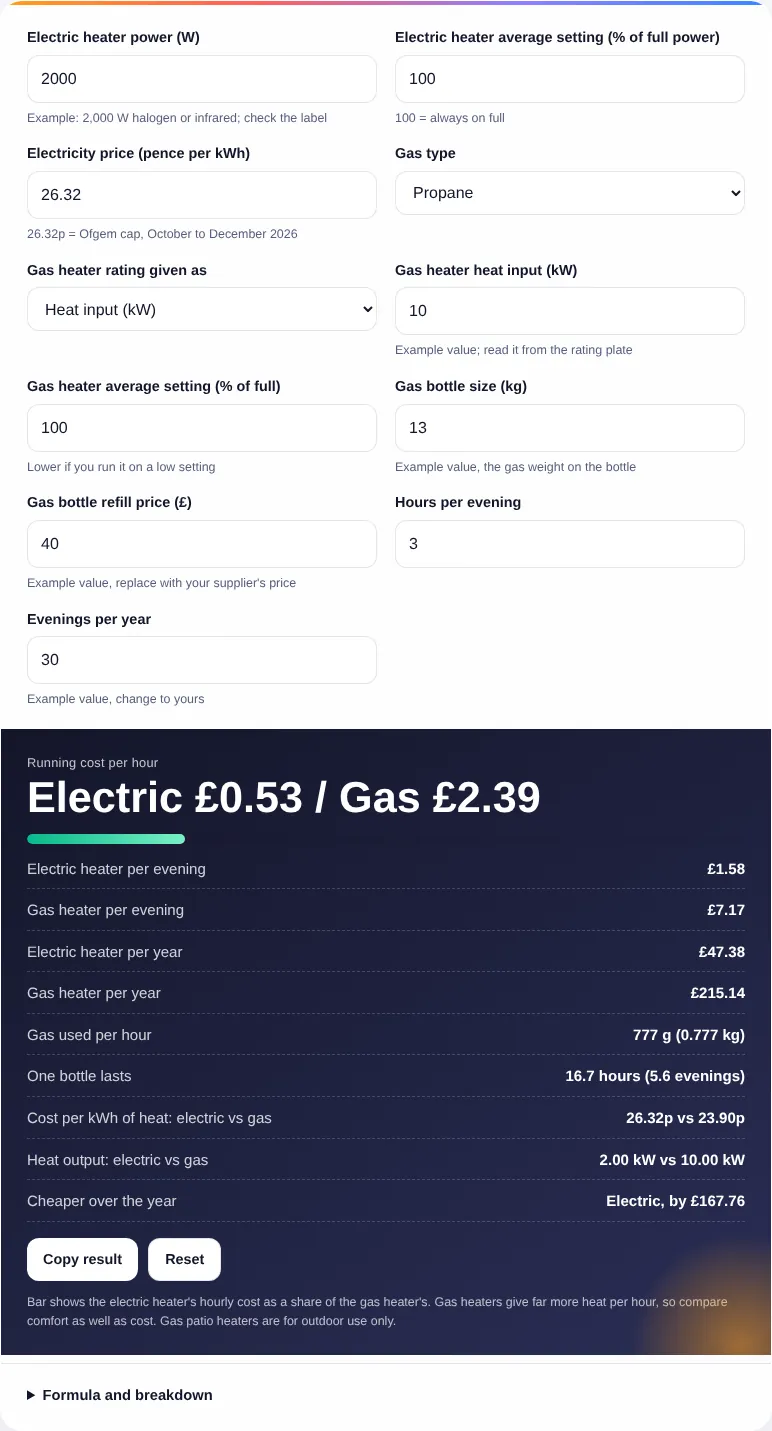
Bar shows the electric heater’s hourly cost as a share of the gas heater’s. Gas heaters give far more heat per hour, so compare comfort as well as cost. Gas patio heaters are for outdoor use only.
Formula and breakdown
n/a
n/a
n/a
This patio heater running cost calculator works out what an electric patio heater and a propane or butane gas patio heater cost to run per hour, per evening and per year, for UK and European households, pubs and cafés deciding which to buy or how often to use one. It reads the heater’s watts or its gas rating, your electricity price and your gas bottle price, and shows how long a bottle will last.
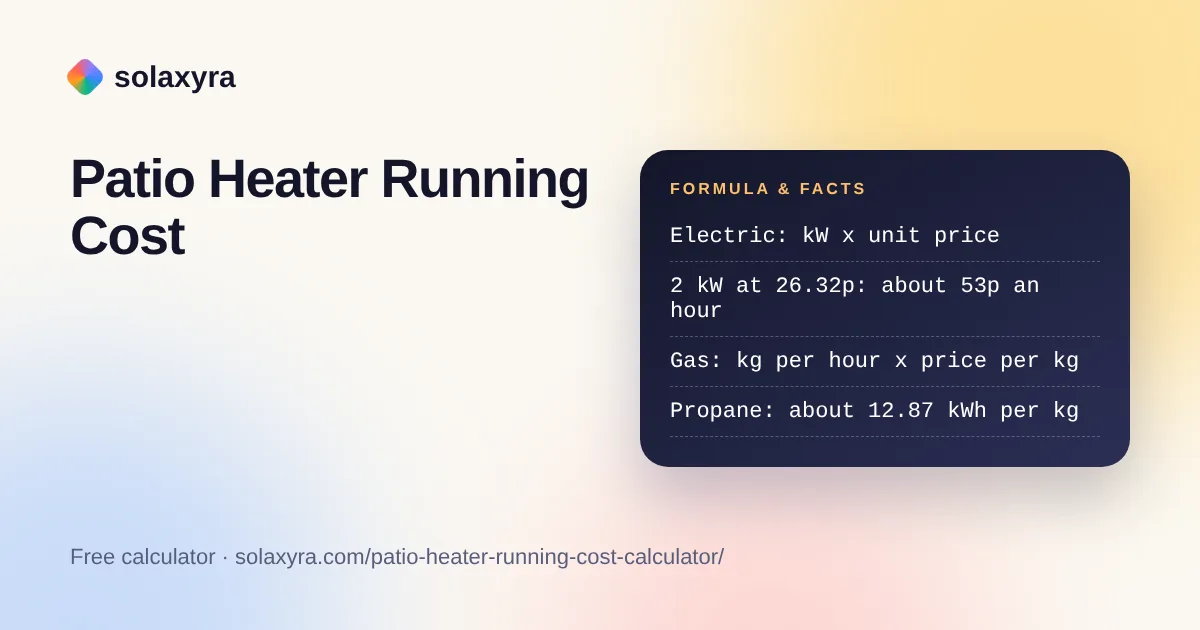
Quick answer: A patio heater running cost calculator multiplies an electric heater’s kW by your unit price, so 2 kW at the 26.32p Ofgem cap costs about 53p an hour. A 10 kW propane heater burns about 0.78 kg an hour; with a 13 kg bottle at an example £40, it costs about £2.39 an hour.
What Is a Patio Heater Running Cost Calculator?
A patio heater running cost calculator is a tool that converts a heater’s power or gas consumption into money per hour of use, so electric and gas models can be compared on the same terms. In plain words: an electric heater costs its power in kilowatts times the price of a kWh. A gas heater costs the kilograms of gas it burns each hour times the price per kilogram, which is the bottle price divided by the gas weight in the bottle.
If the gas heater’s rating plate gives only heat input in kW, the patio heater running cost calculator converts it to kilograms using the energy in the gas. The Wikipedia article on propane gives a lower heating value of 2,043.455 kJ per mole and a molar mass of 44.097 g per mole, which works out at 46.34 MJ, or 12.87 kWh, per kg. For butane the calculator uses Wikipedia’s 13.8 kWh per kg.
How Do You Use the Patio Heater Running Cost Calculator?
- Enter the electric heater’s power in watts from its label, and the average setting if it has a lower power level you use most.
- Enter your electricity unit price. The default is the Ofgem cap rate for October to December 2026.
- Choose propane or butane, then enter the gas heater’s rating either as heat input in kW or as gas use in grams per hour.
- Set the gas heater’s average setting, then the gas weight of your bottle and what you pay to refill it.
- Enter the hours you use the heater each evening and how many evenings a year.
- Read the cost per hour for both heaters, the cost per evening and per year, how long a bottle lasts and which is cheaper over the year.
How Much Does an Electric Patio Heater Cost to Run per Hour?
An electric patio heater costs its power in kW multiplied by your electricity price: at 26.32p per kWh, a 1.5 kW heater costs about 39p an hour, a 2 kW heater about 53p and a 3 kW heater about 79p. The price comes from the Ofgem energy price cap for 1 October to 31 December 2026; a fixed or time-of-use tariff changes the answer, so enter your own rate.
Halogen, carbon and quartz infrared heaters all turn the electricity they draw into heat, so the running cost depends only on the wattage and the hours used, not the heating element. What differs is how the heat reaches people: infrared heaters warm the people and surfaces they face rather than the air, which suits open patios where warm air blows away. The same arithmetic is used in our electric heater running cost calculator for indoor heaters.
How Much Does a Gas Patio Heater Cost to Run per Hour?
A gas patio heater costs the kilograms of gas it burns per hour times the price per kilogram. A 10 kW propane heater on full burns 10 / 12.87 = 0.78 kg an hour; with a 13 kg bottle at an example £40 (£3.08 per kg), that is about £2.39 an hour, and the bottle lasts about 16.7 hours.
The table compares common sizes, worked out with the patio heater running cost calculator. Electric costs use the Ofgem cap rate; gas costs use propane at the example price of £40 for 13 kg, so replace it with your supplier’s price. Heat input values are examples, not ratings of any particular model.
| Heater (example size) | Heat | Fuel used per hour | Cost per hour | Cost for a 3-hour evening |
|---|---|---|---|---|
| Electric, 1.5 kW | 1.5 kW | 1.5 kWh | £0.39 | £1.18 |
| Electric, 2 kW | 2 kW | 2 kWh | £0.53 | £1.58 |
| Electric, 3 kW | 3 kW | 3 kWh | £0.79 | £2.37 |
| Propane, 6 kW | 6 kW | 466 g | £1.43 | £4.30 |
| Propane, 10 kW | 10 kW | 777 g | £2.39 | £7.17 |
| Propane, 13 kW | 13 kW | 1,010 g | £3.11 | £9.32 |
Is a Gas or Electric Patio Heater Cheaper to Run?
Per hour, a typical electric patio heater is cheaper because it is much smaller; per kWh of heat, bottled propane and capped electricity cost about the same. At £40 for 13 kg, propane costs £3.08 per kg, or 23.9p per kWh of heat, against 26.32p for electricity. A 10 kW gas heater therefore costs more per hour than a 2 kW electric heater mainly because it puts out five times as much heat.
So the fair question is how much heat you need. A sheltered seating area where people sit close to the heater may be comfortable with infrared electric heat. An open, windy terrace may need the larger output of a gas heater, often on a low setting. The patio heater running cost calculator shows heat output beside cost so you can compare like with like, and the “average setting” inputs let you model a gas heater turned down.
How Long Does a Gas Bottle Last on a Patio Heater?
A gas bottle lasts its gas weight divided by the heater’s consumption per hour: 13 kg in a heater using 0.78 kg an hour lasts about 16.7 hours, roughly five or six evenings of three hours. Running the heater at half setting roughly doubles that. If the rating plate or manual gives gas use in grams per hour, choose that option in the patio heater running cost calculator for the most direct answer.
Bottle sizes and prices vary between suppliers and between propane and butane. The bottle size field means the weight of gas, not the weight of the full cylinder, so check the label. Keep a spare bottle outdoors and upright, and follow the supplier’s storage advice.
Are Patio Heaters Safe to Use Under Cover?
Gas patio heaters are outdoor appliances and must never be used indoors or in an enclosed space. Health and Safety Executive guidance on domestic gas safety warns that outdoor heaters are not designed for indoor use, and that carbon monoxide is colourless and odourless and can kill without warning. Burning gas with too little air produces carbon monoxide, so a gazebo with closed sides or a garage is not a safe place for one. Follow the manufacturer’s clearances, and any gas work on fixed installations must be done by a Gas Safe registered engineer.
Electric heaters remove the carbon monoxide risk but bring electrical ones. Use a heater rated for outdoor use, plug it into an outdoor socket protected by an RCD, and have any new outdoor circuit or wall-mounted heater installed by a qualified electrician to BS 7671. The watts to amps calculator shows that a 3 kW heater draws about 13 A at 230 V, the full rating of a UK plug.
Worked Example: Infrared vs Propane for Autumn Evenings
Example: a household compares a 1,500 W infrared heater with a propane heater whose rating plate lists 870 g per hour on full. They expect to run the gas heater at about half setting, for 4 hours an evening on 40 evenings a year, with 13 kg propane bottles at an example £40. Electricity is at the 26.32p cap rate. All heater figures are examples.
- Electric: 1.5 kW x 26.32p = 39.5p an hour; 4 hours = £1.58 an evening; 40 evenings = £63.17 a year.
- Gas use: 870 g x 50% = 435 g, or 0.435 kg an hour, giving about 5.6 kW of heat.
- Gas price: £40 / 13 kg = £3.08 per kg. Cost: 0.435 x £3.08 = £1.34 an hour; £5.35 an evening; £214.15 a year.
- Bottle life: 13 / 0.435 = 29.9 hours, about 7.5 evenings, so about 6 bottles a year.
- The electric heater is cheaper by £150.99 a year, but gives 1.5 kW of heat against about 5.6 kW.
The patio heater running cost calculator gives the same figures. Whether the saving is worth the smaller heat output depends on how sheltered the seating is.
Frequently Asked Questions
How much does a patio heater cost to run per hour?
An electric heater costs its kW times your unit price, so 2 kW at the 26.32p Ofgem cap is about 53p an hour. A 10 kW propane heater burns about 0.78 kg an hour, which is about £2.39 with an example £40 for a 13 kg bottle.
Are electric patio heaters cheaper than gas?
Usually per hour, because electric patio heaters are smaller. Per kWh of heat, bottled propane at £40 for 13 kg costs about 23.9p and electricity at the Ofgem cap 26.32p, so the cost of the same amount of heat is similar. Compare heat output as well as price.
How long does a 13 kg propane bottle last in a patio heater?
Divide 13 kg by the heater’s gas use per hour. A heater burning 0.78 kg an hour, about 10 kW, empties it in about 16.7 hours. At half setting it lasts roughly twice as long. Use the grams per hour figure from the rating plate if it is given.
How do I convert a gas heater’s kW rating to gas use?
Divide the heat input in kW by the energy in a kilogram of gas. Propane has a lower heating value of about 12.87 kWh per kg, derived from Wikipedia’s figures, so a 10 kW heater uses about 0.78 kg an hour. Butane is taken as 13.8 kWh per kg.
Can I use a gas patio heater in a gazebo or garage?
No. Gas patio heaters are outdoor appliances. HSE guidance warns that outdoor heaters are not designed for indoor use, and burning gas without enough fresh air produces carbon monoxide, which is colourless, odourless and can kill. Use them only in open air with the maker’s clearances.
What does the patio heater running cost calculator not include?
It leaves out the purchase price, bottle deposits or rental, delivery charges, standing charges and any outdoor wiring. It also assumes the heater runs at the average setting you enter for every hour. Use your own bottle price and electricity tariff for the most accurate answer.
Checked October 2026 by the Solaxyra Editorial Team. Sources: Ofgem: Energy price cap, 1 October to 31 December 2026, Wikipedia: Propane, Wikipedia: Butane, HSE: Domestic gas safety FAQs.