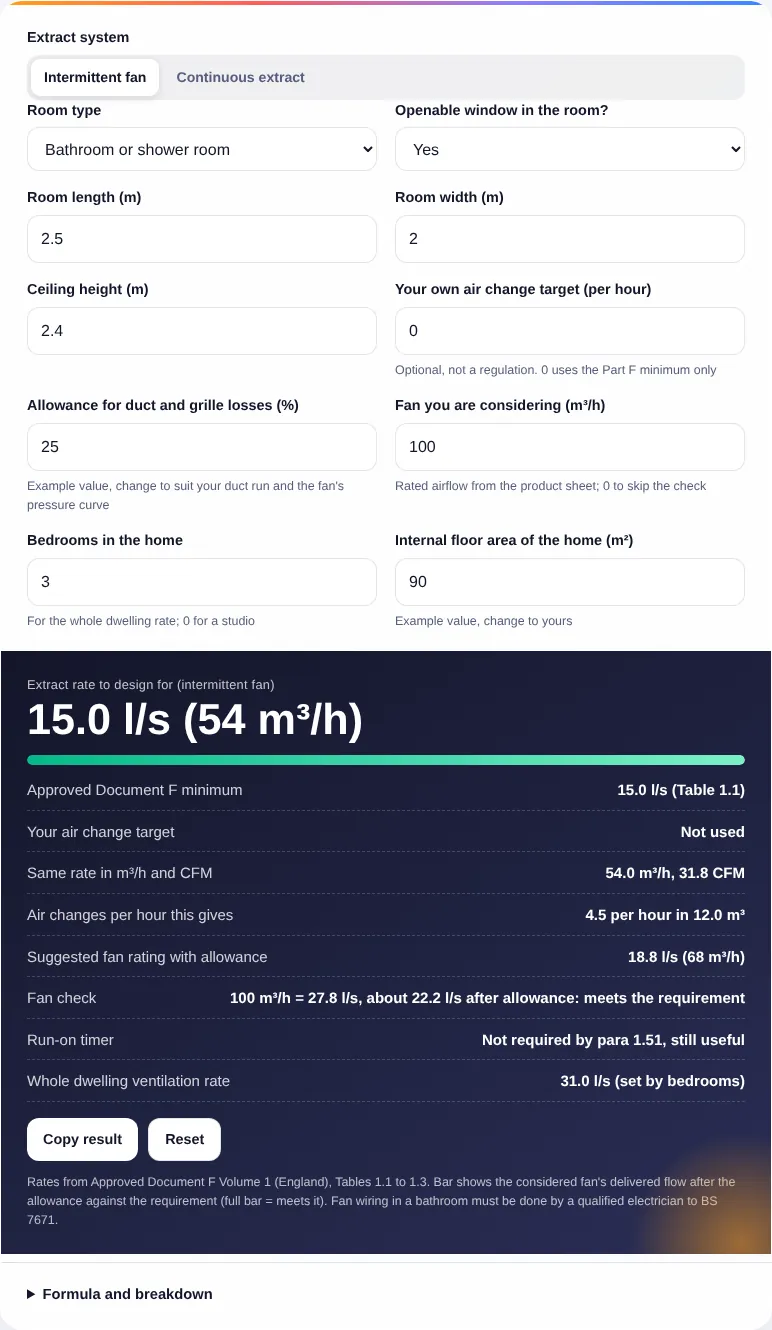
Rates from Approved Document F Volume 1 (England), Tables 1.1 to 1.3. Bar shows the considered fan’s delivered flow after the allowance against the requirement (full bar = meets it). Fan wiring in a bathroom must be done by a qualified electrician to BS 7671.
Formula and breakdown
n/a
n/a
n/a
n/a
This extractor fan size calculator works out the minimum extract rate for a bathroom, kitchen, utility room or toilet in a home in England, in litres per second, cubic metres per hour and CFM, and checks whether a fan you are looking at is big enough once duct and grille losses are allowed for. It is meant for homeowners, landlords and electricians choosing a replacement or new fan, and it shows the rule behind every number.
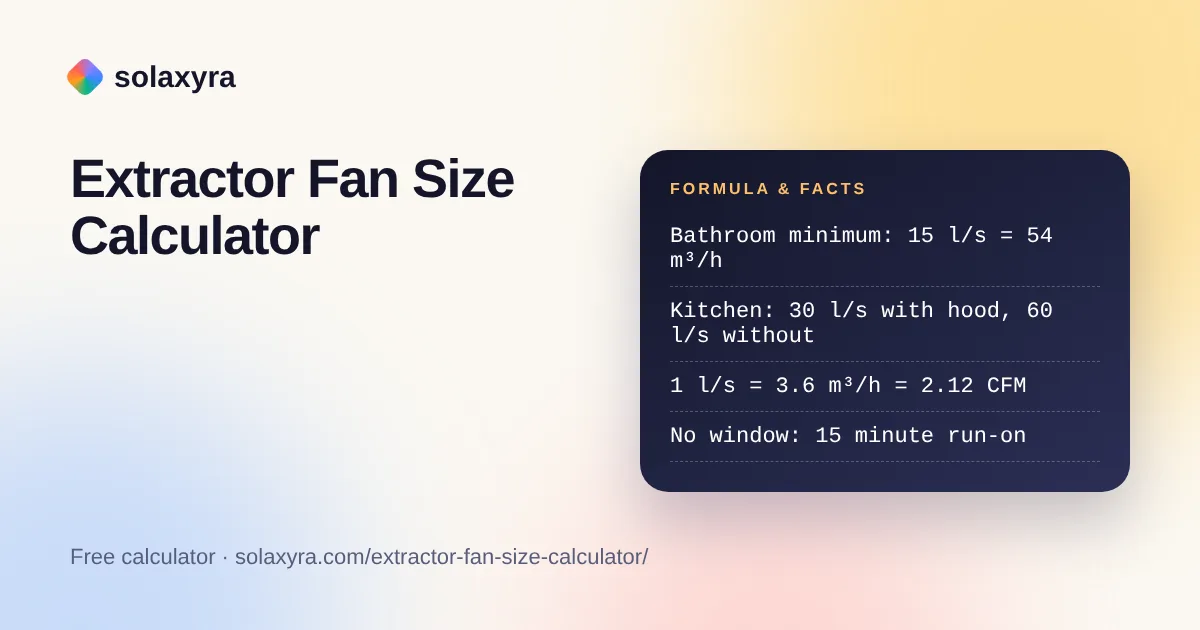
Quick answer: An extractor fan size calculator starts from the legal minimum. In England, Approved Document F asks for at least 15 l/s (54 m³/h) from an intermittent bathroom fan, 30 l/s for a kitchen with an outside cooker hood, 60 l/s for other kitchen fans, 30 l/s for a utility room and 6 l/s for a toilet.
What Is an Extractor Fan Size Calculator?
An extractor fan size calculator is a tool that turns a room type and its dimensions into the airflow a fan must move to remove steam, cooking moisture and odours at source. In plain words: look up the minimum extract rate for the room in the building regulations, compare it with any air change target you want to use, take the larger figure, then add an allowance because a fan never delivers its free-air rating once ducting and a grille are fitted.
Airflow is quoted three ways. The regulations in England use litres per second (l/s). Fan boxes in the UK and Europe usually give cubic metres per hour (m³/h), and one l/s equals 3.6 m³/h. American products use cubic feet per minute: one cubic foot per second is 28.3168 litres per second according to the Wikipedia entry on cubic feet per minute, so one CFM is about 0.472 l/s.
How Do You Use the Extractor Fan Size Calculator?
- Choose an intermittent fan (switched on with the light or a humidity sensor) or a continuous extract system that runs all the time with a boost setting.
- Pick the room type. For a kitchen, say whether the extraction is a cooker hood ducted outside or another fan.
- Enter the room length, width and ceiling height, and say whether the room has a window that opens.
- Optionally enter your own air change target per hour. Leave it at 0 to work to the Part F minimum.
- Set an allowance for duct and grille losses and type the rated airflow of the fan you are considering.
- Read the required rate, the suggested fan rating and the pass or fail check, then open the breakdown to see each step.
What Size Extractor Fan Do I Need for a Bathroom?
A bathroom in England needs an intermittent fan that extracts at least 15 l/s, which is 54 m³/h or about 32 CFM, whatever the size of the room. That figure is in Table 1.1 of Approved Document F Volume 1 for dwellings, the 2021 edition that took effect on 15 June 2022. A continuous system needs a high rate of at least 8 l/s in the bathroom instead.
The rule is a minimum per room, not per cubic metre, so a large family bathroom has the same legal floor as a small en-suite. That is why many fan guides also quote air changes per hour. The extractor fan size calculator lets you add such a target, but treat it as your own choice: Approved Document F does not set air changes for extract fans, and the figures quoted by retailers vary widely.
What Are the Minimum Extract Rates in Approved Document F?
Approved Document F sets five room categories for intermittent extract and four for continuous extract, from 6 l/s for a toilet up to 60 l/s for a kitchen without a cooker hood that vents outside. The table lists both, with the m³/h figure that the extractor fan size calculator also shows and that you will see on fan packaging.
| Room | Intermittent minimum (Table 1.1) | In m³/h | Continuous high rate (Table 1.2) |
|---|---|---|---|
| Kitchen, cooker hood extracting outside | 30 l/s | 108 | 13 l/s |
| Kitchen, no cooker hood extracting outside | 60 l/s | 216 | 13 l/s |
| Utility room | 30 l/s | 108 | 8 l/s |
| Bathroom | 15 l/s | 54 | 8 l/s |
| Sanitary accommodation (toilet) | 6 l/s | 21.6 | 6 l/s |
With continuous extract, Approved Document F also asks that all the extract points together, on their normal continuous setting, reach the whole dwelling ventilation rate in Table 1.3: 19 l/s for one bedroom, 25 for two, 31 for three, 37 for four and 43 for five, plus 6 l/s per extra bedroom, or 0.3 l/s per m² of internal floor area if that is higher. The tool works this out from your bedroom count and floor area. A 2026 edition of Volume 1 keeps the same room rates and takes effect on 24 March 2027 for most building work.
Do Air Change Rules of Thumb Give the Same Answer?
No. Air change rules scale with room volume, so for a small en-suite they can fall close to the legal minimum while for a large bathroom they can call for four times as much airflow. The table compares the 15 l/s Part F minimum with two air change figures that appear in UK retail guides, worked out for three example bathroom sizes with a 2.4 m ceiling.
| Example bathroom | Volume | Part F minimum | 10 air changes | 20 air changes | Part F as air changes |
|---|---|---|---|---|---|
| Small en-suite, 1.8 x 1.5 m | 6.5 m³ | 54 m³/h | 65 m³/h | 130 m³/h | 8.3 per hour |
| Typical bathroom, 2.5 x 2.0 m | 12 m³ | 54 m³/h | 120 m³/h | 240 m³/h | 4.5 per hour |
| Large bathroom, 3.0 x 3.0 m | 21.6 m³ | 54 m³/h | 216 m³/h | 432 m³/h | 2.5 per hour |
A fan sized only to the legal minimum clears steam more slowly in a big room, while a fan sized to 20 air changes may be noisy and pull more warm air out of the house than needed. Many people settle between the two. A larger fan also costs a little more to run; the watts to kWh calculator shows what any fan wattage on the product sheet uses over a year.
Why Should the Fan Be Rated Above the Minimum?
A fan’s headline airflow is measured with no ducting attached, so the flow you get through a length of duct, bends and an outside grille is lower, and sizing with a margin is the simple way to cover that. How much lower depends on the fan’s pressure curve and your duct run, which only the manufacturer’s data can tell you. The allowance in this extractor fan size calculator is therefore an example value of 25%; raise it for long or bendy runs or flexible duct, and check the fan’s published curve where one is given.
Approved Document F also expects fans to be fitted as high as practicable and no more than 400 mm below the ceiling, and in a room with no openable window an intermittent fan should keep running for at least 15 minutes after the room is vacated. The extractor fan size calculator flags that run-on when you say the room has no window.
Do I Need an Electrician to Fit an Extractor Fan?
Usually yes. Under Approved Document P in England, a new circuit, or any addition or alteration to a circuit in the space around a bath or shower (0.6 m out from the tub or tray), is notifiable work, and electrical work should meet BS 7671. A qualified electrician registered with a competent person scheme can do the work, choose a fan suitable for its position and self-certify it. Approved Document F says replacing a fan on the existing cabling does not need to be notified to building control under Part F, but the electrical side still has to be safe.
If damp keeps coming back after a fan is fitted, the condensation risk calculator and a dehumidifier size calculator help find the cause.
Worked Example: Internal En-Suite With No Window
Example: an en-suite in a terraced house measures 1.8 x 1.5 m with a 2.4 m ceiling and has no window. Entered into the extractor fan size calculator, the owner compares a fan rated at 85 m³/h and allows 25% for a short duct and outside grille.
- Volume: 1.8 x 1.5 x 2.4 = 6.48 m³.
- Approved Document F minimum for an intermittent bathroom fan: 15 l/s, which is 15 x 3.6 = 54 m³/h, or 15 / 0.472 = 31.8 CFM.
- Air changes this gives: 54 / 6.48 = 8.3 per hour.
- Suggested rating with the allowance: 15 x 1.25 = 18.75 l/s, or 67.5 m³/h.
- Fan check: 85 m³/h / 3.6 = 23.6 l/s, divided by 1.25 = 18.9 l/s delivered, which meets 15 l/s.
- Because there is no window, the fan needs a run-on of at least 15 minutes after the room is vacated.
Running that fan is cheap: taking an example rating of 5 W for 3 hours a day it uses about 5.5 kWh a year, which the electricity cost calculator turns into pence at your tariff.
Frequently Asked Questions
What size extractor fan do I need for a small bathroom?
In England an intermittent bathroom fan must extract at least 15 l/s, which is 54 m³/h, for any size of bathroom. Add an allowance for the duct and grille, so a fan rated around 70 m³/h or more is a sensible choice for a short duct run.
How do I convert l/s to m³/h for an extractor fan?
Multiply litres per second by 3.6 to get cubic metres per hour, because an hour has 3,600 seconds and a cubic metre holds 1,000 litres. So 15 l/s is 54 m³/h, 30 l/s is 108 m³/h and 60 l/s is 216 m³/h.
What extract rate does a kitchen need?
Approved Document F asks for 30 l/s (108 m³/h) where a cooker hood extracts to the outside, and 60 l/s (216 m³/h) where the kitchen relies on another extract fan. A recirculating hood on its own does not count as extract ventilation.
How long should an extractor fan run after a shower?
Where the room has no openable window, Approved Document F says an intermittent fan should keep running for at least 15 minutes after the room is vacated. A humidity sensor or timer that runs longer is fine and helps clear steam.
Can an extractor fan be too powerful?
Yes, in practice. A much larger fan than needed can be noisier, uses a little more electricity and pulls more warm air out of the home every time it runs. Size to the requirement plus a sensible margin rather than the biggest model available.
Does this extractor fan size calculator apply in Scotland, Wales or Ireland?
The rates come from Approved Document F, which covers England. Scotland, Wales, Northern Ireland and Ireland have their own building regulations, so use the calculator with your own local minimum entered as an air change target or check the local guidance before buying a fan.
Checked October 2026 by the Solaxyra Editorial Team. Sources: Approved Document F: ventilation (gov.uk), Approved Document F Volume 1: Dwellings, 2021 edition, Approved Document F Volume 1: Dwellings, 2026 edition, Approved Document P: electrical safety, dwellings (gov.uk), Wikipedia: Cubic feet per minute.