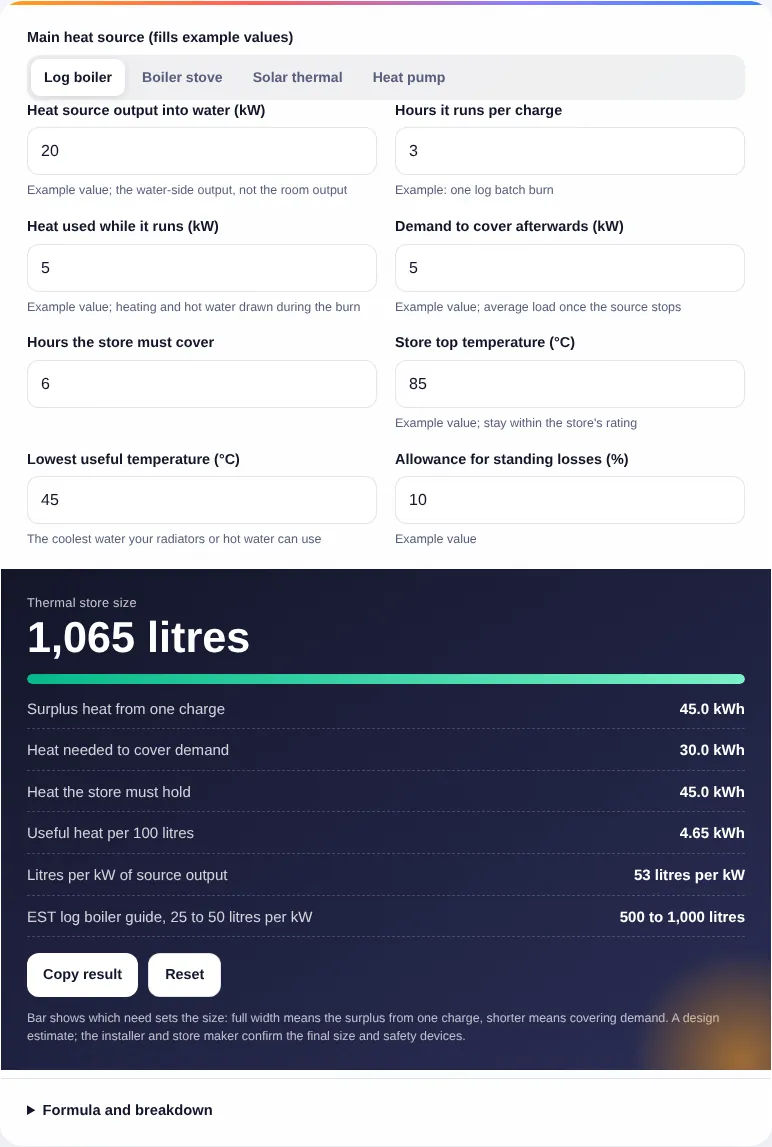
Bar shows which need sets the size: full width means the surplus from one charge, shorter means covering demand. A design estimate; the installer and store maker confirm the final size and safety devices.
Formula and breakdown
n/a
n/a
n/a
This thermal store size calculator works out how many litres a thermal store needs to hold the surplus heat from a log boiler, boiler stove, solar thermal panels or heat pump, or to carry the house through the hours when the heat source is off, for UK and European homes planning a multi-source heating system. It uses the heat capacity of water and the temperature swing the store can actually use, and compares the answer with Energy Saving Trust guidance.
Quick answer: A thermal store size calculator divides the heat to be stored by the heat each litre holds over the usable temperature swing. A 20 kW log boiler burning for 3 hours while the house uses 5 kW leaves 45 kWh; stored between 85 °C and 45 °C with 10% for losses, that needs about 1,065 litres.
What Is a Thermal Store Size Calculator?
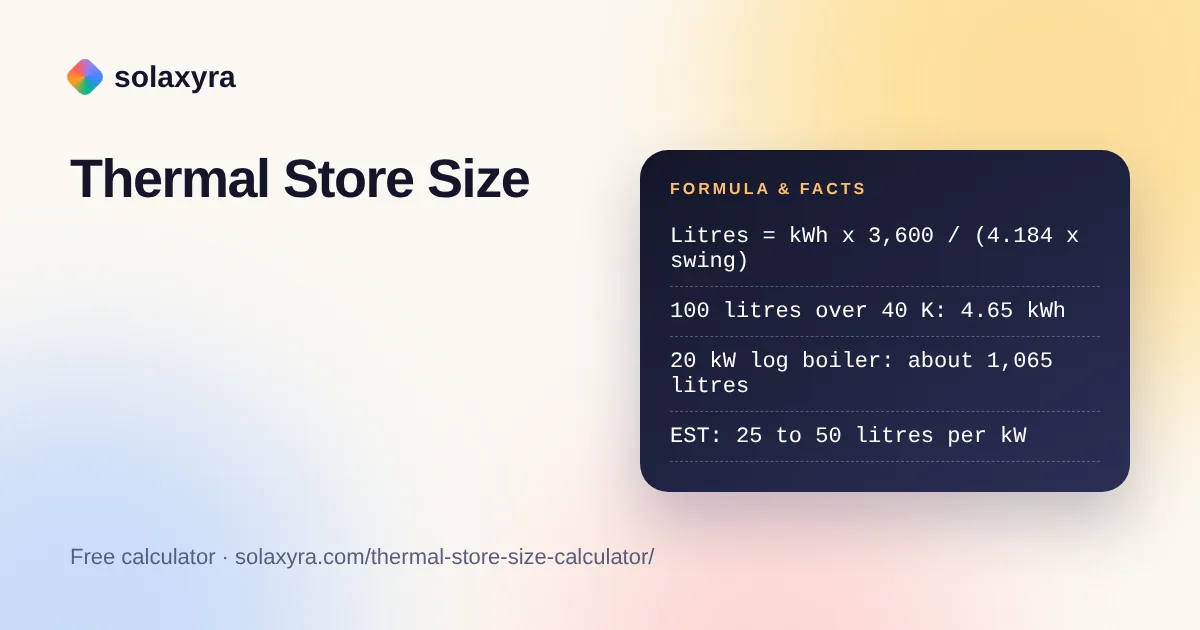
A thermal store size calculator is a tool that estimates the water volume needed to store a given amount of heat between the hottest and coolest useful temperatures in the tank. In plain words: volume in litres equals the heat to store in kWh, times 3,600, divided by 4.184 times the temperature swing in kelvin, with an allowance added for the heat the tank loses through its insulation.
The 4.184 is the heat in kilojoules that warms one litre of water by one degree, from the Wikipedia article on specific heat capacity. AHDB’s horticulture guidance on sizing heat stores uses the same physics, written as heat in kWh equals volume in m³ times the flow to return difference times 1.162.
How Do You Use the Thermal Store Size Calculator?
- Choose the main heat source. The button fills in example values that you should replace with your own.
- Enter the heat source’s output into water in kW, how many hours it runs for one charge and how much heat the house uses while it runs.
- Enter the average demand the store must cover after the source stops, and for how many hours.
- Set the store top temperature and the lowest temperature your radiators, underfloor heating or hot water can still use.
- Add an allowance for standing losses, then read the size in litres and open the breakdown.
How Big Should a Thermal Store Be?
A thermal store should be big enough to absorb the largest surplus from one charge or to cover the hours without the heat source, whichever needs more heat; for a 20 kW log boiler that is often around 1,000 litres. The Energy Saving Trust says wood-fuelled stores range from 500 to 5,000 litres, and that a store for a log batch boiler should be no less than 25 litres per kW and preferably 50 litres per kW.
The default example in the thermal store size calculator comes out at 53 litres per kW, close to the preferred end. Pellet boilers can use a much smaller store because they respond quickly to demand, and the EST notes that smaller stores of about 300 litres suit pellet or log stoves and stoves with back boilers.
How Much Heat Does a Thermal Store Hold?
Each 100 litres holds about 4.65 kWh of useful heat over a 40 K swing, such as 85 °C down to 45 °C; halve the swing and you halve the heat. The table shows the litres needed for different amounts of heat and different usable swings, before any loss allowance.
| Heat to store | 20 K swing | 30 K swing | 40 K swing | 50 K swing |
|---|---|---|---|---|
| 10 kWh | 430 litres | 287 litres | 215 litres | 172 litres |
| 20 kWh | 860 litres | 574 litres | 430 litres | 344 litres |
| 30 kWh | 1,291 litres | 860 litres | 645 litres | 516 litres |
| 45 kWh | 1,936 litres | 1,291 litres | 968 litres | 774 litres |
| 60 kWh | 2,581 litres | 1,721 litres | 1,291 litres | 1,033 litres |
The swing is the key design choice. Low temperature emitters, such as underfloor heating or large radiators, let the store be drawn down further, so the same tank holds more useful heat. That is why the thermal store size calculator asks for the lowest useful temperature rather than assuming one.
Does a Thermal Store for a Heat Pump Need to Be Bigger?
Yes, for the same heat: a heat pump store working between 55 °C and 35 °C has a 20 K swing, half that of an 85 °C to 45 °C wood store, so it needs twice the volume per kWh. With the heat pump example values the thermal store size calculator shows about 1,290 litres to cover 30 kWh, which is why heat pump systems usually rely on a small buffer and the house’s own thermal mass instead of a large store.
The EST says the installer and heat pump manufacturer should decide whether a buffer tank is needed and what size it should be. For the short cycling question, use our heat pump buffer tank size calculator; for running costs, the heat pump running cost calculator compares a heat pump with a gas boiler.
How Much Heat Does a Wood Stove Put Into a Thermal Store?
A boiler stove puts about 65% of its output into water and a stove with a back boiler about 20%, according to the Energy Saving Trust. So a stove rated 10 kW with a back boiler gives only about 2 kW to the store, and the rest heats the room it stands in. Enter the water-side figure, not the stove’s headline rating, in the thermal store size calculator.
The Energy Saving Trust guide to thermal energy stores also notes that a store can bridge a time lag of an hour or more between lighting a stove or boiler and needing hot water, and that connecting a store to renewable sources can cost from a few hundred pounds to over a thousand.
What Safety Rules Apply to Thermal Stores?
A thermal store connected to a solid fuel appliance must be able to dump heat safely, because a log fire cannot be switched off like a boiler, so the design, safety valves and any heat leak circuit must come from a competent installer and the store maker. Hot water storage safety is covered by Part G of the Building Regulations in England, and new electrical circuits for pumps or immersion heaters must be installed by a qualified electrician to BS 7671.
Check that the store’s maximum temperature and pressure ratings suit your heat source before relying on any result. To estimate the power of pumps and immersion back-up, use the electricity cost calculator, and the watts to kWh calculator converts heater power and time into energy.
Worked Example: Log Batch Boiler in a Rural Farmhouse
Example: a farmhouse in Cumbria has a log batch boiler giving 20 kW to water. One batch burns for 3 hours while the house draws 5 kW, and the store must then cover an average 5 kW for 6 hours. The store runs from 85 °C down to 45 °C, and 10% is added for standing losses. These are the default inputs of the thermal store size calculator.
- Surplus from one batch: (20 minus 5) x 3 = 45 kWh.
- Heat to cover the evening: 5 x 6 = 30 kWh, less than the surplus, so the batch sets the size.
- Usable swing: 85 minus 45 = 40 K, so each litre holds 4.184 x 40 / 3,600 = 0.0465 kWh.
- Volume: 45 x 3,600 / (4.184 x 40) = 968 litres.
- With 10% for losses: 968 x 1.1 = 1,065 litres, or 53 litres per kW of boiler output.
- Check: the EST guide of 25 to 50 litres per kW gives 500 to 1,000 litres, so the result sits just above the preferred figure.
Frequently Asked Questions
What size thermal store do I need for a log boiler?
The Energy Saving Trust says no less than 25 litres per kW of boiler output and preferably 50. For a 20 kW log batch boiler that is 500 to 1,000 litres. The calculator checks that range against the heat from one actual batch burn.
How much heat can a 1,000 litre thermal store hold?
About 46.5 kWh over a 40 K swing, such as 85 °C down to 45 °C, using water’s heat capacity of 4.184 kJ per litre per kelvin. Over a 20 K swing the same tank holds about 23 kWh, so emitter temperatures matter as much as tank size.
What is the difference between a thermal store and a hot water cylinder?
The terms overlap. The EST describes a thermal store as a vessel that holds excess heat from a renewable heating system, often a large insulated cylinder also called a buffer or accumulator tank, and counts ordinary hot water cylinders as thermal stores too. For sizing, only the heat held over the usable swing matters.
Can a thermal store take heat from solar panels and a stove?
Yes, if it is designed for several inputs. The EST says thermal stores can take heat from more than one technology when designed for it. Each input needs its own coil or connection and controls that stop one source fighting another.
Why does the lowest useful temperature matter so much?
The store only gives useful heat while its water is hotter than your emitters need. If radiators need 60 °C, water below that is no help for heating, so a store with an 85 °C top gives a 25 K swing instead of 40 K and needs 60% more volume.
How much should I allow for standing losses?
It depends on insulation, tank size and how long heat is held. The calculator uses an example 10% allowance. Stores holding heat for a day or more, or kept in an unheated outbuilding, should allow more; a well insulated store indoors may need less.
Checked October 2026 by the Solaxyra Editorial Team. Sources: Energy Saving Trust: thermal energy stores, AHDB: how to size a heat storage system, Wikipedia: Specific heat capacity, Approved Document G with 2024 amendments (gov.uk).