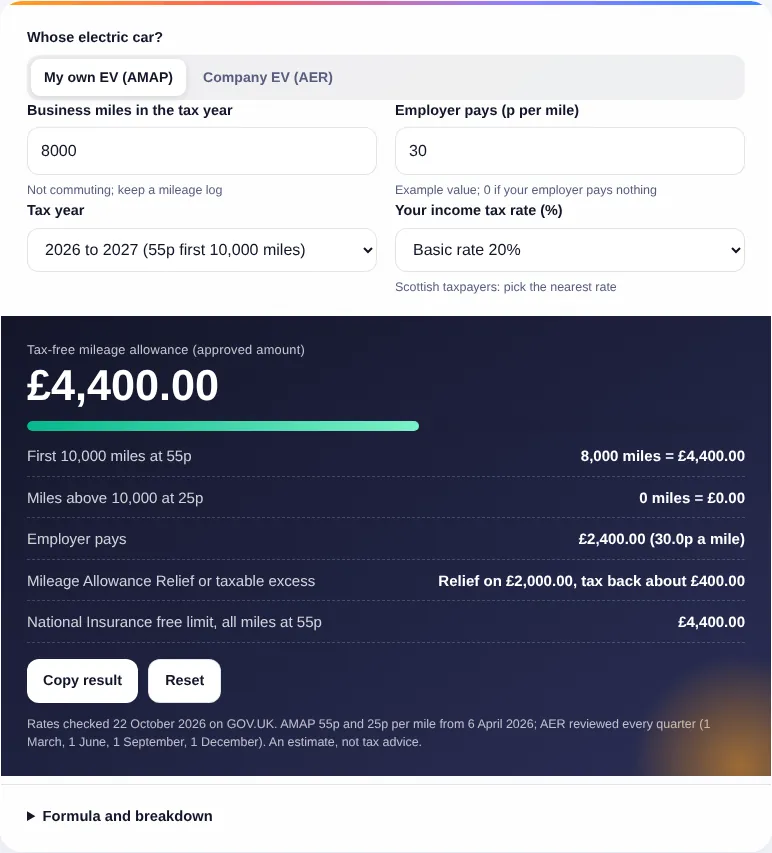
Rates checked 22 October 2026 on GOV.UK. AMAP 55p and 25p per mile from 6 April 2026; AER reviewed every quarter (1 March, 1 June, 1 September, 1 December). An estimate, not tax advice.
Formula and breakdown
n/a
n/a
This EV mileage allowance calculator works out how much a UK employee can be paid tax-free for business miles in an electric car, using HMRC’s approved mileage allowance payments for your own EV and the Advisory Electric Rate for a company EV. It also shows the Mileage Allowance Relief you can claim if your employer pays less, and the taxable excess if it pays more. Rates were checked on GOV.UK on 22 October 2026.
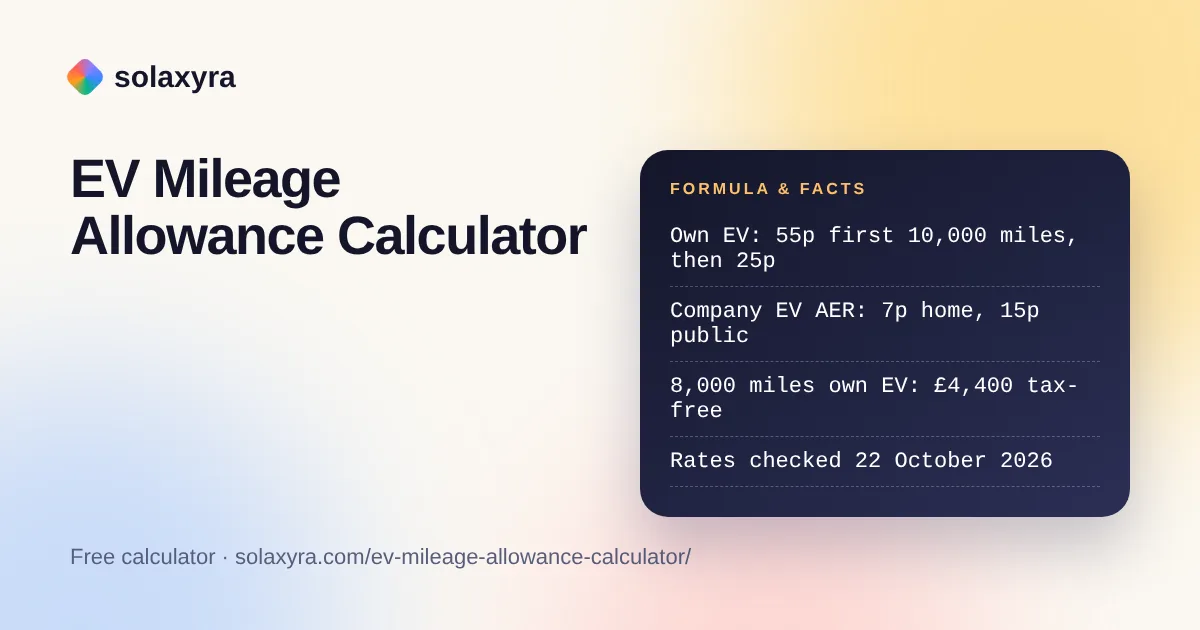
Quick answer: The EV mileage allowance calculator uses HMRC rates. For your own electric car, the tax-free rate is 55p a mile for the first 10,000 business miles from 6 April 2026, then 25p. For a company electric car, the Advisory Electric Rate from 1 September 2026 is 7p a mile for home charging and 15p for public charging.
What Is an EV Mileage Allowance Calculator?
An EV mileage allowance calculator is a tool that finds the maximum an employer can pay for business journeys in an electric car without tax or National Insurance being due. In plain words: for a car you own, the approved amount is business miles up to 10,000 times 55p plus any further miles times 25p; for a company car, it is business miles times the Advisory Electric Rate for the place you charge. Compare that with what your employer pays to see the relief or the excess.
The two systems apply to different cars. Approved mileage allowance payments, often called AMAPs, cover any car the employee owns, whether petrol, diesel, hybrid or electric. The Advisory Electric Rate, or AER, is only for fully electric company cars, and hybrids use the petrol or diesel advisory fuel rates instead.
How Do You Use the EV Mileage Allowance Calculator?
- Choose whether the electric car is your own or a company car.
- Enter the business miles for the tax year. Ordinary commuting does not count.
- Enter what your employer pays per mile; use 0 if it pays nothing.
- For your own car, pick the tax year and your income tax rate.
- For a company car, set the share of charging done at home, and optionally your car’s miles per kWh and electricity prices to compare your real cost with the AER.
- Read the tax-free amount and the relief or excess, then open the breakdown to check the sums.
What Are the HMRC Mileage Rates for Electric Cars in 2026?
For an employee’s own electric car the tax-free rate is 55p a mile for the first 10,000 business miles in the 2026 to 2027 tax year and 25p after that, and for a company electric car it is 7p a mile for home charging or 15p for public charging from 1 September 2026. The table sets out every rate the EV mileage allowance calculator uses.
| Rate | Applies to | Pence per business mile | Effective |
|---|---|---|---|
| AMAP, first 10,000 miles | Employee’s own car or van, any fuel | 55p (45p before 6 April 2026) | From 6 April 2026 |
| AMAP, over 10,000 miles | Employee’s own car or van, any fuel | 25p (unchanged) | From 6 April 2026 |
| National Insurance limit | Employee’s own car or van, all miles | 55p (45p before 6 April 2026) | From 6 April 2026 |
| Advisory Electric Rate, home charging | Fully electric company car | 7p | From 1 September 2026 |
| Advisory Electric Rate, public charging | Fully electric company car | 15p | From 1 September 2026 |
| Motorcycles | Employee’s own motorcycle | 24p | Unchanged |
| Bicycles | Employee’s own bicycle or pedal-assist e-bike | 20p | Unchanged |
The AMAP and National Insurance figures come from the GOV.UK guidance on business travel mileage rules for tax. The AER comes from HMRC’s advisory fuel rates page, which is reviewed on 1 March, 1 June, 1 September and 1 December, so check it again after 1 December 2026. Many guides still quote 45p for the first 10,000 miles; that was the rate up to 5 April 2026.
How Much Mileage Allowance Relief Can I Claim on an Electric Car?
If your employer pays less than the approved amount for your own electric car, you can claim Mileage Allowance Relief on the difference, which reduces your taxable pay; at the basic rate of 20% that is 20p of tax back for every £1 of shortfall. If your employer pays nothing, the whole approved amount is the shortfall.
| Business miles in the year | Approved amount at 55p and 25p (2026 to 2027) | At 45p and 25p (2025 to 2026) | Tax back at 20% if paid nothing (2026 to 2027) | Tax back at 40% |
|---|---|---|---|---|
| 2,000 | £1,100 | £900 | £220 | £440 |
| 5,000 | £2,750 | £2,250 | £550 | £1,100 |
| 10,000 | £5,500 | £4,500 | £1,100 | £2,200 |
| 15,000 | £6,750 | £5,750 | £1,350 | £2,700 |
| 20,000 | £8,000 | £7,000 | £1,600 | £3,200 |
GOV.UK’s tax relief for vehicles you use for work page says you can claim for the current tax year and the four before it, so the EV mileage allowance calculator keeps the 45p option for earlier years. You must keep a log of each journey’s reason and start and end postcodes. If you file Self Assessment, claim through your return. Tax bands come from the 2026 to 2027 rates for England, Wales and Northern Ireland; Scottish rates differ.
What Happens If My Employer Pays More Than 55p a Mile?
Anything above the approved amount is taxable pay: the employer reports the excess on form P11D and you pay income tax on it. National Insurance works differently, because the limit is 55p for every business mile with no drop to 25p, so Class 1 National Insurance is only due on payments above miles times 55p. The EV mileage allowance calculator shows both figures.
How Is the Advisory Electric Rate Worked Out?
HMRC bases the AER on an average of 3.59 miles per kWh, weighted by company car sales, and an electricity price of 24.47p per kWh for home charging or 54.00p per kWh for public charging, which gives 6.81p and 15.02p a mile, rounded to 7p and 15p. Employees who charge in both places can split mileage on a fair and reasonable basis, which is what the home charging share input does.
An employer can pay more than the AER without tax if it can show the real cost per mile is higher. At the Ofgem price cap of 26.32p per kWh, a car doing 3.59 miles per kWh costs about 7.3p a mile at home, slightly above 7p. Less efficient cars or pricier public chargers can cost much more, so enter your own figures. Our EV charging cost calculator shows the cost of a full charge, and the solar EV charging calculator covers charging from panels. To see how a heavy driver’s yearly use translates into kWh, try the watts to kWh calculator.
Worked Example: Own Electric Car Paid 30p a Mile
Example: an employee drives their own electric car 8,000 business miles in the 2026 to 2027 tax year. The employer pays 30p a mile and the employee is a basic rate taxpayer. These are the default inputs of the EV mileage allowance calculator.
- Approved amount: 8,000 x 55p = £4,400, all within the first 10,000 miles.
- Employer pays: 8,000 x 30p = £2,400.
- Shortfall: £4,400 minus £2,400 = £2,000 of Mileage Allowance Relief.
- Tax back at 20%: £2,000 x 20% = £400.
Example two, company car: the same 8,000 miles in a company EV charged 70% at home and 30% in public gives a blended AER of 70% x 7p + 30% x 15p = 9.4p, so up to £752 can be repaid tax-free.
Frequently Asked Questions
Can I claim 55p per mile for an electric car?
Yes, if the electric car is your own and the journeys are business travel. From 6 April 2026 the approved rate for cars and vans is 55p a mile for the first 10,000 business miles in a tax year and 25p after that, the same for every fuel type.
What is the HMRC Advisory Electric Rate now?
From 1 September 2026 the Advisory Electric Rate is 7p a mile for home charging and 15p a mile for public charging. It applies to fully electric company cars only and is reviewed quarterly, on 1 March, 1 June, 1 September and 1 December.
Can I use the advisory rate for a plug-in hybrid company car?
No. HMRC treats hybrid cars as petrol or diesel cars for advisory fuel rates, so a plug-in hybrid company car uses the petrol or diesel rate for its engine size. The Advisory Electric Rate is only for fully electric cars.
How do I claim Mileage Allowance Relief for my EV?
Keep a log of each business journey with the reason and start and end postcodes, then claim through HMRC’s online service, or through your Self Assessment return if you file one. You can claim for the current tax year and the four tax years before it.
Is home to office travel in an electric car a business mile?
Usually not. HMRC excludes commuting from mileage relief unless the journey is to a temporary place of work. Business journeys, such as visiting a client or a temporary site, count, so record each one with its reason and postcodes in your log.
Does the EV mileage allowance calculator include National Insurance?
It shows the National Insurance free limit, which is 55p a mile for all business miles in your own car from 6 April 2026. Payments above that limit attract Class 1 National Insurance through payroll; the exact amount depends on your earnings.
Checked October 2026 by the Solaxyra Editorial Team. Rates checked 22 October 2026. Sources: GOV.UK: Business travel mileage, rules for tax, GOV.UK: Business travel mileage, rules for National Insurance, GOV.UK: Advisory fuel rates, GOV.UK: Tax relief for vehicles you use for work, GOV.UK: Income Tax rates and Personal Allowances, Ofgem: Energy price cap 1 October to 31 December 2026.