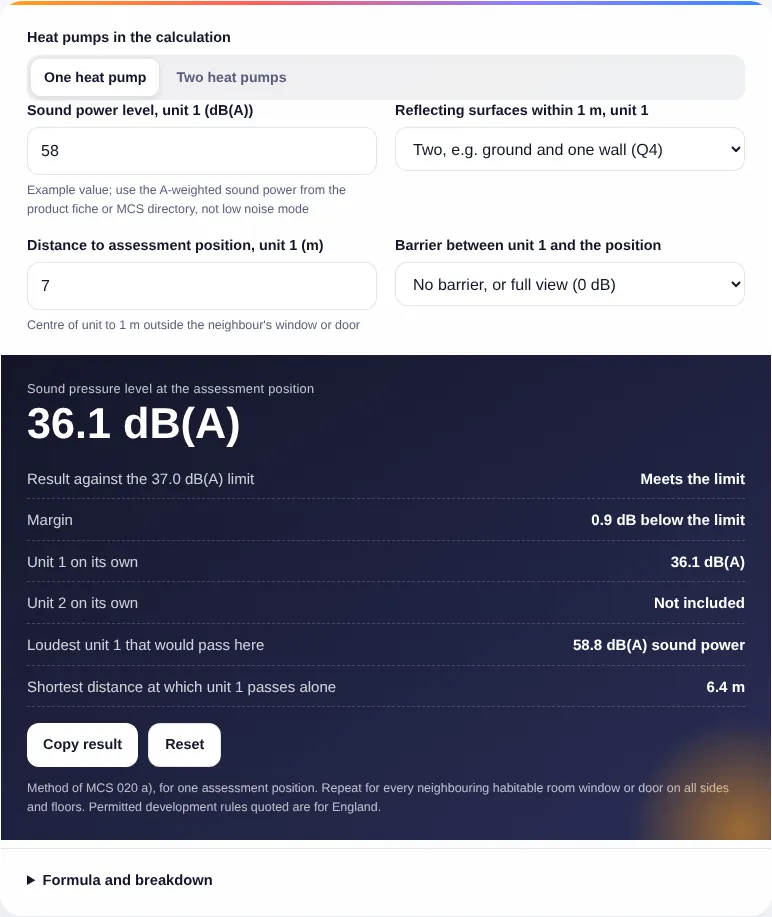
Method of MCS 020 a), for one assessment position. Repeat for every neighbouring habitable room window or door on all sides and floors. Permitted development rules quoted are for England.
Formula and breakdown
n/a
n/a
n/a
This heat pump noise calculator checks whether an air source heat pump meets the 37.0 dB(A) noise limit of MCS 020 a) at a neighbour’s window or door, the test an installation in England must pass to use permitted development rights. It is for homeowners, installers and neighbours who want to see the sum before a unit is fixed to the wall, and it works for one or two heat pumps, solid barriers and up to three reflecting surfaces.
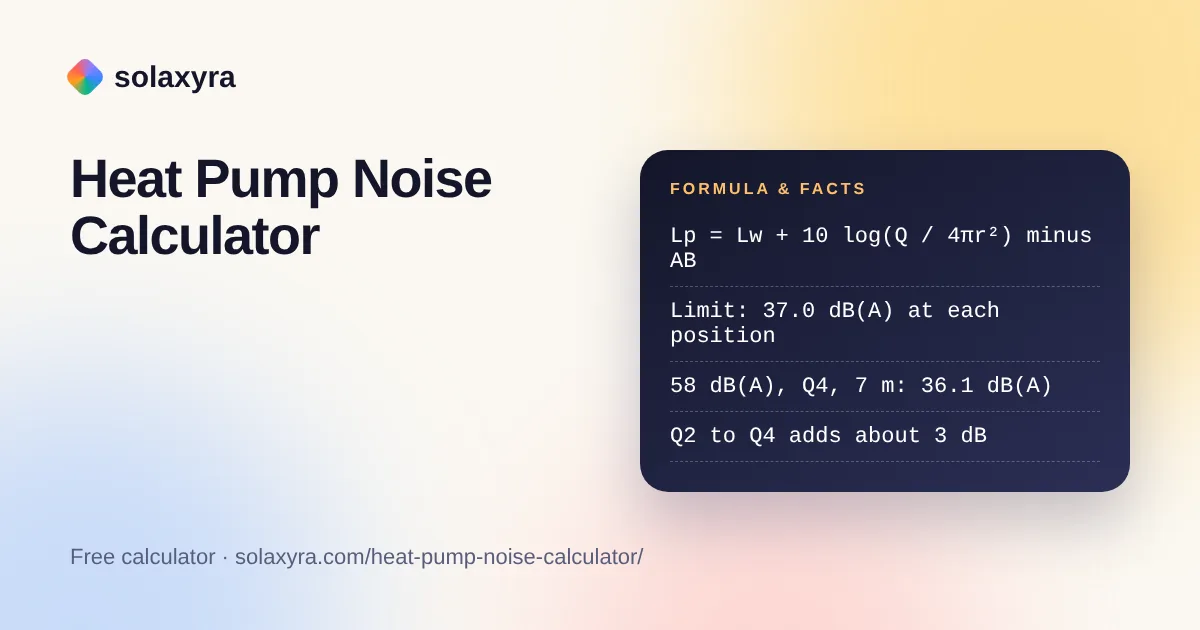
Quick answer: A heat pump noise calculator works out sound pressure as sound power plus 10 log(Q / 4πr²) minus barrier attenuation. Example: a heat pump with 58 dB(A) sound power, against one wall on the ground (Q4), 7 m from a neighbour’s bedroom window with no barrier gives 36.1 dB(A), just under the 37.0 dB(A) limit.
What Is a Heat Pump Noise Calculator?
A heat pump noise calculator is a tool that predicts the sound level from an outdoor heat pump unit at a chosen point near a neighbouring home, so it can be compared with the planning limit. In plain words: start with the manufacturer’s A-weighted sound power level, add 10 times the log of the directivity factor divided by 4π times the distance squared, then subtract any reduction from a solid barrier.
That formula, Lp = Lw + 10 log(Q / (4πr²)) minus AB, comes from MCS 020 a), the MCS air source heat pump sound calculation. The result is rounded to one decimal place and must be 37.0 dB(A) or less at every assessment position.
How Do You Use the Heat Pump Noise Calculator?
- Choose one or two heat pumps. MCS 020 a) includes a method for two units.
- Enter each unit’s A-weighted sound power level from the product fiche, energy label or MCS product directory. Do not use the low noise mode figure, and do not confuse sound power with sound pressure.
- In the heat pump noise calculator, count the reflecting surfaces within 1 m of the unit, such as the ground and nearby walls, and pick Q2, Q4 or Q8.
- Measure, to the nearest 0.1 m, from the centre of the unit to a point 1 m outside the centre of the neighbour’s habitable room window or door.
- Pick the barrier type and how much of the assessment position can be seen from the top edge of the unit, then read the level, the margin and the reverse checks. Repeat for every neighbouring window and door.
What Is the Noise Limit for a Heat Pump Under Permitted Development?
The limit is 37.0 dB(A) LAeq over 5 minutes at each assessment position, calculated by the MCS 020 a) method and ignoring the effect of the façade. In England the amending order SI 2025/560 to the General Permitted Development Order, in force from 29 May 2025, ties Class G permitted development for air source heat pumps to the MCS Planning Standards, now defined as MCS 020 a), and removed the words “or equivalent standards”.
The same Order allows one air source heat pump on a house that is not detached and up to two on a detached house, with the outdoor unit no larger than 1.5 cubic metres, and the unit must not be used solely for cooling. Its transitional provision for development permitted under the old rules ended on 28 May 2026. MCS says compliance applies whether or not the installation is MCS certified. Wales, Scotland and Northern Ireland have their own rules, so check with the local planning authority there.
Why Do Some Forms Still Say 42 dB(A)?
Older calculation forms based on the earlier MCS 020 added a fixed background level of 40 dB(A) to the heat pump’s level and tested the total against 42 dB(A). MCS 020 a) has no background step: the heat pump’s own level is compared directly with 37.0 dB(A). If an installer hands you a form with a 40 dB background line and a 42 dB pass mark, ask for the current calculation; this heat pump noise calculator follows the newer method.
How Far From a Neighbour’s Window Does a Heat Pump Need to Be?
There is no fixed distance: a unit with 58 dB(A) sound power against one wall (Q4) with no barrier passes from about 6.4 m, while a 52 dB(A) unit in the same spot passes from about 3.2 m. The table shows the loudest sound power that passes at each distance with no barrier, rounded down so it stays on the safe side.
| Distance to assessment position | Q2: ground only | Q4: ground and one wall | Q8: ground and two walls |
|---|---|---|---|
| 2 m | 51.0 dB(A) | 47.9 dB(A) | 44.9 dB(A) |
| 3 m | 54.5 dB(A) | 51.5 dB(A) | 48.5 dB(A) |
| 4 m | 57.0 dB(A) | 54.0 dB(A) | 51.0 dB(A) |
| 5 m | 58.9 dB(A) | 55.9 dB(A) | 52.9 dB(A) |
| 6 m | 60.5 dB(A) | 57.5 dB(A) | 54.5 dB(A) |
| 8 m | 63.0 dB(A) | 60.0 dB(A) | 57.0 dB(A) |
| 10 m | 64.9 dB(A) | 61.9 dB(A) | 58.9 dB(A) |
| 15 m | 68.5 dB(A) | 65.4 dB(A) | 62.4 dB(A) |
Each step from Q2 to Q4 to Q8 adds about 3 dB, and doubling the distance takes off about 6 dB. A solid masonry wall or solid fence at least 18 mm thick that hides the position completely adds 10 dB of headroom. The heat pump noise calculator shows both reverse checks for your own inputs.
How Much Does a Wall or Fence Reduce Heat Pump Noise?
A solid barrier at least 18 mm thick, such as a masonry wall or solid fence, takes off 10 dB when the assessment position cannot be seen from the top edge of the unit and 5 dB when it comes into view within 0.25 m above that edge. A solid fence thinner than 18 mm gives 5 dB and 2.5 dB in the same cases.
Open fences, fences with gaps, hedges and other vegetation, and poorly maintained walls count as no barrier at all. The barrier must also extend at least 1 m past each side of the unit. More than three reflecting surfaces within 1 m, such as a unit tucked into a corner under a balcony, cannot meet MCS 020 a) at all.
Can a Heat Pump That Passes Still Annoy the Neighbours?
Yes. The MCS calculation, and so any heat pump noise calculator built on it, does not consider tones or the local background level, and some councils note that rural night-time background can be well below 37 dB(A). A council can still act if a unit causes a statutory nuisance. Placing the unit away from bedrooms and out of corners helps.
The heat pump also needs a dedicated electrical supply installed by a qualified electrician to BS 7671, notifiable in England and Wales under Part P. To see what the quieter, larger or better placed unit costs to run, use the heat pump running cost calculator, and the electricity cost calculator for the cost of each hour it runs. Our heat pump size calculator helps pick the output first.
Worked Example: Detached House With a Garden Wall
Example: an installer in Chester checks a 60 dB(A) air source heat pump on the ground beside a house wall (two reflecting surfaces, Q4), 8.0 m from a neighbour’s first-floor bedroom window. A brick garden wall sits between them, and the window comes into view when the eye is moved up within 0.25 m of the top of the unit, so it counts as partial view.
- Directivity and distance: 10 log(4 / (4 x π x 8.0²)) = 10 log(0.00497) = minus 23.03 dB.
- Barrier: brick wall, partial view = 5 dB.
- Sound pressure: 60 minus 23.03 minus 5 = 31.97, rounded to 32.0 dB(A).
- Check: 32.0 is below 37.0 dB(A), with 5.0 dB to spare. The heat pump noise calculator also shows that a unit up to 65.0 dB(A) would pass at this position, and that this unit would pass from 4.5 m.
The same inputs give the 32.0 dB(A) shown for the first assessment position in the worked example in Appendix A of MCS 020 a).
Frequently Asked Questions
What is the noise limit for an air source heat pump in England?
For permitted development, the heat pump must achieve 37.0 dB(A) or less at every assessment position, calculated by the MCS 020 a) method. Each position is 1 m outside the centre of a window or door to a habitable room of a neighbouring property, measured perpendicular to it.
Where is the assessment position for heat pump noise?
It is 1 m outside the centre point of a door or window to a habitable room of a neighbouring property, measured perpendicular to that opening. Check every side and floor, because the nearest window is not always the loudest. Bathrooms, toilets, hallways, utility rooms and similar are not habitable rooms.
What sound power level should I use?
Use the A-weighted sound power level from the manufacturer’s data, such as the product fiche, energy label or MCS product directory. Do not use the low noise mode value, and do not enter a sound pressure figure, which is usually much lower and quoted at a set distance.
Can I install two heat pumps under permitted development?
Up to two on a detached house and one on other houses, under the 2025 amendment in England. MCS 020 a) combines the units logarithmically, so two equal units at the same distance are about 3 dB louder than one. The heat pump noise calculator adds the second unit for you.
Is the 1 metre boundary rule still in place?
No. MCS reported that the government removed the rule that kept heat pumps at least 1 m from the property boundary in England. A unit close to the boundary still has to meet the 37.0 dB(A) limit at neighbouring windows and doors.
What if my heat pump fails the noise calculation?
Move the unit further away, out of corners to cut reflecting surfaces, behind a solid barrier, or choose a quieter model, then recalculate. If it still fails, the installation needs a planning application, and the council may ask for a fuller noise assessment.
Checked October 2026 by the Solaxyra Editorial Team. Sources: MCS 020 a): Air source heat pump sound calculation, MCS: updated version of MCS 020 published, SI 2025/560 (legislation.gov.uk), GPDO 2015 Schedule 2 Part 14 (legislation.gov.uk), Waverley Borough Council: noise and air source heat pumps.