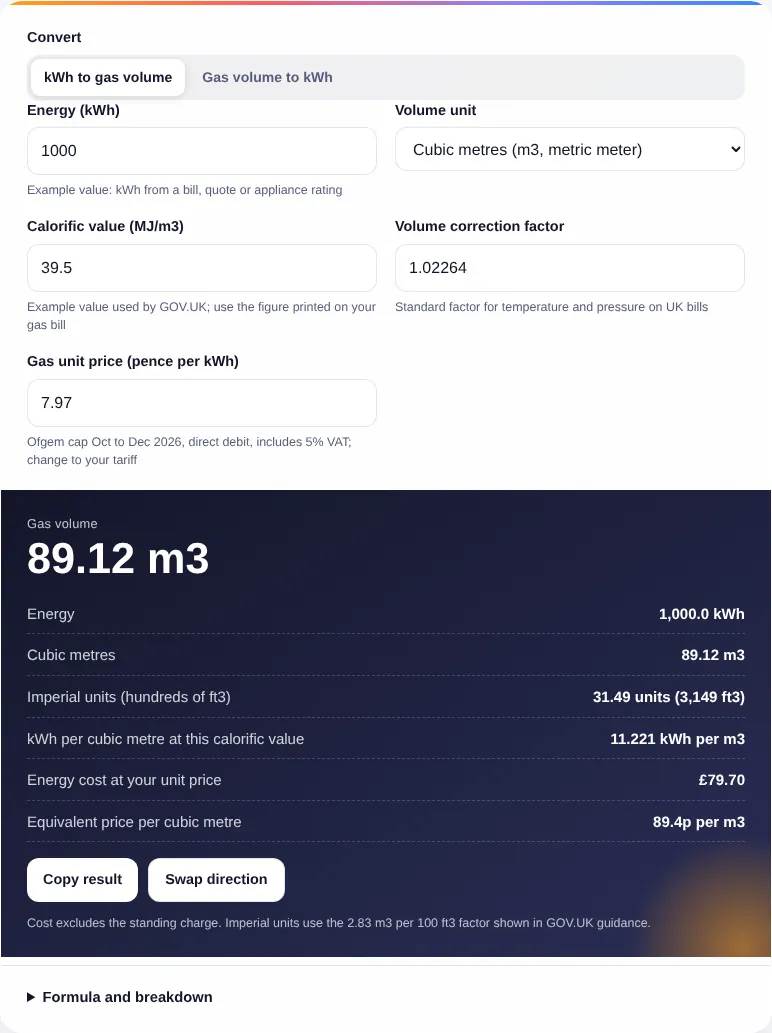
Cost excludes the standing charge. Imperial units use the 2.83 m3 per 100 ft3 factor shown in GOV.UK guidance.
Formula and breakdown
n/a
n/a
This kWh to m3 calculator converts gas energy in kilowatt-hours into the volume of gas in cubic metres, or imperial meter units in hundreds of cubic feet, and back again, using the calorific value and volume correction factor printed on UK gas bills. It is for households and small businesses in Great Britain who want to compare a kWh figure from a tariff, quote or boiler with what their meter records, and it prices the gas at the Ofgem cap or your own rate.
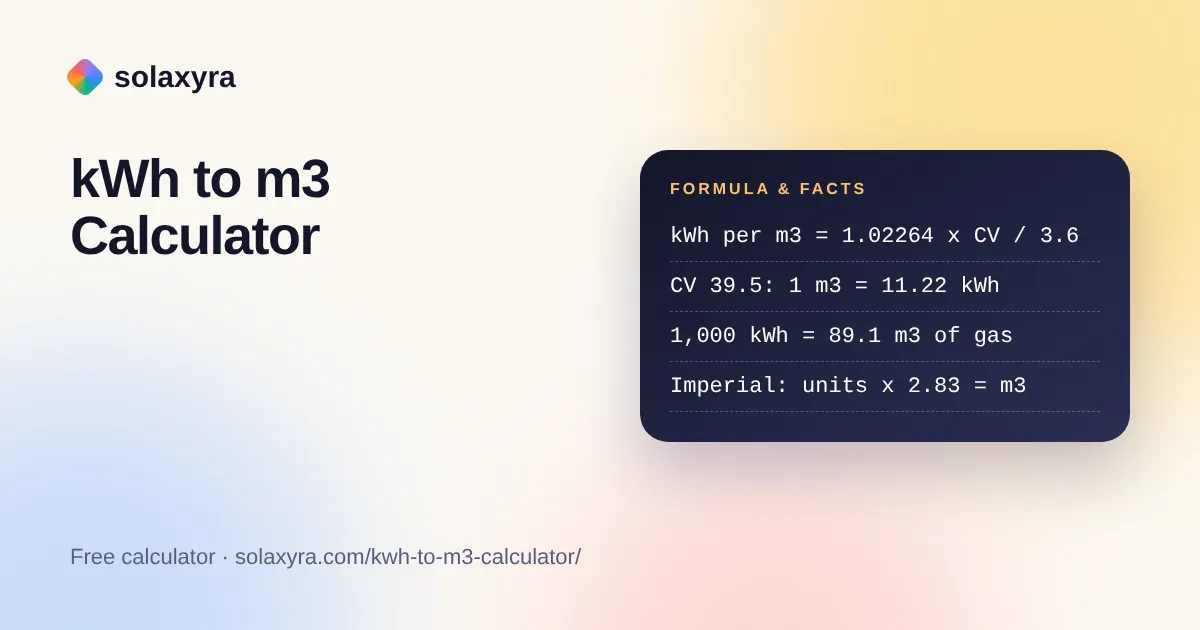
Quick answer: A kWh to m3 calculator divides kWh by the energy in one cubic metre, which is 1.02264 x calorific value / 3.6. At a calorific value of 39.5 MJ/m3 one cubic metre holds about 11.22 kWh, so 1,000 kWh is about 89.1 m3 of gas, or 31.5 imperial units of 100 cubic feet.
What Is a kWh to m3 Calculator?
A kWh to m3 calculator is a tool that converts between the energy you pay for and the volume your gas meter measures. In plain words: kWh per cubic metre equals the volume correction factor times the calorific value in megajoules per cubic metre, divided by 3.6. To go from kWh to cubic metres, divide by that figure; to go from cubic metres to kWh, multiply by it.
The divisor 3.6 comes from the definition of a kilowatt-hour: one kWh is 3.6 MJ, so megajoules divided by 3.6 gives kWh. The correction factor of 1.02264 adjusts the metered volume for temperature and pressure, and the calorific value is the energy content of the gas. Both appear on UK gas bills.
How Do You Use the kWh to m3 Calculator?
- Choose the direction: kWh to gas volume, or gas volume to kWh.
- Enter the amount, for example the kWh on a bill or the difference between two meter readings.
- Choose cubic metres for a metric meter or hundreds of cubic feet for an imperial meter.
- Replace the example calorific value of 39.5 with the figure on your latest gas bill, and leave the correction factor at 1.02264 unless your bill shows another value.
- Enter your unit rate to see the energy cost and the equivalent price per cubic metre.
How Many kWh Are in a Cubic Metre of Gas?
About 11.2 kWh at a typical UK calorific value: 1.02264 x 39.5 / 3.6 = 11.22 kWh per cubic metre. The GOV.UK guide to gas meter readings and bill calculation sets out the method: take the units used, multiply hundreds of cubic feet by 2.83 for an imperial meter, multiply by the calorific value and by 1.02264, then divide by 3.6. It uses 39.5 MJ/m3 as its example and says gas transporters must keep the calorific value between 38 and 41 MJ/m3.
British Gas states in its guide to converting gas m3 to kWh that calorific value usually ranges between 37 and 43 MJ/m3. The table runs the kWh to m3 calculator across that range, with prices at the October to December 2026 cap of 7.97p per kWh including 5% VAT.
| Calorific value (MJ/m3) | kWh per m3 | kWh per imperial unit (100 ft3) | m3 for 1,000 kWh | Price per m3 at 7.97p |
|---|---|---|---|---|
| 37 | 10.510 | 29.74 | 95.1 | 83.8p |
| 38 | 10.795 | 30.55 | 92.6 | 86.0p |
| 39 | 11.079 | 31.35 | 90.3 | 88.3p |
| 39.5 | 11.221 | 31.75 | 89.1 | 89.4p |
| 40 | 11.363 | 32.16 | 88.0 | 90.6p |
| 41 | 11.647 | 32.96 | 85.9 | 92.8p |
| 43 | 12.215 | 34.57 | 81.9 | 97.4p |
Each 1 MJ/m3 change in calorific value moves the kWh in a cubic metre by about 2.5%, which is why the same meter reading can cost slightly different amounts from one bill to the next.
How Do You Convert kWh Back to Cubic Metres?
Multiply the kWh by 3.6 and divide by the correction factor times the calorific value: 1,000 kWh x 3.6 / (1.02264 x 39.5) = 89.12 m3. This reverse step is useful when a tariff, boiler or heat pump quote gives annual use in kWh and you want to know what your meter should show, or when you check how far a meter reading should have moved over a month. The kWh to m3 calculator does it in one step with the swap button.
What Changes With an Imperial Gas Meter?
An imperial meter counts hundreds of cubic feet, so each unit is multiplied by 2.83 to give cubic metres before the energy step. GOV.UK guidance uses this factor and also shows that metric meters measure cubic metres directly. The Wikipedia article on the cubic foot gives one cubic foot as 0.028316846592 m3, so 100 cubic feet is 2.8317 m3, which bills round to 2.83. At 39.5 MJ/m3 one imperial unit holds about 31.75 kWh, almost three times a metric unit.
How Much Does a Cubic Metre of Gas Cost?
About 89p at the October to December 2026 Ofgem cap: 11.22 kWh x 7.97p = 89.4p per cubic metre at a calorific value of 39.5. Ofgem’s cap unit rate of 7.97p per kWh for direct debit includes VAT at 5%, while VAT has been removed from electricity bills from 1 October 2026 to 31 March 2027. The standing charge of 29.68p per day is paid on top and is not included in the price per cubic metre.
For a full bill from two readings including the standing charge, use the gas meter reading calculator; to price electricity alongside gas, the electricity cost calculator works per appliance, and the energy consumption calculator totals household use in kWh.
Worked Example: Checking a Boiler Quote Against the Meter
Example: a heat pump quote estimates that a house uses 11,500 kWh of gas a year for heating and hot water. The household wants to see that as meter units. The latest bill shows a calorific value of 41 MJ/m3 and the meter is imperial. The kWh to m3 calculator works through it as follows.
- Energy per cubic metre: 1.02264 x 41 / 3.6 = 11.647 kWh.
- Volume: 11,500 / 11.647 = 987.4 m3.
- Imperial units: 987.4 / 2.83 = 348.9 units (about 34,891 cubic feet).
- Energy cost at 7.97p: 11,500 x 0.0797 = £916.55 a year, plus the standing charge.
If the meter moved by far more than 349 units over a year, the quote’s figure is too low. The heat pump running cost calculator can then compare that gas use with a heat pump. If you smell gas, HSE advises calling the gas emergency freephone number 0800 111 999, opening doors and windows and turning off the supply at the meter control valve if you know where it is; work on gas appliances must be done by a Gas Safe registered engineer.
Frequently Asked Questions
How many kWh is 1 m3 of gas?
About 11.2 kWh at a calorific value of 39.5 MJ/m3. The exact figure is 1.02264 times the calorific value on your bill, divided by 3.6, so it ranges from about 10.8 kWh at 38 MJ/m3 to 11.6 kWh at 41 MJ/m3.
How many m3 of gas is 1,000 kWh?
About 89.1 m3 at a calorific value of 39.5 MJ/m3. Divide the kWh by the energy in one cubic metre: 1,000 / 11.22 = 89.1. At 38 MJ/m3 it is 92.6 m3, and at 41 MJ/m3 it is 85.9 m3.
What is the 1.02264 in the gas formula?
It is the volume correction factor that UK suppliers use to adjust the measured volume of gas for temperature and pressure, as set out in GOV.UK’s bill calculation guide. Leave it at 1.02264 unless your bill shows a different factor.
Where do I find my calorific value?
It is printed on your gas bill, usually next to the meter readings and conversion, in megajoules per cubic metre. GOV.UK says it is an average and that gas transporters must keep it between 38 and 41 MJ/m3; 39.5 is the example GOV.UK uses.
How do I convert imperial gas units to kWh?
Multiply the units used by 2.83 to get cubic metres, then by 1.02264 and the calorific value, and divide by 3.6. At 39.5 MJ/m3, 100 imperial units is 283 m3, about 3,175 kWh. Choose hundreds of cubic feet in the calculator to do this automatically.
Why does my gas bill show kWh when my meter shows m3?
Gas meters measure volume, but the amount of energy in a cubic metre varies with the gas supplied, so suppliers charge for energy. The bill converts the metered volume to kWh using the calorific value and correction factor, then applies the unit rate per kWh.
Checked October 2026 by the Solaxyra Editorial Team. Sources: GOV.UK, Gas meter readings and bill calculation, Ofgem, energy price cap October to December 2026, British Gas, How to convert gas m3 to kWh, Wikipedia, Cubic foot, HSE, Domestic gas safety FAQs.