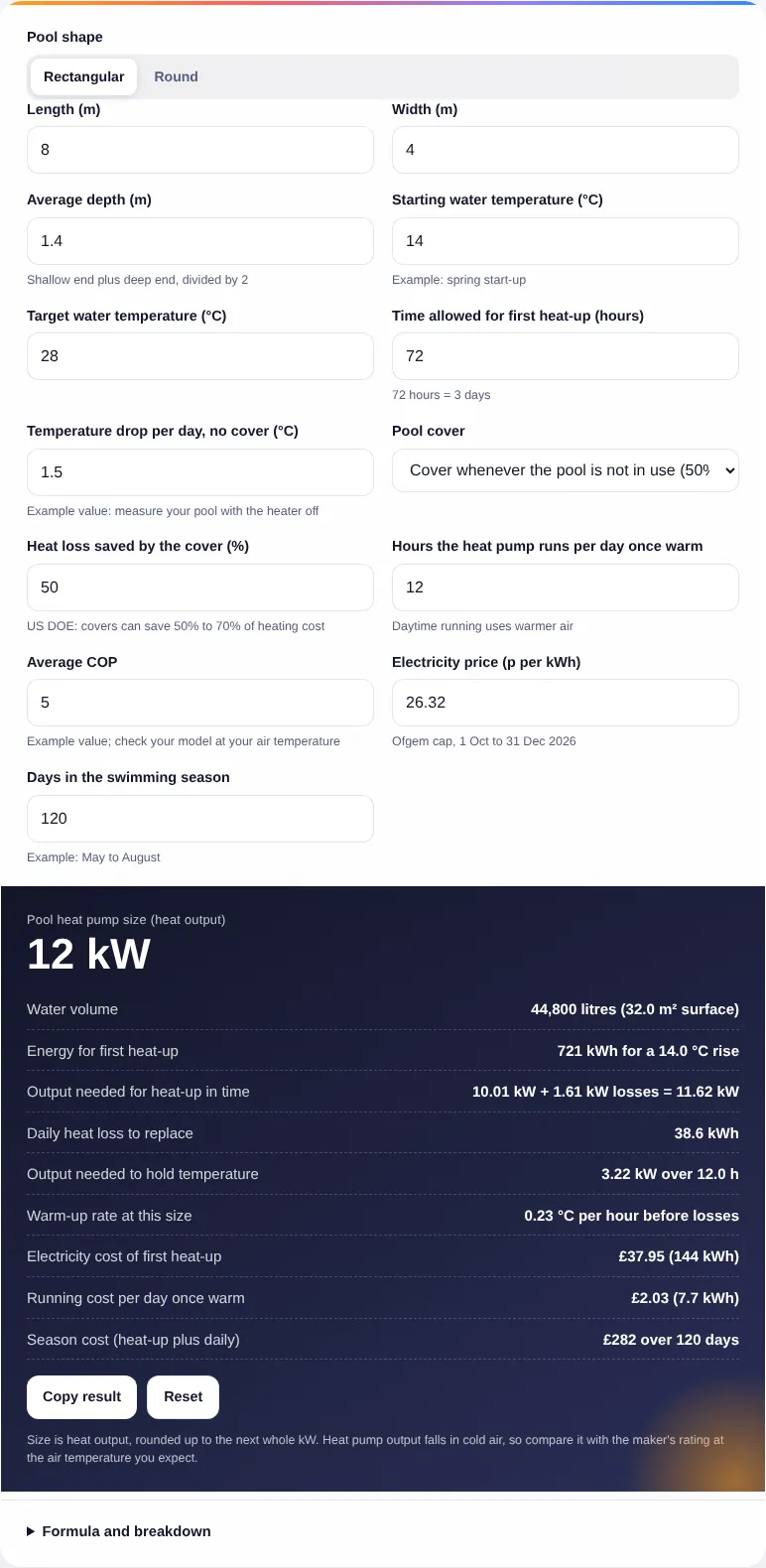
Size is heat output, rounded up to the next whole kW. Heat pump output falls in cold air, so compare it with the maker’s rating at the air temperature you expect.
Formula and breakdown
n/a
n/a
n/a
n/a
This pool heat pump size calculator works out the heat output, in kW, that an air source heat pump needs to warm a swimming pool and keep it warm, for owners of outdoor and above-ground pools in the UK and Europe. It splits the job into the first heat-up and the daily top-up, shows how much a cover changes the answer and estimates the electricity cost from the heat pump's COP.
Quick answer: A pool heat pump size calculator takes the water volume, multiplies it by 1.149 Wh per litre per degree and the temperature rise, divides by the heat-up time and adds daily losses. An 8 x 4 m pool, 1.4 m deep, warmed from 14 °C to 28 °C in three days with a cover needs about 12 kW.

What Is a Pool Heat Pump Size Calculator?
A pool heat pump size calculator is a tool that estimates the heat output a swimming pool heat pump must deliver to raise the water to a target temperature within a chosen time and then hold it there. In plain words: first heat-up energy equals water volume times the heat capacity of water times the temperature rise; dividing by the hours allowed gives a power; the heat pump also has to replace what the pool loses each day, which this tool takes from the temperature drop you measure with the heater off, reduced by the share a cover saves.
The heat capacity comes from the table of specific heat capacities, which lists liquid water at 25 °C at 4.138 J per cm³ per kelvin. A litre is 1,000 cm³, so warming one litre by one degree takes 4,138 J, or about 1.149 Wh.
How Do You Use the Pool Heat Pump Size Calculator?
- Choose rectangular or round, then enter the length and width, or the diameter, and the average depth.
- Enter the starting water temperature, the target temperature and the hours you are willing to wait for the first heat-up.
- Enter how far the water temperature falls in a day without heating or a cover. Measure it if you can.
- Choose whether you use a cover and how much heat loss it saves.
- Set the hours the heat pump runs each day once warm, its average COP, your electricity price and the season length.
- Read the size in kW, the heat-up and holding needs, the warm-up rate and the costs.
What Size Heat Pump Do I Need for My Pool?
For a three-day heat-up with a cover, the pool heat pump size calculator suggests about 6 kW for a 6 x 3 m pool, 12 kW for an 8 x 4 m pool and 20 kW for a 10 x 5 m pool, all warmed from 14 °C to 28 °C. The table uses a 1.5 °C uncovered daily drop, a 50% cover saving, 12 running hours a day and a COP of 5 unless stated.
| Example pool | Volume | Heat-up energy | Size needed | Heat-up cost | Cost per day once warm |
|---|---|---|---|---|---|
| 6 x 3 m, 1.2 m deep | 21,600 L | 348 kWh | 6 kW | £18.30 | £0.98 |
| 8 x 4 m, 1.4 m deep (default) | 44,800 L | 721 kWh | 12 kW | £37.95 | £2.03 |
| 8 x 4 m, no cover | 44,800 L | 721 kWh | 14 kW | £37.95 | £4.07 |
| 8 x 4 m, heat-up over 7 days | 44,800 L | 721 kWh | 6 kW | £37.95 | £2.03 |
| 10 x 5 m, 1.5 m deep | 75,000 L | 1,207 kWh | 20 kW | £63.53 | £3.40 |
| Round above-ground, 4.5 m, 1.2 m deep, 18 to 28 °C in 48 hours | 19,085 L | 219 kWh | 6 kW | £11.55 | £0.87 |
The size is heat output, not electrical input. A heat pump with a COP of 5 delivering 12 kW of heat draws about 2.4 kW of electricity. The daily drop, cover saving and COP are example values, so replace them with your own figures.
How Long Does a Pool Heat Pump Take to Heat a Pool?
Heat-up time equals the energy needed divided by the heat pump's output minus the losses: the default 44,800 litre pool needs 721 kWh to rise 14 °C, so a 12 kW unit takes roughly three days. At that size the water warms about 0.23 °C per hour before losses, because the pool needs 51.5 kWh for every degree.
The heat-up time you accept is the biggest factor in sizing. In the pool heat pump size calculator table, allowing seven days instead of three halves the size from 12 kW to 6 kW for the same pool, while the holding load once warm is only about 3.2 kW over 12 hours. A smaller unit is cheaper to buy but makes the start of the season slow, and a pool left uncovered may struggle to reach the target in cool weather.
How Much Does a Pool Cover Save?
A cover is the cheapest way to cut pool heating: the US Department of Energy calls covering a pool when not in use the single most effective way to reduce pool heating costs and says savings of 50% to 70% are possible. With the 50% low end, the default pool's daily running cost falls from £4.07 to £2.03 and the size needed falls from 14 to 12 kW.
The reason is where the heat goes. A Department of Energy fact sheet on pool heating says about 95% of a pool's heat loss happens at the surface, mostly through evaporation, and that each gallon of 80 °F water that evaporates removes around 8,000 Btu. It also notes that a 7 mph wind across the surface can raise heat loss by 300%, so a sheltered, covered pool needs far less heating.
Why Measure the Daily Temperature Drop?
Measuring how many degrees your pool loses overnight with the heater off gives a better loss figure than any rule of thumb, because it already includes your wind, shade, cover habits and climate. Turn the heater off on a typical evening, note the water temperature, and read it again 24 hours later.
The pool heat pump size calculator converts that drop into energy: every degree in the default pool is 51.5 kWh, so a 1.5 °C drop means 77 kWh a day uncovered, or about 39 kWh with a cover saving half. Repeat the test with and without the cover to find your real saving, then enter it in place of the 50% example.
What COP Should I Expect from a Pool Heat Pump?
A heat pump's coefficient of performance (COP) is the heat it delivers divided by the electricity it uses, so a COP of 5 turns 1 kWh of electricity into 5 kWh of heat. COP changes with air and water temperature, so read the maker's figure for the air temperature you expect rather than the best case on the box.
The COP of 5 in the pool heat pump size calculator is an example value. If you also heat your home with a heat pump, the heat pump running cost calculator shows how seasonal COP changes yearly costs, and the electricity cost calculator works for any other pool equipment, such as the filter pump.
What Electrical Supply Does a Pool Heat Pump Need?
A pool heat pump is fixed outdoor equipment near water, so its supply must be designed and installed by a qualified electrician to BS 7671. In England and Wales this work falls under Part P of the Building Regulations, explained in Approved Document P, and the electrician can certify it.
To estimate the current, divide the size from the pool heat pump size calculator by the COP to get electrical input, then use our kW to amps calculator: a 12 kW unit at COP 5 draws about 2.4 kW, roughly 10 A at 230 V while running, but check the maximum current on the maker's data plate before the circuit is designed.
Worked Example: 8 x 4 m Outdoor Pool Opened in May
Example: an outdoor 8 x 4 m pool in Kent with an average depth of 1.4 m is 14 °C when it is opened in May and should be 28 °C within three days. It loses 1.5 °C a day without a cover, is covered whenever not in use, and the heat pump averages a COP of 5.
- Volume: 8 x 4 x 1.4 = 44.8 m³ = 44,800 litres. Energy per degree: 44,800 x 1.149 Wh = 51.5 kWh.
- Heat-up: 51.5 x 14 °C = 721 kWh over 72 hours = 10.0 kW.
- Daily loss: 51.5 x 1.5 x (1 minus 0.5) = 38.6 kWh, which adds 1.6 kW during heat-up.
- Size: 10.0 + 1.6 = 11.6 kW, rounded up to a 12 kW heat pump. Holding temperature alone needs 38.6 / 12 h = 3.2 kW.
- Costs at 26.32p per kWh: heat-up 721 / 5 = 144 kWh = £37.95; each day after that 7.7 kWh = £2.03; about £282 for a 120-day season.
Frequently Asked Questions
What size heat pump do I need for an 8 x 4 metre pool?
With a 1.4 m average depth, the pool holds 44,800 litres. Warming it from 14 °C to 28 °C in three days with a cover needs about 12 kW of heat output, or about 14 kW without a cover. Accepting a seven-day heat-up halves the size to about 6 kW.
How much energy does it take to heat a pool by one degree?
About 1.149 Wh per litre per degree, from water's heat capacity of 4.138 J per cm³ per kelvin at 25 °C. A 44,800 litre pool therefore needs about 51.5 kWh for each degree, before any heat lost to the air during warming.
Is it better to oversize a pool heat pump?
A larger unit heats the pool faster and copes better in cool spells, but it costs more to buy and may need a bigger electrical supply. Daily running cost depends mainly on heat lost and COP, not unit size, so size for the heat-up time you will actually accept.
How much does it cost to run a pool heat pump?
Divide the heat needed by the COP and multiply by your electricity price. In the default example, the first heat-up costs about £37.95 and each day after that about £2.03 with a cover at 26.32p per kWh and a COP of 5, about £282 for a 120-day season.
Does a pool cover really make a difference?
Yes. The US Department of Energy says covering a pool when it is not in use is the most effective way to cut heating costs, with savings of 50% to 70%. Most heat leaves through the surface by evaporation, which a cover largely stops.
How accurate is this pool heat pump size calculator?
The heat-up energy is physics and is accurate for the volume you enter. The daily loss, cover saving and COP are example values, so measure your own overnight drop and check the maker's output and COP at your typical air temperature before choosing a model.
Checked October 2026 by the Solaxyra Editorial Team. Sources: Wikipedia: Table of specific heat capacities, US Department of Energy: Swimming pool covers, US DOE fact sheet: Conserving energy and heating your swimming pool, GOV.UK: Approved Document P, Ofgem price cap, 1 October to 31 December 2026.