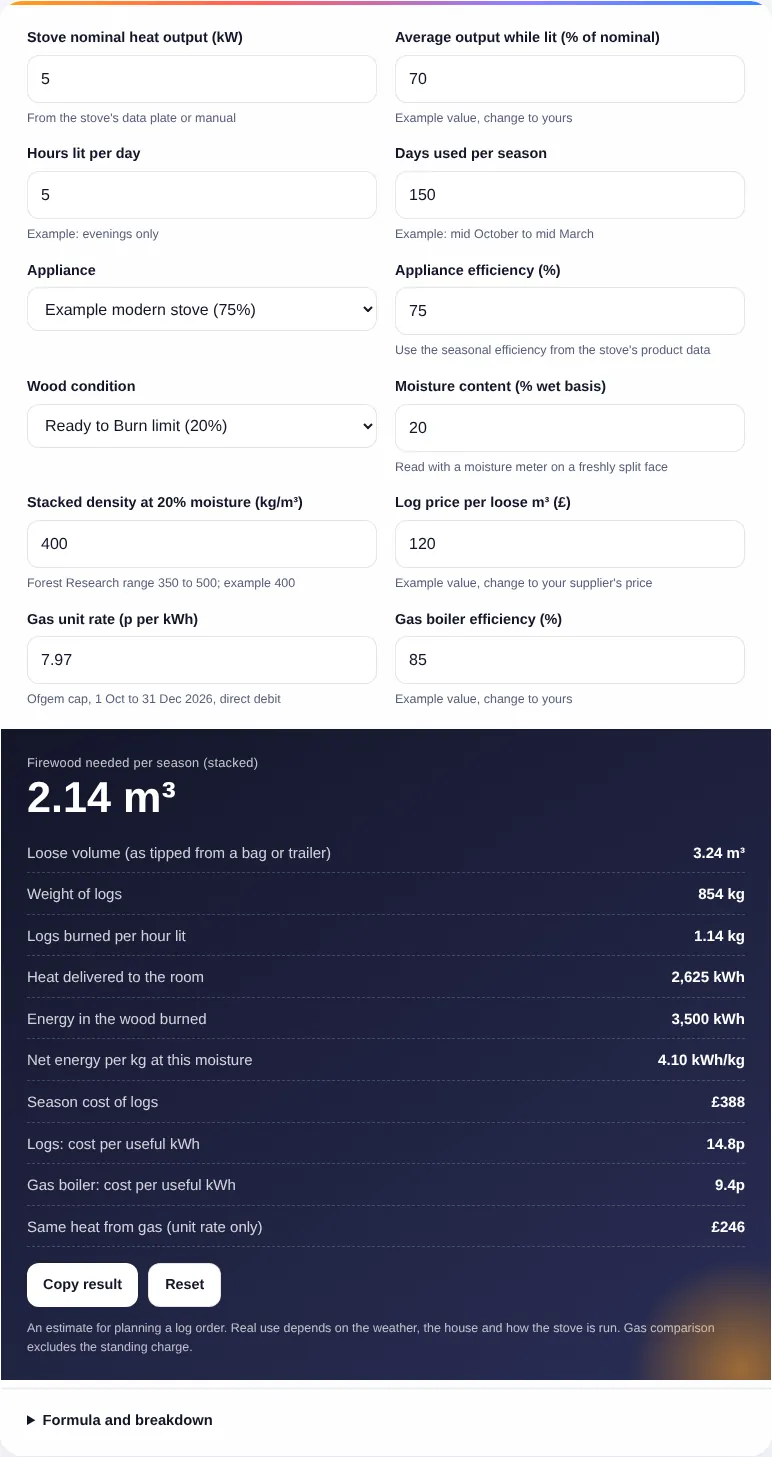
An estimate for planning a log order. Real use depends on the weather, the house and how the stove is run. Gas comparison excludes the standing charge.
Formula and breakdown
n/a
n/a
n/a
n/a
This firewood calculator estimates how much log wood a wood burning stove or open fire will use in a heating season, in kilograms, stacked cubic metres and loose cubic metres, for households in the UK and Ireland ordering logs for winter. It works from the heat you actually want, adjusts the energy in each kilogram for moisture content, and compares the cost of that heat with a gas boiler at the current Ofgem price cap.
Quick answer: A firewood calculator turns stove output and hours of use into kilograms and cubic metres of logs. Example: a 5 kW stove averaging 70% output for 5 hours a day over 150 days delivers 2,625 kWh of heat. At 75% efficiency with 20% moisture logs, that needs about 850 kg, roughly 2.1 m³ stacked or 3.2 m³ loose.
What Is a Firewood Calculator?
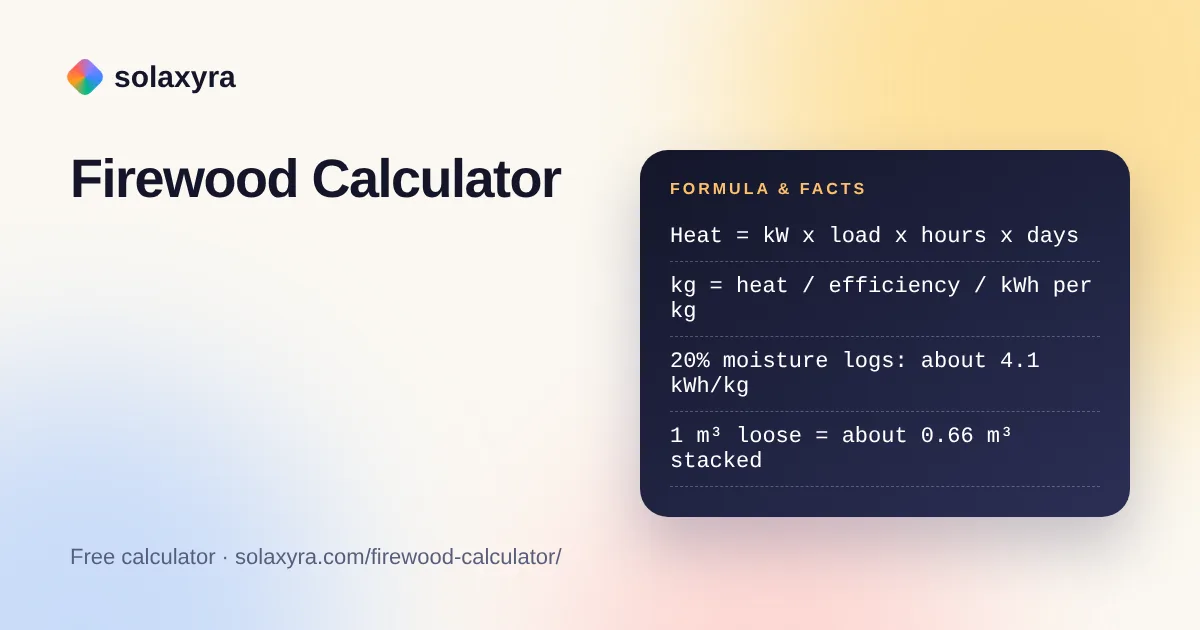
A firewood calculator is a tool that converts a season of stove use into the weight and volume of logs needed to supply it. In plain words: heat delivered equals stove output times average load times hours times days; divide by the stove’s efficiency to get the energy that must be in the wood; divide that by the net energy in one kilogram at your moisture content to get kilograms; then divide by the stacked density to get cubic metres.
Most “how much wood do I need” pages give a band of cubic metres from a points score or a room size, with no stated basis. This firewood calculator shows each step, so you can check the figure against last winter’s deliveries and adjust the inputs until it matches what you really burned.
How Do You Use the Firewood Calculator?
- Enter the stove’s nominal heat output in kW from its data plate or manual.
- Set the average output while lit as a percentage of nominal. Stoves are rarely run flat out; 70% is an example value.
- Enter the hours the fire is lit each day and the number of days you use it in a season.
- Pick the appliance type or type its seasonal efficiency from the product data.
- Pick the wood condition or enter a moisture meter reading in % wet basis.
- Enter the stacked density of your logs, your supplier’s price per loose cubic metre and your gas unit rate, then read the stacked and loose volume, weight and cost comparison.
How Much Energy Is in a Kilogram of Firewood?
Air dry log wood at 20% moisture holds about 4.1 kWh per kg of net (usable) energy, against 5.3 kWh per kg for completely dry wood, according to the Forest Research table of typical calorific values. Water in the log adds weight but no energy, and some of the fire’s heat is spent turning that water into steam.
The firewood calculator uses this relationship: net energy in GJ per tonne = 19 x (1 minus moisture fraction) minus 2.257 x moisture fraction, then divides by 3.6 to give kWh per kg. The 19 GJ per tonne is Forest Research’s figure for oven dry wood, and 2.257 MJ per kg is the heat needed to evaporate water, from the Wikipedia article on enthalpy of vaporization. At 20% moisture the formula gives 4.10 kWh per kg, matching the Forest Research table.
| Moisture content (wet basis) | Net energy (kWh/kg) | Logs needed for 3,500 kWh | Stacked volume needed |
|---|---|---|---|
| 0% (oven dry, reference) | 5.28 | 663 kg | 2.07 m³ |
| 15% (example kiln dried) | 4.39 | 797 kg | 2.12 m³ |
| 20% (Ready to Burn limit) | 4.10 | 854 kg | 2.14 m³ |
| 25% (log grade A1 or A2 limit) | 3.80 | 921 kg | 2.16 m³ |
| 35% (part seasoned example) | 3.21 | 1,090 kg | 2.21 m³ |
| 50% (freshly felled hardwood) | 2.33 | 1,505 kg | 2.35 m³ |
The table uses the default season (3,500 kWh of energy in the wood) and 400 kg per stacked m³ at 20% moisture, with the same dry wood in each stack. Weight rises steeply with moisture, by 76% from 20% to 50%, while the stacked volume rises by about 10%, because a wet log is heavier but not much bigger. The table also holds stove efficiency fixed. In practice wet wood burns cooler and less completely, so the real penalty is larger than shown.
How Many Cubic Metres of Logs Do I Need for Winter?
For evening use of a 5 kW stove, about 2 m³ stacked or 3 m³ loose is a reasonable first order, but the answer scales directly with hours, days and output. Doubling the hours doubles the wood. Running the same heat through an open fire at the 30% Ecodesign minimum instead of a 75% stove raises the need from 2.1 to 5.3 m³ stacked.
Check whether a supplier sells by loose or stacked volume. Logs tipped into a bag or trailer leave far more air between them than logs stacked neatly in a store. The Forest Research Wood as Fuel technical supplement gives 1 m³ loose as about 0.66 m³ stacked, so the firewood calculator divides stacked volume by 0.66 for the loose figure. The same supplement sets log grades A1 and A2 at under 25% moisture.
What Moisture Content Should Firewood Have?
In England, wood sold in units under 2 m³ must be certified Ready to Burn, and wood with more than 20% moisture must not be supplied in those units, under the Air Quality (Domestic Solid Fuels Standards) (England) Regulations 2020, in force since May 2021. Larger loads of 2 m³ or more must instead come with a customer notice, so check the moisture yourself before burning.
Freshly felled wood is far wetter. Forest Research gives average green moisture of about 50% for hardwoods and 55% for conifers. Split, stacked and covered logs dry over time; measure with a moisture meter on a freshly split face rather than the outside of the log. Enter the reading in the firewood calculator to see the kilograms change.
Is Burning Logs Cheaper Than Gas?
It depends almost entirely on the price you pay for logs and how efficient the stove is. With the example price of £120 per loose m³, a 75% stove delivers heat at about 14.8p per useful kWh. Gas at the Ofgem cap of 7.97p per kWh through an example 85% efficient boiler costs about 9.4p per useful kWh, before the standing charge.
The £120 log price is an example only; replace it with your own supplier’s quote, since prices vary widely by region, species and whether logs are kiln dried. Free or very cheap wood changes the comparison completely. If you are weighing electric options too, the electric heater running cost calculator and the heat pump running cost tool give pence per kWh on the same footing.
What Efficiency Should I Use for My Stove?
Use the seasonal efficiency from your stove’s product data; if you have none, the Ecodesign minimums are a floor. Under Commission Regulation (EU) 2015/1185, closed fronted solid fuel stoves sold since 1 January 2022 must reach at least 65% seasonal space heating efficiency, and open fronted appliances at least 30%. The 75% default is an example value, not a measured figure.
Safety comes first with any wood burner. Have a stove and flue fitted by a qualified installer and follow the manufacturer’s instructions. In England, Approved Document J (as amended from 1 October 2022) says a carbon monoxide alarm should be fitted when a fixed solid fuel appliance is installed. Have the chimney swept regularly and never burn wet, painted or treated wood.
Worked Example: Evening Stove in a Semi-Detached House
Example: a household in Shropshire runs a 5 kW stove in the living room for about 5 hours each evening from mid October to mid March, 150 days, at roughly 70% of its rated output. The stove is a modern closed model taken as 75% efficient, and the logs are bought Ready to Burn at 20% moisture.
- Heat delivered: 5 kW x 0.70 x 5 h x 150 days = 2,625 kWh.
- Energy in the wood: 2,625 / 0.75 = 3,500 kWh.
- Net energy per kg: (19 x 0.8 minus 2.257 x 0.2) / 3.6 = 4.10 kWh/kg.
- Weight: 3,500 / 4.097 = 854 kg, about 1.14 kg per hour lit.
- Stacked volume at 400 kg/m³: 854 / 400 = 2.14 m³. Loose volume: 2.14 / 0.66 = 3.24 m³.
- Cost at the example £120 per loose m³: £388, or 14.8p per useful kWh, against about £246 for the same heat from gas at 9.4p per useful kWh.
The firewood calculator result suggests ordering around 3.2 m³ loose, plus a margin for a cold spell. For other household loads, the electricity cost calculator works out appliance running costs at the same price cap.
Frequently Asked Questions
How many kWh are in a cubic metre of logs?
Forest Research gives stacked, air dry logs at 20% moisture 1,400 to 2,000 kWh of net energy per cubic metre, depending on species and stacking. At the example 400 kg per stacked m³ and 4.1 kWh per kg, one stacked cubic metre holds about 1,640 kWh before stove losses.
What is the difference between loose and stacked logs?
Loose logs are measured as tipped into a bag or trailer, with large air gaps. Stacked logs are packed neatly. Forest Research gives 1 m³ loose as about 0.66 m³ stacked, so 3 m³ loose holds roughly the same wood as 2 m³ stacked.
Is kiln dried firewood worth it?
Kiln dried logs are drier, so each kilogram holds more usable energy: about 4.39 kWh at 15% moisture against 2.33 kWh at 50%. Whether they are worth the higher price depends on your quote; enter the moisture and price in the calculator to compare the cost per useful kWh.
Can I still buy wet wood in England?
Wood sold in units under 2 m³ must be Ready to Burn certified with no more than 20% moisture. Loads of 2 m³ or more are not covered by that certification rule but must come with a customer notice, so measure the moisture and dry the logs further if needed.
How much firewood does a stove burn per hour?
A 5 kW stove running at 70% output with 75% efficiency burns about 1.1 kg of 20% moisture logs per hour. Doubling the output doubles the rate, and wetter logs raise the weight burned because each kilogram holds less energy.
Is this firewood calculator accurate?
It is as accurate as its inputs. The energy values follow Forest Research, but average stove load, efficiency and density are estimates. Compare the result with how much wood you used last winter, then adjust the average output or hours until the two agree.
Checked October 2026 by the Solaxyra Editorial Team. Sources: Forest Research: Typical calorific values of fuels, Forest Research: Wood as Fuel technical supplement, Forest Research: Fuel from woodland, Devon and Somerset Trading Standards: Solid fuel for domestic use, Commission Regulation (EU) 2015/1185, DLUHC circular: Approved Document J amendments, Ofgem price cap 1 October to 31 December 2026, Wikipedia: Enthalpy of vaporization.