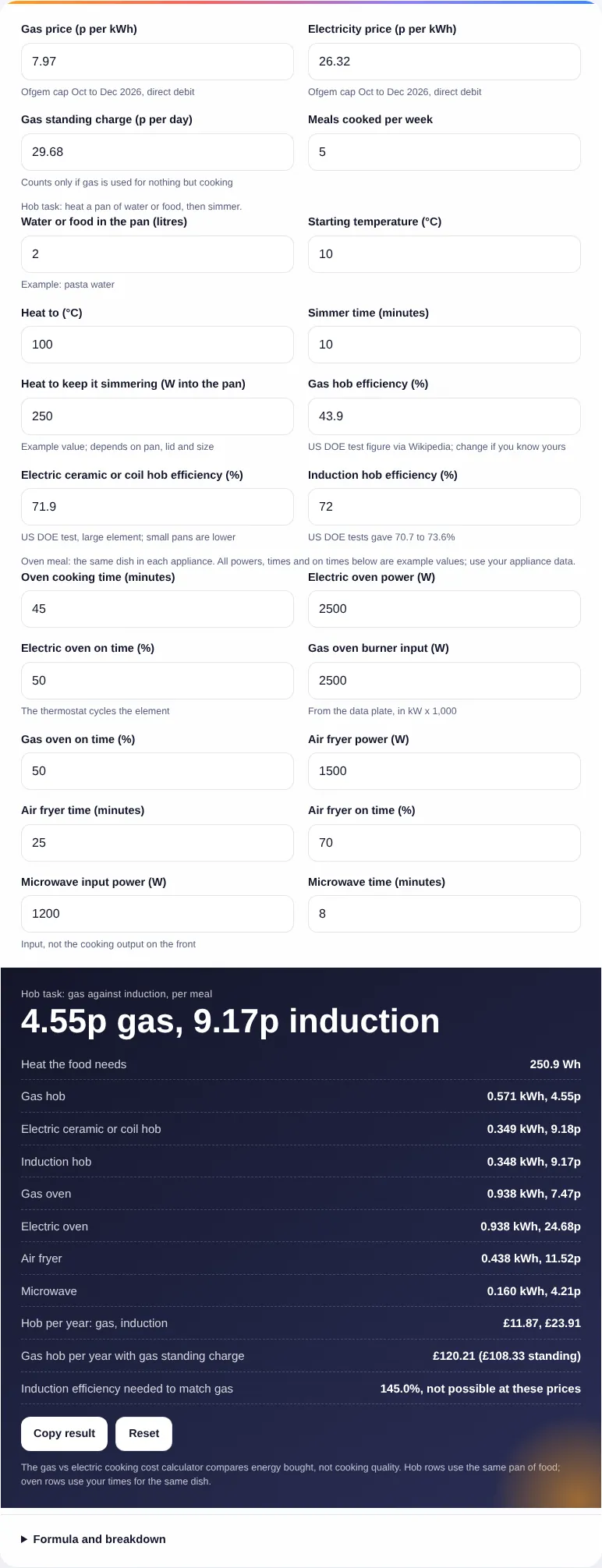
Hob task: heat a pan of water or food, then simmer.
Oven meal: the same dish in each appliance. All powers, times and on times below are example values; use your appliance data.
The gas vs electric cooking cost calculator compares energy bought, not cooking quality. Hob rows use the same pan of food; oven rows use your times for the same dish.
Formula and breakdown
n/a
n/a
n/a
This gas vs electric cooking cost calculator compares what the same meal costs on a gas hob, an electric ceramic or coil hob, an induction hob, a gas oven, an electric oven, an air fryer and a microwave, using UK price cap rates or your own tariff. It works from the heat the food actually needs and each appliance’s efficiency, so the answer reflects both the cheaper price of gas and the better efficiency of electric hobs.
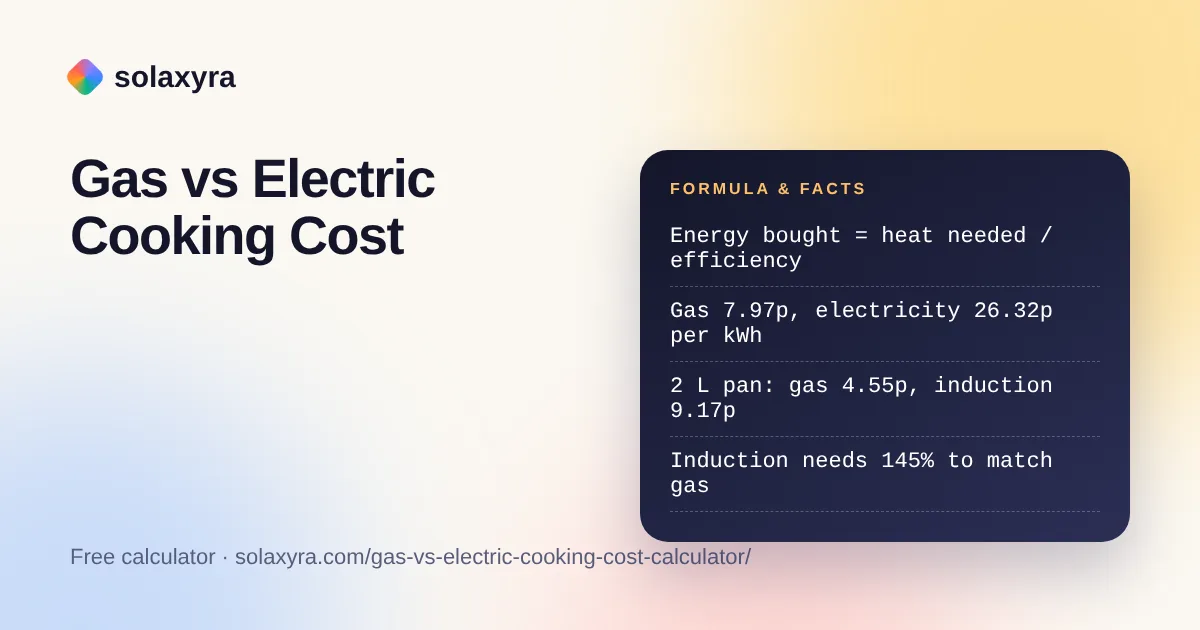
Quick answer: A gas vs electric cooking cost calculator divides the heat a meal needs by each appliance’s efficiency, then prices it per kWh. Heating 2 litres and simmering for 10 minutes costs about 4.55p on a gas hob and 9.17p on induction at the October 2026 cap, because gas costs far less per kWh.
What Is a Gas vs Electric Cooking Cost Calculator?
A gas vs electric cooking cost calculator is a tool that prices the same cooking task on gas and electric appliances so you can see which is cheaper to run. In plain words: energy bought = heat the food needs / appliance efficiency, and cost = energy bought in kWh x the price of that fuel per kWh.
For the hob, the heat needed comes from physics. The Wikipedia article on specific heat capacity gives about 4,184 joules to warm 1 kg of water by 1 °C, which is 1.1622 Wh per litre per degree. Heating 2 litres from 10 °C to 100 °C needs 209.2 Wh; keeping it simmering for 10 minutes at an example 250 W adds 41.7 Wh, for 250.9 Wh in total.
For ovens, air fryers and microwaves the calculator uses power x minutes x the share of time the heater is on, because their losses depend on the cavity, not the food. Those powers and on times are example values; your appliance’s data plate and a plug-in energy meter give better ones.
How Do You Use the Gas vs Electric Cooking Cost Calculator?
- Enter your gas and electricity unit rates, or keep the October 2026 cap figures, and the gas standing charge.
- Enter how many meals a week you cook this way.
- For the hob task, enter the litres in the pan, the starting and target temperatures, and the simmer time and heat.
- Keep or change the three hob efficiencies.
- For the oven meal, enter the cooking time and each appliance’s power, time and on time.
- Read the cost per meal for each method, the yearly hob totals and the efficiency induction would need to match gas.
Is It Cheaper to Cook With Gas or Electric?
On the hob, gas is cheaper at current UK prices: electricity costs 3.3 times as much per kWh as gas, while induction is only about 1.6 times as efficient as a gas burner. The Ofgem price cap announcement sets the average direct debit unit rates for 1 October to 31 December 2026 at 26.32p per kWh for electricity and 7.97p per kWh for gas.
| Method (default example) | Energy bought | Fuel price | Cost per meal | Cost per year, 5 meals a week |
|---|---|---|---|---|
| Gas hob, 43.9% | 0.571 kWh | 7.97p | 4.55p | £11.87 |
| Electric ceramic or coil hob, 71.9% | 0.349 kWh | 26.32p | 9.18p | £23.94 |
| Induction hob, 72% | 0.348 kWh | 26.32p | 9.17p | £23.91 |
| Gas oven, 45 min | 0.938 kWh | 7.97p | 7.47p | £19.48 |
| Electric oven, 45 min | 0.938 kWh | 26.32p | 24.68p | £64.33 |
| Air fryer, 25 min | 0.438 kWh | 26.32p | 11.52p | £30.02 |
| Microwave, 8 min | 0.160 kWh | 26.32p | 4.21p | £10.98 |
The hob rows are the same pan of food; the oven rows use example powers and times for one dish, and both ovens are given the same energy by default so only the price differs. In the gas vs electric cooking cost calculator, change those rows to your appliances’ data. The Energy Saving Trust’s lab tests of cooking costs, updated in October 2026, put a 600 g chicken breast at £0.14 in an air fryer and £0.20 in an electric oven in Great Britain, and a ready-made lasagne at £0.04 in a microwave.
How Efficient Are Gas, Ceramic and Induction Hobs?
In US Department of Energy tests on large elements, a gas burner delivered 43.9% of its energy to the pan, an electric coil 71.9% and induction 70.7 to 73.6%, according to the Wikipedia article on induction cooking. The same article reports ACEEE tests in which induction stayed at about 76% with any pan size, coil hobs fell to 40 to 50% with small pans, and gas fell from 35 to 40% to about 30%.
So induction’s real advantage over a ceramic or coil hob shows with small pans, not large ones, while its advantage over gas is large either way. The EU Ecodesign rules in Regulation (EU) No 66/2014, retained in UK law, require gas hobs to reach more than 55% efficiency in the standard test and electric hobs to use less than 195 Wh per kg in theirs. Laboratory tests use set pans and loads, so everyday results vary; that is why every efficiency in the gas vs electric cooking cost calculator can be changed.
When Would Induction Be Cheaper Than Gas?
Induction becomes cheaper than a gas hob only when electricity costs less than about 13.07p per kWh with gas at 7.97p, using the default efficiencies of 72% and 43.9%. At the cap price of 26.32p, induction would need to be 145% efficient to match gas, which is impossible.
| Electricity price (gas 7.97p) | Gas hob per meal | Induction per meal | Induction efficiency needed to match gas |
|---|---|---|---|
| 26.32p (cap) | 4.55p | 9.17p | 145.0% |
| 20p | 4.55p | 6.97p | 110.2% |
| 15p | 4.55p | 5.23p | 82.6% |
| 13p | 4.55p | 4.53p | 71.6% |
| 10p | 4.55p | 3.48p | 55.1% |
The lower prices are examples of what a cheap off-peak or time-of-use rate might be; check your own tariff. The break-even rule is simple: induction efficiency needed = gas efficiency x electricity price / gas price. The gas vs electric cooking cost calculator works it out for whatever prices you enter, and the electricity cost calculator prices any other appliance by watts and hours.
Does the Gas Standing Charge Change the Answer?
Yes, if gas is used only for cooking: the gas standing charge of 29.68p a day at the cap costs £108.33 a year whether you cook or not, which is far more than the £12.03 a year that induction costs extra in the default example. In that case the gas hob costs £120.21 a year in total against £23.91 for induction, which the gas vs electric cooking cost calculator shows in its standing charge row.
In a home with gas central heating the standing charge is paid anyway, so only the unit costs matter. Removing a gas supply or fitting an induction hob are not DIY jobs. HSE states that anyone employed to work on gas appliances in domestic premises must be a Gas Safe registered engineer, and warns that carbon monoxide cannot be seen, tasted or smelled. A new electric cooker or induction hob circuit must be installed by a qualified electrician to BS 7671. To compare a gas boiler with electric heating, the heat pump running cost calculator applies the same price and efficiency logic.
Worked Example: Pasta Night on Gas and Induction
Example: a household cooks pasta five evenings a week, heating 2 litres of water from 10 °C to boiling and simmering for 10 minutes, which needs an example 250 W of heat to keep the pan at a simmer. Prices are the October 2026 cap: gas 7.97p and electricity 26.32p per kWh.
- Heat needed: 2 x 1.1622 x 90 = 209.2 Wh, plus 250 W x 10 / 60 = 41.7 Wh, so 250.9 Wh.
- Gas hob at 43.9%: 250.9 / 0.439 = 571.5 Wh of gas, x 7.97p = 4.55p a meal.
- Induction at 72%: 250.9 / 0.72 = 348.4 Wh, x 26.32p = 9.17p a meal.
- Meals a year: 5 x 365 / 7 = 260.7. Gas £11.87, induction £23.91, so induction costs £12.03 more.
- Break-even: 43.9 x 26.32 / 7.97 = 145%, so induction cannot match gas at these prices.
The difference is real but small next to the £108.33 gas standing charge. Try your own meals in the gas vs electric cooking cost calculator above, and list your other kitchen appliances in the energy consumption calculator.
Frequently Asked Questions
Is it cheaper to cook with gas or electric in the UK?
On the hob, usually gas. At the October to December 2026 cap electricity costs 26.32p per kWh and gas 7.97p, about 3.3 times as much, while induction is about 1.6 times as efficient as gas in US DOE tests. A microwave or air fryer can still beat a gas oven for small portions.
Is induction cheaper than a gas hob?
Not at current UK cap prices. For induction to match a gas hob at 43.9% efficiency, it would need to be 145% efficient, which is impossible. Induction becomes cheaper only if your electricity costs less than about 13.07p per kWh while gas stays at 7.97p, for example on a cheap off-peak rate.
How efficient is a gas hob compared with an electric hob?
In US Department of Energy tests reported by Wikipedia, large elements reached 43.9% for gas, 71.9% for electric coil and 70.7 to 73.6% for induction. ACEEE tests found coil hobs drop to 40 to 50% with small pans. EU Ecodesign rules require new gas hobs to exceed 55% in their test.
Is a gas oven cheaper to run than an electric oven?
Usually, because gas costs about a third of the price of electricity per kWh. If both ovens use 0.94 kWh for a dish, the gas oven costs 7.47p and the electric oven 24.68p at the October 2026 cap. Real ovens differ, so enter your own oven’s data.
Should I switch from gas to electric cooking to save money?
Not for running costs alone at current prices, unless gas is used only for cooking. In that case, dropping gas removes the standing charge of 29.68p a day, or £108.33 a year at the cap, which is far more than the yearly cooking cost difference for most households.
What is the cheapest way to cook in the UK?
For small portions, a microwave usually costs least, because it heats the food rather than an oven cavity. The Energy Saving Trust’s lab tests put a microwave lasagne at £0.04 and an air fryer chicken breast at £0.14 against £0.20 in an electric oven in Great Britain.
Checked October 2026 by the Solaxyra Editorial Team. Sources: Ofgem: price cap 1 October to 31 December 2026, Wikipedia: Induction cooking, Regulation (EU) No 66/2014, Energy Saving Trust: cheaper cooking, HSE: Domestic gas safety FAQs.