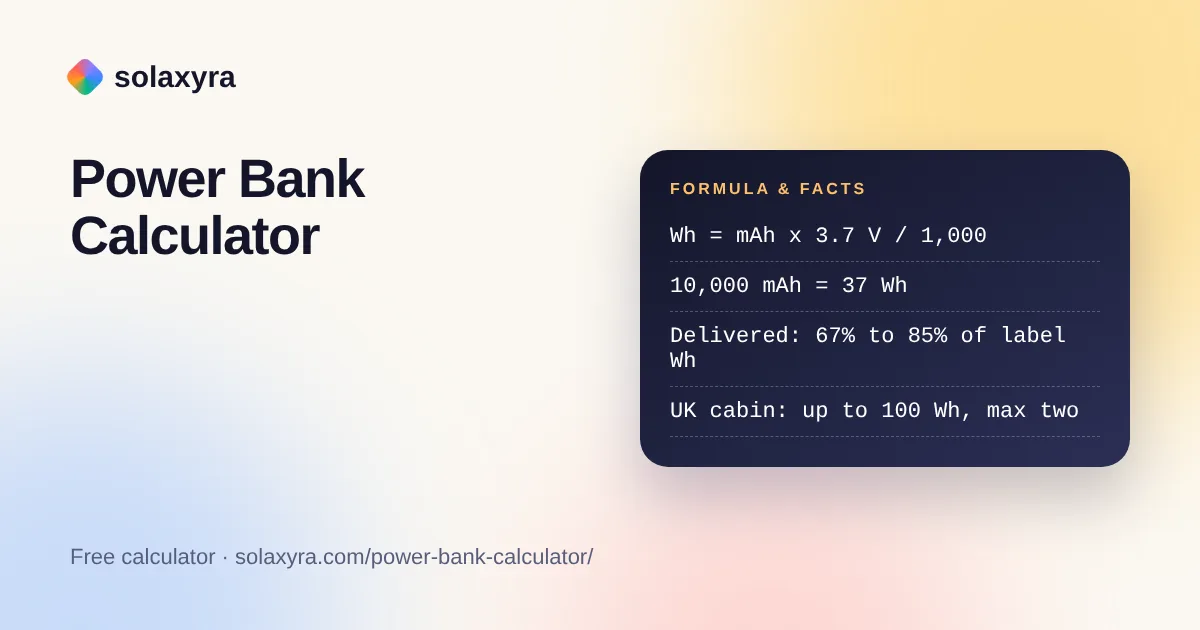
This power bank calculator uses Wh = mAh x V / 1,000, the formula the UK Civil Aviation Authority gives. Real results depend on cable, charging speed, temperature, battery age and whether the device is in use while charging. Check your airline’s own rules before flying.
Formula and breakdown
n/a
n/a
n/a
This power bank calculator works out how many times a power bank will charge your phone, tablet, earbuds or laptop, by converting the mAh on the label to watt-hours and allowing for conversion losses, and it checks the result against the UK flight rules for power banks that apply from 27 March 2026. It suits travellers, commuters and festival-goers in the UK and Europe.
Quick answer: A power bank calculator converts the label rating to energy: mAh x 3.7 V / 1,000 gives watt-hours, so 10,000 mAh is 37 Wh. After 67 to 85% conversion efficiency, that delivers about 25 to 31 Wh, or 1.6 to 2.0 full charges of a 15.4 Wh (4,000 mAh) phone. Power banks up to 100 Wh can go in UK cabin bags.
What Is a Power Bank Calculator?
A power bank calculator is a tool that estimates how many full charges a portable battery pack can give a device, by comparing the energy the power bank delivers with the energy the device's battery holds. The formula in plain words: power bank watt-hours times efficiency, divided by the device's watt-hours for one charge.
Watt-hours come from the label. The UK Civil Aviation Authority's packing guidance gives the conversion: voltage times amp-hours equals watt-hours, and for a rating in mAh, divide the answer by 1,000. The same conversion works in reverse in the mAh to Wh calculator.
How Do You Use the Power Bank Calculator?
- Enter the power bank capacity from its label, in mAh or Wh. For mAh, pick the rated cell voltage printed next to it, usually 3.6 or 3.7 V.
- Choose a device from the list or enter your own battery size in mAh and voltage, or in Wh. The listed devices are examples, so check your own specification.
- Set the charge range, for example 20% to 80% if you top up before the phone runs flat.
- Keep the example overall efficiency of 67% or enter your own figure.
- Read the number of full charges, the 67% to 85% range, the energy delivered and the UK flight rule for that power bank.

Why Does a 10,000 mAh Power Bank Not Give 10,000 mAh?
A 10,000 mAh power bank cannot fill 10,000 mAh of phone batteries because the rating is measured at the cells' 3.6 or 3.7 V, the energy is lost twice in conversion, and phone batteries run at a higher voltage than many people assume. Comparing mAh with mAh ignores all three.
First, the power bank's cells store 10,000 mAh x 3.7 V = 37 Wh, which must be boosted to 5 V or more for USB; at 5 V the same energy is only 7,400 mAh even before losses. Second, Anker's support article puts the power bank's conversion at about 82% efficient and the phone's own charging circuit at about 82% too, which multiplies to about 67%. Anker's blog and Xtorm use a single 85% figure instead. Third, a phone battery labelled 4,000 mAh at an example 3.85 V holds 15.4 Wh, more than 4,000 mAh at 3.7 V would suggest.
| Power bank label | Energy at 3.7 V | Phone charges (15.4 Wh), 67% | Phone charges, 85% | Laptop charges (50 Wh), 67% | Laptop charges, 85% |
|---|---|---|---|---|---|
| 5,000 mAh | 18.5 Wh | 0.8 | 1.0 | 0.2 | 0.3 |
| 10,000 mAh | 37.0 Wh | 1.6 | 2.0 | 0.5 | 0.6 |
| 20,000 mAh | 74.0 Wh | 3.2 | 4.1 | 1.0 | 1.3 |
| 26,800 mAh | 99.2 Wh | 4.3 | 5.5 | 1.3 | 1.7 |
The phone and laptop sizes in the table are example values; the power bank calculator lets you enter your own. The spread between the 67% and 85% columns is real uncertainty, which is why the power bank calculator shows a range instead of one number.
How Many Times Will a Power Bank Charge My Phone?
A 10,000 mAh power bank charges a typical 4,000 mAh phone about 1.6 to 2 times from empty, a 20,000 mAh power bank about 3 to 4 times, and a 5,000 mAh power bank about once. Topping up from 20% to 80% uses only 60% of the phone's battery, so the same power bank gives proportionally more top-ups; set the from and to percentages in the power bank calculator to see how many.
Several things push the real figure towards the low end: using the phone while it charges, a hot phone or power bank, an old power bank whose cells have lost capacity, fast charging at higher voltages and cheap cables. Ranking pages quote efficiency figures from 65% to 90% without saying where they come from, and even one manufacturer uses both 67% and 85% on different pages, so treat any single "charges" number as an estimate.
Can You Take a Power Bank on a Plane in the UK?
Yes, in the cabin only: under the UK rules effective from 27 March 2026, power banks up to 100 Wh need no approval, 100 to 160 Wh need the airline's approval, and each person may carry a maximum of two. The CAA's notice on changes to the rules for lithium batteries and power banks also says power banks must not be recharged on board and should not be used to charge other devices on board.
| Power bank rating | Example at 3.7 V | UK rule (CAA) |
|---|---|---|
| Up to 100 Wh | up to about 27,000 mAh | Cabin baggage only, no approval needed |
| Over 100 Wh, up to 160 Wh | about 27,000 to 43,200 mAh | Cabin baggage only, airline approval needed |
| Over 160 Wh | above about 43,200 mAh | Prohibited in passenger baggage |
| Any power bank | n/a | Never in checked luggage; maximum two per person; protect each one; no recharging on board |
The CAA's passenger guidance adds that crew may ask you to keep power banks in the seat pocket rather than an overhead locker. Airlines in other countries can set stricter rules, so check yours before you fly.
Worked Example: A Weekend Away With One Power Bank
Example: a traveller has a 20,000 mAh, 3.7 V power bank and a phone with an example 5,000 mAh, 3.85 V battery. They plan to top up from 20% to 80% each time and assume 75% overall efficiency, and enter these figures in the power bank calculator.
- Power bank energy: 20,000 x 3.7 / 1,000 = 74 Wh, well under the 100 Wh cabin limit.
- Delivered energy at 75%: 74 x 0.75 = 55.5 Wh.
- Phone battery: 5,000 x 3.85 / 1,000 = 19.25 Wh. One top-up from 20% to 80% uses 60% of that, 11.55 Wh.
- Top-ups: 55.5 / 11.55 = 4.8. Across the 67% to 85% range, that is 4.3 to 5.4 top-ups.
- Decision: enough for a weekend of daily top-ups with some left over, and allowed in the cabin without airline approval.
For bigger loads such as a camping fridge or a laptop all day, a portable power station is the better tool, and the power station runtime calculator estimates its hours. The battery runtime calculator does the same for any battery and load, and the lithium-ion battery voltage chart explains the 3.6 and 3.7 V cell ratings printed on power bank labels.
Frequently Asked Questions
How many Wh is a 10,000 mAh power bank?
About 37 Wh, using the 3.7 V cell rating most power banks print on the label: 10,000 x 3.7 / 1,000 = 37. At 3.6 V it is 36 Wh. Use the Wh figure, not the mAh figure, when comparing power banks with laptops or checking flight rules.
How many times will a 20,000 mAh power bank charge a phone?
About 3 to 4 full charges of a 4,000 mAh phone with a 3.85 V battery, assuming 67 to 85% efficiency. A 20,000 mAh bank stores 74 Wh at 3.7 V and delivers roughly 50 to 63 Wh. Larger phones get fewer charges.
Why is my power bank giving fewer charges than expected?
The mAh rating is at 3.6 or 3.7 V, but USB output runs at 5 V or more, and energy is lost in both the power bank's converter and the phone's charging circuit. Anker estimates about 82% for each stage, or 67% overall. Heat, age and using the phone while charging lower it further.
What size power bank can I take on a plane?
In the UK, power banks up to 100 Wh can go in cabin baggage without approval, and 100 to 160 Wh need the airline's approval. Over 160 Wh is prohibited in passenger baggage. Power banks must never go in checked luggage, and each person may carry two.
Can a power bank charge a laptop?
Yes, if it has a USB-C Power Delivery output that matches the laptop's charging requirement. In energy terms, a 20,000 mAh bank (74 Wh) delivers about 50 to 63 Wh, roughly one charge of an example 50 Wh laptop battery.
Is it better to compare power banks by mAh or Wh?
Wh is better, because it includes voltage and is the figure used for flight rules. Two power banks with the same mAh can hold different energy if their cells are rated at different voltages, and laptop batteries are usually stated in Wh anyway.
Checked October 2026 by the Solaxyra Editorial Team. Sources: UK CAA: Changes to rules on the carriage of lithium cells, batteries and power banks, UK CAA: Pack right, safe flight, Anker support: why doesn't my power bank charge my devices as many times as expected, Xtorm: calculate the number of device charges.