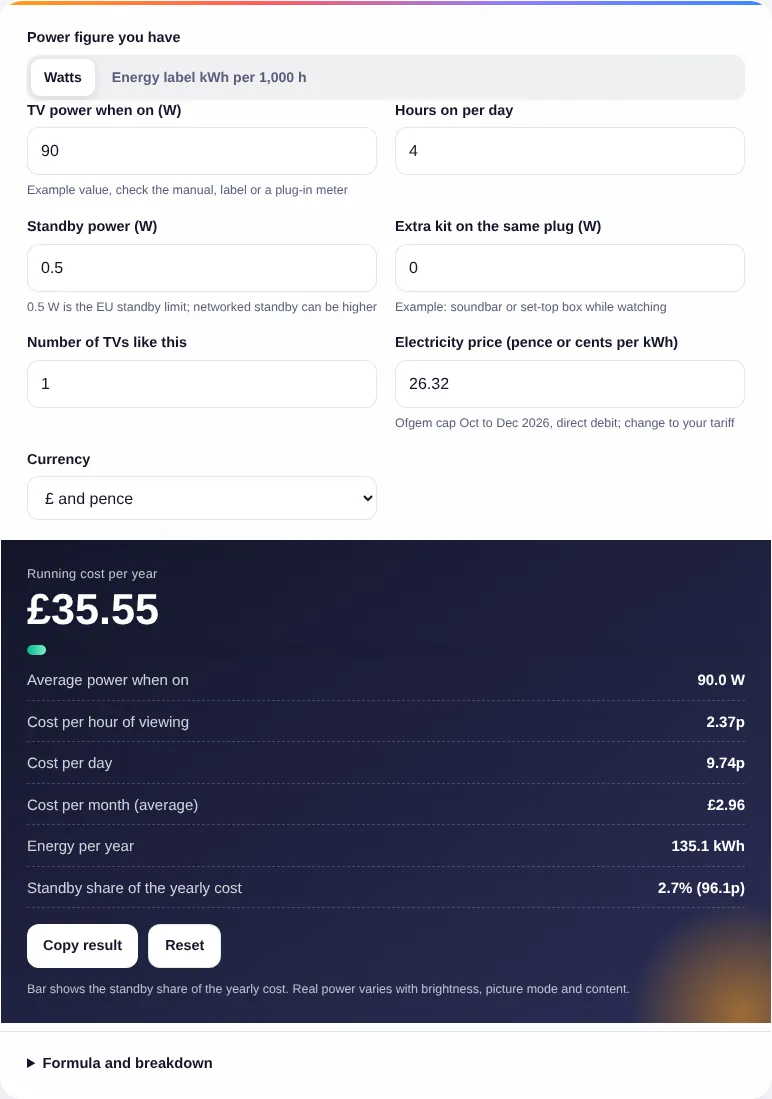
Bar shows the standby share of the yearly cost. Real power varies with brightness, picture mode and content.
Formula and breakdown
n/a
n/a
n/a
This TV running cost calculator shows what a television costs per hour of viewing, per day and per year, for households in the UK, Ireland and across Europe. Enter the TV’s watts, or copy the kWh per 1,000 h figures from its energy label, then add hours watched, standby and any soundbar or set-top box that runs with it.
Quick answer: A TV running cost calculator multiplies the TV’s power by hours watched, adds standby, and applies your unit price. Example: a 90 W TV on for 4 hours a day with 0.5 W standby uses about 135 kWh a year, which costs about £35.55 at the 26.32p Ofgem cap rate, or 2.37p per hour.

What Is a TV Running Cost Calculator?
A TV running cost calculator is a tool that converts a television’s power draw and viewing hours into kilowatt-hours and money. In plain words: daily energy equals watts when on times hours on, plus standby watts times the remaining hours, divided by 1,000; yearly cost equals daily energy times 365 times your price per kWh.
Most published figures use a single average wattage for a screen size. That hides the two things that move the bill most: the actual model’s power and how many hours it is on. The tv running cost calculator lets you enter both, and it uses the label figure if you do not know the watts.
How Do You Use the TV Running Cost Calculator?
- Choose whether you know the TV’s watts or have its energy label.
- Enter the watts, or the SDR and HDR figures from the label and the share of your viewing that is HDR.
- Enter how many hours a day the TV is on and its standby power.
- Add any equipment that runs only while you watch, such as a soundbar, and the number of similar TVs in the home.
- Enter your price per kWh. The default is the Ofgem cap rate for October to December 2026.
- Read the yearly cost, cost per hour and standby share, and open the formula panel to check each step.
How Much Does It Cost to Run a TV per Hour?
A TV costs its watts divided by 1,000, times your price per kWh, for each hour it is on: at 26.32p per kWh that is about 1.3p an hour for a 50 W set and about 6.6p for a 250 W set. The rate is the direct debit unit rate in the Ofgem cap for October to December 2026, which already reflects the removal of VAT from electricity bills between 1 October 2026 and 31 March 2027.
The table shows yearly figures for a range of power ratings, each watched 4 hours a day (example viewing time) and on 0.5 W standby for the other 20 hours. These are calculated values for each wattage, not averages for particular sizes or brands.
| Power when on | Cost per hour | Energy per year | Cost per year at 26.32p |
|---|---|---|---|
| 50 W | 1.32p | 76.6 kWh | £20.17 |
| 90 W | 2.37p | 135.1 kWh | £35.55 |
| 130 W | 3.42p | 193.5 kWh | £50.92 |
| 180 W | 4.74p | 266.4 kWh | £70.13 |
| 250 W | 6.58p | 368.6 kWh | £97.03 |
To turn any appliance’s watts into kWh without costs, use the watts to kWh converter.
How Do You Read the Energy Label on a TV?
The figure in kWh per 1,000 h on a TV energy label is the TV’s average power in watts, because 1 kWh used over 1,000 hours is exactly 1 W. Under Regulation (EU) 2019/2013, the label shows on mode energy consumption in kWh per 1,000 h for SDR content and a second figure for HDR content, each rounded to a whole number.
That makes the label the easiest way to cost a TV in a shop before you buy it: a label of 80 kWh per 1,000 h is an 80 W TV for costing purposes. If you watch a lot of HDR films or play HDR games, enter the HDR figure too and the share of viewing time in HDR, and the tv running cost calculator blends the two. Remember the test uses standard settings; a very bright picture mode can draw more.
How Much Electricity Does a TV Use on Standby?
A TV sold in the EU may draw at most 0.5 W in standby mode and 0.3 W in off mode, with networked standby allowed up to 2 W, under the ecodesign rules in Regulation (EU) 2019/2021. The regulation lets these limits rise slightly where extra functions such as a status display are present and enabled.
At 0.5 W, a TV on standby around the clock uses about 4.4 kWh a year, roughly £1.15 at the cap rate, so standby is a small slice of the bill for most homes. Networked standby, which keeps the set ready for voice control, casting or quick start, has a baseline limit four times higher, so it can cost up to four times as much. The tv running cost calculator shows the standby share; if it is more than a few per cent, check whether quick start is switched on. For all the small loads around the home, the standby power calculator adds them up.
What Else Changes a TV’s Running Cost?
Viewing hours and picture brightness change the cost far more than screen size alone: doubling the hours doubles the cost, and the brightest picture modes push the power well above the label figure. Equipment that runs only while you watch, such as a soundbar, games console or set-top box, adds its watts to every hour of viewing.
- Picture mode: vivid or dynamic modes run the backlight or panel harder; eco and standard modes are closer to the label test.
- Ambient light sensor: lets the TV dim in a dark room, reducing average power.
- Extra kit: enter the soundbar or box watts in the extra kit field.
- Several TVs: set the number of TVs, or add each one with its own wattage in the household energy consumption calculator.
If you run a TV from a portable power station on holiday or during a power cut, the power station runtime calculator shows how many hours of viewing a battery gives.
Worked Example: A Family TV With a Soundbar
Example: a family in Manchester has a TV whose label shows 80 kWh per 1,000 h for SDR and 130 kWh per 1,000 h for HDR. About a quarter of their viewing is HDR. A 20 W soundbar runs whenever the TV is on, and the set is on 6 hours a day, with 0.5 W standby the rest of the time.
- Blended TV power: 80 x 0.75 + 130 x 0.25 = 92.5 W.
- With the soundbar: 92.5 + 20 = 112.5 W while watching.
- Viewing energy: 112.5 W x 6 h / 1,000 = 0.675 kWh a day.
- Standby energy: 0.5 W x 18 h / 1,000 = 0.009 kWh a day.
- Per year: 0.684 kWh x 365 = 249.7 kWh, which at 26.32p is about £65.71, or about 2.96p for each hour of viewing.
Standby is only about 86p of that total. Cutting viewing to 4 hours a day would bring the yearly figure down to roughly £44, which shows that hours matter much more than standby.
Frequently Asked Questions
How much does it cost to watch TV for an hour?
Divide the TV’s watts by 1,000 and multiply by your price per kWh. At the October to December 2026 cap of 26.32p, a 90 W TV costs about 2.4p an hour, a 50 W set about 1.3p and a 250 W set about 6.6p. Add a soundbar or console if it runs at the same time.
What does kWh per 1,000 h on a TV energy label mean?
It is the energy the TV uses in 1,000 hours of watching, measured in a standard test. Because 1 kWh spread over 1,000 hours is 1 W, the number is also the TV’s average power in watts. A label showing 80 kWh per 1,000 h means about 80 W.
Does HDR use more electricity than normal TV?
It can. The EU energy label gives two figures, one for standard dynamic range content and a separate one for HDR, measured in the same test. If the HDR figure on your label is higher, more HDR viewing raises the cost. Enter both and your HDR share to get a blended figure.
How much does a TV cost on standby?
Very little for a modern set in plain standby. EU rules cap standby at 0.5 W, which is about 4.4 kWh and roughly £1.15 a year if left on standby all day at 26.32p. Networked standby, used for voice control or quick start, is allowed up to 2 W.
Does a bigger TV cost more to run?
Generally, because a larger screen needs more light, but technology, brightness and picture mode matter as much as size. Two TVs of the same size can differ a lot, so use the watts or label figure for your model rather than a size average.
How can I reduce my TV running cost?
Use an energy saving or eco picture mode, lower the backlight or brightness, turn on the automatic brightness sensor if the TV has one, switch off rather than leaving it on with nobody watching, and turn off quick start if you do not need it.
Checked October 2026 by the Solaxyra Editorial Team. Sources: Ofgem price cap October to December 2026, Regulation (EU) 2019/2013 on display energy labelling, Regulation (EU) 2019/2021 on display ecodesign.