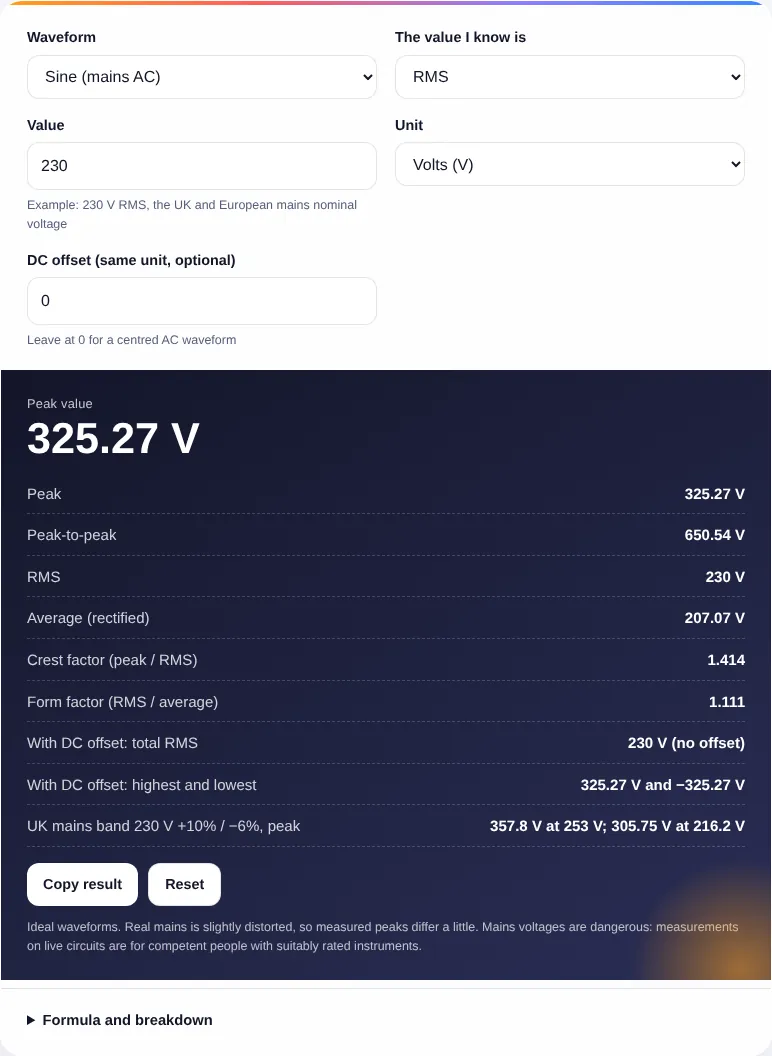
Ideal waveforms. Real mains is slightly distorted, so measured peaks differ a little. Mains voltages are dangerous: measurements on live circuits are for competent people with suitably rated instruments.
Formula and breakdown
n/a
n/a
This peak to RMS calculator converts between the peak, peak-to-peak, RMS and average values of a voltage or current for sine, square, triangle, sawtooth, pulse and rectified waveforms, for students, electronics hobbyists, technicians and engineers in the UK, Europe and elsewhere. It starts from the 230 V RMS mains voltage used in the UK and Europe, handles a DC offset and shows the crest and form factors.
Quick answer: A peak to RMS calculator divides the peak by a factor set by the waveform shape. For a sine wave, RMS is the peak divided by √2, so 230 V RMS mains peaks at 325.3 V and swings 650.5 V peak-to-peak. Square waves have RMS equal to peak; triangle and sawtooth waves use peak divided by √3.
What Is a Peak to RMS Calculator?
A peak to RMS calculator is a tool that turns the highest instantaneous value of an alternating waveform into its root mean square value, the equivalent steady DC level that delivers the same heating power, and back again. In plain words: work out the peak first, then multiply it by the factor for the waveform shape. For a sine wave, RMS equals the peak divided by √2 (about 1.414); peak-to-peak is twice the peak; and the average of the rectified wave is 2 divided by π times the peak.
The factors come from the shape of the wave, not its size or frequency, so they apply equally to voltage and current. The Wikipedia article on root mean square lists them for the common waveforms, and notes that converting between peak and RMS this way assumes a pure sine wave.
How Do You Use the Peak to RMS Calculator?
- Choose the waveform: sine for mains AC, or square, triangle, sawtooth, pulse or rectified sine.
- Choose which value you know: RMS, peak, peak-to-peak or average.
- Enter the value and pick the unit: volts, millivolts, kilovolts, amps or milliamps.
- For a pulse, enter the duty cycle; for a waveform that sits above or below zero, enter the DC offset.
- Read the peak or RMS at the top and every other value below, then open the breakdown to see the factors used.
What Is the Peak Voltage of 230 V Mains?
230 V mains is an RMS figure, so its peak is 230 x √2 = 325.3 V and its peak-to-peak swing is 650.5 V. The Wikipedia article on mains electricity gives the UK supply as 230 V +10% / −6% at 50 Hz, so the voltage at a socket can lawfully sit anywhere from 216.2 V to 253 V RMS. The table shows what that means for the peak.
| Supply, RMS | Where it applies | Peak | Peak-to-peak |
|---|---|---|---|
| 216.2 V | Bottom of the UK band (230 V minus 6%) | 305.75 V | 611.51 V |
| 220 V | Much of Europe before harmonisation | 311.13 V | 622.25 V |
| 230 V | UK and European nominal | 325.27 V | 650.54 V |
| 240 V | UK before harmonisation | 339.41 V | 678.82 V |
| 253 V | Top of the UK band (230 V plus 10%) | 357.8 V | 715.59 V |
| 120 V | United States nominal | 169.71 V | 339.41 V |
The top row matters for anything connected directly to the mains: capacitors, surge protection and switching components see the peak, not the RMS value, and must be rated above about 358 V plus a safety margin. Power calculations, on the other hand, use RMS. The watts to amps calculator works with the 230 V RMS figure directly.
How Do RMS Factors Differ Between Waveforms?
A square wave’s RMS equals its peak, while triangle and sawtooth waves have an RMS of the peak divided by √3, and a pulse has an RMS of the peak times the square root of its duty cycle. The table lists every factor the peak to rms calculator uses, with the peak set to 1.
| Waveform | RMS | Average | Peak-to-peak | Crest factor | Form factor |
|---|---|---|---|---|---|
| Sine | 0.7071 | 0.6366 (rectified) | 2 | 1.414 | 1.111 |
| Square | 1 | 1 (rectified) | 2 | 1 | 1 |
| Triangle or sawtooth | 0.5774 | 0.5 (rectified) | 2 | 1.732 | 1.155 |
| Pulse, 25% duty, 0 to peak | 0.5 | 0.25 | 1 | 2 | 2 |
| Half-wave rectified sine | 0.5 | 0.3183 | 1 | 2 | 1.571 |
| Full-wave rectified sine | 0.7071 | 0.6366 | 1 | 1.414 | 1.111 |
For waves centred on zero, the true average over a cycle is zero, so the table and calculator give the average of the rectified wave, which is what a simple meter responds to. For pulse and rectified waves, which never go below zero, the average is the real DC value.
Why Does My Multimeter Read the Wrong RMS on Some Waveforms?
Many low-cost multimeters measure the rectified average and multiply it by the sine form factor of 1.111, so they read correctly only on sine waves; the Wikipedia article on true RMS converters explains that this correction is only right for a sinusoidal input. On a square wave they read about 11% high, and on a triangle wave about 4% low. A true RMS meter calculates the real value and avoids the error. The form factor row in the peak to rms calculator lets you correct an average-responding reading: multiply it by 0.9 to recover the rectified average, then by the form factor of the actual waveform.
Live mains measurements carry a real risk of electric shock and arc flash. Use a meter and leads rated for the circuit category, and leave work on fixed wiring to a qualified electrician; in the UK, work on installations must meet BS 7671.
How Does a DC Offset Change the RMS?
A DC offset raises the total RMS: for a wave centred on zero, total RMS is the square root of the AC RMS squared plus the offset squared. For waves that already have a DC average, such as pulses, the calculator adds a cross term of twice the offset times that average, so the result stays exact. It also shows the highest and lowest instantaneous values, which is what matters for an input range or a component rating. To relate the RMS value to power in a resistor, use the Ohm’s law calculator.
Worked Example: A Pulse Signal With an Offset
Example: a pulse signal has a measured average of 3 V, a duty cycle of 25%, and sits on a −1.5 V offset.
- Peak: average / duty cycle = 3 / 0.25 = 12 V. For a pulse that runs from 0 to peak, peak-to-peak is also 12 V.
- RMS without offset: 12 x √0.25 = 6 V. Crest factor 12 / 6 = 2; form factor 6 / 3 = 2.
- Total RMS with offset: √(6² + 2 x (−1.5) x 3 + (−1.5)²) = √(36 minus 9 + 2.25) = √29.25 = 5.41 V.
- Highest and lowest values: 12 minus 1.5 = 10.5 V and 0 minus 1.5 = −1.5 V.
The same steps with a sine wave and 230 V RMS give the familiar 325.3 V peak, which you can check by choosing the defaults.
Frequently Asked Questions
How do you convert peak voltage to RMS?
For a sine wave, divide the peak by √2, which is the same as multiplying by 0.7071. A 325.3 V peak is 230 V RMS. Other shapes use other factors: a square wave’s RMS equals its peak, and triangle and sawtooth waves divide the peak by √3.
What is the peak voltage of 230 V mains?
230 V is an RMS value, so the peak is 230 x √2, about 325.3 V, and the peak-to-peak swing is about 650.5 V. At the top of the UK’s permitted band, 253 V, the peak reaches about 357.8 V, so insulation and components must be rated above that.
Why is mains voltage given as RMS?
RMS is the DC voltage that would deliver the same heating power into a resistor. Quoting 230 V RMS means a kettle or heater behaves as it would on 230 V DC, so power calculations such as watts equals volts times amps work directly with the RMS figure.
What is the difference between peak and peak-to-peak?
Peak is the highest value measured from zero, while peak-to-peak is the distance from the lowest point to the highest. For a waveform centred on zero, peak-to-peak is twice the peak. For a pulse or rectified wave that only runs from zero upwards, peak-to-peak equals the peak.
What is crest factor?
Crest factor is the peak divided by the RMS value. A pure sine wave has a crest factor of √2, about 1.414, and a square wave has 1. Higher crest factors mean short, high peaks, which matter for meters, amplifiers and power supplies that must handle the peak without clipping.
Can I use these formulas for current as well as voltage?
Yes. The ratios between peak, peak-to-peak, RMS and average depend only on the waveform shape, so they apply equally to current. A sine current of 10 A RMS has a peak of 14.14 A. Choose amps or milliamps in the unit list.
Checked October 2026 by the Solaxyra Editorial Team. Sources: Wikipedia, Root mean square, Wikipedia, Mains electricity, Wikipedia, True RMS converter.