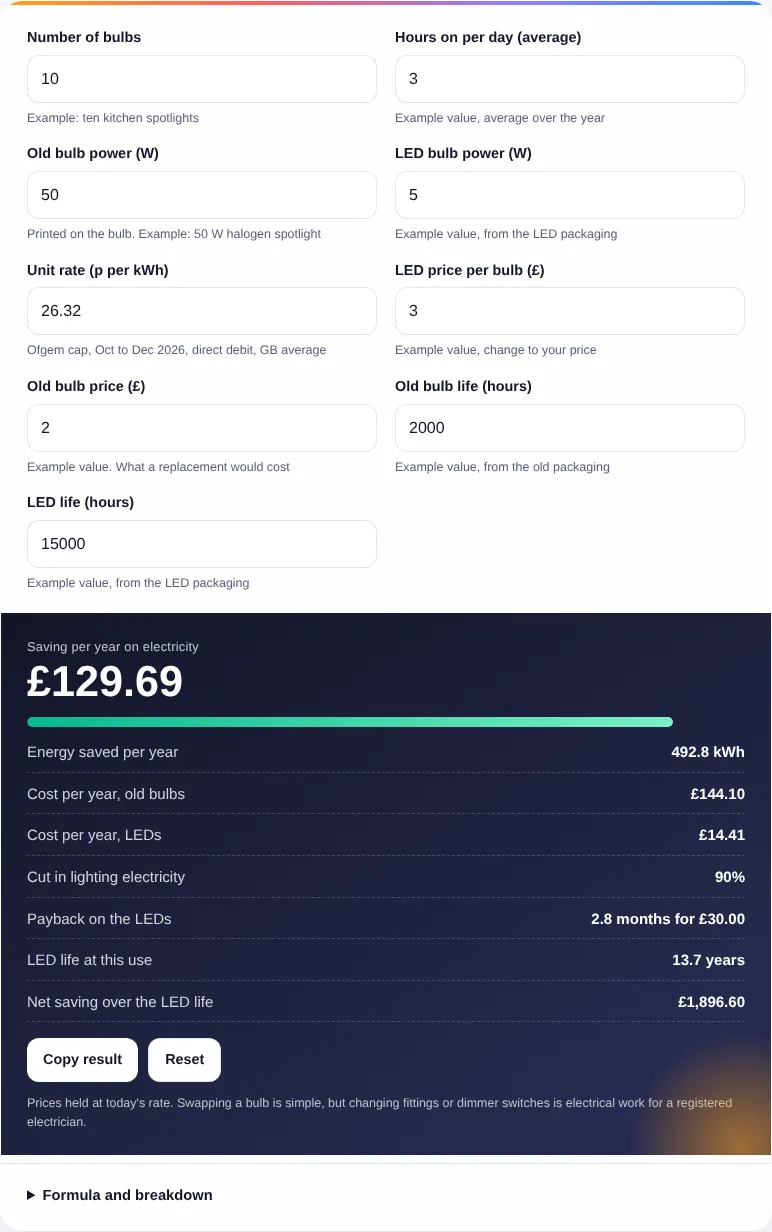
Prices held at today’s rate. Swapping a bulb is simple, but changing fittings or dimmer switches is electrical work for a registered electrician.
Formula and breakdown
n/a
n/a
n/a
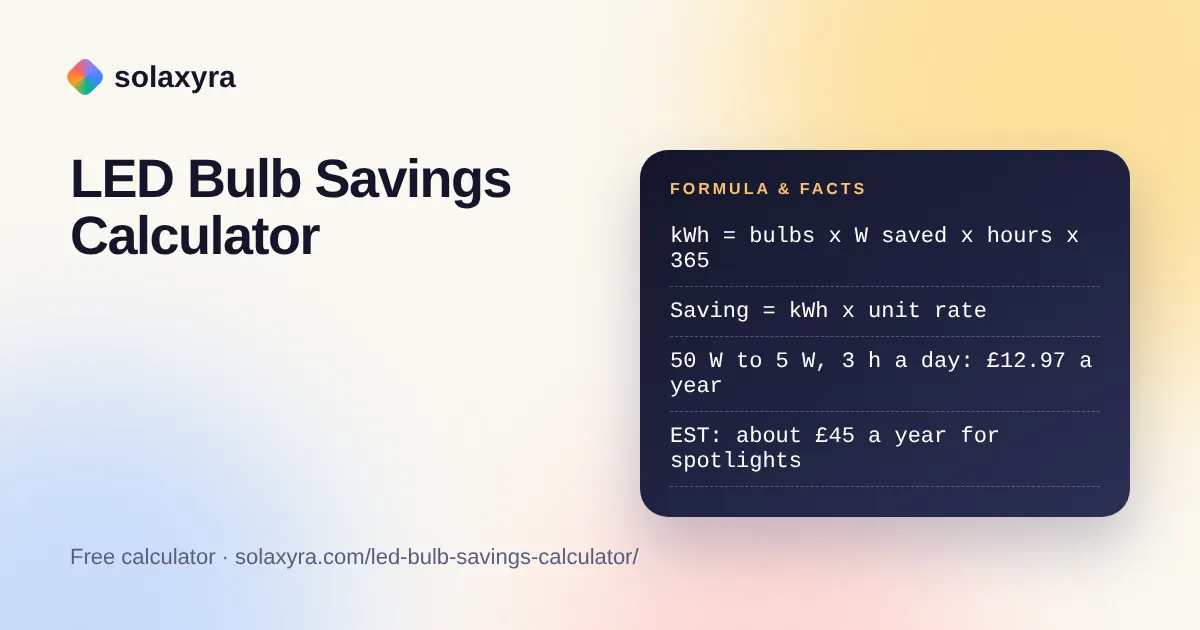
This LED bulb savings calculator shows how much electricity and money you save each year by replacing halogen, incandescent or older energy-saving bulbs with LEDs, how quickly the new bulbs pay for themselves and what you save over their life, for UK households and anyone who enters their own unit rate. It starts from the Ofgem price cap rate for October to December 2026.
Quick answer: An LED bulb savings calculator multiplies the watts saved per bulb by the number of bulbs, hours a day and 365, then by your unit rate. Ten 50 W halogen spotlights swapped for 5 W LEDs and used 3 hours a day save 492.8 kWh, about £129.69 a year at 26.32p per kWh.
What Is an LED Bulb Savings Calculator?
An LED bulb savings calculator is a tool that compares the running cost of your existing bulbs with LED replacements and turns the difference into a yearly saving and a payback time. In plain words: subtract the LED’s watts from the old bulb’s watts, multiply by the number of bulbs and the hours they are on each year, divide by 1,000 to get kWh, and multiply by your price per kWh. Divide the cost of the LEDs by that yearly saving to get the payback time.
The led bulb savings calculator also looks at the whole life of the LED. Over its rated hours you would otherwise have bought several replacement halogen bulbs, so it adds that avoided spending to the energy saving and subtracts what the LEDs cost.
How Do You Use the LED Bulb Savings Calculator?
- Enter how many bulbs you are replacing and how many hours a day they are on, averaged across the year.
- Enter the old bulb’s wattage, printed on the bulb or its base, and the LED’s wattage from the packaging.
- Keep the default unit rate of 26.32p per kWh or enter the rate on your bill.
- Enter the price of each LED and, for the lifetime figure, the price and rated life of the old bulbs and the LED’s rated life.
- Read the yearly saving, the payback in months and the net saving over the LED’s life, then check the breakdown.
How Much Does One LED Bulb Save a Year?
Each watt you save for one hour a day is worth about 9.6p a year at the Ofgem cap rate of 26.32p per kWh, so a 50 W halogen spotlight replaced by a 5 W LED and used 3 hours a day saves about £12.97. The table shows yearly savings per bulb for common swaps. The LED wattages are examples; check the lumens on the packaging to match the brightness you need.
| Old bulb | Example LED | 1 hour a day | 3 hours a day | 5 hours a day | kWh saved a year at 3 hours |
|---|---|---|---|---|---|
| 35 W halogen spotlight | 4 W | £2.98 | £8.93 | £14.89 | 33.9 |
| 50 W halogen spotlight | 5 W | £4.32 | £12.97 | £21.62 | 49.3 |
| 40 W incandescent | 5 W | £3.36 | £10.09 | £16.81 | 38.3 |
| 60 W incandescent | 8 W | £5.00 | £14.99 | £24.98 | 56.9 |
| 100 W incandescent | 14 W | £8.26 | £24.79 | £41.31 | 94.2 |
| 11 W compact fluorescent | 7 W | £0.38 | £1.15 | £1.92 | 4.4 |
The last row is the useful warning: replacing an energy-saving bulb that still works saves very little, while replacing halogens and old incandescent bulbs saves a lot. To check any other appliance in the same way, use the electricity cost calculator.
How Much Can a Whole Home Save by Switching to LED?
The Energy Saving Trust says that replacing the remaining halogen spotlights in your home with LEDs could save £45 a year in Great Britain and £55 in Northern Ireland, and that LEDs use 80% less electricity than halogen. At today’s cap rate, £45 is about 171 kWh, the same as saving 45 W for roughly 10 lit hours every day. That might be three or four 50 W spotlights on for about three hours each.
Your own figure depends on how many bulbs you have and how long they are on, which is why the led bulb savings calculator asks for both. Kitchens and living rooms, where lights are on for hours each evening, usually give the fastest payback. The same trust adds that switching lights off as you leave a room saves about £7 a year in Great Britain.
How Do You Choose an LED as Bright as Your Old Bulb?
Match lumens, not watts: the Energy Saving Trust gives 470 lumens as the equivalent of a 40 W incandescent bulb, 800 lumens for 60 W and 1,520 lumens for 100 W. LED packaging lists lumens, wattage and colour temperature, so pick the lumens first, then compare watts between LED options to find the most efficient one.
For colour, the trust suggests very warm white of about 2,700 K for living rooms and bedrooms, warm white of 2,700 to 3,000 K for general use, and cool white of 4,000 to 4,500 K for kitchens and bathrooms, with a colour rendering index of 80 or more for most tasks.
Do LED Bulbs Work With Dimmer Switches?
Only when the bulb is marked dimmable and the dimmer is compatible with LEDs. The Energy Saving Trust notes that not all LED bulbs work with a dimmer and you may need to upgrade the dimmer control. Changing a bulb is a simple job once the light is switched off and the old bulb has cooled, but replacing a dimmer switch or a light fitting is electrical work for a registered electrician, and in the UK it must meet BS 7671.
Worked Example: Ten Kitchen Spotlights
Example: a kitchen has ten 50 W halogen spotlights on for an average of 3 hours a day. They are replaced with 5 W LEDs costing £3 each. The prices and rated lives below are example values.
- Power saved: 10 x (50 minus 5) = 450 W.
- Energy saved: 450 W x 1,095 hours a year / 1,000 = 492.75 kWh.
- Saving: 492.75 x 26.32p = £129.69 a year. The halogens cost £144.10 a year to run and the LEDs £14.41.
- Payback: £30 / £129.69 = 2.8 months.
- LED life: 15,000 hours / 1,095 = 13.7 years. Over that time the energy saving is £1,776.60 at today’s price, and 75 replacement halogens at £2 (rated 2,000 hours) are avoided, worth £150.
- Net saving over the LED life: £1,776.60 + £150 minus £30 = £1,896.60.
If the lights are part of a wider plan to cut your bill, the energy consumption calculator shows how lighting compares with everything else in the home.
Frequently Asked Questions
How much do LED bulbs save a year?
Each watt saved for one hour a day is worth about 9.6p a year at 26.32p per kWh. Swapping a 50 W halogen spotlight for a 5 W LED used 3 hours a day saves 49.3 kWh, about £13 a year. Ten such spotlights save about £130.
How long does an LED bulb take to pay for itself?
Divide the price of the LEDs by the yearly saving. Ten LED spotlights at £3 each saving £129.69 a year pay back in under three months. A bulb used for half an hour a day can take well over a year, so start with the lights that are on longest.
How many lumens do I need to replace a 60 W bulb?
The Energy Saving Trust gives 800 lumens as the equivalent of a 60 W incandescent bulb, 470 lumens for 40 W and 1,520 lumens for 100 W. Compare lumens on the packaging rather than watts, because LEDs give the same light from far fewer watts.
Should I replace halogen bulbs that still work?
Usually yes for lights used every day, because the energy saving repays the LED cost within months. The Energy Saving Trust says replacing the remaining halogen spotlights in a home could save £45 a year in Great Britain. For rarely used lights, replacing them when they fail is fine.
Do LED bulbs work with my dimmer switch?
Only if both are compatible. The Energy Saving Trust notes that not all LED bulbs work with a dimmer and that you may need to upgrade to an LED-compatible dimmer. Buy bulbs marked dimmable, and have a registered electrician replace the dimmer switch if it needs changing.
What colour LED bulb should I choose?
The Energy Saving Trust suggests very warm white, about 2,700 K, for living rooms and bedrooms, warm white of 2,700 to 3,000 K for general use, and cool white of 4,000 to 4,500 K for kitchens and bathrooms. A colour rendering index of 80 or more suits most tasks.
Checked October 2026 by the Solaxyra Editorial Team. Sources: Energy Saving Trust, Getting the best out of your LED lighting, Ofgem price cap, October to December 2026.