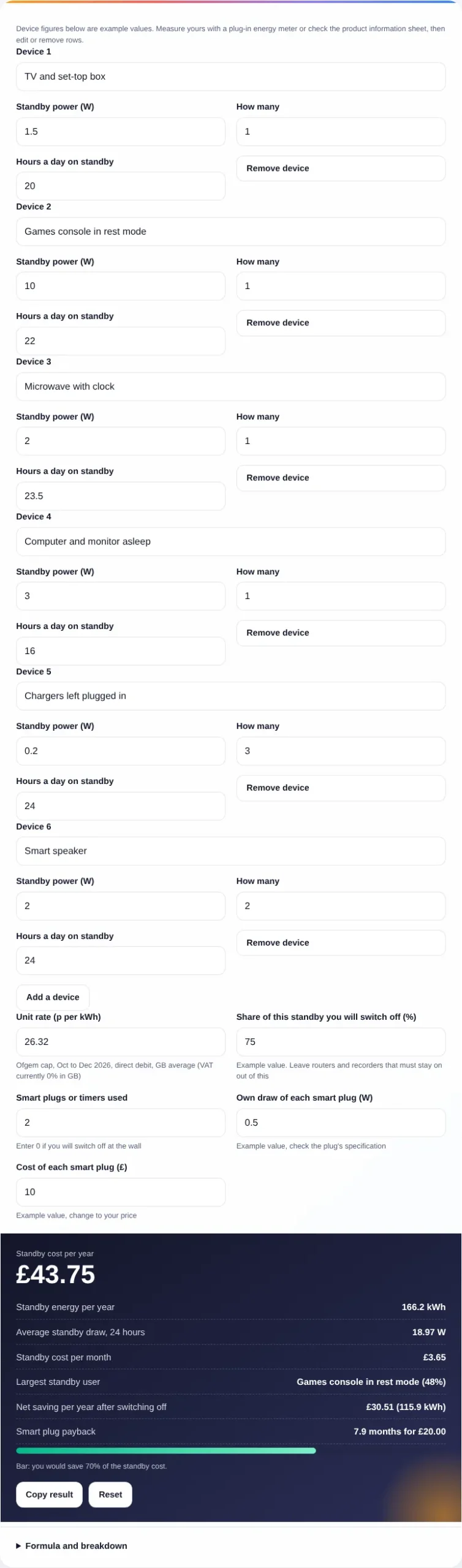
Device figures below are example values. Measure yours with a plug-in energy meter or check the product information sheet, then edit or remove rows.
Bar: share of the standby cost you would save.
Formula and breakdown
n/a
n/a
n/a
This standby power calculator adds up the electricity used by devices left on standby in your home and shows the yearly kWh, the cost at UK prices and how much you would really save by switching them off, for households in the UK and anywhere else you enter your own unit rate. It lists each device separately, finds the biggest drain and subtracts what smart plugs themselves use.
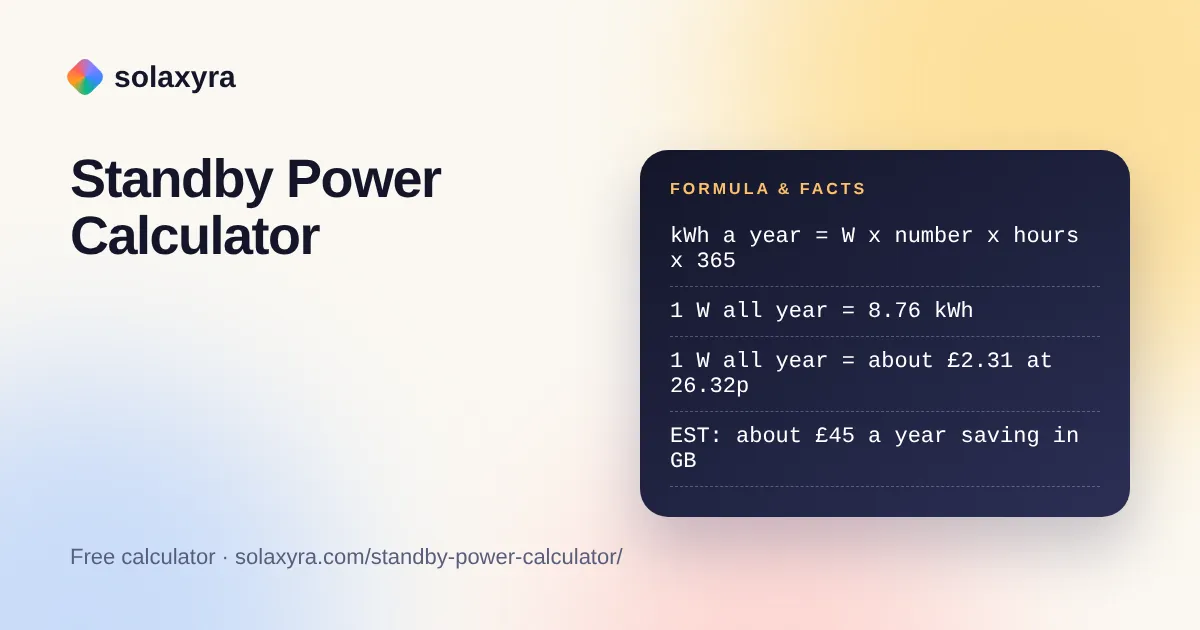
Quick answer: A standby power calculator multiplies each device's standby watts by the number of devices and hours a day, then by 365, to give kWh a year. Each watt left on all year uses 8.76 kWh, about £2.31 at 26.32p per kWh. The Energy Saving Trust puts the GB saving from switching off standby at about £45.
What Is a Standby Power Calculator?
A standby power calculator is a tool that turns the small, constant draw of devices that are plugged in but not in use into a yearly energy total and cost. In plain words: multiply each device's standby watts by how many you have and by the hours a day it sits on standby, add the devices together, multiply by 365 and divide by 1,000 to get kWh a year, then multiply by your unit rate.
Standby is the power a device uses while waiting to be switched on by a remote, keeping a clock, or staying ready to wake. It is different from equipment that is simply always on, such as a fridge, a broadband router or an alarm, which you would not switch off. Keep those out of the share you plan to cut.
How Do You Use the Standby Power Calculator?
- Edit the example devices, or remove them and add your own with "Add a device".
- For each device, enter its standby power in watts, how many you have and how many hours a day it spends on standby.
- Keep the default unit rate of 26.32p per kWh or enter the rate from your bill.
- Enter the share of this standby you will actually switch off.
- If you plan to use smart plugs or timers, enter how many, their own power draw and their price.
- Read the yearly cost, the largest user and the net saving, then open the breakdown to see each step.
How Much Does Standby Power Cost a Year?
Every watt drawn around the clock uses 8.76 kWh a year, which costs about £2.31 at the Ofgem price cap rate of 26.32p per kWh for October to December 2026. VAT is currently 0% on domestic electricity in Great Britain, so that is also the price you pay. The table scales the same arithmetic up.
| Draw, 24 hours a day | kWh a year | Cost a year at 26.32p | Typical of |
|---|---|---|---|
| 0.5 W | 4.38 | £1.15 | EU standby limit since 2013 |
| 1 W | 8.76 | £2.31 | EU limit with a display |
| 2 W | 17.52 | £4.61 | Two devices at 1 W |
| 5 W | 43.80 | £11.53 | Several older devices |
| 10 W | 87.60 | £23.06 | A device that stays partly active |
| 20 W | 175.20 | £46.11 | A whole home's standby |
| 50 W | 438.00 | £115.28 | A home with many networked devices |
The Energy Saving Trust says you can save around £45 a year in Great Britain, and £55 in Northern Ireland, by turning appliances off standby. It does not publish the assumptions behind that figure, but at today's cap rate £45 is about 171 kWh, or roughly 20 W running all year, which sits close to the 20 W row above.
Which Devices Use the Most Standby Power?
Devices that stay connected or ready to wake quickly usually draw the most on standby, while devices that only keep a clock or a light draw a watt or two. EU ecodesign rules, first set in Regulation 1275/2008, have limited simple standby and off modes to 0.5 W, or 1 W with a display or status information, since 6 January 2013, according to the Wikipedia article on standby power. A reading well above that usually means the device is still partly active, for example a games console set to download updates.
The only reliable way to know is to measure. A plug-in energy monitor between the socket and the device shows its draw; leave it for an hour or more and read the kWh, because cheap meters are less accurate at very low power. The watts to kWh calculator turns any single reading into energy and cost.
Do Smart Plugs Save Money on Standby?
A smart plug saves money only when the standby it removes is larger than its own draw, which it uses every hour of the year to stay connected. A plug drawing 0.5 W uses 4.38 kWh a year, about £1.15, so it is not worth fitting one to a phone charger drawing 0.2 W. It pays back quickly on a console or a TV corner with several devices behind one plug.
The standby power calculator subtracts the plugs' own use from your saving and warns you if the result is negative. A switched extension lead or the socket switch does the same job for nothing, as long as it is easy to reach. Do not overload an extension lead, and never daisy-chain them; for larger loads, the energy consumption calculator helps you see what is plugged in where.
Is It Safe to Switch Everything Off at the Wall?
It is safe and sensible for most home electronics, but some equipment must stay on. Leave fridges and freezers, smoke and security alarms, medical devices, heating controls and boilers, and anything set to record or update overnight. Some projectors and laser printers run a cooling fan after shutdown, so let them finish before switching off. If a socket, switch or plug feels warm or shows scorch marks, stop using it and have it checked by a registered electrician.
Worked Example: A Living Room and Home Office
Example: a home has a TV and set-top box (1.5 W for 20 hours a day), a games console in rest mode (10 W for 22 hours), a microwave clock (2 W for 23.5 hours), a computer and monitor asleep (3 W for 16 hours), three chargers left plugged in (0.2 W each, all day) and two smart speakers (2 W each, all day). These are example figures, not measurements.
- Daily standby: 30 + 220 + 47 + 48 + 14.4 + 96 = 455.4 Wh, an average draw of about 19 W.
- Yearly: 455.4 x 365 / 1,000 = 166.2 kWh.
- Cost: 166.2 x 26.32p = £43.75 a year, or £3.65 a month.
- Largest user: the console, at 48% of the total.
- Switching off 75% with two smart plugs drawing 0.5 W each: 124.7 kWh saved minus 8.8 kWh used by the plugs = 115.9 kWh, worth £30.51 a year.
- Two plugs at £10 each pay back in about 8 months.
The console alone is worth tackling first: setting it to a full power-off mode, if your model offers one, may save more than all the other devices together.
Frequently Asked Questions
How much does it cost to leave something on standby?
Each watt of standby running all year uses 8.76 kWh. At the October to December 2026 cap rate of 26.32p per kWh that is about £2.31 a year per watt. A device drawing 10 W on standby around the clock costs about £23 a year.
How much can I save by switching off standby?
The Energy Saving Trust says you can save around £45 a year in Great Britain and £55 in Northern Ireland by turning appliances off standby. Your own figure depends on which devices you have, so list them in the standby power calculator to see your saving.
Which appliances use the most standby power?
Devices that stay networked or ready to wake, such as games consoles in rest mode, set-top boxes and recorders, and some computers, tend to draw the most. Simple devices with a clock or light usually draw a watt or two. Measure with a plug-in meter to be sure.
Is it safe to switch appliances off at the wall?
For most electronics, yes, and it removes their standby use completely. Leave fridges, freezers, alarms, medical equipment and devices that need to update or record switched on. Check the manual for anything that needs a cool-down period, such as some projectors and printers.
Do smart plugs use electricity?
Yes. A smart plug needs a little power to stay connected, so it adds its own draw every hour of the year. The calculator subtracts that from your saving. If a plug controls only a device with very low standby, it can use more than it saves.
What is the legal standby limit in the EU?
EU ecodesign rules first set limits in Regulation 1275/2008. From 6 January 2013 standby and off modes were limited to 0.5 W, or 1 W with a display or status information. A reading of several watts usually means the device is still partly active, for example staying connected to a network.
Checked October 2026 by the Solaxyra Editorial Team. Sources: Energy Saving Trust, Quick tips to save energy, Ofgem price cap, October to December 2026, Wikipedia, Standby power.