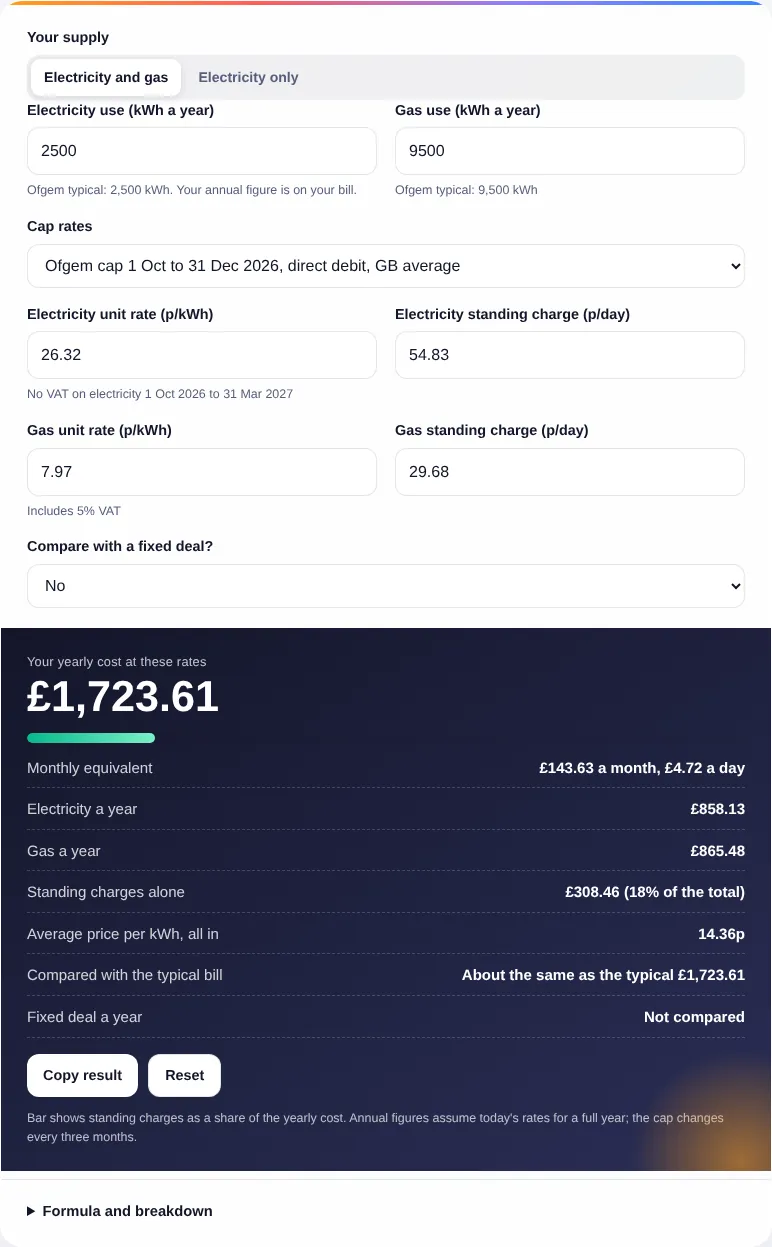
Bar shows standing charges as a share of the yearly cost. Annual figures assume today’s rates for a full year; the cap changes every three months.
Formula and breakdown
n/a
n/a
n/a
This energy price cap calculator works out what your own electricity and gas use costs over a year at the Ofgem price cap rates for 1 October to 31 December 2026, for households in England, Scotland and Wales on a standard variable tariff. Enter your annual kWh from a bill, keep the Great Britain average direct debit rates or type in your region’s rates, and compare the result with a fixed deal you have been offered.
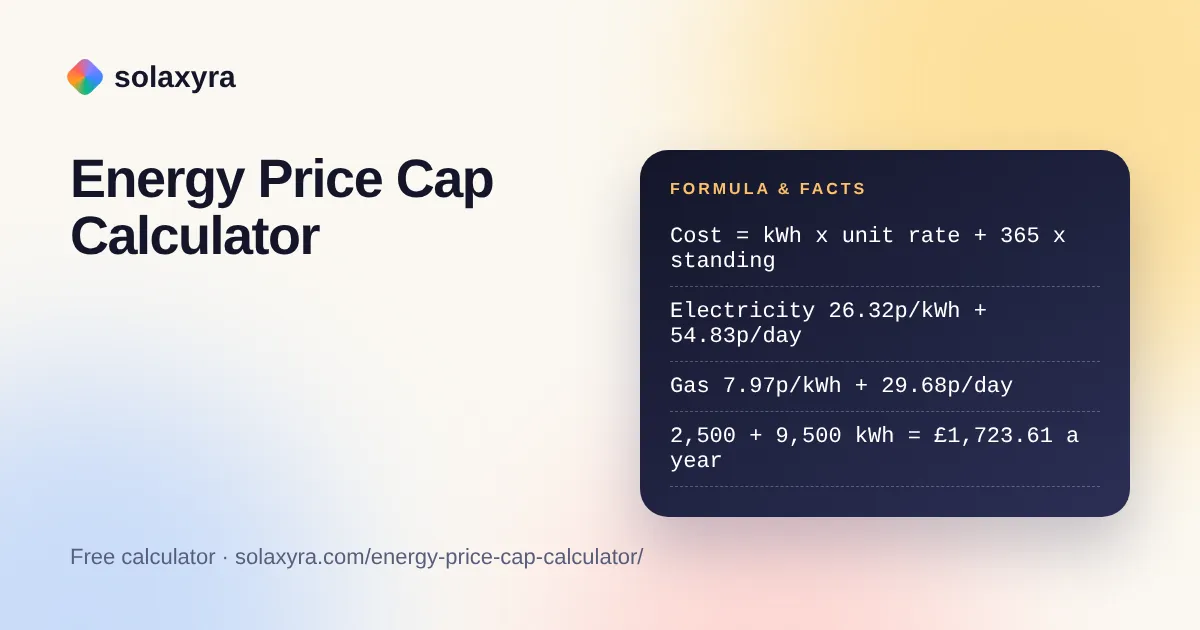
Quick answer: An energy price cap calculator multiplies your yearly kWh by the cap unit rates and adds 365 days of standing charges. At the October to December 2026 direct debit cap, 2,500 kWh of electricity and 9,500 kWh of gas cost £1,723.61 a year, matching Ofgem’s typical £1,723. Your own figure depends on your usage.
What Is an Energy Price Cap Calculator?
An energy price cap calculator is a tool that turns the cap’s unit rates and standing charges into a yearly and monthly cost for your actual usage, rather than for Ofgem’s typical household. The cap itself is not a limit on your bill: Ofgem’s energy price cap guide says it sets the maximum price for each unit of electricity and gas and for the standing charge, but does not limit the cost of your total bill. In plain words: yearly cost equals kWh times unit rate, plus 365 times the daily standing charge, for each fuel.
For how the cap is set, who it covers and when it changes, read our energy price cap guide. This page is for working out your own number.
How Do You Use the Energy Price Cap Calculator?
- Choose electricity and gas, or electricity only if your home has no gas supply.
- Enter your yearly electricity and gas use in kWh. Your bill or supplier app usually shows the last 12 months; if not, start from Ofgem’s typical 2,500 kWh and 9,500 kWh, or turn gas meter readings into kWh with the gas bill calculator.
- Keep the Great Britain average direct debit rates, or switch to your own rates if you pay another way or want your region’s exact figures.
- Optionally, enter a fixed deal’s unit rates and standing charges to compare.
- Read the yearly, monthly and daily cost, the split by fuel, the share taken by standing charges and your average price per kWh.
What Are the Price Cap Rates From 1 October 2026?
From 1 October to 31 December 2026, the cap for direct debit customers, averaged across Great Britain, is 26.32p per kWh for electricity with a 54.83p daily standing charge, and 7.97p per kWh for gas with a 29.68p daily standing charge. According to Ofgem’s announcement, this is a 4% rise for a typical dual-fuel direct debit household, and the government has removed VAT from electricity bills from 1 October 2026 to 31 March 2027, while gas still carries 5% VAT.
Rates differ by region and by payment method (direct debit, standard credit or prepayment), and Ofgem publishes regional tables. If your region’s rates differ from the average, enter them in the energy price cap calculator. Ofgem has said the next cap levels will be announced by 25 November 2026.
How Much Will My Energy Bill Be Under the Price Cap?
It depends almost entirely on how much energy you use: at the October 2026 direct debit cap, every 1,000 kWh of electricity adds £263.20 a year and every 1,000 kWh of gas adds £79.70, on top of £308.46 a year in standing charges for a dual-fuel home. The table shows yearly costs for different usage levels, worked out from the cap rates.
| Usage per year | Yearly cost | Monthly equivalent | Standing charge share |
|---|---|---|---|
| 1,500 kWh electricity only | £594.93 | £49.58 | 34% |
| 2,500 kWh electricity only | £858.13 | £71.51 | 23% |
| 3,500 kWh electricity only | £1,121.33 | £93.44 | 18% |
| 5,000 kWh electricity only | £1,516.13 | £126.34 | 13% |
| 2,500 kWh electricity, 5,000 kWh gas | £1,364.96 | £113.75 | 23% |
| 2,500 kWh electricity, 9,500 kWh gas | £1,723.61 | £143.63 | 18% |
| 2,500 kWh electricity, 14,000 kWh gas | £2,082.26 | £173.52 | 15% |
The monthly figure is the yearly cost spread evenly. Your actual direct debit may differ because suppliers often smooth payments over the year, and you use far more gas in winter than in summer.
Why Do Standing Charges Matter So Much for Low Users?
Standing charges are paid every day whatever you use, so the less energy you use, the larger the share of your bill they make up: at the October 2026 cap they are about a third of the cost for a home using 1,500 kWh of electricity a year, but under a fifth for a typical dual-fuel home. That is why cutting usage saves less than people expect for small flats, and why the energy price cap calculator shows your average price per kWh with standing charges included.
To see which appliances drive your electricity use, the energy consumption calculator adds up devices into a yearly kWh you can enter here, and the electricity cost calculator prices a single appliance at the same unit rate.
Should I Fix My Energy Tariff or Stay on the Price Cap?
A fixed deal is cheaper only if its rates, applied to your own usage, beat the cap over the whole fixed term, including any exit fees. The comparison option does that sum for the current cap level. The cap changes every three months and may rise or fall, so a fix that looks dearer now could be cheaper later, and the other way round. This calculator gives the cost at today’s rates; it is not financial advice.
If you have solar panels or are thinking about a battery, the solar savings calculator uses the same unit rate to value the electricity you would no longer buy.
Worked Example: An Electric-Heated Flat Versus a Typical Home
Example: a two-bedroom flat in Glasgow with no gas supply uses 3,500 kWh of electricity a year and pays by direct debit at the Great Britain average cap rates.
- Units: 3,500 kWh x 26.32p = £921.20.
- Standing charge: 365 x 54.83p = £200.13.
- Yearly cost: £1,121.33, or £93.44 a month and £3.07 a day.
- Standing charges are 18% of the total; the all-in average price is 32.04p per kWh.
- A dual-fuel house using 4,200 kWh of electricity and 14,000 kWh of gas would pay £2,529.70 a year at the same cap, and a fixed deal at 25p and 50p (electricity) and 7.5p and 28p (gas) would cost £2,384.70, £145.00 less at today’s cap level.
Frequently Asked Questions
What is the energy price cap from October 2026?
From 1 October to 31 December 2026, the direct debit cap averaged across Great Britain is 26.32p per kWh and 54.83p a day for electricity, and 7.97p per kWh and 29.68p a day for gas. Ofgem gives a typical dual-fuel bill of £1,723 a year.
Does the price cap limit my total bill?
No. The cap limits the unit rates and standing charges a supplier can charge on a standard variable tariff. The more energy you use, the more you pay, so a large home can pay far more than the typical figure while still being on capped rates.
How is the typical £1,723 bill worked out?
It applies the cap rates to typical use of 2,500 kWh of electricity and 9,500 kWh of gas over a year, plus 365 days of standing charges for each fuel. The calculator reproduces it: £858.13 for electricity plus £865.48 for gas equals £1,723.61.
Does the price cap include VAT?
Yes, the published rates are what you pay. Between 1 October 2026 and 31 March 2027 there is no VAT on electricity, so the electricity rates carry none, while the gas rates include VAT at 5%.
Why are my rates different from the price cap average?
The figures most often quoted are averages for direct debit customers across Great Britain. Actual capped rates vary by region and by payment method, such as standard credit or prepayment, and fixed tariffs are not covered by the cap at all. Your bill shows your exact rates.
How do I find my annual energy usage in kWh?
Your annual statement or supplier app normally shows your usage over the last 12 months. You can also add up the kWh on your last four quarterly bills, or convert gas meter readings to kWh using the calorific value on your bill.
Checked October 2026 by the Solaxyra Editorial Team. Sources: Ofgem: Changes to the energy price cap, 1 October to 31 December 2026, Ofgem: Energy price cap, Ofgem: Price cap rates by region.