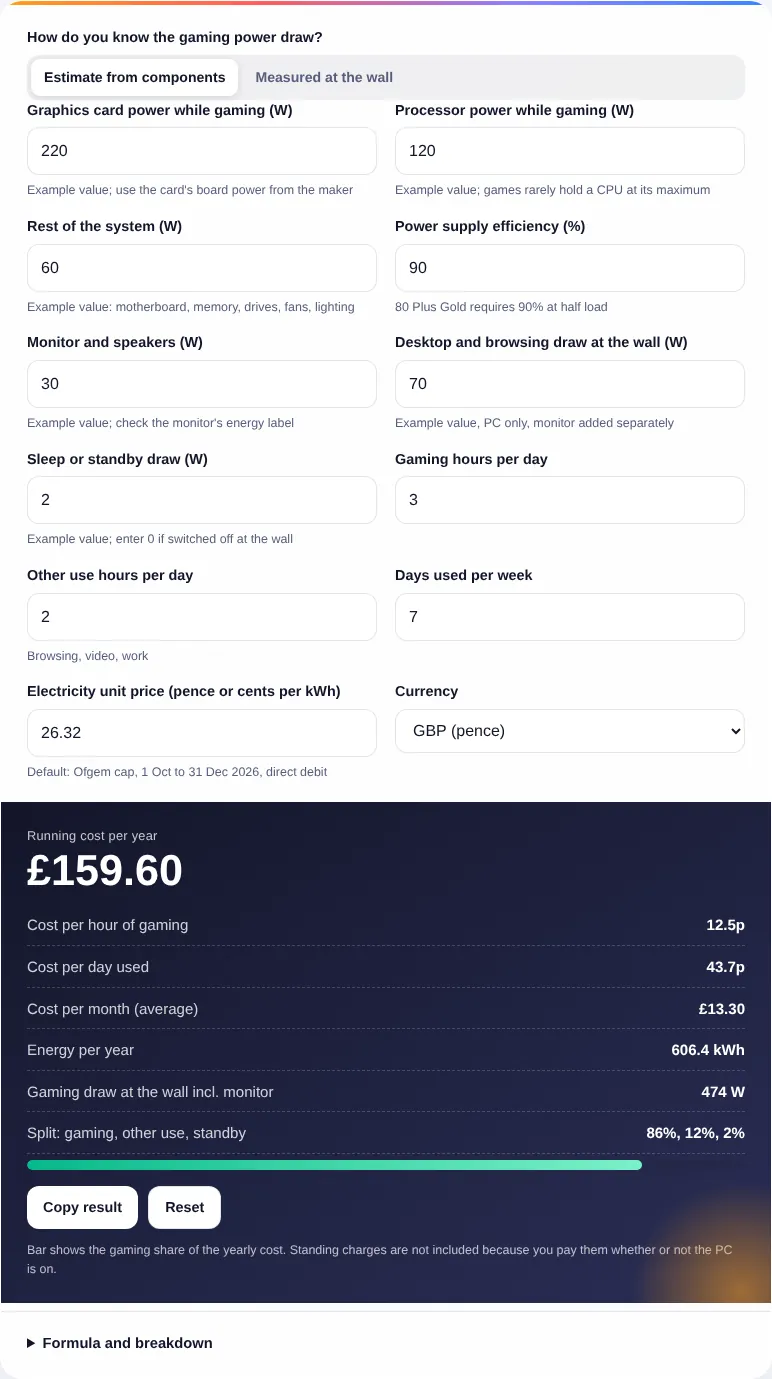
Bar shows the gaming share of the yearly cost. Standing charges are not included because you pay them whether or not the PC is on.
Formula and breakdown
n/a
n/a
n/a
This gaming PC running cost calculator works out what your computer and monitor cost to run per gaming hour, per day, per month and per year, for PC gamers in the UK, Ireland, Europe and elsewhere. It starts from the Ofgem price cap for October to December 2026, splits gaming, desktop use and standby, and can estimate the draw from your components or take a figure you have measured at the plug.
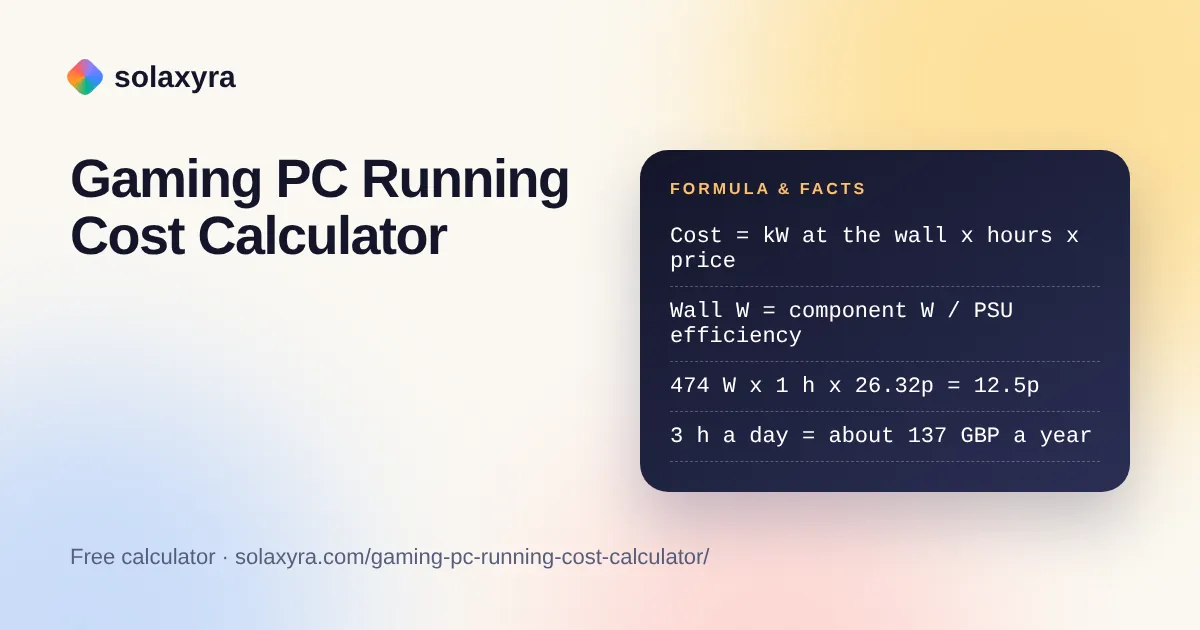
Quick answer: A gaming pc running cost calculator multiplies the draw at the wall in kilowatts by hours of use and your unit price. A PC and monitor drawing 474 W while gaming use 0.474 kWh an hour, about 12.5p at the Ofgem cap of 26.32p per kWh. Three hours a day costs roughly £137 a year.
What Is a Gaming PC Running Cost Calculator?
A gaming PC running cost calculator is a tool that turns a computer’s power draw and your hours of use into a cost in pounds, euros or dollars. In plain words: cost equals power at the wall in watts, divided by 1,000, multiplied by hours, multiplied by the price per kWh, added up for gaming, other use and standby.
The gaming pc running cost calculator uses the electricity unit rate only. Under the Ofgem price cap for 1 October to 31 December 2026, the direct debit rate is 26.32p per kWh with a standing charge of 54.83p per day, and Ofgem notes that VAT has been removed from electricity bills from 1 October 2026 to 31 March 2027. Your own tariff may differ, so change the price to match your bill.
How Do You Use the Gaming PC Running Cost Calculator?
- Choose Estimate from components, or Measured at the wall if you have a plug-in energy monitor.
- For an estimate, enter the graphics card and processor power while gaming, the rest of the system, and your power supply’s efficiency.
- Enter the monitor and speakers, the desktop draw for browsing or video, and the sleep or standby draw.
- Enter gaming hours, other use hours and days used per week.
- Check the unit price and currency, then read the yearly, monthly, daily and hourly costs and the split between gaming, other use and standby.
How Much Does It Cost to Run a Gaming PC per Hour?
At 26.32p per kWh, every 100 W of draw at the wall costs about 2.6p an hour, so a 500 W gaming setup costs about 13p an hour. The table shows the hourly cost and the yearly cost of three hours of gaming every day at the current cap.
| Draw at the wall while gaming | Cost per hour | Cost per year at 3 h a day |
|---|---|---|
| 100 W | 2.6p | £28.82 |
| 200 W | 5.3p | £57.64 |
| 300 W | 7.9p | £86.46 |
| 400 W | 10.5p | £115.28 |
| 500 W | 13.2p | £144.10 |
| 600 W | 15.8p | £172.92 |
| 800 W | 21.1p | £230.56 |
| 1,000 W | 26.3p | £288.20 |
To price other devices in the room, such as a console or a heater, use the electricity cost calculator, or list everything together in the home energy consumption calculator.
How Many Watts Does a Gaming PC Actually Use?
A gaming PC uses only what its parts need at that moment, which is usually well below the power supply’s rating: a 750 W or 1,000 W unit is a ceiling, not a running figure. The graphics card normally draws the most during games, the processor the next most, and the motherboard, memory, drives and fans add a smaller amount.
The most accurate method is a plug-in energy monitor between the wall socket and the PC: read it during a typical game and again on the desktop. If you do not have one, add the maker’s board power for the graphics card to a realistic processor figure and the rest of the system, then divide by the power supply efficiency. The defaults in the gaming pc running cost calculator are example values only, so replace them with your own parts.
Does Power Supply Efficiency Change the Bill?
Yes, but modestly: the wall draw equals the power the parts use divided by the efficiency, so a more efficient supply wastes less as heat. According to the Wikipedia summary of 80 Plus certification, 115 V internal supplies must reach 85% at half load for Bronze, 90% for Gold, 92% for Platinum and 94% for Titanium.
| Efficiency at 400 W load | Draw at the wall | Cost per year at 3 h a day |
|---|---|---|
| 82% | 488 W | £140.59 |
| 85% | 471 W | £135.63 |
| 87% | 460 W | £132.51 |
| 90% | 444 W | £128.09 |
| 92% | 435 W | £125.31 |
Efficiency changes with load and mains voltage, so treat these as indicative. The saving rarely justifies replacing a working power supply on its own.
How Much Does Leaving a PC On Cost?
A PC left on the desktop around the clock at 70 W uses about 613 kWh a year, roughly £161 at the current cap, while sleep or standby at a couple of watts costs only a few pounds. Set the PC to sleep when idle and switch off the monitor, and the standby share in the result shrinks to almost nothing. The watts to kWh calculator converts any constant draw to energy, and the standby power calculator totals small loads around the home.
Worked Example: Evening Gaming on a Mid-Range PC
Example: a mid-range desktop with a 220 W graphics card, a processor drawing about 120 W while gaming, 60 W for the rest of the system and a 90% efficient power supply, plus a 30 W monitor, used for 3 hours of gaming and 2 hours of other use every day, on the October 2026 cap of 26.32p per kWh.
- Gaming draw: (220 + 120 + 60) / 0.90 = 444 W at the wall, plus 30 W monitor = 474 W.
- Gaming energy: 0.474 kWh x 3 h x 365 days = 519.5 kWh a year.
- Other use: (70 + 30) W x 2 h x 365 = 73 kWh; standby: 2 W x 19 h x 365 = 13.9 kWh.
- Total: 606.4 kWh a year, costing £159.60, or about £13.30 a month and 12.5p per gaming hour.
Gaming accounts for about 86% of the cost, so cutting a frame-rate cap or undervolting the graphics card affects the bill more than anything done to idle or standby use.
Frequently Asked Questions
How much does it cost to run a gaming PC per hour?
Divide the draw at the wall in watts by 1,000 and multiply by your unit price. At the October to December 2026 Ofgem cap of 26.32p per kWh, 300 W costs about 7.9p an hour, 500 W about 13.2p and 800 W about 21.1p. Add the monitor’s draw too.
Does a 750 W power supply use 750 W?
No. The rating is the most the power supply can deliver, not what the PC draws. A gaming PC takes only what its parts need at that moment, often far less than the rating, plus the power supply’s own losses. Use a plug-in energy monitor to see the real figure.
How much does PSU efficiency affect running costs?
A little. For a 400 W load used three hours a day, an 82% efficient supply draws about 488 W and a 92% efficient one about 435 W at the wall, a difference of around £15 a year at 26.32p per kWh. Heavy daily use widens the gap.
Is it cheaper to leave a gaming PC on or turn it off?
Turning it off or letting it sleep is cheaper. A PC left on the desktop at 70 W around the clock uses about 613 kWh a year, roughly £161 at the current cap, while a few watts in sleep or standby cost only a few pounds a year.
Do I need to include the standing charge?
No. The standing charge is a fixed daily amount you pay whether or not the PC is switched on, so it does not change with gaming. The calculator counts only the unit cost of the electricity the PC, monitor and speakers actually use.
Is a gaming laptop or console cheaper to run than a desktop?
It depends on the hardware, so measure rather than guess. A desktop with a large graphics card often draws more while gaming, but check each device with a plug-in energy monitor, enter the figure in measured mode and compare the yearly costs side by side.
Checked October 2026 by the Solaxyra Editorial Team. Sources: Ofgem, energy price cap 1 October to 31 December 2026, Wikipedia, 80 Plus.