Sizing estimate only. Battery, inverter and wiring work must be designed and checked by a qualified electrician under BS 7671 in the UK or your local wiring rules.
Formula and breakdown
n/a
n/a
n/a
n/a
This off grid solar calculator sizes the solar array, battery bank, inverter and charge controller for a cabin, workshop, farm building or home with no grid connection, using inputs that suit UK, Irish and European winters as well as sunnier sites.
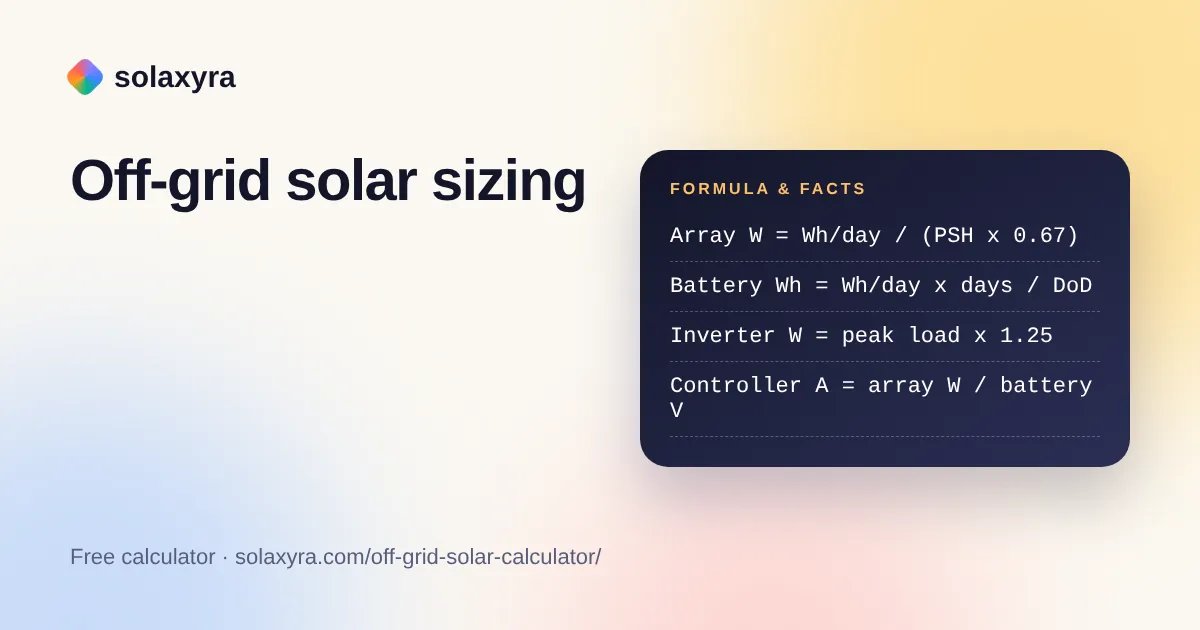
Quick answer: An off grid solar calculator divides your daily watt-hours by worst-month peak sun hours and a performance ratio (PVGIS uses 0.67 for off-grid systems) to get panel watts. Battery size is daily use times days of autonomy, divided by usable depth of discharge and inverter efficiency. Inverters need headroom above your largest simultaneous load.
What Is an Off Grid Solar Calculator?
An off grid solar calculator is a sizing tool that turns your daily electricity use and local sunlight into the panel, battery, inverter and controller ratings a stand-alone system needs. In plain words: panel watts equal daily watt-hours divided by sun hours and system losses; battery watt-hours equal daily use multiplied by the days you want in reserve, divided by the share of the battery you can safely use.
Without a grid to fall back on, the system has to work in the darkest month you plan to use it. That is the main difference from grid-tied sizing, where the yearly total matters and a shortfall simply comes from the grid. For a home that is connected, the solar panel calculator is the better starting point.
How Do You Use the Off Grid Solar Calculator?
- Enter your daily energy use in watt-hours. Multiply each appliance’s watts by the hours it runs per day and add them up. A fridge that cycles should be counted at its average draw.
- Enter the peak sun hours for the worst month you will live off the system. Open the free PVGIS tool from the EU Joint Research Centre, choose your location and tilt, and read the monthly daily output per kWp; that figure is your peak sun hours.
- Keep the 67% performance ratio unless you have a reason to change it. It covers panel heat, cable, controller, battery and inverter losses together.
- Choose days of autonomy: how long the battery must carry you through dull weather.
- Pick the battery voltage and chemistry. The depth of discharge fills in automatically and can be edited.
- Enter your panel rating, the largest load that can run at the same moment, and the biggest start-up surge.
- Read the results and open the formula breakdown to see each step.
How Many Solar Panels Do You Need to Go Off Grid?
For 2.5 kWh a day you need roughly 750 W of panels at 5 peak sun hours, but about 3,700 W at 1 peak sun hour, so winter light decides the answer. The calculator rounds the array up to whole panels of the wattage you enter.
The performance ratio matters as much as the sun hours. The PVGIS user manual states that its off-grid model uses a whole-system performance ratio of 0.67, lower than a grid-tied system, because energy passes through a battery and often an inverter before it is used. Many online tools assume 0.75 or more, which leaves a winter shortfall.
| Worst-month peak sun hours | Array for 2,500 Wh per day (PR 0.67) | 430 W panels |
|---|---|---|
| 1.0 | 3,731 W | 9 |
| 1.5 | 2,488 W | 6 |
| 2.0 | 1,866 W | 5 |
| 3.0 | 1,244 W | 3 |
| 4.0 | 933 W | 3 |
| 5.0 | 746 W | 2 |
Tilting panels steeply raises winter output at the cost of some summer output, which suits off-grid use. The solar panel angle calculator shows the trade-off for your latitude.
How Big Should an Off-Grid Battery Bank Be?
A good rule is daily use multiplied by two days of autonomy, divided by usable depth of discharge and inverter efficiency: 2.5 kWh a day becomes about 6.9 kWh of lithium or 9.3 kWh of lead-acid. The calculator also converts this to amp-hours at 12, 24 or 48 V, because batteries are sold by Ah.
Depth of discharge is the share of rated capacity you plan to use. PVGIS applies a default cut-off at 40% charge for lead-acid batteries, which means 60% usable, and suggests 20% for lithium, which means 80% usable. Those are the defaults here. Your battery manual has the final word, and a deeper daily cycle shortens life on most chemistries.
More days of autonomy make the battery larger and the system more forgiving. In a cloudy climate, two or three days is common for full-time living; a weekend cabin with a backup generator can use one. To turn the result into a series and parallel layout, use the battery bank size calculator.
What Size Inverter and Charge Controller Do You Need Off Grid?
Choose an inverter with a continuous rating about 25% above everything that can run at once, and a surge rating above the largest start-up load. A 1,500 W simultaneous load therefore points to about 1,900 W continuous. Motors in fridges, pumps and power tools draw several times their running watts for a moment when they start, so check the surge figure on both the appliance and the inverter datasheet.
The charge controller rating is the array power divided by the battery voltage, plus a margin. 1,290 W into a 24 V battery is about 54 A, or 67 A with 25% headroom. The same array on 48 V needs half the current, which is why larger systems move to 48 V: thinner cables, smaller losses and fewer controllers. The MPPT charge controller calculator adds the cold-weather open-circuit voltage check that every controller needs.
Should You Size for Winter or Use a Generator?
Sizing for the worst month with no backup gives the most reliable system but often the largest; many off-grid owners size for spring and autumn and cover December and January with a generator. Run the calculator twice, once with winter sun hours and once with the shoulder-month figure, and compare the extra panels and batteries with the cost and noise of occasional generator use. A seasonal home used from March to October only needs the March figure.
Cutting the load is usually cheaper than adding panels. Replacing an old fridge, moving washing to sunny days and using gas or wood for heating and cooking can halve the winter daily total.
Worked Example: Rhys’s Cabin in Powys
Rhys in Powys, mid Wales, uses his cabin from March to October. His lights, fridge, laptop, water pump and a few hours of power tools add up to 2,000 Wh a day. His largest simultaneous load is 1,200 W and the saw starts at about 2,400 W.
- He checks PVGIS for his site and panel tilt. For this example, assume March, his darkest month of use, shows 2.5 kWh per kWp per day.
- Array: 2,000 Wh divided by (2.5 x 0.67) gives 1,194 W. With 430 W panels he needs three, or 1,290 W.
- Battery: 2,000 Wh x 2 days, divided by (0.80 x 0.90), gives 5,556 Wh, about 5.6 kWh. At 24 V that is 231 Ah of LiFePO4.
- Inverter: 1,200 W x 1.25 gives 1,500 W continuous, with a surge rating of at least 2,400 W.
- Controller: 1,290 W divided by 24 V, times 1.25, gives 67 A, so he looks at a 70 A MPPT controller.
An electrician registered with a UK competent person scheme designs the battery protection and the cabin’s AC wiring to BS 7671, and checks that the cable from the battery to the inverter is rated for the full-load current.
Frequently Asked Questions
How many peak sun hours should I use for off-grid sizing?
Use the lowest monthly figure for the months you will rely on the system. PVGIS gives monthly output per kWp for any location in Europe, and that number per day equals peak sun hours. Using the yearly average leaves you short in winter.
What performance ratio should I use for an off-grid system?
The PVGIS off-grid model uses 0.67, which covers panel temperature, wiring, charge controller, battery and inverter losses together. Use a lower figure for shaded or poorly ventilated arrays and only go higher if you have measured data from a similar system.
How many days of autonomy do I need?
Two to three days suits most full-time off-grid homes in cloudy climates. One day can work for weekend use or where a generator starts automatically. Each extra day adds a full day’s use, divided by depth of discharge, to the battery size.
Is 12 V, 24 V or 48 V better for off-grid solar?
Higher voltage means lower current for the same power, so cables are thinner and losses smaller. 12 V suits small systems such as sheds and vans, 24 V suits mid-sized cabins, and 48 V is usual for whole homes and inverters above a few kilowatts.
Can I use lead-acid batteries off grid?
Yes, but you need a larger bank because less of the capacity is usable. PVGIS assumes lead-acid is not discharged below 40% charge, against 20% for lithium, so lead-acid needs about a third more nominal capacity for the same usable energy.
Do I need an electrician for an off-grid solar system?
Yes for anything beyond a small plug-in kit. Battery banks store a lot of energy and inverters produce mains voltage. In the UK the AC wiring must meet BS 7671 and should be installed or checked by a registered electrician; elsewhere follow the local wiring rules.
Checked October 2026 by the Solaxyra Editorial Team. Sources: PVGIS user manual, European Commission JRC, PVGIS overview, European Commission JRC.