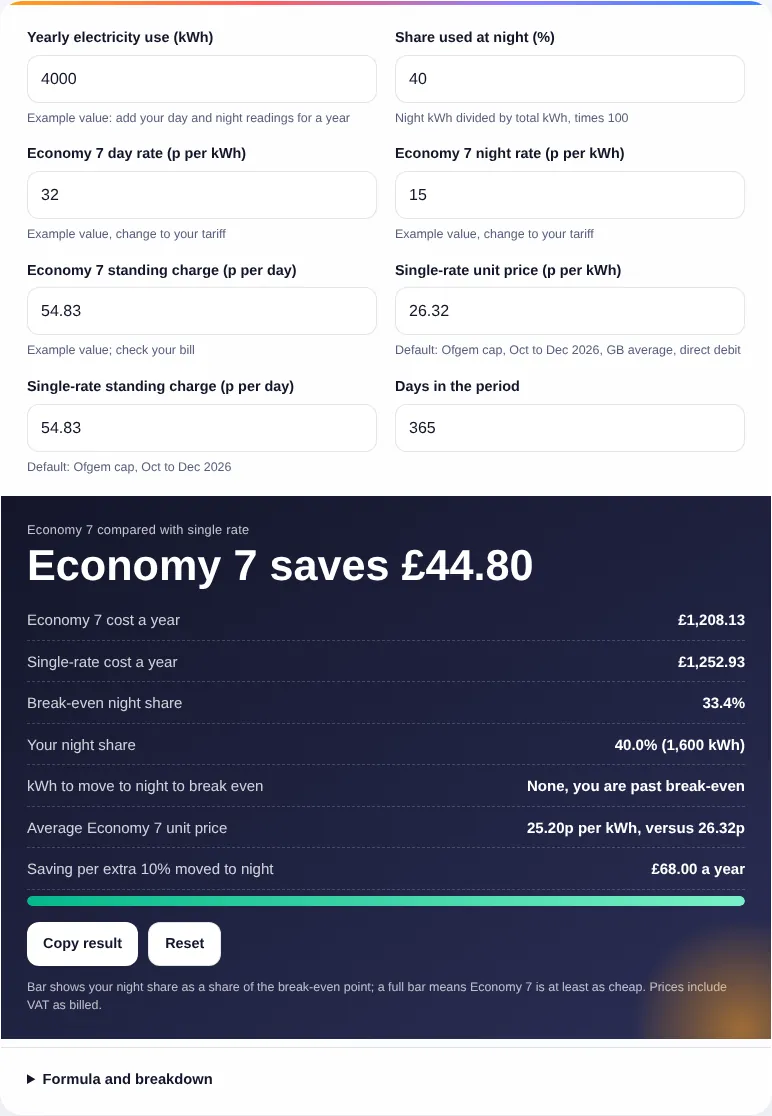
Bar shows your night share as a share of the break-even point; a full bar means Economy 7 is at least as cheap. Prices include VAT as billed.
Formula and breakdown
n/a
n/a
n/a
This Economy 7 calculator compares a year on an Economy 7 day and night tariff with a single-rate tariff, including both standing charges, and tells you the night share at which Economy 7 breaks even, for households in England, Scotland, Wales and Northern Ireland with or considering a two-rate meter. Enter your yearly kWh, your night share and the rates from your bill.
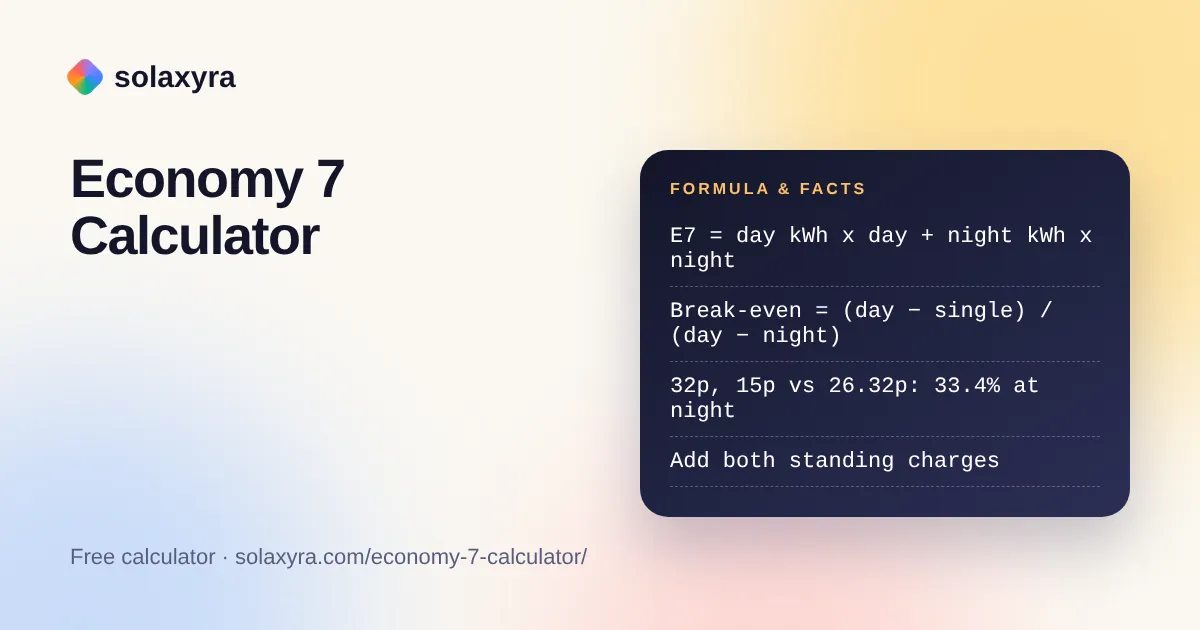
Quick answer: An Economy 7 calculator prices day and night kWh separately and compares the total with one single rate. With example rates of 32p day and 15p night against the 26.32p cap rate, Economy 7 breaks even at 33.4% of use at night; a 4,000 kWh home using 40% at night saves about £44.80 a year.
What Is an Economy 7 Calculator?
An Economy 7 calculator is a tool that works out whether a two-rate electricity tariff with seven cheaper night hours costs less than a single-rate tariff for your pattern of use. In plain words: Economy 7 cost equals day kWh times the day rate, plus night kWh times the night rate, plus the standing charge; you compare that with all kWh times the single rate plus its standing charge.
The Wikipedia article on Economy 7 describes it as a UK differential tariff whose off-peak period lasts seven hours in total, often starting around 12:30am in winter (GMT) or 1:30am in summer (BST), with exact times varying by region and meter. The catch is the day rate. Under the Ofgem price cap, the peak and off-peak rates together cannot be more than the cap, so suppliers usually set the day rate above the single rate to pay for the cheap night rate. That is why the share of use at night decides the answer.
How Do You Use the Economy 7 Calculator?
- Enter your yearly electricity use. On an Economy 7 meter, add the day (normal) and night (low) register totals for a year.
- Enter the share used at night: night kWh divided by total kWh, times 100.
- Enter your Economy 7 day rate, night rate and standing charge from your bill or a quote.
- Leave the single-rate price and standing charge at the Ofgem cap defaults, or enter a quote you have.
- Read the yearly cost both ways, the break-even night share and how many kWh you would need to move to the night to break even.
What Percentage of Use Must Be at Night for Economy 7 to Pay?
Economy 7 pays when your night share is above the break-even point, which equals the day rate minus the single rate, divided by the day rate minus the night rate: with 32p day, 15p night and a 26.32p single rate, that is 5.68 / 17 = 33.4%. Different standing charges move the point up or down, and the economy 7 calculator includes that term.
Because supplier rates vary, there is no single national break-even figure. The table uses the Ofgem cap single rate of 26.32p and equal standing charges, with example day and night rates you might see on bills, to show how sensitive the answer is.
| Example day rate | Example night rate | Break-even night share (single rate 26.32p) |
|---|---|---|
| 30p | 13p | 21.6% |
| 30p | 15p | 24.5% |
| 32p | 12p | 28.4% |
| 32p | 15p | 33.4% |
| 34p | 15p | 40.4% |
| 34p | 18p | 48.0% |
A higher day rate pushes break-even up quickly, while a lower night rate pulls it down. Moving the day rate from 32p to 34p with a 15p night rate lifts break-even by 7 points, so check your own figures rather than relying on a rule of thumb.
What Are the Current Economy 7 Rates?
Economy 7 rates are set by each supplier and vary by region, so this economy 7 calculator uses example values that you should replace with your own. Ofgem publishes a single-rate cap figure, which for 1 October to 31 December 2026 is 26.32p per kWh with a 54.83p daily standing charge for an average GB direct debit customer. Its guide to cap unit rates explains that for multi-rate tariffs like Economy 7 the peak and off-peak rates together cannot be more than the cap, but it does not give a separate day and night rate for you to use here.
Ofgem also confirms that the government has removed VAT from electricity bills from 1 October 2026 to 31 March 2027, on its October to December 2026 price cap page. Use rates as they appear on your bill so both tariffs are compared on the same basis.
Who Is Economy 7 Good For?
Economy 7 suits homes that put a large share of their electricity into the night: storage heaters, an immersion-heated hot water cylinder, or an electric car charged overnight. Storage heaters and immersion heaters are often wired to a separate circuit that only switches on during the night period, which is how many all-electric flats reach 60% or more at night. Our electric heater running cost calculator estimates how many kWh heating adds, and the solar EV charging calculator shows how much an EV adds to your night use.
It usually does not suit homes with gas heating and daytime use, people who work from home, or homes with solar panels that already cover much of the daytime load at no cost. A home battery can also move cheap night energy into the day; the home battery savings calculator estimates that saving. Changing a meter or wiring circuits to a timer is work for the supplier or a qualified electrician; in the UK, electrical work must meet BS 7671.
How Can I Find My Night Share of Electricity?
Divide the kWh on your night (low) register by the total of both registers over the same period and multiply by 100: 1,200 night kWh out of 4,000 total is 30%. Use a full year if you can, because heating makes winter use very different from summer. A smart meter or your supplier’s app usually shows day and night kWh separately; older two-rate meters show two numbered registers.
If you are on a single-rate meter now, estimate night use from appliances that could run in those seven hours, using the energy consumption calculator to total their kWh. Timer-friendly loads are washing machines, dishwashers, tumble dryers, hot water cylinders and EV charging. Avoid running tumble dryers and washing machines unattended overnight unless the manufacturer’s instructions allow it, and fit a working smoke alarm.
Worked Example: An All-Electric Flat With Storage Heaters
Example: an all-electric flat with storage heaters and an immersion cylinder uses 7,500 kWh a year, 65% of it at night. With example Economy 7 rates of 33p day and 14p night and the same 54.83p standing charge on both tariffs, Economy 7 costs 7,500 x (0.35 x 33p + 0.65 x 14p) = £1,548.75 plus £200.13 in standing charges, £1,748.88 a year. A single rate at 26.32p costs £1,974.00 plus £200.13, or £2,174.13. Economy 7 saves £425.25, and break-even is (33 − 26.32) / (33 − 14) = 35.2%.
Now take the same flat after the storage heaters are replaced by a heat pump, using 3,000 kWh a year with 20% at night. Economy 7 costs £876.00 plus £200.13, or £1,076.13, while single rate costs £789.60 plus £200.13, or £989.73. Economy 7 is now £86.40 a year dearer, and the household would need to move about 455 kWh a year into the night to break even.
Frequently Asked Questions
Is Economy 7 worth it?
It is worth it when the share of your electricity used at night is above the break-even point for your rates, often somewhere between about 20% and 50%. Homes with storage heaters, immersion heaters or overnight EV charging usually pass; homes with mostly daytime use usually do not.
What hours are Economy 7?
Economy 7 gives seven hours of cheaper electricity at night, but the exact times depend on your region and meter, and older meters may not change with the clocks. A common pattern starts around 12:30am in winter or 1:30am in summer. Check the times with your supplier or on your bill.
Why is the Economy 7 day rate higher than the normal rate?
Under the price cap, the peak and off-peak rates together cannot be more than the cap, so a cheap night rate is usually balanced by a day rate above the single rate. That is why Economy 7 can cost more than a single rate if most of your use is in the day.
How do I calculate my Economy 7 break-even point?
Subtract the single rate from the day rate, add any difference in yearly standing charges divided by your yearly kWh, then divide by the day rate minus the night rate. With 32p day, 15p night and 26.32p single, the break-even night share is 5.68 divided by 17, or 33.4%.
Does Economy 7 apply to gas?
No. Economy 7 is an electricity tariff only, and gas is charged at one unit rate whatever the time of day. Homes with gas heating usually use little electricity at night, which is why Economy 7 rarely saves them money.
Can I switch from Economy 7 to a single rate?
Usually yes. Many suppliers can bill a two-rate meter on a single-rate tariff, or reconfigure a smart meter, and some will replace the meter. Ask your supplier, and run this economy 7 calculator with your real readings first so you know which tariff is cheaper.
Checked October 2026 by the Solaxyra Editorial Team. Sources: Ofgem: price cap 1 October to 31 December 2026, Ofgem: energy price cap unit rates and standing charges, Wikipedia: Economy 7.