Bar shows the share of each boil’s cost spent on water you do not use. Physics estimate from litres and temperature rise; real kettles also use a little energy to heat the element and body.
Formula and breakdown
n/a
n/a
n/a
This kettle running cost calculator works out what each boil of an electric kettle costs from the litres you heat and the temperature rise, and adds up the cost per day and per year at the UK price cap or your own tariff. It also shows how much of that money goes on water you boil but never use, and works anywhere in Europe if you enter your own price.
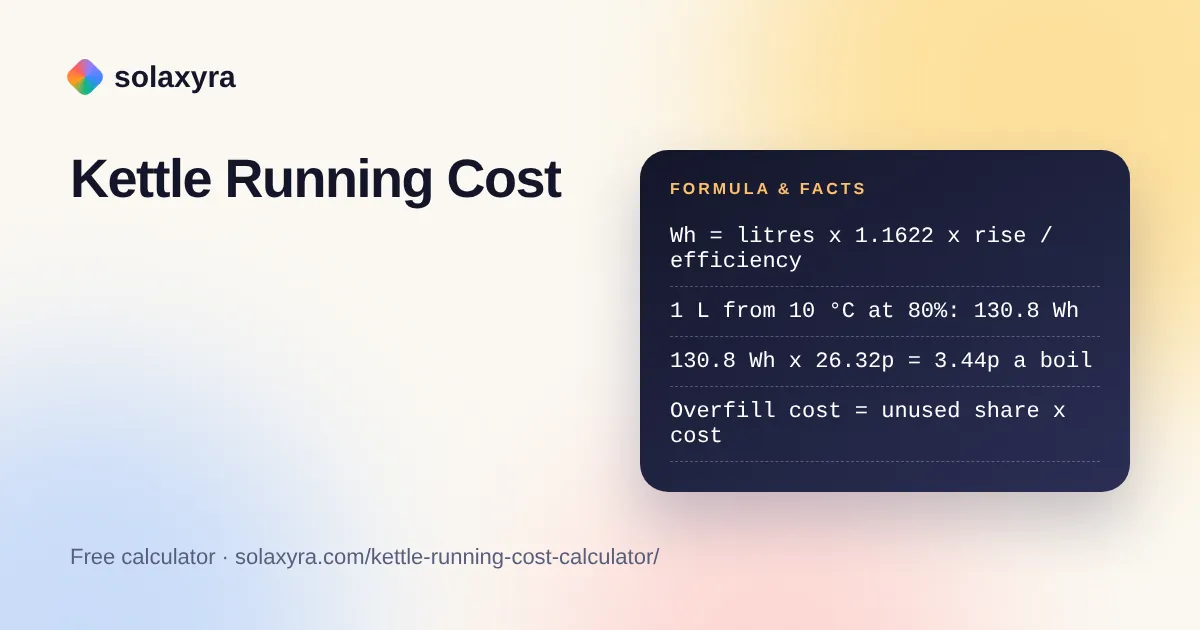
Quick answer: A kettle running cost calculator multiplies litres by 1.1622 Wh per litre per °C and the temperature rise, then divides by kettle efficiency. Boiling 1 litre from 10 °C at an assumed 80% efficiency takes 130.8 Wh, which costs 3.44p at the Ofgem cap of 26.32p per kWh.
What Is a Kettle Running Cost Calculator?
A kettle running cost calculator is a tool that turns the amount of water you boil into energy and money, using the physics of heating water rather than just the kettle’s wattage. In plain words: energy in watt-hours equals litres x 1.1622 x (target temperature minus cold water temperature) divided by efficiency, and cost equals that energy in kWh multiplied by your unit price.
The figure 1.1622 comes from water’s specific heat capacity. The Wikipedia article on specific heat capacity gives about 4,184 joules to heat 1 kg of water by 1 K, and 4,184 divided by 3,600 seconds in an hour is 1.1622 Wh. A litre of water weighs about 1 kg, so heating 1 litre by 90 °C needs at least 104.6 Wh before any losses.
The kettle’s wattage only sets how fast that energy goes in. A 3 kW kettle and a 2.2 kW kettle use about the same energy for the same water; the faster one simply finishes sooner. That is why a calculator based on watts x minutes can mislead if the boiling time is guessed.
How Do You Use the Kettle Running Cost Calculator?
- Enter the water you boil each time, from the scale on the kettle.
- Enter the water you actually pour, for example two mugs, to see the overfill cost.
- Enter how many times a day you boil the kettle.
- Enter the kettle’s power from the label on the base, which sets the time.
- Set the cold water temperature and the temperature you heat to; some kettles stop at 70, 80 or 90 °C.
- Keep or change the example efficiency, and enter your electricity price.

How Much Does It Cost to Boil a Kettle?
At the Ofgem cap of 26.32p per kWh for October to December 2026, boiling 1 litre from 10 °C costs about 3.44p at an assumed 80% efficiency, and a full 1.7 litre kettle about 5.85p. The Ofgem announcement gives 26.32p as the average direct debit unit rate, and notes that VAT is removed from electricity bills from 1 October 2026 to 31 March 2027.
| Water boiled | Energy per boil | Cost per boil | Time at 3 kW | Time at 2.2 kW | Cost per year, once a day |
|---|---|---|---|---|---|
| 0.25 L (one mug) | 32.7 Wh | 0.86p | 39 s | 53 s | £3.14 |
| 0.5 L | 65.4 Wh | 1.72p | 1 min 18 s | 1 min 47 s | £6.28 |
| 1.0 L | 130.8 Wh | 3.44p | 2 min 37 s | 3 min 34 s | £12.56 |
| 1.5 L | 196.1 Wh | 5.16p | 3 min 55 s | 5 min 21 s | £18.84 |
| 1.7 L (full kettle) | 222.3 Wh | 5.85p | 4 min 27 s | 6 min 4 s | £21.35 |
The table assumes 10 °C cold water, a full boil and 80% efficiency, which is an example value rather than a measured figure for any model. Change the efficiency in the kettle running cost calculator if you have test data for your kettle. To compare with other appliances, the electricity cost calculator works from watts and hours.
How Much Can You Save by Not Overfilling the Kettle?
Every litre you boil and do not use costs the same as one you do, so boiling 1 litre for two mugs wastes half the energy. With five such boils a day, the kettle running cost calculator’s default, that overfill costs £31.40 a year at 26.32p per kWh.
The Energy Saving Trust’s quick tips to save energy say that avoiding overfilling the kettle can save £10 a year in Great Britain and £12 in Northern Ireland. Their figure rests on their own assumptions about a typical household; the kettle running cost calculator lets you put in your own habits. Do not fill below the kettle’s minimum mark.
Does Boiling to a Lower Temperature Save Money?
Yes: heating to 80 °C instead of 100 °C cuts the energy by about 22% when the water starts at 10 °C, because the temperature rise falls from 90 to 70 degrees. Kettles with temperature settings make this easy for green tea or coffee.
| Heat to | Energy for 1 litre from 10 °C | Cost at 26.32p | Saving against a full boil |
|---|---|---|---|
| 100 °C | 130.8 Wh | 3.44p | 0% |
| 90 °C | 116.2 Wh | 3.06p | 11% |
| 80 °C | 101.7 Wh | 2.68p | 22% |
| 70 °C | 87.2 Wh | 2.29p | 33% |
Water used for baby formula or anything that must be safe to drink should follow the product’s own instructions about boiling, whatever it costs.
Is It Cheaper to Boil Water in a Kettle or on the Hob?
It depends on the efficiency of each and the price of the fuel: an electric kettle heats the water from an element in or under it, while some of the heat from a gas flame escapes around the pan, but gas costs far less per kWh (7.97p against 26.32p at the October 2026 cap). Without measured efficiencies for your kettle, hob and pan, there is no single answer; if you know them, divide each fuel price by its efficiency and compare.
The same physics settles kettle versus microwave. Heating 1 litre from 10 °C to 100 °C needs 104.6 Wh of heat whatever does the heating, which is 2.75p at 26.32p per kWh before any losses. A lower-wattage appliance such as a microwave does not use less energy for the same water; it only takes longer, so it can only be cheaper if it wastes less heat, and a kettle with its element in the water already wastes little. Compare methods by efficiency, not by wattage.
Two other things change the cost per boil. On a time-of-use tariff the cost scales directly with the unit rate you pay at that hour, so enter that rate in the kettle running cost calculator. Limescale on the element or base slows heating in hard water areas; descaling as the kettle maker recommends keeps it working as designed. A boiling water tap is a different case, because it keeps a tank hot all day, so its standing heat loss has to be measured with a plug-in energy meter before it can be compared fairly.
Whatever the method, never leave a pan unattended on the hob, and keep kettle flexes and bases away from the edge of the worktop and from water. A damaged kettle lead or base should be replaced, not repaired at home. Running several high-power appliances on one extension lead can overload it; the watts to amps calculator shows that a 3 kW kettle alone draws about 13 A at 230 V, so it should not share a lead with other high-power appliances.
Worked Example: A Busy Household Kettle
Example: a household boils a 3 kW kettle five times a day, filling it to the 1 litre mark each time but only pouring about 0.5 litres. The tap water is at 10 °C, the efficiency is taken as 80% and the tariff is the Ofgem cap of 26.32p per kWh.
- Energy per boil: 1.0 x 1.1622 x (100 minus 10) / 0.80 = 130.8 Wh.
- Cost per boil: 0.1308 kWh x 26.32p = 3.44p.
- Time to boil: 130.8 Wh / 3,000 W = 0.0436 h, about 2 minutes 37 seconds.
- Per day: 5 x 3.44p = 17.21p. Per year: 238.6 kWh, £62.80.
- Overfill: half of each boil is unused, so £31.40 a year goes on water poured away or left to cool.
Boiling only the 0.5 litres needed would halve the bill to about £31 a year, without changing how many cups of tea the household drinks.
Frequently Asked Questions
How much does it cost to boil a kettle in the UK?
At the October to December 2026 cap of 26.32p per kWh, boiling 1 litre from 10 °C costs about 3.44p, assuming 80% efficiency. A full 1.7 litre kettle costs about 5.85p and one mug about 0.86p. Your cost depends on the water volume, starting temperature and tariff.
How many kWh does a kettle use?
About 0.13 kWh to boil 1 litre from 10 °C at an assumed 80% efficiency, and about 0.22 kWh for a full 1.7 litre kettle. The physics minimum for 1 litre is 0.105 kWh; the rest is heat lost to the kettle body, the air and steam.
Does a 3 kW kettle cost more to run than a 2 kW kettle?
Not noticeably. Both must put the same energy into the same water, so a 3 kW kettle draws more power for a shorter time. Its cost per boil is about the same; the main difference is speed. Volume of water and temperature matter far more than wattage.
How much does a kettle cost to run per year?
Boiling 1 litre five times a day uses about 239 kWh a year, which costs about £62.80 at 26.32p per kWh with an assumed 80% efficiency. Boiling only what you need is the simplest saving: halving the water halves the cost.
Is it cheaper to reboil a kettle that has just boiled?
Yes, if the water is still warm, because the temperature rise is smaller. Water that has cooled to 50 °C needs a little over half the energy of cold water at 10 °C to reach 100 °C. Once it has cooled to room temperature, the saving is small.
How long does a kettle take to boil?
Divide the energy by the kettle’s power. One litre from 10 °C at 80% efficiency needs 130.8 Wh, which takes about 2 minutes 37 seconds at 3 kW and 3 minutes 34 seconds at 2.2 kW. A full 1.7 litres takes about 4 minutes 27 seconds at 3 kW.
Checked October 2026 by the Solaxyra Editorial Team. Sources: Ofgem: price cap 1 October to 31 December 2026, Wikipedia: Specific heat capacity, Energy Saving Trust: Quick tips to save energy.