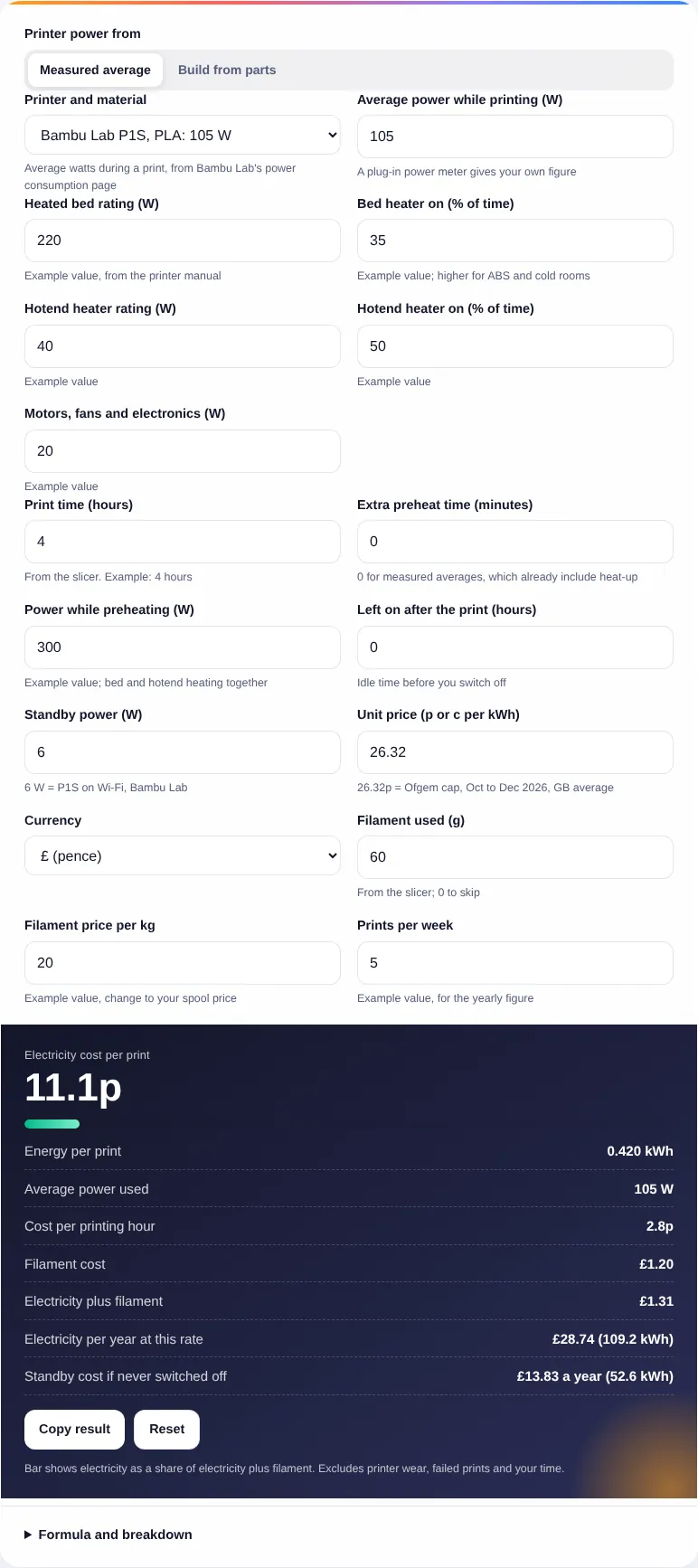
Bar shows electricity as a share of electricity plus filament. Excludes printer wear, failed prints and your time.
Formula and breakdown
n/a
n/a
n/a
This 3D printer electricity cost calculator works out what a single print costs in electricity, with filament added if you want the full material cost, for hobbyists and small print sellers in the UK and Europe. It uses measured average power figures published by a printer maker, or builds an estimate from the heated bed, hotend and electronics, and prices the energy at the Ofgem cap or your own tariff.
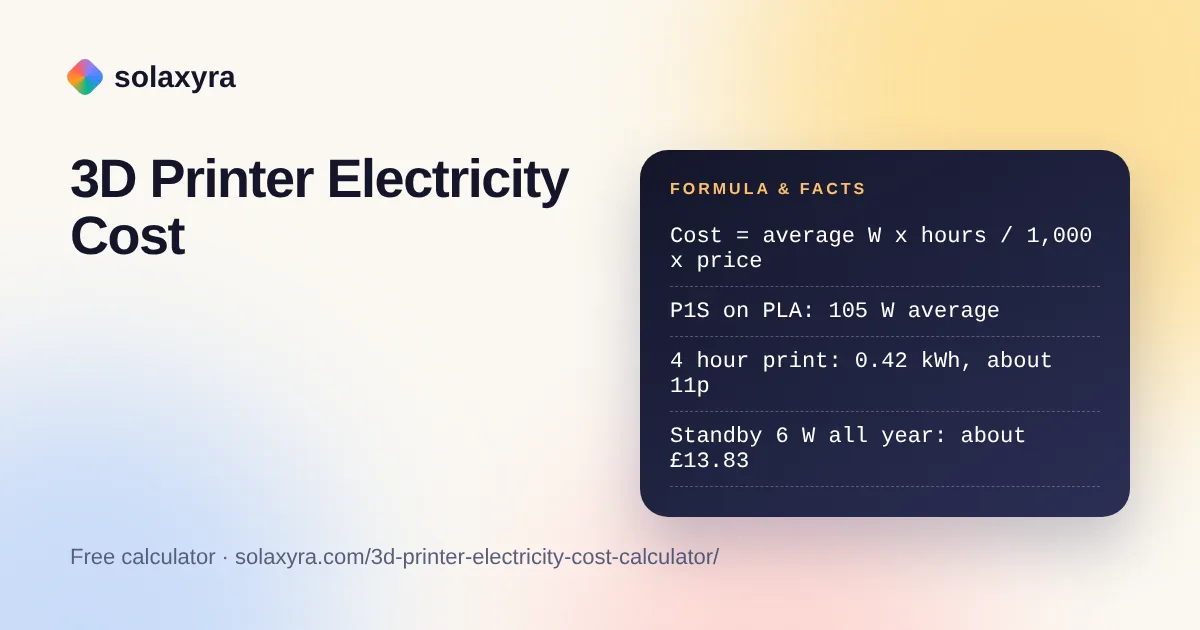
Quick answer: Electricity cost per print equals average watts times print hours divided by 1,000, times your unit price. A Bambu Lab P1S printing PLA averages 105 W, so a 4 hour print uses 0.42 kWh and costs about 11p at 26.32p per kWh. Filament usually costs far more.
What Is a 3D Printer Electricity Cost Calculator?
A 3D printer electricity cost calculator is a tool that converts a printer’s average power and the length of a print into kilowatt hours, then multiplies by the price of electricity. In plain words: energy in kWh equals average watts times hours divided by 1,000, and cost equals kWh times the unit price. Preheating and time left on standby add a little more.
The key input is average power, not the power supply rating. A heated bed and hotend draw full power while warming up, then switch on and off to hold temperature, so the average across a print is much lower than the peak. Bambu Lab’s own figures show a P1S averaging 105 W printing PLA, against a supply rating of 1,100 W at 220 V.
How Do You Use the 3D Printer Electricity Cost Calculator?
- Choose “Measured average” and pick your printer and material, or type a figure from a plug-in power meter. If your printer is not listed, choose “Build from parts”.
- In parts mode, enter the heated bed and hotend ratings from the manual, the share of time each heater is on, and the power of motors, fans and electronics.
- Enter the print time from your slicer, any extra preheat time, and how long the printer stays on after the print.
- Set your unit price and currency, then the filament weight and spool price.
- Read the electricity cost per print, the kWh, the cost per printing hour, filament cost, the yearly total and the cost of leaving the printer on standby.
How Much Electricity Does a 3D Printer Use?
Bambu Lab’s measured averages run from 80 W for an A1 mini printing PLA to 395 W for an H2D printing PC, so a typical desktop printer uses roughly 0.1 to 0.4 kWh per printing hour. These figures come from the Bambu Lab power consumption page, which lists energy and average power for test prints of each model and material.
| Printer and material (Bambu Lab test) | Average power | Cost per hour at 26.32p | 4 hour print |
|---|---|---|---|
| A1 mini, PLA | 80 W | 2.1p | 0.32 kWh, 8.4p |
| A1, PLA | 95 W | 2.5p | 0.38 kWh, 10.0p |
| P1S, PLA | 105 W | 2.8p | 0.42 kWh, 11.1p |
| P1P, PLA | 110 W | 2.9p | 0.44 kWh, 11.6p |
| P1S, ABS | 140 W | 3.7p | 0.56 kWh, 14.7p |
| X1 or X1C, ABS | 150 W | 3.9p | 0.60 kWh, 15.8p |
| H2D, PLA | 197 W | 5.2p | 0.79 kWh, 20.7p |
| A1, ABS | 200 W | 5.3p | 0.80 kWh, 21.1p |
| X1E, ABS | 260 W | 6.8p | 1.04 kWh, 27.4p |
| H2D, PC | 395 W | 10.4p | 1.58 kWh, 41.6p |
The unit price is the Ofgem cap rate for 1 October to 31 December 2026. Bambu Lab’s test prints lasted about 15 to 23 minutes, so heat-up makes up a bigger share of the average than in a long print; real long prints may average a little less. That is why the 3D printer electricity cost calculator sets extra preheat time to 0 for these presets.
Why Does ABS Cost More to Print Than PLA?
In Bambu Lab’s tests ABS raised average power on every printer listed: the A1 went from 95 W on PLA to 200 W on ABS, more than double, and the P1S rose from 105 W to 140 W. Materials printed hotter keep the heaters on for more of the time.
The enclosed P1S rose by a third for ABS while the open-frame A1 doubled; an enclosure that holds warm air is a likely reason. Room temperature matters too: a printer in a cold garage works harder than one in a heated room. To see the effect on your own machine, plug it into a power meter and enter the measured average in the 3D printer electricity cost calculator.
How Much Does Leaving a 3D Printer On Standby Cost?
A P1S on Wi-Fi draws 5.8 to 6 W on standby, according to Bambu Lab, which is about 52.6 kWh and £13.83 a year at 26.32p per kWh if it is never switched off. That can be more than the electricity for all its prints for a light user.
The 3D printer electricity cost calculator shows this as a separate yearly line and lets you add hours left on after each print. Other Bambu Lab standby figures range from 4 to 5.4 W for the A1 to 25 to 27 W for the H2D. The electricity cost calculator handles any other always-on device, and the standby power calculator totals a whole house of them.
Is Filament or Electricity the Bigger Cost?
For most prints filament costs much more than electricity, which is why the 3D printer electricity cost calculator shows both. At an example £20 per kg, a 60 g print uses £1.20 of filament against about 11p of electricity on a P1S, so electricity is under 10% of the material cost.
Electricity matters more for long, light prints, heated chambers and printers left on all day. Selling prints also brings printer wear, failed prints and your time, which this tool leaves out. If you print from a portable power station, the power station runtime calculator shows how long a battery would last at the same average watts, and the watts to kWh calculator converts any wattage into energy.
Worked Example: A 6.5 Hour PETG Print on an Open-Frame Printer
Example: a hobbyist in Manchester has an open-frame printer not in the preset list, so uses parts mode with example values: a 220 W bed on 35% of the time, a 40 W hotend on 50% of the time and 20 W for motors, fans and the board.
- Average power: 220 x 0.35 + 40 x 0.5 + 20 = 117 W.
- Printing energy: 117 x 6.5 / 1,000 = 0.7605 kWh.
- Preheat: 300 W for 5 minutes = 0.025 kWh. Left on 8 hours afterwards at 6 W = 0.048 kWh.
- Total: 0.8335 kWh x 26.32p = 21.9p.
- Filament: 150 g at an example £25 per kg = £3.75, so the print costs £3.97 in electricity and filament.
The 3D printer electricity cost calculator gives the same figures, with a yearly total of £57.04 at five prints a week. Measuring the real average with a power meter is the best way to replace the example heater percentages.
Follow the maker’s instructions on where to place and how to supervise the printer. Any new socket or circuit for a print room is electrical work for a registered electrician to BS 7671.
Frequently Asked Questions
How much does it cost to run a 3D printer per hour?
At the Ofgem cap rate of 26.32p per kWh, Bambu Lab’s measured averages give about 2.1p an hour for an A1 mini on PLA, 2.8p for a P1S on PLA and 10.4p for an H2D printing PC. Multiply your printer’s average watts by your unit price and divide by 1,000.
How many watts does a 3D printer use?
Average power while printing is far below the power supply rating. Bambu Lab lists 80 to 110 W for its smaller printers on PLA and up to 395 W for the H2D printing PC. Power is higher while the bed first heats up, which is included in those averages.
Does the heated bed use the most electricity?
On most printers it is the largest heater, holding a large plate at temperature. Bambu Lab notes that on every model except the A1 mini the bed heater runs directly from the mains. Switching from PLA to ABS more than doubled the A1’s average in its tests.
How much electricity does a 3D printer use on standby?
Bambu Lab lists standby draw from about 4 to 6 W for the A1, P1P and P1S up to 25 to 27 W for the H2D on Wi-Fi. Left on all year, 6 W is about 52.6 kWh, roughly £13.83 at 26.32p per kWh.
Is the 3D printer electricity cost calculator accurate for my printer?
It is exact for the average power you enter. The presets are the maker’s measured figures for short test prints, and parts mode uses example heater percentages. For the best result, measure a full print with a plug-in power meter and enter that average.
Should I include electricity when pricing 3D prints for sale?
Yes, but it is usually a small part. A 4 hour PLA print on a P1S uses about 11p of electricity, while filament, failed prints, printer wear and your time normally cost more. The calculator adds filament; the other costs need your own figures.
Checked October 2026 by the Solaxyra Editorial Team. Sources: Bambu Lab Wiki: Power consumption, Ofgem: Energy price cap 1 October to 31 December 2026.