This guide explains the difference between kilowatts and kilowatt-hours for UK households, so you can read an appliance label, a solar quote, a battery specification or your electricity bill and know exactly what each number means and what it costs. Getting kW vs kWh right is the first step in every energy calculation, and mixing them up is the most common reason home estimates go wrong.
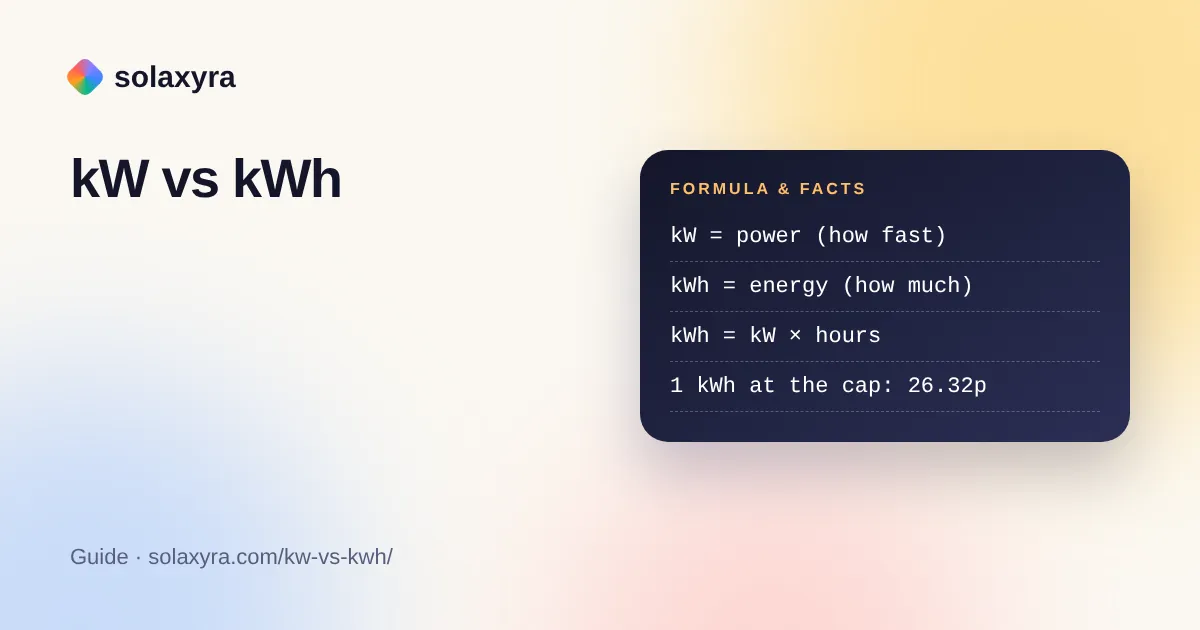
Quick answer: In kW vs kWh, a kilowatt (kW) measures power, the rate at which energy is used or produced at a moment. A kilowatt-hour (kWh) measures energy, the amount used over time. One kW for one hour is one kWh. UK bills charge per kWh, currently 26.32p on average under the October 2026 price cap.
What is the difference between kW and kWh?
A kilowatt is a unit of power and a kilowatt-hour is a unit of energy: kW tells you how fast, kWh tells you how much. The kilowatt-hour is defined as the energy delivered by one kilowatt of power for one hour, which equals 3.6 megajoules. A watt is one joule per second, and a kilowatt is 1,000 watts.
A road trip is a useful picture. Speed in miles per hour tells you how fast you are going at a given moment; the distance on the trip meter tells you how far you have gone. Power (kW) is like speed. Energy (kWh) is like distance. A car doing 60 mph for two hours covers 120 miles, and a 2 kW heater running for three hours uses 6 kWh.
The link between the two is one simple formula:
Energy (kWh) = power (kW) × time (hours)
Turn it round to find average power: kW = kWh ÷ hours. If you know any two of the three, you can work out the third.
Which one do you pay for on your electricity bill?
You pay for kWh. Each kWh is one “unit” on a UK bill, and under the Ofgem price cap for October to December 2026 the average direct debit unit rate is 26.32p per kWh. On top of that comes a standing charge of 54.83p per day, which does not depend on how many kWh you use.
So running something rated at 1 kW for one hour costs 26.32p at the average cap rate. Running something rated at 1 kW for ten minutes uses one sixth of a kWh and costs about 4.4p. Power on its own does not cost money; power multiplied by time does. To price any appliance at your own unit rate, use the electricity cost calculator.
Ofgem’s typical domestic consumption value for electricity is 2,500 kWh a year. Spread over the 8,760 hours in a year, that is an average power of only about 0.29 kW, even though your kettle may draw ten times that for a few minutes. That gap between brief peaks and a low average is exactly why kW and kWh describe different things.
How do you convert kW to kWh for an appliance?
Multiply the appliance’s power in kW by the hours it runs; if the label shows watts, divide by 1,000 first. These steps work for any appliance with a rating plate:
- Find the power rating on the plate or in the manual, for example 2,000 W.
- Convert to kW by dividing by 1,000: 2,000 W = 2 kW.
- Estimate how many hours it runs, for example 4 hours a day.
- Multiply: 2 kW × 4 h = 8 kWh a day.
- Multiply by your unit rate to get cost: 8 × 26.32p = £2.11 a day.
- For appliances that cycle on and off, such as heaters with a thermostat or fridges, the real kWh will be lower than the rating suggests, so use a plug-in energy monitor or the manufacturer’s kWh figure where you can.
The watts to kWh calculator does these steps for you, and the home energy consumption calculator adds up a whole list of appliances.
What is rated in kW and what is rated in kWh?
Anything that describes how much power a device can draw or deliver is in kW (or W); anything that describes an amount stored, used or generated over a period is in kWh. The table sorts common UK examples. The appliance wattages are example values, so check the labels on your own equipment; costs use the 26.32p cap rate.
| Item | Number in kW (power) | Number in kWh (energy) | Example cost at 26.32p |
|---|---|---|---|
| LED bulb, example 10 W for 5 hours | 0.01 kW | 0.05 kWh | 1.32p |
| Kettle, example 3 kW for 3 minutes | 3 kW | 0.15 kWh | 3.95p |
| Fan heater, example 2 kW for 4 hours | 2 kW | 8 kWh | £2.11 |
| Home EV charger, example 7 kW for 4 hours | 7 kW | 28 kWh | £7.37 |
| Plug-in solar kit, full output for 1 hour | up to 0.8 kW (800 W) | 0.8 kWh generated | Saves up to 21p if all used at home |
| Home battery | Power rating, how fast it charges or discharges | Capacity, how much it stores (typical 10 kWh) | Depends on tariff |
| Rooftop solar system | Size in kWp (peak power) | Yearly generation in kWh | Depends on use and export |
| Your electricity bill | Not shown for most homes | Units used in kWh | Unit rate per kWh plus standing charge |
The plug-in solar row uses the government’s limit: from 27 August 2026 plug-in kits in Great Britain produce up to 800 W. The kWh they actually generate depends on weather, season and orientation, which is why a kit’s 0.8 kW rating says nothing on its own about yearly savings.
Why does kW vs kWh matter for solar panels and batteries?
For solar panels, the kW (more precisely kWp, kilowatt peak) is the size of the system under standard test conditions, while the kWh is what it produces over a day or year; you need both to judge a quote. A 4 kWp system and a 4 kWh daily output are completely different statements, and the ratio between them, kWh per kWp, tells you how productive the site is. The kWh per kWp calculator works this out from your generation data.
For batteries the two numbers describe different limits. The kWh is the tank size: how much energy it can store. The kW is the tap size: how fast it can deliver that energy. Example: a battery rated 5 kW and 10 kWh can run a 5 kW load for at most 2 hours (10 ÷ 5), or a 1 kW load for up to 10 hours, before losses. If your evening peak includes a 3 kW oven and a 3 kW kettle at once, a 5 kW battery cannot cover all of it, however many kWh it holds. The Energy Saving Trust gives 10 kWh as a typical home battery capacity.
Heat pumps are rated by heat output in kW, but you pay for the electricity they use in kWh. A heat pump delivering 6 kW of heat with a COP of 3 draws about 2 kW of electricity, so in one hour it uses about 2 kWh, costing about 53p at the cap rate.
What are the most common kW and kWh mistakes?
The most common mistake is writing kW/h or “kWh per hour”; the correct unit of energy is kWh, and kW/h would mean a change in power over time, which is almost never what anyone intends. Other errors to watch for:
- Comparing a battery’s kWh capacity with an appliance’s kW rating directly, without dividing to get hours.
- Treating a solar system’s kWp as its daily output.
- Reading half-hourly smart meter data as kW. Each half-hour reading is energy in kWh. To get the average power in that half hour, multiply by 2; for 15 minute data, multiply by 4.
- Assuming the bill tracks kW. Domestic UK bills charge per kWh plus a daily standing charge.
- Forgetting that watts and kilowatts differ by 1,000: a 1,500 W hair dryer is 1.5 kW, not 1,500 kW.
How much power can a UK plug socket supply?
A standard UK 13 A plug can supply about 3 kW: at 230 V, 230 × 13 = 2,990 W. That is why most kettles and portable heaters sold for UK sockets are rated at or below about 3 kW. Appliances that need more, such as electric showers, cookers and most home EV chargers, are wired on their own dedicated circuits. Any new circuit or change to fixed wiring must be installed by a qualified electrician and meet BS 7671, the UK wiring regulations.
The kW figure matters for safety and circuit sizing; the kWh figure matters for cost. If you want to see what a rating means in amps for your circuit, the kW to amps calculator converts it at UK voltages.
Frequently Asked Questions
Is kWh the same as a unit of electricity?
Yes. On a UK electricity bill one unit is one kilowatt-hour. If your bill shows 250 units for the month and your unit rate is 26.32p, the energy part of that bill is 250 × 26.32p, which is £65.80, before the daily standing charge.
How many kWh does a 1 kW appliance use?
A 1 kW appliance uses 1 kWh for every hour it runs at full power. Half an hour uses 0.5 kWh and ten hours uses 10 kWh. Appliances with thermostats switch on and off, so their real use is usually lower than the rating times the hours.
Is kW/h the same as kWh?
No. kWh means kilowatt multiplied by hours and is a unit of energy. kW/h would mean kilowatts per hour, a rate of change in power, which is almost never what is meant. Always write energy as kWh.
Why does my battery have both a kW and a kWh rating?
The kWh rating is how much energy the battery stores; the kW rating is how fast it can charge or discharge. Divide kWh by kW to find the minimum time it can run at full output, for example 10 kWh ÷ 5 kW = 2 hours.
How do I turn smart meter half-hourly kWh into kW?
Each half-hourly reading is the energy used in 30 minutes. Multiply it by 2 to get the average power in kW during that half hour. For example, 0.75 kWh in a half hour means an average of 1.5 kW.
Checked October 2026 by the Solaxyra Editorial Team. Sources: Wikipedia: kilowatt-hour, Ofgem: energy price cap 1 October to 31 December 2026, GOV.UK: plug-in solar panels come to market, Energy Saving Trust: battery storage.