This guide explains how the Ofgem cap on household gas and electricity prices works for homes in England, Scotland and Wales, what it does and does not limit, and how to turn the current rates into a yearly bill for your own usage. With the energy price cap explained step by step, you can check whether your supplier is charging what the rules allow and judge whether a fixed deal is worth a look.
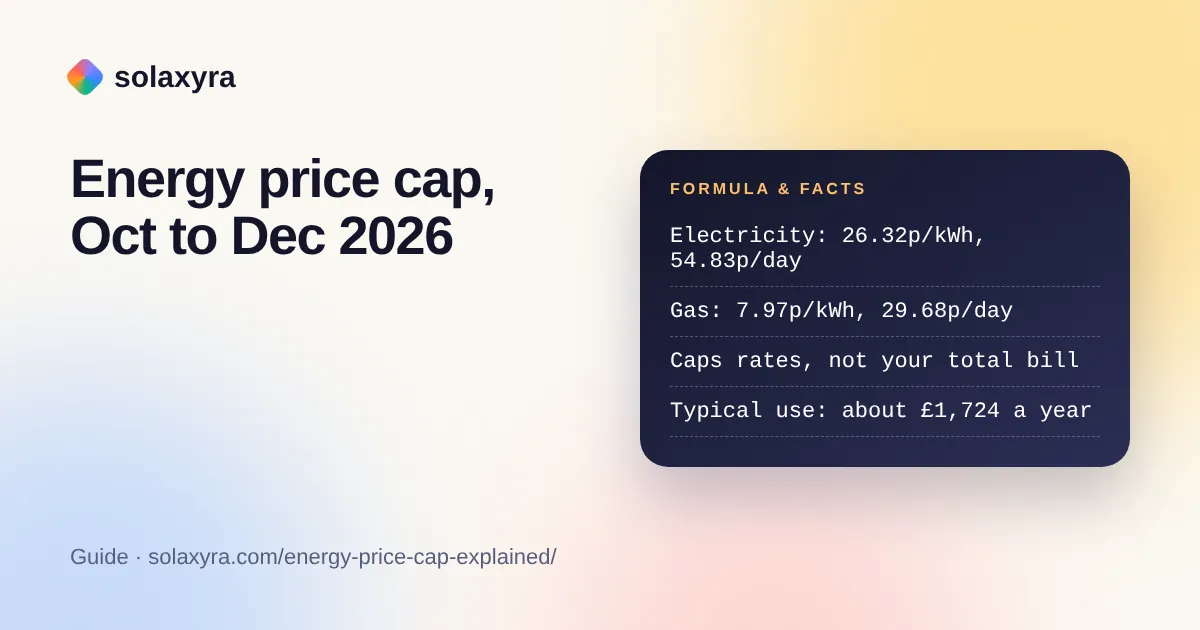
Quick answer: The energy price cap is the maximum Ofgem allows suppliers to charge per kWh and per day on standard variable tariffs in England, Scotland and Wales. It changes every three months. From 1 October to 31 December 2026 the average direct debit cap is 26.32p per kWh for electricity and 7.97p per kWh for gas. Total bills are not capped.
What does the energy price cap actually limit?
The cap limits two numbers on your tariff, the unit rate (pence per kWh) and the standing charge (pence per day), and it does not limit the total you pay in a year. Ofgem states this plainly on its price cap explainer: the more energy you use, the higher your bill will be.
This is the single most common misunderstanding. Headlines often quote a “typical bill” figure, and many people read it as a ceiling on what they can be charged. It is not. That figure is just the capped rates multiplied by an assumed level of use. A household that uses twice the typical amount of electricity will pay roughly twice the unit costs, all at capped rates and all perfectly legal.
The standing charge is the fixed daily amount you pay to stay connected, whether you use any energy or not. It is capped too, but because it does not depend on use, it makes up a much larger share of the bill for low users than for high users. The table further down shows this in numbers.
What are the price cap rates from 1 October to 31 December 2026?
For a household paying by direct debit, the average capped rates in Great Britain are 26.32p per kWh and 54.83p per day for electricity, and 7.97p per kWh and 29.68p per day for gas. These come from Ofgem’s announcement of changes to the cap for October to December 2026, published on 26 August 2026.
| Fuel (direct debit, GB average) | Unit rate | Standing charge | VAT in the figure |
|---|---|---|---|
| Electricity | 26.32p per kWh | 54.83p per day | None (0% from 1 Oct 2026 to 31 Mar 2027) |
| Gas | 7.97p per kWh | 29.68p per day | Included at 5% |
Ofgem says prices rise by 4% for a typical dual fuel direct debit household compared with the previous quarter, and links the rise to higher wholesale gas prices. The next announcement is due on 25 November 2026 and will cover 1 January to 31 March 2027.
These are averages. Your own capped rates depend on your region, how you pay (direct debit, standard credit on receipt of a bill, or prepayment) and your meter type. Ofgem publishes the regional tables on its website, and your supplier must show your actual rates on your bill and in your account.
Why is there no VAT on electricity this winter?
The government has removed VAT from household electricity bills from 1 October 2026 to 31 March 2027, so the capped electricity rates for this period contain no VAT, while gas still carries the usual 5%. Ofgem confirms this in both its October announcement and its explainer page.
This matters when you compare figures. If you see an older electricity rate quoted with VAT, it is not like for like. As a simple check of the arithmetic, adding 5% to 26.32p gives 27.64p, so a rate quoted around that level with VAT is broadly equivalent before tax. When the zero rate ends on 31 March 2027, expect rates to be quoted with VAT again unless the government says otherwise.
Who is protected by the price cap and who is not?
The cap protects households in England, Scotland and Wales who are on a standard variable tariff, which is the default tariff you are moved to when a fixed deal ends or if you never chose one. Prepayment customers on a default tariff are covered as well, at their own capped levels.
The cap does not apply to:
- fixed tariffs, where the price is agreed in your contract for a set term;
- business energy contracts;
- homes supplied through a heat network (communal or district heating);
- Northern Ireland, which has a separate market and regulator and is not part of the Ofgem cap.
If you are on a fixed deal, the cap still matters as a benchmark. A fixed rate above the current cap costs you more today, though it may protect you if the cap rises later. Nobody can promise which way the next quarter will go, so compare the fixed rates against the cap figures above rather than against a headline.
How is the energy price cap calculated?
Ofgem builds the cap from eight cost allowances that a supplier is expected to face, adds them together for each fuel, and turns the result into a unit rate and a standing charge. According to Ofgem, the building blocks are:
- Wholesale costs: buying the gas and electricity on the wholesale market, which is the largest and most volatile part.
- Network costs: building and running the pipes and wires that bring energy to homes.
- Policy costs: government schemes funded through bills, such as the Warm Home Discount.
- Operating costs: running a supplier, including billing and customer service.
- EBIT: an allowance for supplier earnings before interest and tax.
- Headroom: a small allowance for uncertainty.
- Levelisation: an adjustment so that standing charges are spread fairly across payment methods.
- VAT: currently 5% on gas and 0% on electricity until 31 March 2027.
Because the cap is announced several weeks before each period starts and then holds for three months, it moves some time after wholesale markets do. That lag works both ways: rises reach bills later, and so do falls.
What does the cap mean for a typical yearly bill?
At the October to December 2026 rates, a home using Ofgem’s typical 2,500 kWh of electricity and 9,500 kWh of gas a year would pay about £1,724 if those rates applied for a full year. Ofgem revised its typical domestic consumption values from 1 July 2026, from 2,700 kWh to 2,500 kWh for electricity and from 11,500 kWh to 9,500 kWh for gas, so older articles using the previous values will show higher “typical” bills.
The table below is our own arithmetic using the GB average direct debit rates. The low and high rows are examples only, not official categories; change them to the figures on your annual statement.
| Yearly use | Electricity cost | Of which standing charge | Gas cost | Total per year | Per month |
|---|---|---|---|---|---|
| Example low: 1,500 kWh electricity, 6,000 kWh gas | £594.93 | £200.13 (34%) | £586.53 | £1,181.46 | £98.46 |
| Ofgem typical: 2,500 kWh electricity, 9,500 kWh gas | £858.13 | £200.13 (23%) | £865.48 | £1,723.61 | £143.63 |
| Example high: 4,000 kWh electricity, 15,000 kWh gas | £1,252.93 | £200.13 (16%) | £1,303.83 | £2,556.76 | £213.06 |
Two things stand out. First, the standing charges alone come to £308.46 a year for dual fuel (£200.13 electricity plus £108.33 gas) before you boil a kettle. Second, the standing charge is a third of a low user’s electricity bill but only a sixth of a high user’s, which is why small households often feel the cap is unfair. Our guide to how standing charges work goes into this in more depth.
To price a single appliance at the capped rate, use the appliance electricity cost tool, or list everything in the house with the home energy consumption calculator to estimate your yearly kWh before you work out the bill.
How do you check your own bill against the cap?
You can check your bill in about ten minutes using your latest statement and the Ofgem regional table for your area. Work through these steps:
- Find your tariff name. If it says “standard variable”, “default” or similar, the cap applies; if it is a fixed deal, it does not.
- Note your unit rates and standing charges for each fuel from the bill or your online account.
- Look up the capped rates for your region and payment method on Ofgem’s website for the current period.
- Compare each figure. On a default tariff, your rate should not be higher than the cap for your region, payment method and meter.
- Find your annual kWh on your statement, multiply by the unit rate, then add 365 days of standing charge to get your own yearly estimate.
- If a rate looks too high, contact your supplier, quote the Ofgem figure for your region and ask for an explanation in writing.
Example: a flat with a single rate meter on a default direct debit tariff uses 1,800 kWh of electricity a year and has no gas. At the GB average cap, that is 1,800 × 26.32p = £473.76 for units plus 365 × 54.83p = £200.13 for standing charge, about £673.89 a year or £56.16 a month. Your regional figure will differ slightly.
Does the price cap apply to Economy 7 and smart tariffs?
Default tariffs for multi-register meters such as Economy 7 are capped too, with their own day and night rates; Ofgem’s typical value for these meters was revised to 3,400 kWh from 1 July 2026. The cap only covers default tariffs, so a smart or time of use tariff you signed up to on a fixed contract is not capped; check your tariff terms to see which kind you have.
If you have solar panels, a battery or an electric car, your import price still follows your tariff, so the cap only helps if you are on a default tariff. What you earn for exported electricity is a separate matter, paid under the Smart Export Guarantee, and the price cap does not set export rates. To see how running costs compare across heating options at capped rates, the heat pump versus gas running cost tool uses the same unit prices.
Frequently Asked Questions
Does the energy price cap limit my total bill?
No. The cap limits the unit rate per kWh and the daily standing charge on default tariffs. Your total bill depends on how much energy you use, so a household using more than the typical amount will pay more than the headline typical bill figure.
How often does the energy price cap change?
Ofgem resets the cap every three months, for periods starting 1 January, 1 April, 1 July and 1 October. The next announcement is due on 25 November 2026 and will set the cap for 1 January to 31 March 2027.
Does the price cap apply in Northern Ireland?
No. The Ofgem price cap covers households in England, Scotland and Wales only. Northern Ireland has a separate energy market and its own regulator, so prices there are set and regulated in a different way.
Am I covered by the cap if I am on a fixed tariff?
No. A fixed tariff has prices agreed in your contract for a set term, so the cap does not apply. It is still useful as a benchmark: compare your fixed unit rates and standing charges with the current cap for your region.
Why is my electricity rate different from 26.32p per kWh?
26.32p is the Great Britain average for direct debit. Capped rates vary by region, payment method and meter type, so your own rate can be a little higher or lower and still be within the cap for your circumstances.
Is VAT included in the price cap rates?
For 1 October 2026 to 31 March 2027 the government has removed VAT from household electricity, so capped electricity rates contain no VAT. Gas rates still include VAT at 5%, as Ofgem confirms in its October 2026 announcement.
Checked October 2026 by the Solaxyra Editorial Team. Sources: Ofgem: changes to the energy price cap, 1 October to 31 December 2026, Ofgem: energy price cap explained, Ofgem: summary of changes with revised typical consumption values.