Bar shows thermostat on-time. Unit cost only; the daily standing charge is paid regardless.
Formula and breakdown
Cost = kW × on-time % × hours × unit price
This electric heater running cost calculator works out what a fan heater, oil-filled radiator, convector or infrared panel costs to run per hour, day, week and heating season, for homes in the UK, Ireland and Europe. It allows for thermostat cycling and starts with the current Ofgem price cap unit rate, which you can replace with your own tariff in pounds, euros or dollars.
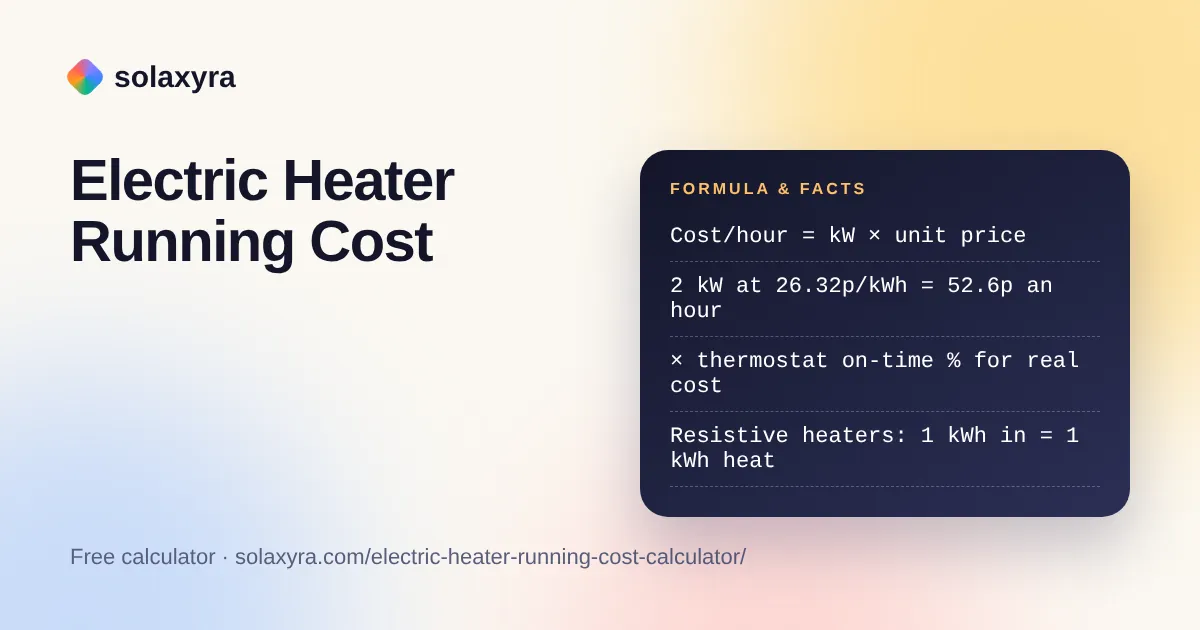
Quick answer: Multiply the heater’s power in kW by your unit rate. At the Ofgem cap of 26.32p per kWh for October to December 2026, a 1 kW heater costs 26.3p an hour, a 2 kW heater 52.6p and a 3 kW heater 79.0p at full power. A thermostat that cycles the heater lowers the real cost.
What Is an Electric Heater Running Cost Calculator?
An electric heater running cost calculator is a tool that turns a heater’s power rating, the hours it is switched on and the share of time its thermostat keeps it heating into kilowatt-hours and money. In plain words: kilowatts multiplied by on-time percentage, multiplied by hours, gives kWh, and kWh multiplied by your unit price gives the cost.
- Cost per hour at full power = heater kW × unit price
- Average cost per hour = full power cost × thermostat on-time %
- Cost per season = average cost per hour × hours per day × days per week × heating weeks
How Do You Use the Electric Heater Running Cost Calculator?
- Choose your currency. The UK default is the cap rate; euros and dollars start with a labelled example price to replace with your tariff.
- Pick the heater type. It fills in a typical rating, which you should overwrite with the wattage on your heater’s label or the setting you actually use (many heaters have 1 kW and 2 kW settings).
- Set the thermostat on-time. If the heater has no thermostat, use 100%. If it clicks on and off, estimate the share of each hour it is heating, or read it from a plug-in energy monitor.
- Enter hours switched on per day, days per week and heating weeks per year.
- Read the cost per heating season, plus hourly, daily and weekly figures and the money saved by thermostat cycling.
- Open Formula and breakdown to check each step, then use Copy result to save the figures.
Which Type of Electric Heater Is Cheapest to Run?
For the same wattage and the same hours, every plug-in resistive heater costs the same to run, because each one turns practically all the electricity it uses into heat. A 2 kW fan heater, a 2 kW oil-filled radiator and a 2 kW convector all use 2 kWh per hour at full power; the physics of electric resistance heating leaves no room for one to be more “efficient” than another in that sense.
What differs is how the heat reaches you, and that changes how long you need to run it:
- Fan heaters push warm air out quickly, which suits short bursts in a small room, but the warmth fades soon after they stop.
- Oil-filled radiators heat a sealed reservoir and keep giving off heat after switching off, which suits steady background warmth with a thermostat.
- Convector heaters warm air that rises and circulates around the room by itself, quietly.
- Infrared or radiant panels warm people and surfaces in their line of sight rather than the air, so a lower-wattage panel aimed at a desk or sofa can keep one person comfortable without heating the whole room.
The cheapest heater to run is therefore the lowest wattage that keeps you comfortable for the fewest hours. The only electric heating that delivers more heat than the electricity it uses is a heat pump, which moves heat from outside rather than generating it; compare one with the heat pump running cost calculator.
How Much Does a 2 kW Electric Heater Cost to Run?
A 2 kW heater costs 52.6p per hour at full power on the October to December 2026 cap rate of 26.32p per kWh, or £2.11 for a 4-hour evening. If its thermostat keeps it heating for 75% of the time once the room is warm, the same evening costs about £1.58.
| Heater power | Cost per hour | 4-hour evening at full power | 4-hour evening at 75% on-time |
|---|---|---|---|
| 500 W | 13.2p | 52.6p | 39.5p |
| 1,000 W | 26.3p | £1.05 | 79.0p |
| 1,500 W | 39.5p | £1.58 | £1.18 |
| 2,000 W | 52.6p | £2.11 | £1.58 |
| 2,500 W | 65.8p | £2.63 | £1.97 |
| 3,000 W | 79.0p | £3.16 | £2.37 |
Costs use 26.32p per kWh, the average direct debit unit rate in Ofgem’s price cap for 1 October to 31 December 2026. Your regional or fixed rate may differ, so enter the unit rate from your bill for an exact answer.
How Does a Thermostat Change the Running Cost?
A thermostat cuts the cost in direct proportion to the time the heater is switched off: a heater that heats for 45 minutes in each hour uses 75% of its full-power energy. The calculator shows this as the saving from thermostat cycling.
How much a thermostat saves depends on the room, not the heater. A small, well insulated room reaches its set temperature quickly and the heater then cycles often; a large or draughty room keeps it running nearly all the time. Heaters without a thermostat run at full power for as long as they are switched on, so a plug-in timer or a model with a built-in thermostat usually pays for itself quickly. Use a plug-in energy monitor over a typical evening to measure your real on-time.
Are Electric Heaters Cheaper Than Central Heating?
Per unit of heat, direct electric heating usually costs more than gas central heating in Great Britain, because the October to December 2026 cap puts electricity at 26.32p per kWh and gas at 7.97p per kWh. A gas boiler loses some heat up the flue, but not enough to close a gap of more than three times.
An electric heater can still be the cheaper choice when it heats one occupied room for a few hours instead of warming the whole house. If you work from home alone, heating just your office with a small heater may cost less than running the boiler for every room. For a whole-home comparison, include the boiler’s efficiency and your actual gas use from your bill.
Is It Cheaper to Run Electric Heaters on Economy 7?
Only if the heat is used at night or stored: Economy 7 gives a lower rate for 7 hours at night and a higher rate during the day, according to Citizens Advice. Storage heaters are designed for this: the Energy Saving Trust explains they charge a core during the cheaper period and release the heat during the day. A portable heater used in the evening on Economy 7 pays the higher daytime rate, which can make it dearer than on a single-rate tariff.
Worked Example: A Home Office in Cardiff
Gareth in Cardiff works from home and wants to heat only his small office for 5 hours a day, 5 days a week, through a 22-week winter. He pays the cap rate of 26.32p per kWh.
- Option 1, a 2 kW oil-filled radiator with a thermostat that keeps it heating 60% of the time: 2 × 0.6 × 5 = 6 kWh a day, costing £1.58 a day, £7.90 a week and £173.71 over the winter (660 kWh).
- Option 2, a 600 W infrared panel aimed at his desk, running at full power: 0.6 × 5 = 3 kWh a day, costing 79p a day, £3.95 a week and £86.86 over the winter (330 kWh).
The panel halves his cost because it uses fewer kWh, not because it turns electricity into heat more efficiently. Gareth tries it for a week with an energy monitor to make sure he stays warm enough before deciding.
Use portable heaters as the manufacturer instructs: keep the stated clearances, never cover them, and keep them away from bedding and curtains. Fixed wall heaters on their own circuit should be installed by a qualified electrician, to BS 7671 in the UK or the local wiring rules elsewhere. To cost other appliances on the same tariff, use the electricity cost calculator.
Frequently Asked Questions
How much does a 3 kW heater cost per hour?
A 3 kW heater uses 3 kWh per hour at full power. At the Ofgem cap rate of 26.32p per kWh for October to December 2026 that is 79.0p per hour. With a thermostat cycling it to 75% on-time, the average falls to about 59p per hour.
Are oil-filled radiators cheaper to run than fan heaters?
Not per hour at the same wattage, because both turn practically all their electricity into heat. An oil-filled radiator keeps giving off heat after switching off, so with a thermostat it may cycle off for longer, which can lower the cost of keeping a room warm.
Do infrared heaters use less electricity?
An infrared heater uses exactly its rated wattage, like any electric heater. It can cost less overall because it warms people and surfaces directly, so a lower-wattage panel may keep you comfortable in one spot without heating all the air in the room.
How do I find out how much power my heater uses?
Check the rating label on the heater or its manual for the wattage of each setting, often 1 kW and 2 kW. A plug-in energy monitor shows actual consumption in kWh, which also captures thermostat cycling over a typical day.
Is it cheaper to leave an electric heater on low all day?
Usually not. An electric heater’s cost depends only on the kWh it uses, and a room kept warm all day loses heat all day. Heating the room only when you are in it, with a thermostat and timer, normally uses fewer kWh.
How much does it cost to run an electric heater overnight?
Multiply the heater’s kW by the hours and your unit rate. A 1 kW heater running 8 hours at full power uses 8 kWh, costing £2.11 at 26.32p per kWh. On an Economy 7 tariff, use your lower night rate for the hours it covers.
Checked October 2026 by the Solaxyra Editorial Team. Sources: Ofgem, energy price cap 1 October to 31 December 2026, Wikipedia, Electric heating, Energy Saving Trust, electric storage heaters, Citizens Advice, using storage heaters efficiently.