Unit cost only. The daily standing charge is paid whatever you switch on, so it is not added per appliance.
Formula and breakdown
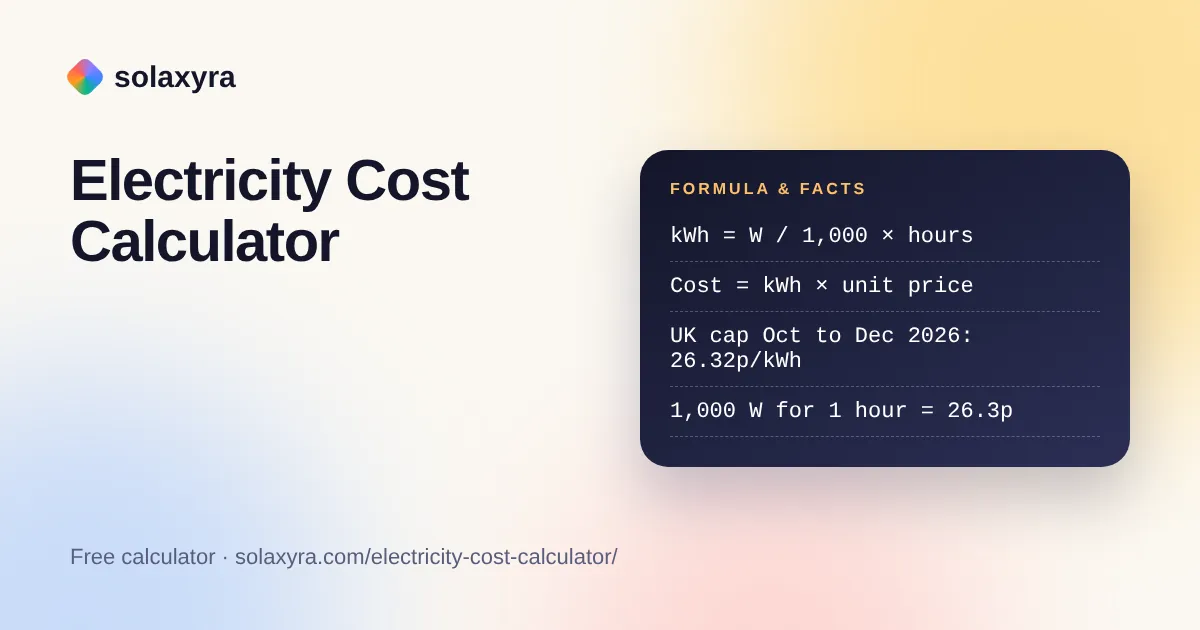
Cost = W / 1,000 × hours × unit price
This electricity cost calculator shows what any appliance costs to run per hour, day, week, month and year, for households in the UK, Ireland, the EU and beyond. It starts with the current Ofgem price cap unit rate for Great Britain and lets you switch to euros or dollars and enter the price from your own bill.
Quick answer: Divide the appliance’s wattage by 1,000 to get kilowatts, multiply by the hours used to get kWh, then multiply by your unit price. At the Ofgem price cap of 26.32p per kWh for 1 October to 31 December 2026, a 1,000 W appliance costs 26.3p per hour and a 100 W one 2.6p.
What Is an Electricity Cost Calculator?
An electricity cost calculator is a tool that converts an appliance’s power rating and usage time into kilowatt-hours, then multiplies them by your unit price to give a running cost. In plain words: watts divided by 1,000, times hours, gives kWh, and kWh times the price per kWh gives the cost.
A kilowatt-hour is the energy used by a 1,000 W appliance running for one hour, and it is the “unit” your supplier bills you for. The full formula used here is:
- Average power (kW) = rated watts / 1,000 × average power % × number of appliances
- Energy per day (kWh) = average power × hours per day
- Cost per year = energy per day × days per week × 365 / 7 × unit price
How Do You Use the Electricity Cost Calculator?
- Choose your currency. Pounds use pence per kWh; euros and dollars use a price per kWh.
- Enter the appliance power in watts or kilowatts, from the rating plate, the manual or a plug-in energy monitor.
- Enter the hours used per day and the days used per week. Use decimals for part hours: 0.5 is 30 minutes.
- Set the number of identical appliances, such as six light bulbs or two monitors.
- Lower the average power percentage for appliances that switch on and off under a thermostat, if you know the duty cycle.
- Check the unit price. The UK default is the cap rate; replace it with the rate on your bill for an exact figure.
- Read the yearly cost and the hourly, daily, weekly and monthly breakdown, then open Formula and breakdown to see every step.
To total several appliances at once, use the home energy consumption calculator, which adds rows for each device. If you only need the kWh figure, the watts to kWh converter is simpler.
How Much Does It Cost to Run a 1,000 W Appliance for an Hour?
A 1,000 W appliance running for one hour uses exactly 1 kWh, so it costs your unit price: 26.32p at the GB price cap for October to December 2026. A 2,000 W appliance costs 52.6p per hour and a 3,000 W kettle 79.0p per hour of boiling time, though a kettle only runs for a few minutes at a time.
The cap figures come from Ofgem’s price cap announcement: 26.32p per kWh and a standing charge of 54.83p per day for electricity paid by direct debit. They are averages across England, Scotland and Wales, and actual rates vary by region, payment method and tariff. If you are on a fixed or other tariff, live in Northern Ireland or live outside Great Britain, enter the unit rate from your own bill.
Running Cost by Wattage at the UK Price Cap
Costs at 26.32p per kWh. The yearly column assumes four hours of use every day.
| Appliance power | kWh per hour | Cost per hour | Cost per year at 4 hours a day |
|---|---|---|---|
| 10 W | 0.01 | 0.26p | £3.84 |
| 60 W | 0.06 | 1.58p | £23.06 |
| 100 W | 0.1 | 2.63p | £38.43 |
| 500 W | 0.5 | 13.16p | £192.14 |
| 1,000 W | 1 | 26.32p | £384.27 |
| 2,000 W | 2 | 52.64p | £768.54 |
| 3,000 W | 3 | 78.96p | £1,152.82 |
How Do You Find an Appliance’s Wattage?
Look for the rating plate or sticker on the back or underside of the appliance, which states the power in watts (W) or kilowatts (kW), or check the manual or product listing. If the plate shows only volts and amps, multiply them: 230 V × 0.5 A is about 115 W, an upper limit rather than the typical draw.
A plug-in energy monitor between the socket and the appliance gives the most accurate figure, because it measures what the device actually draws over hours or days. This matters for fridges, freezers, games consoles and computers, whose real consumption is often far below the rated maximum. For devices that cycle, the monitor’s kWh reading over a full day can replace the power and hours inputs: enter it as 1,000 W for that many hours, or use the kWh directly with your price.
Should You Include the Standing Charge?
No, not per appliance: the standing charge of 54.83p per day under the October to December 2026 cap is a fixed daily fee, about £200 a year, that you pay whatever you switch on. Adding it to one appliance’s cost would overstate what that appliance adds to your bill.
Include it only when estimating a whole-home bill, by adding the daily standing charge × 365 to the total of all appliances. Solar panels, batteries and efficient appliances cut the unit cost but not the standing charge, which is worth remembering when you weigh up solar panel savings.
Why Is My Real Cost Lower Than the Calculation?
Usually because the appliance does not run at full rated power all the time; fridges, freezers, ovens, irons and heaters switch on and off under a thermostat, so their average draw is lower. A heater that is powered for 40 minutes in each hour once the room is warm has an average power of about 67% of its rating.
Set the average power percentage to match if you know it from an energy monitor. The electric heater running cost calculator applies this thermostat duty cycle directly. Some devices also have several power settings, so enter the wattage of the setting you actually use.
Is Electricity Cheaper at Night?
Only on a time-of-use tariff: a standard single-rate tariff charges the same price per kWh at every hour of the day. The Energy Saving Trust explains that tariffs such as Economy 7 give cheaper rates at certain times, typically overnight, with a higher daytime rate. If you are on one, run the calculator twice, once with each rate, and split the hours between them.
Worked Example: A Home Office in Leeds
Emma in Leeds works from home five days a week and pays the cap rate of 26.32p per kWh by direct debit. Her laptop, monitor and lamp draw 120 W together for 8 hours a day, and she uses a 1.5 kW fan heater for 3 hours each working day in winter.
- Desk setup: 0.12 kW × 8 h = 0.96 kWh a day, which costs 25.3p a day and £65.88 a year over about 261 working days.
- Fan heater at full power: 1.5 kW × 3 h = 4.5 kWh a day, which costs £1.18 a day. If she used it every working day for a year it would cost £308.79, so a five-month heating season is closer to £130.
- Together, on a working day in winter, she adds about £1.44 to her electricity bill on top of the standing charge she pays anyway.
Emma lowers the heater’s average power to 60% once she sees in the breakdown that its thermostat cycles, which brings the daily heater cost down to about 71p.
Frequently Asked Questions
How do I calculate the cost of electricity per hour?
Divide the appliance’s wattage by 1,000 and multiply by your price per kWh. A 2,000 W heater at 26.32p per kWh costs 2 × 26.32 = 52.6p per hour. Use your bill’s unit rate rather than an average for an exact figure.
What is the electricity price cap from October 2026?
From 1 October to 31 December 2026, Ofgem’s cap for electricity paid by direct debit averages 26.32p per kWh with a standing charge of 54.83p per day, across England, Scotland and Wales. Your regional rate may differ slightly.
How many kWh does a 100 W appliance use in a day?
A 100 W appliance uses 0.1 kWh for every hour it runs, so 2.4 kWh if it runs for 24 hours. At 26.32p per kWh that is about 63p per day, or 2.6p for each hour of use.
Does the calculator include VAT?
It uses whatever unit price you enter. The default is Ofgem’s published cap rate for October to December 2026, which Ofgem states as the price consumers pay on average. For other tariffs or countries, enter the unit price exactly as it appears on your bill.
Why does my fridge cost less than the calculator shows?
A fridge compressor switches on and off to hold the set temperature, so it draws its rated power for only part of each hour. Measure a full day with a plug-in energy monitor, or lower the average power percentage until the kWh matches.
How do I work out the cost per month?
Work out the yearly cost from daily use and days per week, then divide by 12. This averages out short and long months. For an appliance used daily, the monthly figure is close to the daily cost multiplied by 30.4.
Checked October 2026 by the Solaxyra Editorial Team. Sources: Ofgem, changes to the energy price cap between 1 October and 31 December 2026, Energy Saving Trust, electric storage heaters, Citizens Advice, using storage heaters efficiently.