Valid for resistive (ohmic) loads in DC circuits, and for AC circuits with purely resistive loads using RMS values.
Formula and breakdown
V = I × R
This ohms law calculator finds voltage, current, resistance and power from any two of them, for students, hobbyists and anyone checking a circuit, with unit prefixes from microamps to kilowatts. Pick the two values you know, enter them, and the other two appear with the formula and working shown underneath.
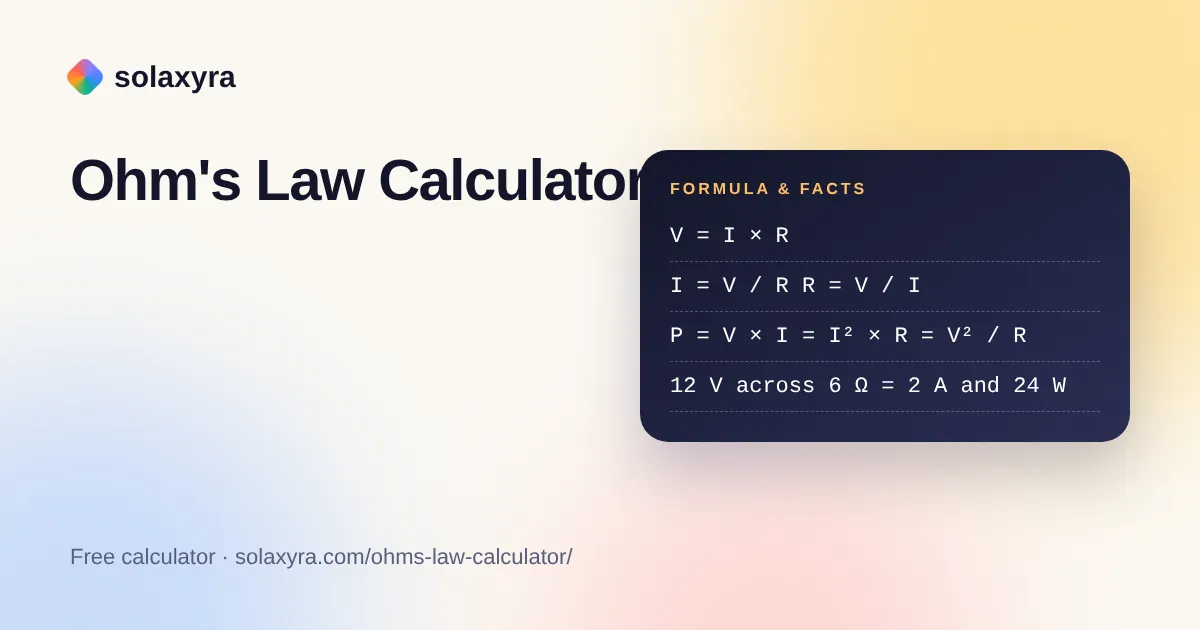
Quick answer: Ohm’s law states that voltage equals current multiplied by resistance, V = I × R, so I = V / R and R = V / I. Adding P = V × I gives P = I² × R and P = V² / R. A 6 ohm load on 12 V draws 2 A and uses 24 W.
What Is an Ohms Law Calculator?
An ohms law calculator is a tool that applies the fixed relationship between voltage, current and resistance, plus the power equation, to solve for the unknown quantities in a resistive circuit. In plain words: the current through a conductor rises in proportion to the voltage across it, and the constant linking the two is the resistance.
The relationship is named after the German physicist Georg Ohm, who published it in 1827 in a treatise on the galvanic circuit, as recorded in the history of Ohm’s law. Voltage is measured in volts (V), current in amperes (A), resistance in ohms (Ω) and power in watts (W). Power is the rate at which energy is turned into heat or work, and in a resistor all of it becomes heat, the effect known as Joule heating.
How Do You Use the Ohms Law Calculator?
- Choose which two values you know from the drop-down list, for example voltage and resistance.
- Enter each value and pick its unit: mV, V or kV; µA, mA or A; mΩ, Ω, kΩ or MΩ; mW, W or kW.
- Read the main answer at the top of the results, followed by all four values with sensible prefixes.
- Check the energy per hour of use in watt-hours if you want to estimate running cost or battery drain.
- Open Formula and breakdown to see the exact formulas and numbers, including a check that V = I × R.
- Use Copy result to paste all four values into your notes or lab report.
How Do You Calculate Current from Voltage and Resistance?
Divide the voltage by the resistance: I = V / R. A 12 V supply across a 6 Ω resistor drives 12 / 6 = 2 A, and a 230 V supply across a 17.6 Ω heating element drives about 13 A.
Keep the units consistent. If the resistance is in kilohms, the current comes out in milliamps: 5 V across 1 kΩ gives 5 mA. The calculator converts prefixes for you, which removes the most common source of errors by a factor of 1,000. For mains appliances where you know the wattage rather than the resistance, the watts to amps calculator is the faster route, and it also covers three-phase supplies.
How Do You Calculate Power with Ohm’s Law?
Multiply voltage by current, P = V × I, or substitute Ohm’s law to use whichever pair you know: P = I² × R or P = V² / R. A 2 A current through 6 Ω gives 2² × 6 = 24 W, the same answer as 12 V × 2 A.
The squared terms explain two practical rules. Doubling the current through a fixed resistance quadruples the heat, which is why cable size matters so much at high currents. And for a fixed voltage, a lower resistance means more power: halving a heating element’s resistance doubles its output. The heat lost in a cable run is I² × R of the cable, which the voltage drop calculator turns into volts and percentages.
When Does Ohm’s Law Not Apply?
Ohm’s law holds only for ohmic components, whose resistance stays constant as voltage and current change; diodes, LEDs, transistors and gas discharge lamps are non-ohmic and need their datasheet curves instead. Their current rises very steeply once a threshold voltage is reached, so a fixed R value gives the wrong answer.
- Temperature: a conductor’s resistance changes as it heats up. A filament lamp or heater element has a much lower resistance when cold than when glowing, so the switch-on current is higher than the running current.
- AC circuits with motors, transformers or capacitors: these add reactance, so the opposition to current is impedance, not plain resistance. Use apparent power and the power factor calculator for those loads.
- Resistive AC loads such as kettles, immersion heaters and incandescent lamps do follow V = I × R when you use RMS voltage and current.
Measuring live mains circuits is dangerous. Use a meter rated for the circuit category, and leave any work on fixed wiring to a qualified electrician; in the UK, electrical installation work must meet BS 7671, and elsewhere the local wiring rules apply.
Ohm’s Law Formula Table
All twelve rearrangements of Ohm’s law and the power equation, grouped by the value you want to find.
| To find | From V and I | From V and R | From I and R | From P and one other |
|---|---|---|---|---|
| Voltage V | given | given | V = I × R | V = P / I, or V = √(P × R) |
| Current I | given | I = V / R | given | I = P / V, or I = √(P / R) |
| Resistance R | R = V / I | given | given | R = V² / P, or R = P / I² |
| Power P | P = V × I | P = V² / R | P = I² × R | given |
How Much Current Does a 230 V Appliance Draw?
Divide the appliance’s rated power by 230 V: a 3,000 W kettle draws about 13.0 A, a 2,000 W heater about 8.7 A and a 1,000 W appliance about 4.35 A. For a purely resistive appliance you can also work out the hot element resistance with R = V² / P, which gives about 17.6 Ω for the 3,000 W kettle.
These figures use the nominal 230 V single-phase supply found across the UK and EU. Real mains voltage varies a little from hour to hour, so measured current will differ slightly. Appliances with motors or electronic power supplies draw a little more current than P / V suggests, because their power factor is below 1.
Worked Example: Choosing an LED Resistor in Glasgow
Tom in Glasgow is building a 12 V indicator panel for his campervan. The datasheet for his red LED gives a forward voltage of 2.0 V at the recommended 20 mA.
- Voltage across the resistor: 12 V − 2.0 V = 10 V.
- Resistance needed: R = V / I = 10 V / 0.020 A = 500 Ω. He selects voltage and current in the calculator and reads 500 Ω.
- Power in the resistor: P = V × I = 10 × 0.020 = 0.2 W.
- Nearest standard value above 500 Ω is 510 Ω, so he switches the calculator to voltage and resistance: I = 10 / 510 = 19.6 mA and P = 10² / 510 = 0.196 W.
- He fits a 0.5 W resistor so it runs cool, well inside its rating.
If he later adds a 12 V fan rated at 6 W, the same tool with voltage and power shows it draws 0.5 A and behaves like a 24 Ω load while running.
Frequently Asked Questions
What are the three forms of Ohm’s law?
The three forms are V = I × R to find voltage, I = V / R to find current and R = V / I to find resistance. They are the same relationship rearranged, so knowing any two of voltage, current and resistance always gives the third.
How do you calculate resistance from voltage and power?
Square the voltage and divide by the power: R = V² / P. A 230 V, 2,000 W heater element has a hot resistance of 230 × 230 / 2,000 = 26.5 ohms. The cold resistance measured with a meter will be lower.
Does Ohm’s law work for AC circuits?
Yes, for purely resistive AC loads such as heaters and kettles, using RMS voltage and current. Where motors, transformers or capacitors are involved, reactance appears and you need impedance and power factor, so P = V × I gives apparent power rather than real power.
Why does my measured resistance not match the calculation?
Resistance changes with temperature, so a heater element or lamp filament measured cold reads lower than its hot working value. Meter lead resistance, tolerance on the component and non-ohmic parts such as diodes in the circuit also cause differences.
What is the difference between Ohm’s law and Watt’s law?
Ohm’s law links voltage, current and resistance, V = I × R. The power equation, often called Watt’s law, links power to voltage and current, P = V × I. Combining the two gives P = I² × R and P = V² / R for resistive loads.
How many amps is 12 volts through 6 ohms?
Twelve volts across six ohms drives 2 amps, because I = V / R = 12 / 6. The resistor dissipates 24 watts as heat, so it needs a power rating comfortably above 24 W, or it will overheat quickly.
Checked October 2026 by the Solaxyra Editorial Team. Sources: Wikipedia, Ohm’s law, Wikipedia, Joule heating, Wikipedia, Mains electricity by country.