Power banks must travel in the cabin, never in checked bags, and the UK CAA allows two per person. Airlines can set stricter rules, so check before you fly.
Formula and breakdown
…
This mAh to Wh calculator converts a battery’s charge rating in milliamp-hours into its energy in watt-hours, and back again, for travellers, gadget buyers and anyone comparing power banks, camera batteries or drone packs. It also places the result in the UK Civil Aviation Authority’s flight categories, so you can see at once whether a power bank is fine for the cabin, needs airline approval or must stay at home.
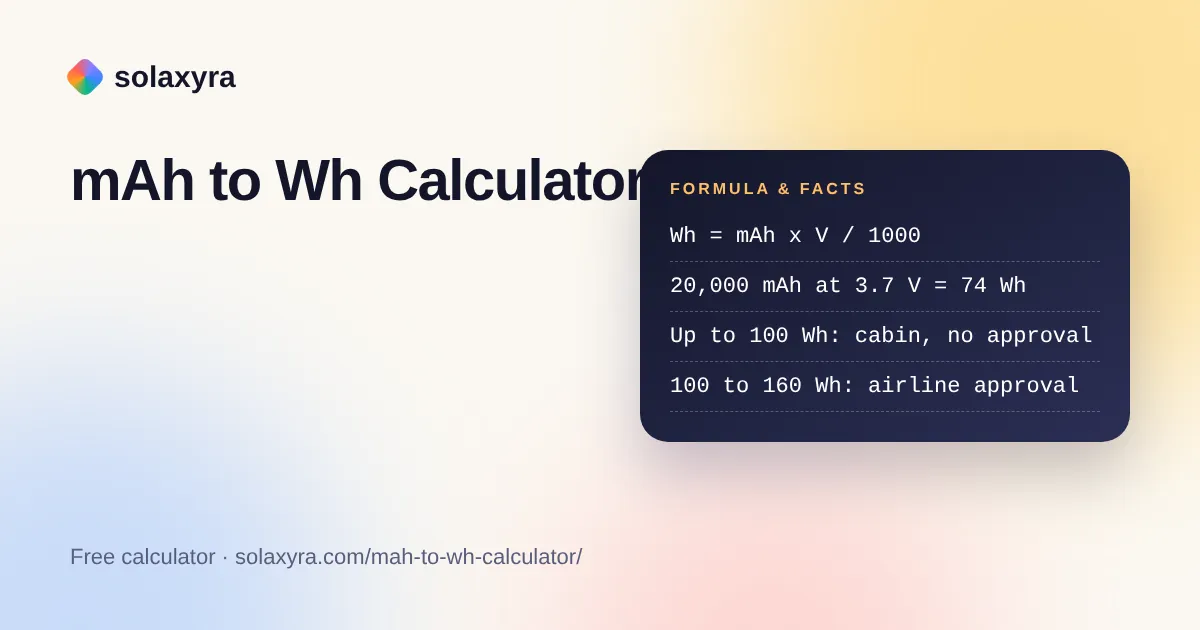
Quick answer: To convert mAh to Wh, multiply the capacity in mAh by the nominal voltage and divide by 1,000. A 20,000 mAh power bank at 3.7 V holds 74 Wh. Use the cell voltage on the label, not 5 V. This mAh to Wh calculator also shows whether the battery falls under the 100 Wh or 160 Wh flight limits.
What Is a mAh to Wh Calculator?
A mAh to Wh calculator is a converter that turns a battery’s charge capacity into the energy it stores by multiplying by its voltage. In plain words: watt-hours equal milliamp-hours times volts, divided by 1,000, and milliamp-hours equal watt-hours times 1,000, divided by volts.
The milliamp-hour on its own only tells you how much charge a battery holds. As the ampere-hour entry on Wikipedia points out, a 1,000 mAh battery at 1.5 V stores far less energy than a 1,000 mAh battery at 12 V. Watt-hours include the voltage, which is why airlines, regulators and laptop makers use Wh to compare batteries fairly.
How Do You Use the mAh to Wh Calculator?
- Choose mAh to Wh, or Wh to mAh if your label shows watt-hours.
- Enter the capacity from the label or specification sheet.
- Pick the voltage. Choose the cell voltage printed on the battery (many lithium-ion power banks state 3.6 V or 3.7 V), or type a custom value.
- Enter how many identical batteries you are carrying to see the combined energy.
- Optionally enter the battery size of the device you want to charge and an efficiency figure to estimate the number of full charges.
- Read the Wh result and the flight category, then copy it if you want to show it to your airline.
Which Voltage Should You Use for mAh to Wh?
Use the nominal cell voltage printed on the battery label, because that is the voltage at which the mAh rating was measured; for most lithium-ion power banks it is 3.6 V or 3.7 V. The 5 V you see on the USB port is produced by a boost circuit inside the power bank, and the charge delivered at 5 V is lower than the cell rating because the voltage is higher and some energy is lost on the way.
Getting this wrong matters. A 20,000 mAh power bank is 74 Wh at 3.7 V but would appear to be 100 Wh if you multiplied by 5 V, which wrongly puts it on the edge of the approval threshold. The calculator warns you whenever a 5 V figure is entered.
How Big a Power Bank Can You Take on a Plane in the UK?
You can take power banks up to 100 Wh in your cabin bag without approval, between 100 Wh and 160 Wh with the airline’s approval, and none above 160 Wh, with a limit of two power banks per person. Those are the thresholds in the UK CAA’s Pack right for a safe flight guidance, which also says spare batteries and power banks must never go in checked luggage.
Since 27 March 2026 the CAA has also set out that power banks must not be recharged on board and should not be used to charge other devices during the flight. The Swiss Federal Office of Civil Aviation battery rules give the same 100 Wh and 160 Wh limits and the same two-per-person cap for power banks. Airlines can be stricter than the regulator, and security staff may refuse a power bank without a readable rating, so check your carrier’s page and keep the label clean.
How Many mAh Is 100 Wh?
100 Wh is about 27,000 mAh at 3.7 V and about 27,800 mAh at 3.6 V. That is why so many travel power banks stop at 25,000 to 27,000 mAh. At 3.85 V, used in some newer cells, the ceiling drops to roughly 26,000 mAh, so a 26,800 mAh pack with 3.85 V cells would be just over 100 Wh. Always run the numbers with the voltage on your own label.
mAh to Wh Conversion Table for Power Banks
Wh = mAh x V / 1,000, rounded to one decimal. The flight column uses the 3.7 V figure and the UK CAA thresholds.
| Capacity | Wh at 3.6 V | Wh at 3.7 V | Wh at 3.85 V | UK flight category at 3.7 V |
|---|---|---|---|---|
| 5,000 mAh | 18.0 | 18.5 | 19.2 | Cabin, no approval |
| 10,000 mAh | 36.0 | 37.0 | 38.5 | Cabin, no approval |
| 20,000 mAh | 72.0 | 74.0 | 77.0 | Cabin, no approval |
| 25,000 mAh | 90.0 | 92.5 | 96.2 | Cabin, no approval |
| 26,800 mAh | 96.5 | 99.2 | 103.2 | Cabin, no approval (approval needed at 3.85 V) |
| 30,000 mAh | 108.0 | 111.0 | 115.5 | Airline approval needed |
| 40,000 mAh | 144.0 | 148.0 | 154.0 | Airline approval needed |
| 50,000 mAh | 180.0 | 185.0 | 192.5 | Not allowed in passenger baggage |
Worked Example: Packing Batteries for a Flight From Bristol
Hannah from Bristol is flying to Lisbon with a 26,800 mAh power bank and two spare camera batteries. The power bank label says 3.7 V; each camera battery says 2,000 mAh and 7.4 V.
- Power bank: 26,800 x 3.7 / 1,000 = 99.2 Wh, under 100 Wh, so it can go in her cabin bag without approval.
- Camera batteries: 2,000 x 7.4 / 1,000 = 14.8 Wh each, well under 100 Wh. She keeps them in the cabin too, with the contacts covered so they cannot short.
- Charges for her phone: with a 15 Wh phone battery and an example 80 percent efficiency, 99.2 x 0.8 / 15 = about 5.3 full charges.
Hannah does not recharge the power bank or use it to charge her phone during the flight. For a larger portable power station on a camping trip, where flight rules do not apply, she would use the power station runtime calculator, and for 12 V leisure batteries rated in amp-hours, the Ah to kWh calculator does the same job at a bigger scale.
Frequently Asked Questions
How many Wh is a 20,000 mAh power bank?
A 20,000 mAh power bank built from 3.7 V lithium-ion cells holds 20,000 x 3.7 / 1,000 = 74 Wh. At 3.6 V it would be 72 Wh and at 3.85 V about 77 Wh. All of these are under the 100 Wh level that the UK CAA allows in the cabin without airline approval.
What is the largest power bank I can take on a plane?
Under UK CAA guidance, power banks up to 100 Wh can go in your cabin bag without approval, those over 100 Wh and up to 160 Wh need the airline’s approval, and anything over 160 Wh is not allowed in passenger baggage. The limit is two power banks per person.
Should I use 3.7 V or 5 V to convert mAh to Wh?
Use the nominal cell voltage printed on the label, often 3.6 V or 3.7 V for lithium-ion power banks. The 5 V figure is the USB output after a boost converter. Using 5 V with the cell mAh overstates the energy by about a third and can wrongly suggest a power bank breaks flight limits.
Can I put a power bank in checked luggage?
No. The UK CAA says spare batteries and power banks must be carried in the cabin and never packed in checked luggage, because they can overheat and cause a fire. In the cabin, crew can see and deal with a battery that starts to smoke or burn.
How do I convert Wh to mAh?
Multiply the energy in Wh by 1,000 and divide by the voltage. A 100 Wh battery at 3.7 V is 100 x 1,000 / 3.7 = 27,027 mAh, so at that voltage roughly 27,000 mAh is the most a power bank can hold and still sit at or under 100 Wh.
How many phone charges will my power bank give?
Divide the power bank’s Wh by the phone battery’s Wh, then multiply by the charging efficiency. A 74 Wh power bank charging a 15 Wh phone battery at an example 80 percent efficiency gives about 3.9 full charges. Real results vary with cable, temperature and phone use while charging.
Checked October 2026 by the Solaxyra Editorial Team. Sources: UK CAA: Pack right for a safe flight, UK CAA: Changes to rules on lithium batteries and power banks, Swiss FOCA: Batteries, Ampere-hour (Wikipedia).